Future Literacy is part of Education & Skills , where learning, judgment, technology, discipline, and practical capability come together.
Future literacy is not the ability to predict what happens next. Instead, it is the ability to notice what is changing, understand what the change demands, and prepare before its consequences become unavoidable.
That distinction matters because prediction is fragile. A forecast can fail, a tool can change, and an employer can reorganize. Likewise, a credential can lose signaling power while a new technology creates leverage in one part of a system and transfers risk somewhere else.
Capability travels better.
Future Literacy therefore approaches the future as an operating condition, not a spectacle. The work connects pattern recognition, systems thinking, judgment, learning, technology, workforce change, career resilience, and adaptive capability into one practical system for staying useful when conditions move.
Start with the pressure you can already see. Then build for the change you cannot see yet.
Where to Start With Future Literacy
You do not need to begin at the beginning. Instead, start where uncertainty is already creating pressure in your life or work. From there, move outward as the framework becomes useful.
If You’re New Here
Understand the Core Idea
Learn why reading change, thinking ahead, and preparing across several possible futures are becoming basic capabilities.
Start With Future Literacy →
If Work Feels Less Predictable
Build Career Capital
Examine automation exposure, portable skills, labor-market signals, evidence, learning, AI leverage, risk, and career resilience.
Strengthen Your Position ↓
If the Problem Is Clarity
Strengthen How You Think
Build pattern recognition, systems thinking, judgment, attention, cognitive capacity, and adaptive learning.
Build the Foundations ↓
If You Need to Read the Market
Follow Workforce Signals
Examine changing employment, training, apprenticeships, automation, credentials, and the labor pipeline without treating every headline as structural change.
Read the Signals ↓
The Future Literacy Framework
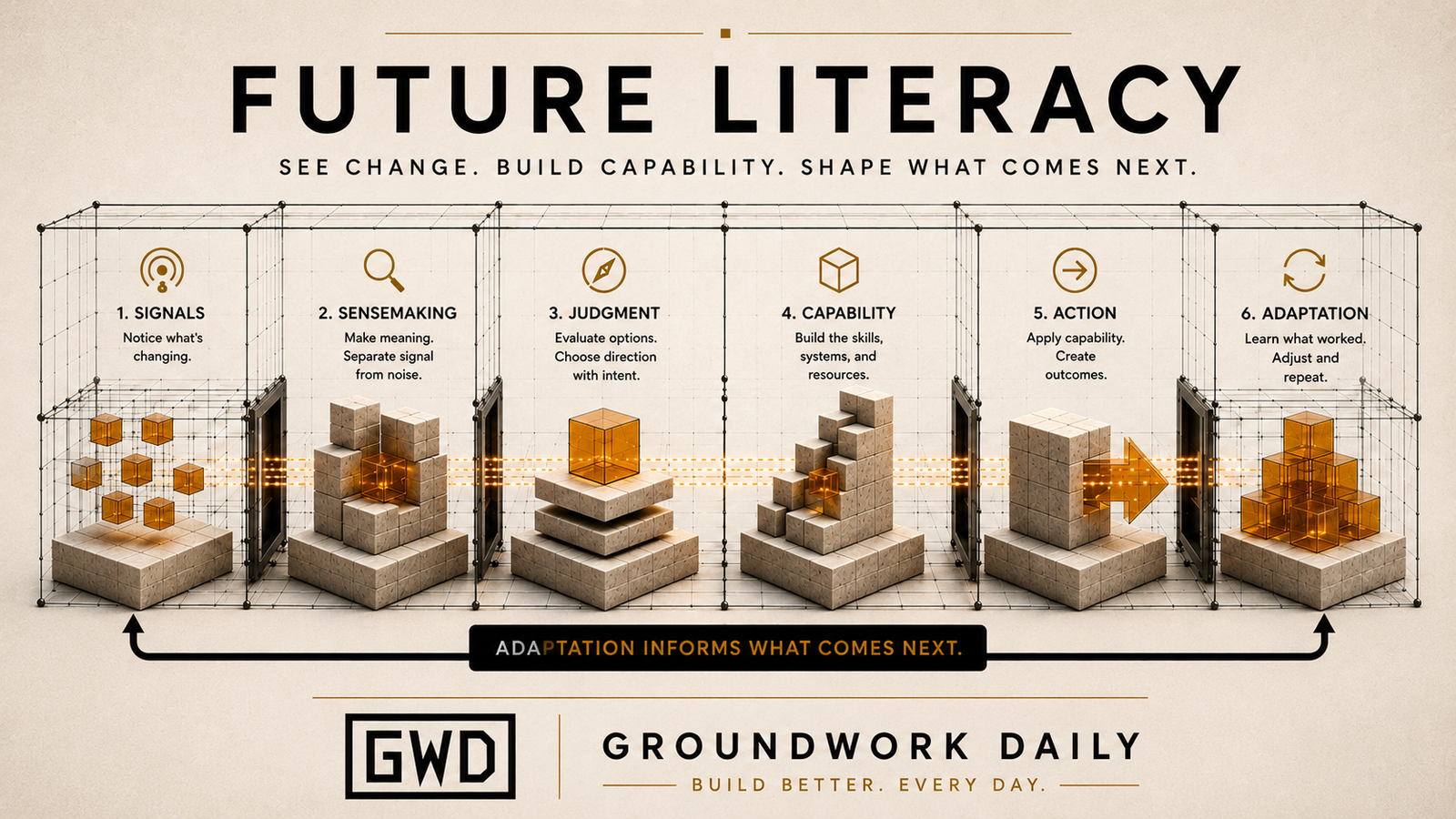
Future Literacy works as a sequence rather than a forecast. Each step helps you move from noticing change to responding intelligently without requiring perfect certainty first.
From Change to Capability
Signals → Sensemaking → Judgment → Capability → Action → Adaptation
Adaptation creates new information. As a result, what you learn from action becomes part of the next signal.
First, Read What Is Changing
01 · Signals
Notice What Is Moving
Watch incentives, behaviors, costs, constraints, technologies, language, and expectations before their consequences become obvious.
Build Pattern Recognition →
02 · Sensemaking
Understand the System
Next, connect the signals, identify relationships, and distinguish structural movement from temporary noise.
Strengthen Systems Thinking →
Then, Decide What Deserves Action
03 · Judgment
Decide What Matters
Decide what deserves attention, what can wait, what needs protection, and when the available evidence is sufficient to move.
Strengthen Clarity →
04 · Capability
Build What Travels
From there, develop skills, systems, knowledge, evidence, and resilience that remain useful when tools or circumstances change.
Develop Adaptive Capability →
Finally, Move and Learn From the Result
05 · Action
Put Understanding to Work
Turn interpretation into a decision, practice, system, experiment, or structural change instead of waiting for perfect certainty.
Build the Daily Structure →
06 · Adaptation
Update Without Drifting
Finally, use feedback to revise assumptions, tools, methods, and capabilities while preserving what still works.
Stay Capable Through Change →
The Three Layers of Future Literacy
Future Literacy works across three connected layers. First, it develops the capabilities needed to navigate change. Next, it applies those capabilities to career resilience and economic pressure. Meanwhile, a third layer helps you interpret workforce changes while they are still developing.
Build the Foundation
Future Literacy Foundations
Build pattern recognition, systems thinking, judgment, cognitive capacity, adaptive learning, and the structure needed to stay capable under changing conditions.
Strengthen Your Position
Career Capital
Apply those capabilities to work, AI, skills, evidence, labor markets, risk, leverage, learning, and career resilience.
Read What Is Changing
Workforce Signals
Follow emerging changes in employment, education, training, credentials, automation, and the labor pipeline before their consequences become obvious.
Career Capital: Build Security That Travels
Job security is increasingly too narrow a measure of career strength. A more useful question is whether your capability, evidence, knowledge, relationships, and financial position can continue working for you when the environment changes.
How strong is your position if the job, employer, technology, market, or operating environment changes?
Career Capital develops that position in three steps. First, understand where you are exposed and what travels. Next, learn to read demand and prove current capability. Finally, build enough resilience and leverage to withstand disruption without starting from zero.
Step One: Understand Exposure and Portability
Before you can strengthen a career position, you need to know where the risk sits. At the same time, you need a clear view of which capabilities can survive a change in employer, tool, title, industry, or operating environment.
01 · Exposure
Black Workers and Automation: The Real Exposure Map
Separate automation potential from job loss by examining occupational exposure, concentration, and transition distance.
02 · Capability
83% of Black Respondents Know AI — So Why Aren’t More Using It to Build?
Move from AI awareness into experimentation, working use, integration, and deliberate leverage.
03 · Portability
The Portable Skill Problem: Why Your Expertise Doesn’t Always Travel
Test which parts of your expertise remain useful when the employer, tool, industry, title, or environment changes.
Step Two: Read the Market and Prove Current Capability
Once you understand what travels, external reality matters more. Therefore, the next task is learning to read demand before crisis arrives, turning capability into evidence, and keeping your learning system active after formal education ends.
04 · Signals
How to Read a Job Market Before the Layoffs Start
Treat layoffs as a late signal and look for weakening demand while there is still room to respond.
05 · Evidence
The Credential Gap Is Closing. The Capability Gap Is Widening.
Credentials establish history. However, current evidence demonstrates whether your capability still works now.
06 · Learning
What Learning Actually Requires After 30
Design adult learning around retrieval, spacing, deliberate practice, and limited cognitive capacity.
Step Three: Build Resilience, Knowledge, and Leverage
A strong career position needs more than employable skills. Accordingly, the final step examines who carries risk, how knowledge compounds, who captures the value created by new tools, and what alternatives exist if the current job disappears.
07 · Risk
The Gig Economy Transferred the Risk. Did You Notice?
Examine the costs inside flexibility and who carries volatility when institutions transfer more risk to workers.
08 · Knowledge
How to Build a Personal Knowledge Management System That Works
Turn scattered information into intellectual infrastructure that supports decisions and future work.
09 · Leverage
AI Productivity at Work: Who Benefits From the Value You Create?
Turn AI-assisted productivity into visible evidence, stronger positioning, portable capability, and leverage.
10 · Resilience
How to Build a Career Contingency Plan Before You Need One
Connect income, runway, capability, evidence, network, and alternatives before losing one job becomes a full-system emergency.
Build the Capabilities That Make Adaptation Possible
Career resilience is only one application of Future Literacy. Underneath it sits a deeper capability layer: noticing patterns, understanding systems, protecting attention, exercising judgment, learning effectively, and adapting without losing direction.
These capabilities reinforce one another. For example, strong pattern recognition without judgment can create noise. Likewise, judgment without cognitive capacity can collapse under pressure. Skills without adaptability can also become stranded when the environment changes.
See Patterns and Understand Systems
Pattern Recognition
Read movement before consensus forms.
Identify repetition, divergence, incentives, constraints, and emerging signals without pretending every signal is destiny.
How to Read the Patterns That Shape Your Future →Systems Thinking
Look beneath events to the structure producing them.
Understand inputs, incentives, bottlenecks, feedback loops, relationships, and recurring outcomes.
Use Systems Thinking in Real Life →Protect Judgment and Build Adaptive Capability
Judgment & Clarity
Protect your ability to choose under pressure.
Reduce noise, preserve cognitive bandwidth, and create enough separation between incoming pressure and your response.
Think Clearly When Everything Pulls at You →Adaptive Capability
Build skills that can change shape.
Move from simply possessing a skill to being able to transfer, modify, and extend it under new conditions.
Understand the Three Levels of Capability →Combine Skills and Protect the Structure
Skill Stack
Combine capabilities instead of betting on one.
Build a portfolio of judgment, communication, digital fluency, systems thinking, financial fluency, and adaptive learning.
Build the Skill Stack You Actually Need →Operating Structure
Make capability usable on ordinary days.
Protect time, attention, energy, and clarity so useful capability remains available when pressure rises.
Build a Daily System That Protects Capacity →Keep Building
→ How to Stay Capable When the Future Moves Faster Than You Do
Read the Workforce Before the Change Feels Obvious
The capabilities above are durable. The labor market, however, is not.
Workforce Signals looks at specific changes in employment, training, automation, education, credentials, and the pathways people use to enter and move through work. Rather than chasing every workforce headline, the goal is to recognize developments that may change what people need to learn, how work is organized, where opportunity is moving, or which assumptions are becoming less reliable.
Watch the Work, the Skills, and the Training Pipeline
Automation
How Automation Is Changing Work
Separate the technology from the actual changes in tasks, roles, workflow, and capability demand.
Human Capability
The Skills AI Cannot Replace
Examine where human judgment, context, coordination, responsibility, and embodied competence retain value.
Training
Why Apprenticeships Are Growing Again
Follow the renewed importance of paid work-based learning, mentorship, occupational training, and recognized credentials.
Labor Pipeline
College vs Apprenticeship: The New Labor Pipeline
Examine how multiple education and training pathways are competing to produce reliable workforce capability.
When Change Reaches the Work Itself
Capability Has to Hold in the Real World
Some workforce questions become clearer when you move from labor-market abstractions to the work itself. Work Hands examines tools, materials, process, standards, training, inspection, handoffs, responsibility, and the judgment required when competence has to survive contact with real constraints.
A forecast can tell you where demand may be moving. By contrast, it cannot replace the work of becoming competent enough to be trusted when the job has to be done correctly.
Explore Work Hands →Build the Next Layer
The challenges created by change rarely stay in one category. For instance, a workforce shift can become a learning problem, while a new tool can become an attention problem. In the same way, a career question can quickly become a skills question.
Strong preparation therefore means knowing where to go when the problem changes shape.
Go Deeper Where the Pressure Is Showing Up
Build Broader Capability
Education & Skills
Go deeper into learning, practical capability, judgment, technology, discipline, and the skills that help you operate effectively under changing conditions.
Explore Education & Skills →
Build Applied Competence
Work Hands
Follow the skilled-work path through standards, tools, process, judgment, inspection, training, responsibility, and workmanship that has to hold.
Explore Work Hands →
Govern the Tools
Tech as Discipline
Move beyond whether a technology is impressive and examine how tools should fit into your attention, routines, work, and decision-making.
Explore Tech as Discipline →
Protect Your Attention
Mind as Discipline
Go deeper into focus, cognitive control, mental structure, clarity, and the attention required to make good decisions when information keeps competing for your mind.
Explore Mind as Discipline →
What Future Literacy Should Help You Do
You do not need someone to pretend they know exactly what comes next.
Instead, you need a way to recognize meaningful change earlier, distinguish signal from noise, understand the system beneath the change, and identify assumptions that are becoming less reliable.
After that, a more important question appears:
What can you build now that will remain useful if conditions move?
In some cases, the answer is a portable skill. In others, it may be better judgment, protected cognitive capacity, a stronger learning system, financial runway, clearer evidence, or a better understanding of how several systems interact.
The goal is not prediction. The goal is preparedness with enough structure to adapt.
Read the Signal. Build the Capability.
The future will continue producing uncertainty. No framework can remove that.
However, you can become less dependent on certainty. Begin by noticing what is changing and understanding the mechanism underneath it. Then decide what deserves attention and build the capability the new condition requires.
From there, act before every variable is settled. Finally, use the feedback to adapt without discarding what still works.
That process will not make the world stand still. Instead, it can make you harder to destabilize while it moves.
See change. Build capability. Shape what comes next.
Further Groundwork
Future Literacy: Why the Ability to Think Ahead Is Now a Basic Skill
Begin with the foundational argument for reading change before it becomes unavoidable.
How to Build a Career Contingency Plan Before You Need One
Turn career uncertainty into an operating plan built around runway, evidence, network, capability, and alternatives.
Education & Skills
Build further through learning, judgment, technology, discipline, and practical capability.
Work Hands
Move from workforce change into the standards, training, tools, judgment, and verification behind skilled work.
Jordan Avery
Explore more work on adaptability, systems thinking, pattern recognition, and capability under changing conditions.
Receipts
OECD Skills Outlook 2025
Research on adult skills, literacy, adaptive problem solving, changing skill demand, and capabilities that support economic and social resilience.
U.S. Bureau of Labor Statistics · Occupational Outlook Handbook
Federal occupational information on employment, training pathways, wages, job outlook, and workforce demand.
U.S. Department of Labor · Apprenticeship.gov
Federal information on Registered Apprenticeship, work-based learning, mentorship, progressive wages, and recognized occupational credentials.