Black workers and automation are often discussed through one alarming idea: millions of jobs are exposed, so millions of workers must be headed toward displacement. That conclusion is too simple.
Automation does not move evenly through the labor market. Instead, it reaches tasks before it reaches entire occupations. It can eliminate some work, compress the number of people needed for other work, increase the productivity of workers who remain, and create demand elsewhere.
Race still matters because workers are not distributed evenly across occupations, industries, geographies, wages, credentials, or pathways into the next job. Therefore, the useful question is not simply, Will automation hurt Black workers?
The better question is this:
Where are Black workers exposed, what kind of exposure is it, and how difficult is the move from the work they have into the work that remains valuable?
This article builds that map. Not panic. Not reassurance. Mechanics.
Black Workers and Automation: What the Exposure Map Actually Shows
Start with the distinction most automation coverage skips: automation potential is not the same as job loss.
A technology may be capable of performing part of a job without eliminating the job itself. Likewise, an occupation may contain highly automatable tasks while employment in that occupation still grows because demand expands. In other cases, a worker may use AI every day and become more valuable rather than less valuable.
The Bureau of Labor Statistics makes this distinction in its employment projections work. AI can affect occupational tasks, productivity, staffing patterns, and demand without producing a simple one-for-one reduction in jobs.
Five Different Questions Are Being Collapsed Into One
When people discuss Black workers and automation, several different measurements are often treated as though they describe the same outcome. They do not.
Can a machine perform some of the tasks? That is automation potential.
Does AI interact with the work? That is AI exposure.
Will an employer need fewer workers? That is labor compression.
Will the occupation shrink? That is an employment outcome.
Can the worker move if the role changes? That is transition capacity.
McKinsey’s earlier research on the future of work in Black America modeled a 2030 scenario in which African American workers face a modestly higher rate of automation-driven displacement than white or Asian workers — 23.1 percent, compared with 22.4 percent for white workers and 21.7 percent for Asian workers, though still below the 25.5 percent rate projected for Hispanic and Latino workers. In raw numbers, that gap works out to roughly 132,000 African American jobs potentially displaced by 2030. The research points to overrepresentation in office support, food service, and production work as the main driver, alongside underrepresentation in higher-growth fields such as education, health, business, and law.
The more useful finding in that research isn’t the size of the number. It’s where Black workers sit. The same report found African Americans concentrated in regions and community types further from projected job growth, and it flagged a wide gap by gender: African American women, overrepresented in growing healthcare roles, were projected to see a lower displacement rate (21.6 percent) than white or Asian workers overall, while African American men were projected at 24.8 percent, among the highest of any group studied.
Either way, that research is not a timer counting down to a fixed number of layoffs. It is a scenario model showing how occupational structure could change under a particular set of assumptions.
Generative AI Added Another Layer
Generative AI complicated the map because exposure now extends far beyond routine physical work.
Pew Research Center found that workers in highly AI-exposed occupations are disproportionately college educated and higher paid. Black workers were less concentrated in the most AI-exposed occupations than White or Asian workers in that analysis.
That finding does not mean Black workers are protected. Instead, it shows why the Black workers and automation question requires more than one exposure measure.
The map has layers.
Where Black Workers and Automation Exposure Actually Sit
The cleanest way to understand automation risk is to look below job titles and examine the work itself.
A title can survive while its internal task mix changes dramatically. For example, an administrative worker may keep the same title while software handles scheduling, document formatting, routine correspondence, data entry, and first-pass research.
Similarly, a customer service worker may remain in place while automated systems absorb simple inquiries and leave humans with escalations. A manager may still manage while AI performs reporting and routine coordination.
In each case, the occupation survives. However, the valuable part of the occupation moves.
1. Repetition
Tasks become easier to automate when the same input reliably produces the same kind of output.
Routine processing, scheduling, sorting, transcription, basic reporting, standard document production, and predictable transactions are structurally easier targets than work that requires interpretation under changing conditions.
2. Codifiability
If good performance can be written as a clear set of rules, examples, templates, or patterns, software has more room to absorb part of the workflow.
This is one reason generative AI reaches beyond traditional factory automation. Language work can also contain repeatable patterns.
3. Low Consequence for Error
Organizations can automate more aggressively when a mistake is inexpensive, reversible, or easy to detect.
By contrast, where errors carry legal, medical, financial, safety, reputational, or operational consequences, human review and accountability often remain more important even when AI performs substantial portions of the work.
4. Weak Need for Context
Machines generally perform better when the relevant information already exists inside the system.
Human value grows when the work depends on unstated context, local knowledge, trust, conflicting priorities, organizational history, negotiation, or understanding what people mean rather than only what they entered into a form.
5. Weak Ownership of the Outcome
A task is easier to hand to software when nobody expects the system itself to accept responsibility.
For instance, AI can draft a recommendation, but someone may still need to approve it. A system can identify an anomaly, yet someone must decide whether it matters. Likewise, AI can generate an answer while a person remains accountable for what happens next.
Consequently, the difference between producing output and carrying responsibility will matter more as automation spreads.
The Four Zones of Automation Exposure
A binary model—safe job versus unsafe job—is not useful enough for understanding Black workers and automation.
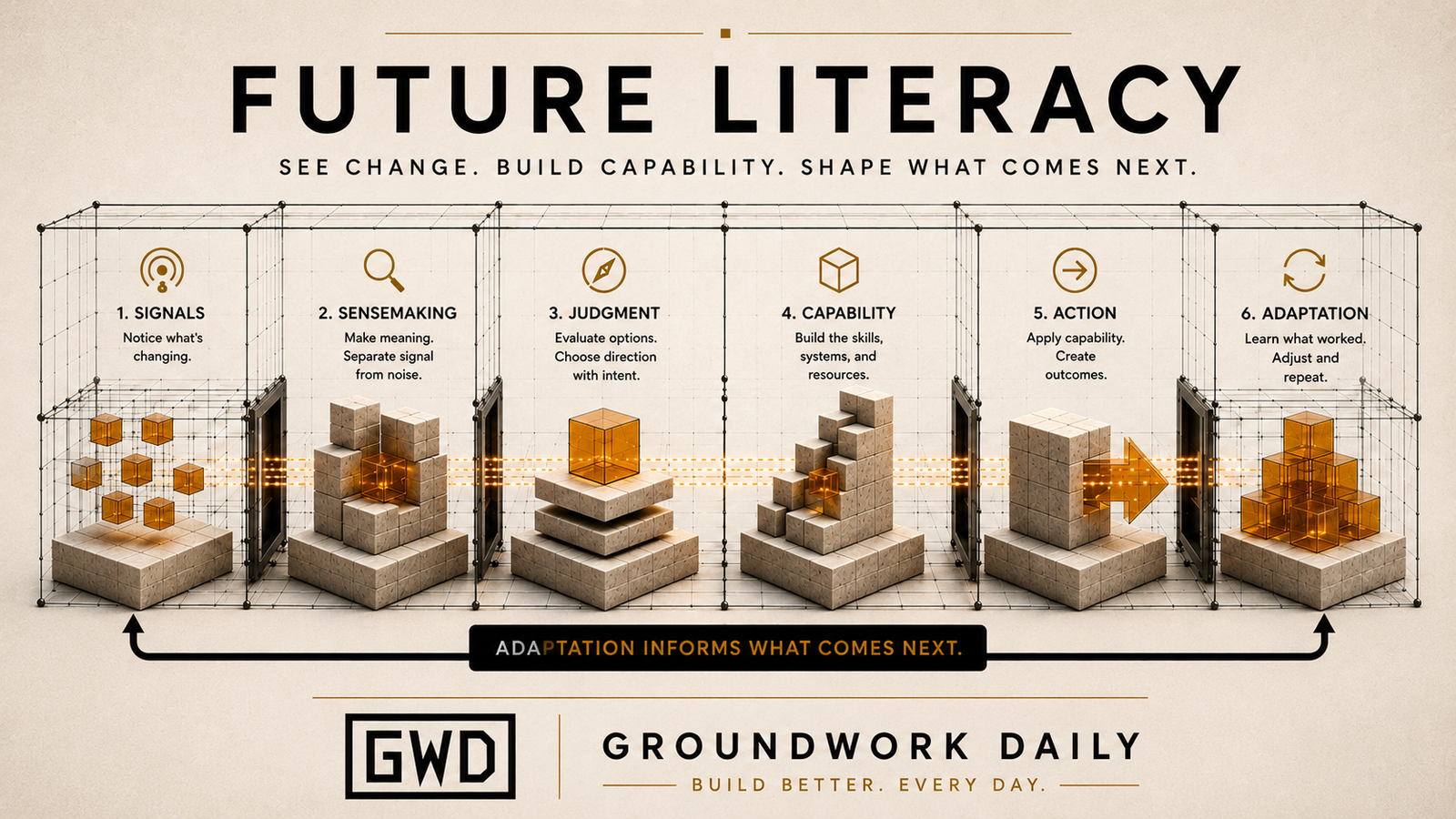
Future Literacy uses a four-zone model instead.
Zone 1
Replace
The task is routine, codifiable, predictable, and economically attractive to automate. Therefore, substitution pressure is likely to increase.
Zone 2
Compress
The role remains, but technology allows fewer workers to produce the same amount of output. As a result, headcount can fall even when the occupation survives.
Zone 3
Augment
AI absorbs lower-value work while increasing the output of people who can direct, verify, integrate, and apply the technology effectively.
Zone 4
Defend
The work depends heavily on context, trust, physical presence, ambiguity, judgment, coordination, or accountability. Technology may assist without owning the core outcome.
One Job Can Sit in Several Zones
The important point is that these zones can exist inside the same occupation.
A nurse may have documentation tasks in the Compress zone while patient assessment remains far more resistant to substitution. Meanwhile, a manager may automate reporting and become more responsible for judgment and coordination.
Likewise, a skilled trades worker may use software for estimating while physical installation still requires presence, experience, and real-world problem solving.
Therefore, job-title thinking is too blunt. Workers need task-level literacy instead.
Generative AI Changed Which Work Counts as Exposed
Traditional automation was associated mainly with machinery, factories, repetitive physical work, and back-office processing. Generative AI widened the field.
Research, drafting, analysis, summarization, coding, document preparation, customer communication, design iteration, and information processing can now be partially automated or accelerated.
Education Is Not the Same as Protection
This shift creates a paradox for Black workers and automation.
Some occupations with high educational requirements are highly exposed to AI because much of their work happens through information. At the same time, jobs that require physical presence, interpersonal trust, or variable real-world environments may be less exposed to current generative AI.
Therefore, the old hierarchy—more education equals more technological safety—is unreliable. The reverse is unreliable too.
A worker should not conclude that physical work is automatically safe or that knowledge work is automatically doomed.
Instead, ask the structural question:
Which parts of the work can move to the machine, and what becomes more valuable in the human role after they do?
Skills Can Survive Even When Workflows Change
McKinsey’s more recent research on people, AI agents, and robots reinforces this point. The analysis finds that today’s technology could, in theory, automate more than half of current US work hours — but is explicit that this is a measure of technical potential, not a forecast of job losses. More encouraging for the “skills survive” argument: more than 70 percent of the skills employers currently seek are used in both automatable and non-automatable work.
As a result, many existing human skills may remain useful even while the way those skills are deployed changes.
That is the signal worth watching.
The Bigger Risk for Black Workers and Automation: Transition Distance
Two workers can hold equally exposed jobs and face completely different futures.
One worker may have six months of savings, current software skills, a professional network outside the employer, a credential that travels, recent evidence of work, and several adjacent occupations nearby.
Another worker may have no financial buffer, highly employer-specific experience, limited proof of transferable capability, restricted geographic mobility, and few nearby alternatives that pay enough.
The automation exposure may be similar. The economic risk is not.
Future Literacy Framework
Transition Distance
Transition distance is the capability, credential, financial, geographic, and network distance between the work you have and the next viable work you could realistically enter.
Exposure and Mobility Are Different Problems
This is the layer most automation conversations miss.
Exposure describes pressure on the current position. By contrast, transition distance describes the difficulty of reaching the next one.
Consequently, a worker with moderate exposure and extreme transition distance may be in a more fragile position than someone with high exposure and strong mobility.
For Black workers, that distinction matters because occupational concentration does not exist separately from differences in household wealth, access to networks, geography, credentials, transportation, caregiving responsibility, or employer opportunity.
A transition that looks small on a labor-market chart can be enormous inside a household.
The Five Parts of Transition Distance
1. Capability distance: What can the next role do that you cannot demonstrate yet?
2. Credential distance: Does entry require a license, certification, degree, apprenticeship, clearance, or formal qualification?
3. Financial distance: Can you afford the learning period, temporary income loss, transportation, equipment, or a reduced starting wage?
4. Geographic distance: Do viable roles exist where you live, or does opportunity require commuting, relocation, or remote eligibility?
5. Network distance: Do people outside your current employer know what you can do?
Training matters. However, training alone cannot solve all five distances. Runway, access, evidence, mobility, and timing matter too.
The goal is not to make every distance disappear. Instead, shorten the distance before pressure arrives.
Build Your Personal Black Workers and Automation Exposure Map
You do not need access to an economic forecasting model to make the Black workers and automation question useful at the individual level.
You need an honest inventory of your own work.
Step 1: Break the Job Into Tasks
Do not begin with your title. Instead, write what you actually do.
List the recurring tasks that consume your week: processing, writing, coordinating, repairing, selling, reviewing, analyzing, transporting, scheduling, troubleshooting, teaching, approving, negotiating, documenting, supervising, or serving customers.
The title hides the mechanism. The task list reveals it.
Step 2: Mark Each Task by Structure
Next, label every task with one or more of these characteristics:
- Routine — repeated with little variation.
- Codifiable — can be explained clearly through rules or examples.
- Judgment-heavy — requires weighing competing information.
- Relational — depends on trust, persuasion, care, conflict, or coordination.
- Physical — requires presence in an unpredictable real-world environment.
- Accountable — someone must own the consequence of the decision.
Step 3: Test What Technology Can Already Do
Then audit your job against technology that employers can deploy now, not against science fiction.
Can software draft the routine email? Can AI summarize the report? Can an automated system schedule the appointment? Can a chatbot absorb the first layer of customer questions?
For physical work, ask whether a machine can perform the task reliably in the actual environment where you work.
Most importantly, separate real capability from demonstration videos, vendor promises, and headlines.
Step 4: Identify the Value-Creating Tasks
Now ask a harder question:
If the routine work disappeared tomorrow, what would my employer still need me to be good at?
That answer points toward the more durable lane.
Perhaps it is judgment, client trust, troubleshooting, technical translation, exception handling, coordination, or ownership of the final outcome.
Whatever remains important after routine execution gets cheaper deserves more of your development time.
Step 5: Identify Two Adjacent Roles
Do not jump immediately toward a completely different career. Instead, start sideways.
Which occupations use 60 to 80 percent of what you already know while improving your position on exposure, wages, demand, or mobility?
An adjacent move usually carries less transition distance than total reinvention. That advantage matters when time and money are constrained.
Step 6: Measure the Gap
For each adjacent role, write the missing requirements as specific gaps rather than vague ambitions.
- One software platform.
- One certification.
- One portfolio example.
- One technical skill.
- One stronger communication capability.
- One license.
- One relationship with people already doing the work.
Once the gap becomes visible, the transition becomes easier to govern.
Step 7: Build Proof Before You Need Permission
A résumé saying you are adaptable is weak evidence. Therefore, build something visible.
Use the tool. Complete the certification. Document the project. Lead the process. Teach the skill. Create the work sample.
In other words, make your future capability observable before you urgently need somebody else to believe you have it.
What Black Workers Should Build as Automation Advances
The lazy answer to Black workers and automation has often been some version of “learn to code.” That is not a workforce strategy.
No single technical skill provides permanent protection. Instead, the stronger position is a capability stack that travels across changing tools.
The Durable Capability Stack
AI fluency → knowing how to use, direct, evaluate, and constrain AI systems inside real work.
Domain expertise → understanding the field well enough to recognize when an automated answer is incomplete or wrong.
Judgment → deciding under ambiguity when rules do not produce a clean answer.
Communication → translating complexity into action across customers, coworkers, managers, and systems.
Verification → checking evidence, outputs, assumptions, and consequences instead of trusting machine fluency.
Systems understanding → seeing how the task connects to workflow, incentives, risk, and downstream outcomes.
Portable proof → evidence of capability that remains legible outside one employer.
Do Not Search for an Automation-Proof Career
Notice what is missing from that capability stack: there is no promise of an automation-proof career.
That promise would be dishonest.
The objective is to become useful on both sides of the transition. First, understand the existing work deeply enough to know what is changing. Then learn the technology well enough to work with it. Finally, strengthen the human capabilities that become more valuable when routine execution becomes cheaper.
That is a more durable strategy than hiding from automation.
Do Not Confuse AI Adoption With AI Advantage
Using AI is not automatically career advancement.
For example, if everyone in a department gains the same tool and produces more work, the productivity baseline may simply rise. In that case, speed improves without necessarily improving wages, bargaining power, or career mobility.
Ask Whether Technology Expands Your Scope
The better question is whether technology increases the scope of what you can own.
Can you solve a larger problem? Can you manage a more complex workflow? Can you make better decisions? Can you take responsibility for an outcome that previously required more people?
Equally important, can you demonstrate a capability that transfers outside your current employer?
If not, speed alone may not strengthen your economic position.
This is why AI fluency belongs inside a larger capability system. Tools multiply what is already there: weak judgment can become faster weak judgment, while strong judgment paired with better tools can become leverage.
The Black Workers and Automation Exposure Map Is Also a Mobility Map
The strongest career strategy is not to guess which job titles will survive. That forecast will keep changing.
Instead, maintain a live map of where value is moving.
Signals Worth Watching
- routine tasks disappearing from job descriptions;
- fewer entry-level roles supporting the same amount of work;
- AI fluency appearing inside previously nontechnical positions;
- employers combining responsibilities that once belonged to separate jobs;
- new requirements for verification, oversight, compliance, or quality control;
- growth in occupations where technology expands demand rather than only reducing labor;
- valuable tasks moving from execution toward judgment and coordination.
These are signals, not predictions. Nevertheless, they show where workers should look before pressure becomes obvious.
Mobility Changes the Meaning of Exposure
This is ultimately why Black workers and automation cannot be reduced to a ranking of threatened occupations.
The same exposed role can produce very different outcomes depending on how quickly a worker can move toward the next viable position.
Therefore, resilience depends on more than protecting the job you have. It also depends on making the next move less expensive in time, money, credentials, and learning.
The Groundwork: Shorten the Distance Before You Have to Move
Black workers do not need another article telling them automation is coming. The useful work begins after that sentence.
Where does exposure sit? Which part of the job is actually vulnerable? Is technology replacing the work, compressing the workforce, or augmenting the people who remain?
Then ask the mobility questions. What adjacent role preserves the value of what you already know? How far away is that role? What capability can you build now that shortens the distance?
That is future literacy applied to Black workers and automation.
It does not require predicting every layoff or pretending any occupation is permanently safe. Nor does it require workers to reinvent themselves every eighteen months.
Instead, read the structure. Find where value is moving. Build the capability before the transition becomes urgent.
The strongest career position is not a job nobody can automate. It is the ability to recognize when your position is changing, understand where value is moving, and reach the next viable position before pressure makes the decision for you.
Further Groundwork
How to Read the Patterns That Shape Your Future
Use pattern literacy to separate isolated events from directional changes that deserve action.
How to Use Systems Thinking in Real Life
Identify the structures, incentives, constraints, and feedback loops producing repeated outcomes.
How to Stay Capable When the Future Moves Faster Than You Do
A practical capability model for adapting without chasing every new tool or trend.
AI Hiring Systems: Who Actually Gets the Job?
A structural look at how automated screening, ranking, and human review shape access to work.
Receipts
U.S. Bureau of Labor Statistics · AI Impacts in Employment Projections
BLS analysis of how generative AI may affect occupational tasks, productivity, staffing, and projected employment.
Pew Research Center · Which U.S. Workers Are More Exposed to AI on Their Jobs?
Analysis of occupational AI exposure by education, pay, gender, race, ethnicity, and industry.
McKinsey Global Institute · The Future of Work in Black America
Occupational and geographic analysis of automation exposure and potential workforce transitions affecting Black Americans, modeling a 2030 scenario.
McKinsey Global Institute · Agents, Robots, and Us: Skill Partnerships in the Age of AI
Research on how work may be redistributed across people, AI agents, and robots while many existing human skills remain relevant.