The credential gap is becoming less useful as a complete explanation for who is prepared for modern work. Degrees, licenses, certifications, and other qualifications still matter. However, they do not automatically prove that a person’s current capability matches a job that is changing underneath them.
That distinction is becoming harder to ignore.
In a Bright Horizons workforce survey, 42 percent of employees said they expected their role to change significantly because of AI within the following year. Yet only 17 percent said they used AI frequently.
That is not simply an AI adoption problem.
It exposes a broader capability gap: the distance between what a worker’s qualifications suggest and what the worker can currently apply, demonstrate, verify, and produce.
A credential may tell an employer what you completed.
Capability answers a different question:
What can you do now, under current conditions, with the tools and problems that actually exist?
The strongest position is not credentials or capability.
It is credible qualification backed by current, demonstrated capability.
What the Credential Gap Actually Means Now
For a long time, formal qualifications did several jobs at once.
A degree could signal that a person had completed a structured course of study. It could also suggest persistence, baseline knowledge, exposure to a field, and the ability to meet institutional standards.
In regulated professions, qualifications do even more. Licenses and accredited credentials can protect safety, establish legal eligibility, and create necessary standards of practice.
None of that has disappeared.
However, the labor market is increasingly separating the credential from the capability it is supposed to represent.
A Credential Is a Signal, Not the Skill Itself
A qualification is evidence about preparation.
It is not identical to preparation.
Two people can hold the same degree and have very different levels of current capability. One may have spent the past five years applying, extending, and updating the underlying skills. Another may have moved into work where those skills were rarely used.
The credential remains the same.
The operating capability does not.
That difference becomes more important when tools and workflows change quickly.
Skills-First Does Not Mean Credential-Free
This is where the conversation often becomes sloppy.
A skills-first labor market does not mean every degree becomes irrelevant.
OECD work on skills-first labor markets describes a shift toward identifying and evaluating demonstrated competencies more directly. At the same time, the OECD treats qualifications as complementary frameworks that can organize, validate, and communicate skill development.
That is the useful distinction.
The credential can establish a signal.
The employer still needs to know whether the capability is real, current, and applicable.
Why the Capability Gap Can Widen After Graduation
The capability gap does not necessarily begin in school.
Often, it develops later.
A worker earns a qualification, enters a field, and becomes competent in the operating environment of that moment. Then the environment changes.
Software changes. Regulations shift. Automation absorbs routine tasks. AI enters the workflow. Customer expectations move. Teams become smaller or broader. Employers reorganize responsibilities.
The original qualification does not update itself.
The worker has to do that.
Experience Can Hide Capability Decay
Years of employment are valuable, but tenure can create another weak assumption: if someone has remained in a field for a long time, every relevant skill must have remained current.
That is not guaranteed.
A person may have fifteen years of industry experience but only one year of experience repeated fifteen times.
Another worker may have five years of experience that includes new tools, harder problems, broader responsibility, and repeated skill expansion.
Years measure time.
They do not automatically measure capability growth.
AI Makes the Separation Easier to See
The Bright Horizons findings make the problem unusually visible.
Many workers expect AI to change their jobs. Yet far fewer report frequent AI use.
That does not mean every employee should use generative AI every day.
Some jobs do not require it, some uses are inappropriate, and some systems raise privacy, accuracy, security, or compliance concerns.
Still, the gap between expected change and practical exposure is informative.
If the operating environment moves before the worker’s capability moves, credentials alone cannot close the distance.
The Labor Market Is Asking for More Direct Evidence
Employers have always cared about what people can do.
What is changing is the amount of direct evidence available to assess it.
Structured interviews, work samples, portfolios, technical assessments, simulations, pre-employment tests, apprenticeships, project histories, and digital work artifacts can all reveal capability that a credential alone cannot show.
OECD research indicates that skills-first practices are increasingly using direct assessment methods. Across OECD countries with available data, nearly half of surveyed employers expect to use pre-employment tests to assess skills between 2025 and 2030, and roughly a third plan to use psychometric profiling as well.
Work Experience Remains a Powerful Signal
The World Economic Forum’s Future of Jobs research points in the same direction.
Employers expect work experience to remain a far more common way of assessing skills than university-degree completion alone: OECD analysis of that WEF data finds that about 80 percent of surveyed employers plan to prioritize work experience in hiring through 2030, compared with just over 40 percent who expect to rely on university degrees.
That does not prove employers no longer value education.
Instead, it shows why applied evidence matters.
A qualification can help answer, What has this person studied or completed?
Experience and demonstrated work help answer, What happens when this person encounters the problem?
The Capability Evidence Stack
If credentials are becoming one signal among several, workers need a better way to think about proof.
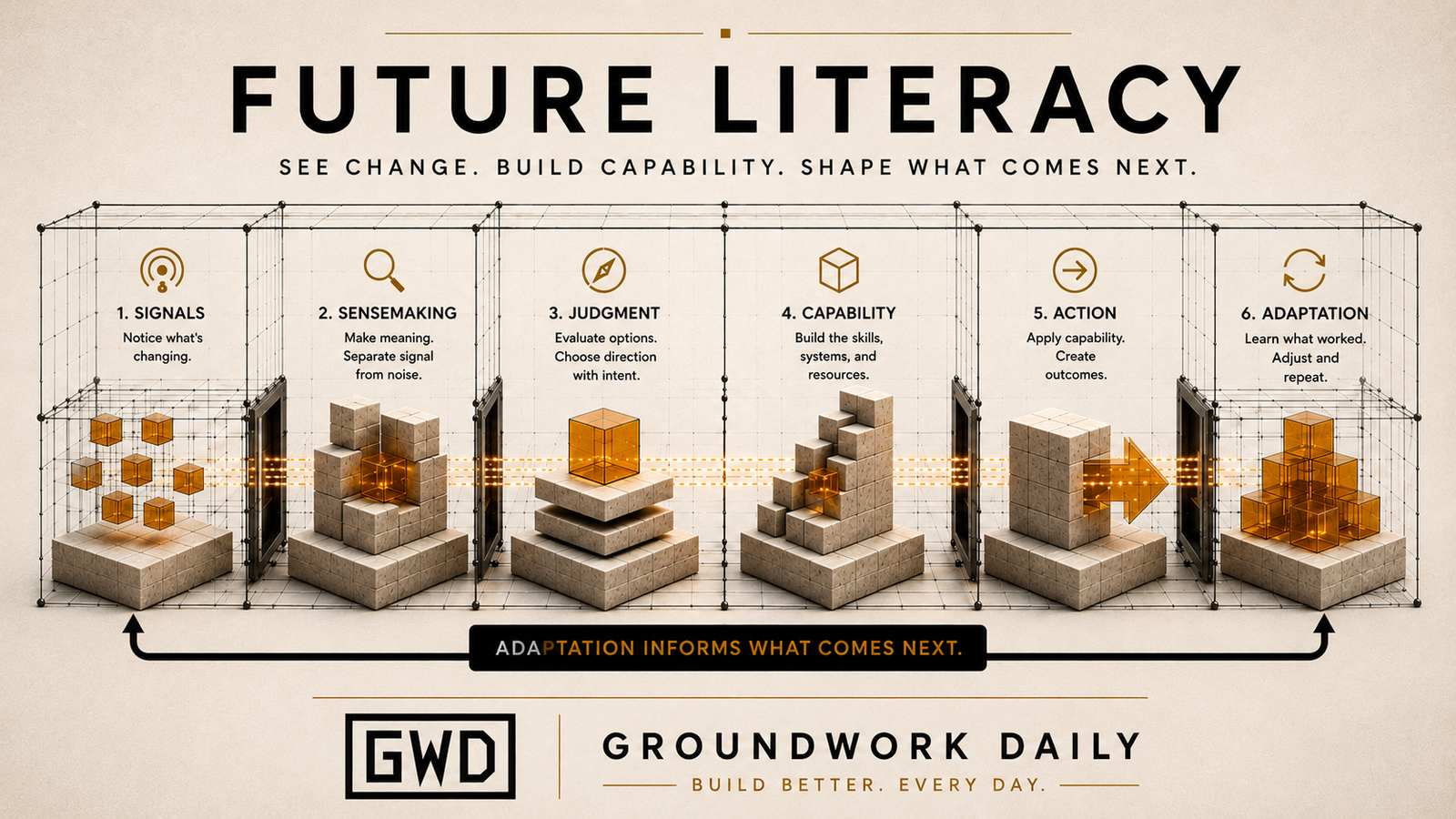
Future Literacy uses a five-part Capability Evidence Stack.
Layer 1
Qualification
What formal preparation, education, licensing, or recognized training establishes your baseline credibility?
Layer 2
Application
Where have you used the knowledge against a real problem, workflow, customer need, or operating constraint?
Layer 3
Evidence
What result, project, work sample, portfolio item, or measurable outcome makes the capability visible?
Layer 4
Currency
How recently have you used the capability with the tools, standards, and conditions that matter now?
Layer 5
Transfer
Can you apply the capability outside the exact employer, tool, or setting where you originally developed it?
The stack changes how you read your own résumé.
A credential without application is incomplete evidence.
Application without visible results can be difficult for another employer to interpret.
Old evidence may not establish current capability.
And expertise that works in only one proprietary setting may carry a high portability tax.
Strong career capital connects all five layers.
Current Capability Has a Half-Life
Some knowledge remains useful for decades.
Other knowledge ages quickly.
The difference matters.
Fundamental accounting logic may remain valuable even as accounting software changes. Clinical judgment may remain critical even as documentation systems evolve. Strong writing principles can survive dozens of software platforms.
However, the way those capabilities are executed can change rapidly.
Separate Durable Knowledge From Changing Interfaces
This prevents two bad reactions.
The first is assuming everything you learned is obsolete because a new tool appeared.
The second is assuming nothing needs to change because the underlying profession still exists.
Usually, both are wrong.
The more useful question is:
Which part of my expertise is durable, and which part must be refreshed because the operating environment changed?
That question protects depth without confusing depth with stasis.
Where Credentials Still Carry Real Value
A serious article about the credential gap has to say this clearly: formal credentials still matter.
Higher educational attainment remains associated with stronger employment outcomes across OECD countries. Qualifications also matter heavily where professional standards, licensing, safety, law, or advanced technical knowledge require them.
The correct response is not to abandon credentials.
It is to stop asking credentials to prove more than they can prove.
Credentials Are Strongest When They Perform a Necessary Function
A credential can be especially valuable when it:
- creates legal eligibility to practice;
- establishes a recognized technical baseline;
- provides access to a profession or apprenticeship pathway;
- signals substantial domain preparation;
- offers structured learning that would be difficult to assemble independently;
- carries strong market recognition across multiple employers.
Those are real advantages.
However, the credential still benefits from current application and evidence.
Do Not Collect Credentials to Avoid Building Proof
Another degree, certificate, or course can feel productive because it has a clear beginning and end.
Sometimes it is exactly the right investment.
Other times it becomes a substitute for application.
Before buying another credential, ask whether the role actually requires it, whether employers repeatedly value it, whether it will close a specific capability gap, and whether it produces practice, evidence, or access you cannot create more efficiently another way.
If the answer is unclear, more education may not be the bottleneck.
The Capability Gap Is Not Just a Hiring Problem
Workers often think about proof only when applying for a new job.
That is too narrow.
Capability affects what happens after hiring as well.
It determines which problems you can own, which technologies you can absorb, how much supervision you require, and whether your scope can expand when the organization changes.
Internal Mobility Also Runs on Evidence
Suppose an employer begins using AI across operations.
Two employees may hold similar qualifications and similar titles.
One waits for formal training.
The other learns the approved tools, understands the policy boundaries, redesigns a low-risk workflow, measures the result, and documents the verification process.
The second employee has created new evidence.
That evidence can affect project access, promotion, role design, and bargaining power even if neither employee changes employers.
This is why capability development belongs inside the job, not only beside it.
Do Not Confuse Tool Use With Capability
Post 2 in this Future Literacy sequence made this distinction around AI, and it applies here too.
Using a tool is not the same as owning a capability.
A worker can generate a spreadsheet without understanding the model. Someone can produce code without being able to debug the system. Another person can use AI to draft an answer without knowing whether the answer is correct.
Speed can hide fragility.
Capability Includes Judgment
A useful capability has more structure.
You need enough domain understanding to frame the problem, enough tool fluency to execute efficiently, and enough verification, contextual judgment, and responsibility to own the final outcome.
That combination is harder to commoditize than tool access alone.
Future Literacy Framework
The Capability Test
If the tool disappeared tomorrow, would you still understand the problem well enough to recognize good work, direct a replacement process, and judge the outcome?
If the answer is yes, the tool is extending capability.
If the answer is no, the tool may be temporarily masking a gap.
Run a 30-Minute Credential-to-Capability Audit
You do not need to abandon your résumé or rebuild your career.
You need to test whether your strongest signals still connect to current work.
Step 1: List Your Three Strongest Credentials
Include degrees, certifications, licenses, apprenticeships, or formal training that materially affects how employers understand you.
Do not list everything you have ever completed.
Start with what carries real market weight.
Step 2: Write the Capability Each Credential Is Supposed to Signal
Do not write the subject name.
Write what you should be able to do because of the preparation.
For example, “business degree” is a credential.
“Analyze operating performance, understand financial tradeoffs, communicate decisions, and manage structured projects” describes capability.
Step 3: Mark the Last Time You Used It
Recent application matters.
If an important capability has not been used for several years, ask whether it needs refreshing.
Step 4: Find the Evidence
What could another person inspect: a project, a result, a work sample, a performance metric, a recommendation, a portfolio item, an assessment, or a completed system?
If the only evidence is the credential itself, mark the capability as under-demonstrated.
Step 5: Compare Against Current Job Requirements
Review several strong postings in your field and one or two adjacent roles.
Which capabilities appear repeatedly? Which tools have become common? What responsibilities are broader than they were several years ago?
This turns the market into a reference point rather than relying on memory.
Step 6: Identify the Largest Capability Gap
Find the important requirement with the weakest combination of application, evidence, and currency.
That is the gap to work on first, not the most fashionable skill or the easiest certificate.
The highest-value gap.
Step 7: Build Proof in 90 Days
Choose a practical way to create evidence.
Use the skill in a project. Improve an existing workflow. Build a work sample. Complete a relevant assessment. Take ownership of a new process. Produce something that shows the capability operating under real constraints.
The outcome should be more than learning.
It should be proof.
The Strongest Signal Is Credential Plus Capability
The debate between degrees and skills is often framed badly.
It asks which one wins.
That creates a false choice.
A strong credential can reduce uncertainty for an employer. Demonstrated capability can reduce it further.
Together, they are stronger than either one treated as sufficient by itself.
Think in Signal Layers
The Strongest Labor-Market Signal
Credential → I completed recognized preparation.
Experience → I have encountered the work in practice.
Evidence → Here is what I produced or improved.
Currency → I can operate under today’s conditions.
Judgment → I understand enough to make decisions when the tool or script is insufficient.
That structure is difficult to fake.
It is also more resilient when one hiring convention changes.
The Groundwork: Keep the Signal Connected to the Substance
The credential gap is not disappearing because education stopped mattering.
The more important shift is that employers have more reason, and more tools, to look beyond formal qualification alone.
Meanwhile, the work itself keeps moving.
AI changes workflows. New systems change execution. Roles absorb adjacent responsibilities. Skill requirements shift. What counted as current capability five years ago may no longer be enough evidence today.
That creates the real risk.
You can possess an impressive signal while the substance underneath it slowly falls out of alignment with the market.
The response is not endless credential collection, and it is not dismissing education either.
Keep the two connected.
Use credentials where they create access, trust, structure, or required qualification. Then keep building application, evidence, currency, portability, and judgment around them.
A credential can tell the market where you started. Your capability tells the market what you can do from here.
Further Groundwork
The Portable Skill Problem: Why Your Expertise Doesn’t Always Travel
Test whether your expertise retains its value when the employer, industry, tool, or professional context changes.
83% of Black Respondents Know AI — So Why Aren’t More Using It to Build?
See why familiarity and tool use are different from building repeatable capability, evidence, and leverage.
How to Read a Job Market Before the Layoffs Start
Track hiring, skill migration, demand pressure, and other signals before structural change becomes obvious.
The Skill Stack You Actually Need in 2026
Build combinations of capabilities that remain useful as tools, roles, and employer expectations change.
Receipts
Bright Horizons · 2026 Workforce Outlook
Workforce survey reporting that 42 percent of employees expected significant AI-driven role change within a year while only 17 percent reported frequent AI use.
OECD · Empowering the Workforce in the Context of a Skills-First Approach
Research on skills-first hiring, demonstrated competencies, skills signalling, assessment practices, and the continuing role of qualifications.
OECD · A Skills-First Labour Market
Analysis of how labor markets can connect credentials, learning, skills evidence, assessments, and employer demand more directly, including employer plans for pre-employment tests and work-experience-based hiring through 2030.
World Economic Forum · Future of Jobs Report 2025
Global employer research on changing skill requirements, workforce strategy, work experience, education signals, and expected skill disruption through 2030.