Learning after 30 can feel harder than learning did at 20. Usually, though, the explanation is more complicated than “your brain got old.” You may be working full time, raising children, managing a household, caring for family, carrying financial obligations, and trying to learn in whatever time survives.
That changes the problem.
At 20, a class may have given you a schedule, assignments, practice, feedback, deadlines, and several hours a week devoted to one subject. Later in life, you may get a video, a course login, a stack of saved articles, and forty-five quiet minutes on a Tuesday night.
Those are not the same learning conditions.
Age does matter to cognition, but there is no meaningful cliff at 30 where adults suddenly lose the ability to learn. Different cognitive abilities change at different rates across adulthood. At the same time, adults carry something younger learners have had less time to accumulate: knowledge, context, judgment, experience, and mental models that new information can attach to.
So the practical question is not whether you can still learn.
It is whether your learning system fits the life you actually have.
You do not need to learn like you did at 22. You need a system built for limited time, repeated retrieval, useful practice, feedback, and real application.
Why Learning After 30 Feels Different
The most useful place to start is with a correction.
Learning does not suddenly stop working when you turn 30. Research on normal cognitive aging shows a more uneven picture. Some abilities become less efficient over time, while others remain relatively stable for much longer. Vocabulary and accumulated knowledge, for example, can remain strong even as processing speed or some forms of memory become less efficient with age.
More importantly, age is only one variable.
Your environment may have changed far more dramatically than your capacity to learn.
You Have More Competition for Attention
Consider what surrounds a typical learning session now.
Your workday may still be in your head. Messages are arriving. Someone needs dinner. The laundry needs moving. A bill needs attention. You are tired enough to notice it but not tired enough to stop scrolling.
Then you open a course and expect your brain to behave as if nothing else exists.
That is a weak operating model.
Attention is not an unlimited resource. Therefore, a practical adult learning system should reduce switching and make the learning target small enough to engage with deeply.
You Probably Have Less Structured Practice
School did something useful that is easy to miss once you leave it: it made you come back.
You encountered material on Monday, answered questions on Wednesday, completed an assignment on Friday, and saw related material again before an exam.
Even when the teaching was mediocre, the structure often created repeated contact.
Adult self-study can do the opposite. You may watch three hours of material in one sitting, feel productive, and then not touch the subject again for two weeks.
That feels efficient because you covered a lot.
However, coverage is not the same as retention.
Learning After 30 Is Not an Information Problem
Most adults do not suffer from a shortage of things to learn from.
The shortage is everywhere else.
You can find courses, videos, podcasts, books, newsletters, explainers, tutorials, communities, AI tutors, and thousands of people telling you what you should learn next.
As a result, the modern learning problem is often mistaken for an information-acquisition problem.
It is usually a conversion problem.
How much of what you consume can you retrieve later? Of that, how much can you actually use? And how much changes what you can do?
Exposure Can Feel Like Learning
You watch a clear explanation and think, Yes, that makes sense.
Then someone asks you to explain the idea without the video.
Suddenly, the clarity disappears.
This is one of the traps of passive learning. Recognition can feel like mastery because the material looks familiar while it is in front of you.
But work rarely asks whether something looks familiar.
Work asks whether you can retrieve it, adapt it, use it, or make a decision with it.
Future Literacy Principle
Exposure Is Not Capability
If you can recognize an idea only while the explanation is in front of you, you have encountered it. You have not necessarily learned to use it.
The Adult Learning Loop
A better system treats learning as a loop rather than a pipeline.
You do not simply consume information and move forward forever. Instead, useful learning repeatedly brings important material back into contact with memory and real work.
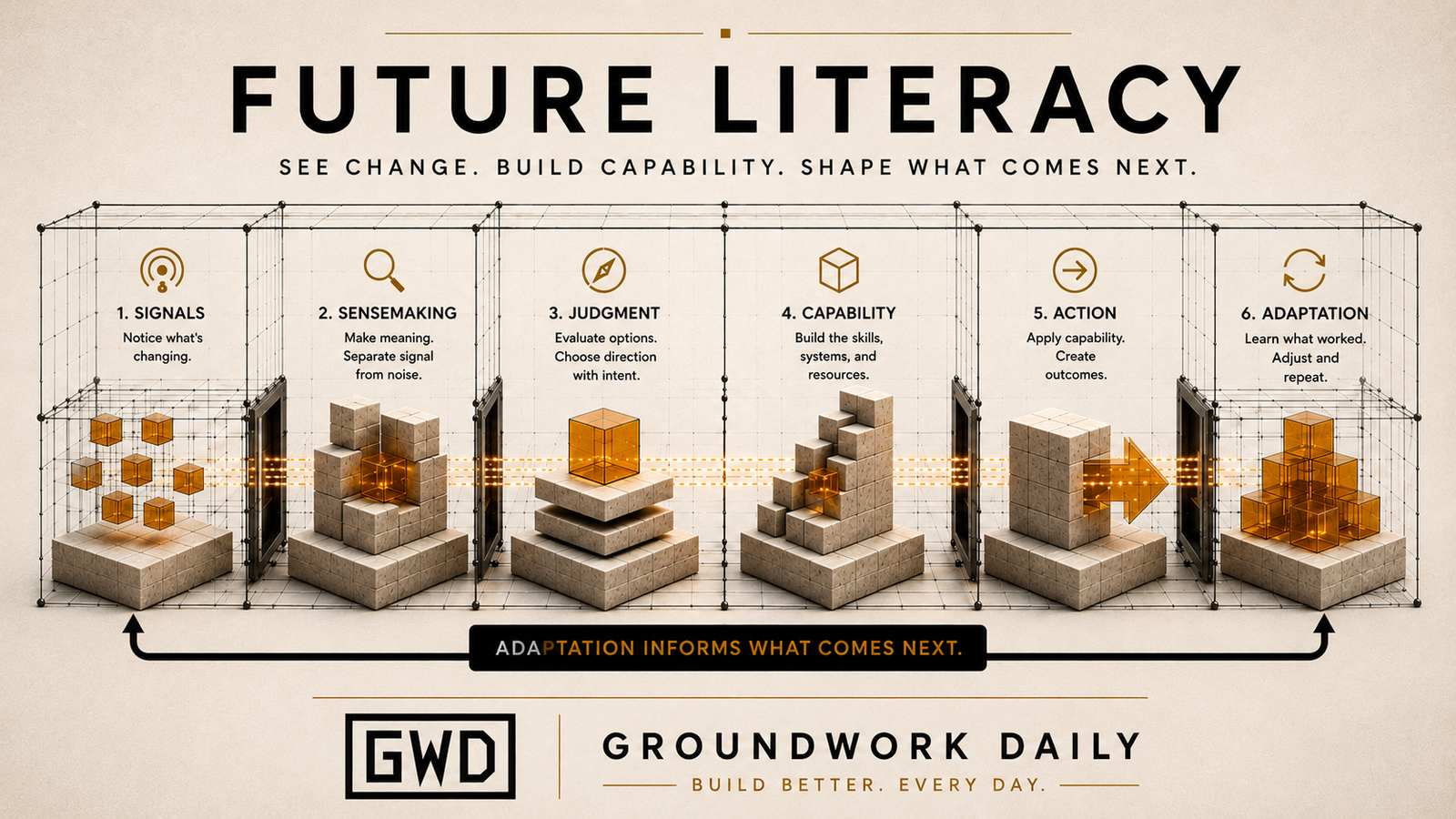
Future Literacy uses five moves:
Move 1
Acquire
Encounter a new idea, method, fact, or skill from a credible source.
Move 2
Retrieve
Try to bring the knowledge back without immediately reopening the source.
Move 3
Apply
Use it against a problem, decision, project, exercise, or realistic example.
Move 4
Correct
Find the error, weak assumption, missing step, or misunderstood detail and repair it.
Move 5
Revisit
Return after enough time has passed that remembering requires some effort.
The loop is simple on purpose.
You can use it to learn financial modeling, a new software platform, a language, a technical process, AI-assisted research, public speaking, project management, or almost anything else that requires retained knowledge plus application.
More importantly, the loop gives you a way to judge learning activities.
If all you ever do is acquire, the system is incomplete.
Retrieval Changes the Job Your Memory Has to Do
One of the most reliable ways to strengthen memory is to practice retrieving information rather than only reviewing it.
That does not require flashcards for everything.
It simply means closing the source and making your memory work.
Ask Before You Reopen
Suppose you spend twenty minutes learning a new framework.
Before looking back at your notes, ask:
- What were the three main ideas?
- How would I explain this to someone else?
- What problem is this framework supposed to solve?
- Where would it fail?
- How could I use it this week?
Then check your answers.
The gaps are useful. In fact, finding them is part of the point.
Retrieval exposes what recognition hides.
Do Not Turn Retrieval Into a Performance Test
You are not trying to prove that you are smart.
You are trying to locate what has not stuck yet.
That means forgetting something during practice is not evidence that the learning session failed. It gives you information about what needs another pass.
Then feedback matters.
Retrieval without correction can reinforce mistakes, so check your answer after you commit to one.
Spacing Makes Limited Time Work Harder
If you have four hours available this week, the instinct may be to protect one large block and finish as much as possible.
Sometimes that is necessary, especially for projects that require uninterrupted concentration.
For retention, though, returning to important material across separate sessions can be more useful than compressing every encounter into one sitting.
Research on the spacing effect has found benefits across age groups, including younger and older adults.
Spacing Does Not Require a Complicated Schedule
You do not need an algorithm.
Try this instead:
Learn something on Monday.
Retrieve it briefly on Wednesday.
Apply it on Saturday.
Return to it the following week.
The exact interval depends on what you are learning and how long you need to retain it. Still, the principle is useful: do not make the first encounter the last encounter.
Sleep Is Part of the Learning System
Sleep advice is often dropped into productivity articles as generic wellness filler.
Here it has a more specific role.
Research across many areas of memory has found that sleep supports memory consolidation. In plain language, some of the work of stabilizing what you learned continues after the study session ends.
That does not mean one short night erases everything you studied.
Nor does it mean sleep can rescue weak practice.
It means a learning plan that repeatedly steals from sleep to create study time may be trading against itself.
Do Not Build a System That Requires Chronic Exhaustion
This matters for adults because late-night study is often the easiest time to find.
Sometimes that is your only realistic window, and real life wins.
However, if your plan requires you to lose sleep five nights a week, the plan is probably too large.
Shrink the learning load before you normalize exhaustion.
Thirty focused minutes repeated across a week may be more sustainable than a heroic schedule that collapses after ten days.
Your Existing Knowledge Is Learning Infrastructure
Adult learners are not empty containers.
That matters more than most “learn anything fast” advice acknowledges.
By 30, 40, or 50, you may have years of professional experience, stories, mistakes, relationships, domain knowledge, and patterns you have seen repeatedly.
New knowledge can attach to that structure.
Research on prior knowledge shows that what people already know can influence how new information is encoded, understood, and remembered.
Attach the New Skill to Something You Already Understand
If you are learning data analysis, connect it to data you already care about. Learning AI? Apply it to a workflow you already understand well enough to judge. Learning finance? Use a business or household example with real meaning. And if you are picking up a new management method, compare it with situations you have already lived through.
This gives the new information somewhere to land.
However, prior knowledge is not automatically helpful. Old assumptions can also distort new learning. Therefore, experience should be used as a scaffold, not as proof that your current model is already correct.
The Hardest Adult Learning Decision Is What Not to Learn
Once you accept that time is scarce, choosing what to learn becomes more important than finding the perfect course.
This is where anxiety creates bad strategy.
AI is changing. Your industry is changing. Someone says everyone should learn Python. Someone else says data literacy. Another person says sales, finance, cybersecurity, prompting, automation, leadership, or video.
You could spend the next decade preparing for everything and become useful at nothing.
Choose Skills by Return, Not Urgency Theater
Before committing meaningful time to a skill, test it against four questions.
The Learning Return Test
Relevance → Does this skill solve a problem that actually matters to my work, career, business, or life?
Frequency → Will I have enough opportunities to use it that practice can continue after the course ends?
Leverage → Could this skill improve my output, judgment, mobility, income, or ability to learn adjacent skills?
Evidence → Can I produce something within 90 days that proves I can use it?
A skill that scores well on all four deserves attention.
A skill that sounds important but has no clear application may deserve a bookmark instead.
Learning After 30 Needs a Smaller Target
A common failure mode is choosing a subject instead of a capability.
“Learn AI” is too large.
“Use an approved AI tool to turn meeting notes into a verified first draft of a project brief” is learnable.
“Learn finance” is too large.
“Build and explain a basic cash-flow forecast for my business” gives you a target.
“Learn data” is too large.
“Clean a dataset, calculate three useful metrics, and explain what changed” is concrete.
Define What Better Looks Like
Before you start, write one sentence:
At the end of this learning cycle, I should be able to ______ without following a step-by-step tutorial.
That sentence forces the learning goal toward capability.
It also tells you when to stop consuming and start practicing.
A Four-Hour Weekly Learning System
Four hours is not a magic number.
Use whatever time you genuinely have.
Still, four hours is a useful design constraint because it forces prioritization. You cannot pretend you are going back to school full time. You have to make the hours carry weight.
Hour 1: Acquire
Learn one bounded piece of material.
Do not open five sources unless comparison is part of the task. Pick a credible source and stay with the problem long enough to understand its basic structure.
Take notes sparingly.
Write what you need to think with, not a transcript of everything you saw.
Hour 2: Retrieve and Explain
Come back later without starting from your notes.
Write what you remember. Sketch the process. Explain it aloud. Answer questions. Then reopen the source and correct the gaps.
This session may feel harder than Hour 1.
That is useful.
Hour 3: Apply
Use the skill against something real or realistic.
Build the spreadsheet. Write the analysis. Configure the tool. Run the process. Make the presentation. Solve the case.
Application creates the kind of friction that explanations remove.
Now you discover what you actually understand.
Hour 4: Correct, Document, and Revisit
Review what went wrong.
Fix the weakest part. Then write a short record of what you learned, what still confuses you, and what you should attempt next.
Finally, schedule the next retrieval or application session.
That last step matters because an unfinished learning loop tends to become a forgotten learning project.
Use AI Without Outsourcing the Learning
AI can make adult learning dramatically more accessible.
It can explain terminology, generate examples, quiz you, create practice problems, compare approaches, critique a draft, or help you find the point where your understanding breaks.
That is valuable.
However, the tool can also remove exactly the struggle that was supposed to produce learning.
Make AI Increase Practice, Not Replace It
If you are learning to write, do not ask AI to write every first draft. When you are learning analysis, do not let it interpret every dataset before you form a view. And if you are learning code, do not accept a working solution you cannot explain.
Instead, use the tool to create more feedback loops.
Ask it to quiz you.
Ask for a new problem with the same underlying structure.
Explain your reasoning and ask where it is weak.
Ask for counterexamples.
Then verify anything consequential.
The objective is not to protect yourself from assistance.
It is to make sure the assistance leaves you more capable than it found you.
Stop Measuring Learning by Hours Consumed
Time matters, but hours are a weak measure of progress.
You can spend twenty hours watching excellent instruction and still be unable to perform the task.
Instead, track evidence.
Can you explain the concept without notes? Could you solve a new version of the problem, or use the skill inside real work? Are you able to identify and correct your own errors? And if you return after two weeks, do you still recover the important parts?
Those are better indicators of learning.
Know When to Stop Learning and Start Building
Courses can become a comfortable hiding place.
There is always another module, another certification, another expert, or another book that promises to make you ready.
At some point, more preparation produces less value than contact with the actual problem.
Move Into Production Earlier
If you are learning for work, try to produce something useful before you feel fully ready.
Keep the stakes appropriate. Do not practice on a safety-critical task you are not qualified to perform.
But when the risk is manageable, application is where knowledge becomes capability.
Make the small project.
Build the prototype.
Write the analysis.
Run the workflow.
Then let reality tell you what you need to learn next.
The Groundwork: Learn Less, Retain More, Apply Faster
Learning after 30 is not a contest to see who can consume the most information before bedtime.
Your constraints are real.
So use them.
Choose fewer learning targets. Make them relevant enough to apply. Retrieve instead of endlessly rereading. Space important material across time. Protect sleep when you can. Attach new ideas to knowledge you already possess. Then get the skill into contact with real work before another course replaces it.
The point is not to recreate school inside an already crowded life.
The point is to build a learning system that survives Tuesday.
You do not need twenty hours a week to become more capable. You need enough recurring contact with the right problem for knowledge to move from something you recognize to something you can use.
Learn less at once. Come back more often. Use what you learn before it evaporates.
Further Groundwork
The Credential Gap Is Closing. The Capability Gap Is Widening.
See why qualifications remain useful while current application, evidence, and judgment increasingly determine practical capability.
The Portable Skill Problem: Why Your Expertise Doesn’t Always Travel
Test whether the capabilities you are building can survive a change in employer, industry, tool, or professional context.
83% of Black Respondents Know AI — So Why Aren’t More Using It to Build?
Move beyond familiarity and tool use toward repeatable application, production, evidence, and leverage.
The Skill Stack You Actually Need in 2026
Decide which combinations of capabilities deserve scarce learning time as tools and job requirements continue to change.
Receipts
Clinics in Geriatric Medicine · Normal Cognitive Aging
Review of how cognitive abilities change differently across normal aging, including areas that remain comparatively resilient and others that become less efficient.
Aging, Neuropsychology, and Cognition · Teaching Older Adults to Use Retrieval Practice
Research showing that retrieval practice can improve learning and memory in older adults and can be taught as a self-regulated learning strategy.
Aging, Neuropsychology, and Cognition · The Spacing Effect in Older and Younger Adults
Experimental research examining spaced learning and long-term recall in both younger and older adults.
Emerging Topics in Life Sciences · Sleep and Memory Consolidation Across the Lifespan
Systematic review examining the relationship between sleep, memory, and cognition across different stages of life.
Frontiers in Behavioral Neuroscience · The Influence of Prior Knowledge on Memory
Review of how accumulated knowledge shapes memory, learning, prediction, and the acquisition of new information.