Future literacy is the discipline of thinking ahead without pretending certainty exists.
That distinction matters because the future is not a destination waiting to be guessed correctly. It is a changing field of signals, systems, pressures, possibilities, and consequences that interact over time.
Most people are taught to approach uncertainty in one of two weak ways. They either search for a prediction that will make the future feel settled, or they ignore the future until changing conditions force a response.
Neither approach is strong enough.
Instead, future literacy asks a more useful question: How do you make decisions today that remain workable across several plausible tomorrows?
That is disciplined foresight.
It does not require perfect forecasts. Rather, it requires better observation, stronger assumptions, clearer judgment, adaptable capability, and enough composure to keep thinking when certainty disappears.
Groundwork Daily treats this as a practical capability system. The objective is not to become obsessed with the future. The objective is to become less fragile when the future refuses to follow the script.
What Future Literacy Actually Means
Future literacy is not the ability to know what happens next.
Instead, it is the ability to use possible futures as tools for better thinking in the present.
That means imagining more than one plausible outcome, examining the assumptions underneath your plans, identifying structural changes, and deciding what remains useful across several possible conditions.
In other words, the future becomes a testing environment.
You can ask whether a career plan still works if hiring slows. A household can examine whether its budget holds if costs rise. A team can ask whether its workflow survives a new tool, a staffing change, or a different customer expectation.
The goal is not to forecast every detail correctly.
Instead, the goal is to discover where the current system is unnecessarily fragile.
Future Literacy Is a Present-Day Skill
This point is easy to miss.
Although the discipline looks forward, its value shows up now. Better foresight changes how you allocate attention, build skills, structure money, evaluate technology, interpret risk, and make commitments.
Therefore, the practice belongs inside ordinary decision-making rather than inside a distant category called “the future.”
A strong decision today should not depend on one narrow scenario being exactly right.
It should have enough structural integrity to survive reasonable change.
Why Future Literacy Rejects the Prediction Trap
Prediction is attractive because certainty feels efficient.
If you knew what would happen, the next move would appear obvious. Unfortunately, complex systems rarely offer that luxury.
Technology changes behavior. Behavior changes markets. Markets alter incentives. Institutions respond at different speeds. Politics, culture, demographics, regulation, capital, and public expectations interact in ways that make simple forecasts brittle.
Consequently, a single confident prediction can become a weak foundation for an expensive decision.
The Better Question
Prediction asks, What will happen?
Disciplined foresight asks, What still works if my first expectation is wrong?
That question produces a different kind of strategy.
For example, instead of betting a career on one specific technology winning, you might build skills that remain useful across several tools. Rather than assuming one income path will remain stable, you might increase financial margin and transferable capability.
Likewise, an organization can avoid locking its entire operating model to a forecast that has not yet earned that level of confidence.
Preparation becomes stronger when it does not require certainty to justify itself.
Forecasts Still Have a Role
Rejecting prediction worship does not mean ignoring forecasts.
Forecasts can be useful inputs. Scenario planning, economic projections, demographic data, labor-market research, technology adoption patterns, and policy analysis can all improve judgment.
However, the forecast should remain evidence, not doctrine.
A mature operating model asks how reliable the source is, what assumptions produced the estimate, what could change the outcome, and what decision would still make sense across a reasonable range.
That is a stronger relationship with uncertainty.
Three Principles of Future Literacy
Groundwork Daily’s approach rests on three principles that keep foresight practical.
1. The Future Is Plural
There is rarely one inevitable future.
Several plausible pathways can exist at the same time because people, institutions, technologies, markets, and public policy continue influencing one another.
Therefore, treating one narrative as destiny is risky.
A stronger approach asks what could plausibly happen under several sets of conditions.
This does not mean every scenario deserves equal weight. Some possibilities have much stronger evidence behind them than others.
Still, considering alternatives prevents one assumption from quietly becoming the entire strategy.
2. Assumptions Are Often the Hidden Risk
Every plan contains beliefs about what will remain true.
You may assume a job category will continue paying the same premium. A family may assume housing costs will remain manageable. A company may assume customers will keep tolerating a slow process.
Usually, the plan does not fail because planning itself was useless.
Instead, one or more assumptions stop matching reality.
Future literacy therefore makes assumptions visible before they become points of failure.
3. Preparation Usually Beats Precision
You do not need perfect foresight to make a strong move.
Often, you only need enough foresight to reduce fragility.
A savings buffer can help across many scenarios. Clear communication remains valuable across tools. Systems thinking transfers between industries. Better digital judgment remains useful even when the platform changes.
Similarly, stronger health, trusted relationships, and transferable skills create options even when the exact source of disruption cannot be predicted.
The best preparation is often valuable across several futures at once.
Seven Capacities That Make Future Literacy Useful
Future literacy becomes meaningful when it can be trained.
Groundwork Daily organizes the work around seven related capacities. None requires clairvoyance, and none depends on knowing every emerging trend.
1. Pattern Recognition
Pattern recognition helps you distinguish an isolated event from meaningful repetition.
One unusual signal may mean very little. However, several related changes across time can point toward a deeper movement.
The discipline is learning to notice repetition without rushing into a dramatic story.
Groundwork Daily explores this more deeply in How to Read the Patterns That Shape Your Future.
2. Temporal Awareness
Temporal awareness means understanding that systems operate on different clocks.
Technology may move quickly while regulation moves slowly. A labor-market shift may appear first in job descriptions before it appears in unemployment data. Household stress can accumulate gradually before one visible expense exposes the problem.
As a result, timing matters.
A useful signal today may not require immediate action. Conversely, a quiet shift may deserve preparation before public attention catches up.
3. Systems Thinking
Systems thinking moves beyond events and asks what structure keeps producing them.
It examines inputs, incentives, dependencies, constraints, feedback loops, and leverage points.
This prevents a recurring problem from being misdiagnosed as a series of unrelated accidents.
For the full operating framework, read How to Use Systems Thinking in Real Life.
4. Continuous Capability Building
Future readiness depends less on collecting information than on maintaining useful capability.
A person who can learn, apply, review, and update has more resilience than someone whose confidence depends on one fixed body of knowledge.
That does not mean learning constantly.
Instead, it means developing the judgment to decide what deserves investment and then practicing deeply enough for the skill to become usable.
The distinction is central to The Three Levels of Capability.
5. Adaptive Planning
A rigid plan can become obsolete faster than the person following it realizes.
Adaptive planning keeps direction while allowing methods to change.
For example, a two-year direction can stay coherent even if the route changes because of a new employer, technology, family responsibility, or economic condition.
The objective is not to abandon commitments whenever friction appears.
Rather, the objective is to know what should remain stable and what can legitimately move.
6. Ethical Foresight
Not every technically possible future is desirable.
That is why foresight also requires judgment about consequences.
A new system can increase efficiency while reducing privacy. Automation can improve productivity while shifting risk toward workers. A convenience can create dependency. A policy can solve one problem while producing another downstream.
Ethical foresight asks who benefits, who carries the cost, what incentives are created, and what consequences may appear later.
Without that layer, foresight can become sophisticated short-termism.
7. Composure Under Complexity
Complexity creates pressure to simplify too quickly.
People reach for certainty because uncertainty is uncomfortable. Yet premature certainty can produce weak decisions.
Composure gives you enough internal stability to hold competing information without immediately turning ambiguity into panic.
This is why the earlier Groundwork Daily work on clear thinking and bandwidth protection matters here.
Better foresight needs a mind with enough capacity to think.
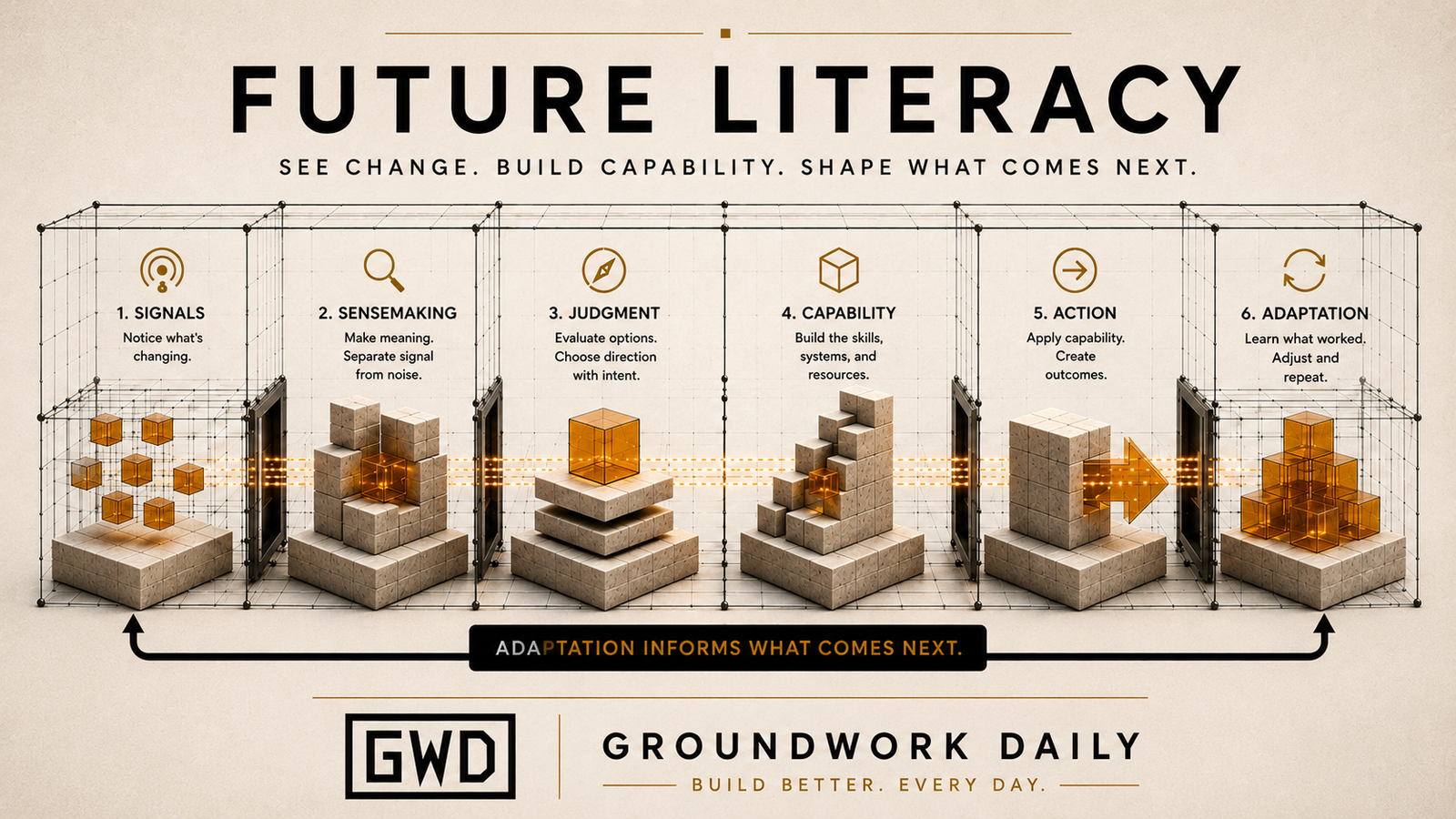
The Groundwork Daily Future Literacy Loop
These capacities become more useful when they operate as one loop.
Signals → What changed?
Sensemaking → What might the signal mean in context?
Judgment → How strong is the evidence, and what matters?
Capability → What can you actually do in response?
Action → What is the smallest useful move?
Adaptation → What did reality teach back?
The loop matters because foresight without action becomes intellectual entertainment.
At the same time, action without sensemaking becomes reaction.
Future literacy connects the two.
Signals Are Not Instructions
Every signal does not deserve a response.
A headline is not automatically a trend. A trend is not automatically structural. A structural change is not automatically relevant to your responsibilities.
Therefore, observation needs filters.
Ask whether the signal is repeated, credible, consequential, and connected to something you can reasonably influence or prepare for.
This preserves bandwidth while still keeping you alert.
Judgment Converts Information Into Priority
Information abundance makes judgment more valuable, not less.
When hundreds of signals compete for attention, the scarce resource is the ability to determine what matters.
That requires context, evidence, proportion, and sometimes patience.
Consequently, disciplined foresight does not reward the person who reacts first. It rewards the person who responds appropriately.
Adaptation Closes the Loop
No strategy survives unchanged forever.
Once action produces feedback, the model must update.
Perhaps the feared change never materializes. Maybe a new tool proves less useful than expected. Alternatively, a small signal may strengthen into something structural.
Adaptation means incorporating that evidence without defending the old interpretation simply because it was yours.
That is intellectual discipline.
What Future Literacy Looks Like in Real Life
The framework becomes useful when it changes ordinary decisions.
Career
Suppose several employers in your field begin changing job descriptions around AI-assisted workflows.
A prediction-driven response says, “AI will eliminate my role,” or, “AI is only hype.” Both statements jump too quickly.
A future-literate response studies the pattern.
Which tasks are changing? Which skills are gaining value? Are requirements appearing across employers or only in a niche? What capability could be tested cheaply now?
Then the person builds a small, reversible learning experiment before making a dramatic career decision.
Money
Imagine household costs are rising faster than expected.
The weak response waits until the month becomes a crisis. Another weak response assumes permanent catastrophe after one expensive period.
A stronger approach compares several months, separates temporary expenses from structural increases, tests assumptions about future cash flow, and builds margin where possible.
The point is not predicting every price.
It is reducing dependence on one fragile financial scenario.
Technology
New tools regularly promise transformation.
Future literacy does not demand immediate adoption or reflexive rejection.
Instead, ask what problem the tool solves, which workflow it changes, what dependency it creates, and whether the benefit survives outside the demo.
A small experiment can generate more useful evidence than hours of commentary.
Household and Family Decisions
Foresight also belongs inside ordinary family life.
Changing caregiving needs, transportation costs, school schedules, housing conditions, health demands, or employment patterns can reshape capacity gradually.
Families benefit when those signals are discussed before they become emergencies.
The question becomes: What would make this household less fragile if the current condition changed?
What Future Literacy Is Not
A strong framework also needs boundaries.
It Is Not Trend Chasing
Trend chasing confuses novelty with importance.
Future literacy asks whether a change is structural, relevant, and durable enough to deserve attention.
It Is Not Doom Scrolling
Consuming more bad news does not automatically create preparedness.
In fact, excessive exposure can reduce the clarity required to make useful decisions.
Awareness needs boundaries.
It Is Not Certainty Theater
Confidence does not make an uncertain claim more accurate.
Good foresight states assumptions, acknowledges uncertainty, and updates when evidence changes.
It Is Not Permanent Reinvention
Constant adaptation can become another form of instability.
The goal is selective adaptation: preserve what remains useful, update what no longer fits, and avoid rebuilding the entire operating system because one new tool entered the market.
A Simple Future Literacy Practice
You do not need a forecasting department to practice disciplined foresight.
Start with one area that matters to your actual responsibilities.
Step One: Name the Signal
Write down what changed without adding a story.
For example: “Three employers added this capability to similar job postings,” is cleaner than, “My profession is disappearing.”
Step Two: Identify the Assumption
Ask what your current plan assumes will remain true.
That may involve income, technology, health, staffing, demand, cost, regulation, or another dependency.
Step Three: Build More Than One Scenario
Create a small range rather than one dramatic forecast.
What happens if the current trend strengthens? What if it slows? What if the environment changes in a different way altogether?
The scenarios do not need elaborate storytelling.
They only need enough variation to expose fragility.
Step Four: Find the Robust Move
Ask what action remains useful across several scenarios.
Often, the answer is not dramatic.
It may be building a transferable skill, increasing cash margin, improving documentation, reducing one dependency, strengthening a relationship, or testing a new workflow.
Step Five: Define What Would Change Your Mind
Decide what evidence would strengthen or weaken your interpretation.
This protects the process from becoming a story you keep defending regardless of reality.
Step Six: Review
Return to the assumption later.
What changed? Which scenario became more plausible? What disappeared? Which preparation still makes sense?
That review turns foresight into an operating rhythm instead of a one-time exercise.
Why Future Literacy Matters in a Changing World
The value of future literacy rises when the environment becomes harder to read.
Work is becoming more tool-dependent. Skill requirements are changing unevenly. Artificial intelligence is altering workflows at different speeds across occupations. Meanwhile, households continue navigating cost pressure, demographic change, information abundance, and institutional uncertainty.
None of this means collapse is inevitable.
It means rigid assumptions become more expensive.
For that reason, Groundwork Daily places this work inside Education & Skills. The central proposition is that foresight is not reserved for governments, executives, futurists, or strategy teams.
Ordinary people can learn to notice signals, question assumptions, test scenarios, build transferable capability, and make decisions with more structural integrity.
Those skills do not eliminate uncertainty.
They improve your position inside it.
Future Literacy Has a Larger Foresight Tradition
Groundwork Daily’s framework is distinct, but the larger discipline of strategic foresight has an established institutional history.
Organizations such as the OECD use foresight and scenario work to help governments examine uncertainty, anticipate emerging challenges, and stress-test policy assumptions.
The common thread is important: the purpose is not perfect prediction.
Instead, foresight expands the range of conditions considered before decisions become difficult to reverse.
For institutional context, see the OECD’s work on strategic foresight.
Groundwork Daily brings that discipline closer to the scale of careers, households, skills, attention, technology, money, and everyday decision-making.
The Groundwork Daily Distinction
Future literacy at Groundwork Daily is not primarily about forecasting the next technology or publishing dramatic predictions.
The framework begins with a different operating premise:
Read change without worshipping novelty.
Build capability before pressure makes the gap expensive.
Protect enough bandwidth to interpret signals clearly.
Use systems thinking to find structure beneath events.
Choose robust moves instead of brittle predictions.
Update when reality teaches back.
That is the operating model.
It treats foresight as practical infrastructure rather than intellectual theater.
The Path Forward
The future will not become perfectly legible.
That is not a flaw in the framework. It is the condition the framework is designed for.
Start by noticing what is changing. Then separate signal from noise.
Make your assumptions visible and test them against more than one plausible condition. Afterward, identify what action remains useful even if your preferred scenario does not happen.
Most importantly, keep enough humility to update.
You do not need to predict the next decade.
You need to build enough capability, judgment, and structural resilience that one wrong forecast does not take the whole system down with it.
That is future literacy: not knowing the future, but becoming harder for uncertainty to break.
Further Groundwork
The Skill Stack You Actually Need in 2026
Build the foundational capabilities that make disciplined foresight usable under changing conditions.
How to Read the Patterns That Shape Your Future
Develop stronger signal recognition without turning every event into a prediction.
How to Use Systems Thinking in Real Life
Examine the structures, incentives, dependencies, and feedback loops underneath repeated outcomes.
How to Stay Capable When the Future Moves Faster Than You Do
Use selective adaptation so change strengthens capability instead of consuming it.
Education & Skills
Explore Groundwork Daily’s broader work on learning, judgment, technology, systems, and practical capability.
Receipts
OECD · Strategic Foresight
Institutional work on using foresight, scenarios, uncertainty analysis, and anticipatory thinking to improve present-day decisions.
OECD Skills Outlook 2025
Research on adult skills, adaptive problem solving, skill use, and capability under changing economic and social conditions.
World Economic Forum · Future of Jobs Report 2025
Employer research on technology adoption, changing skill demand, workforce transformation, and reskilling pressures.