
Money Monday · Economy & Ownership
Economic infrastructure for Black sovereignty is the system that determines whether economic activity becomes durable control. In practice, it depends on what a community can retain, organize, own, protect, govern, and eventually transfer.
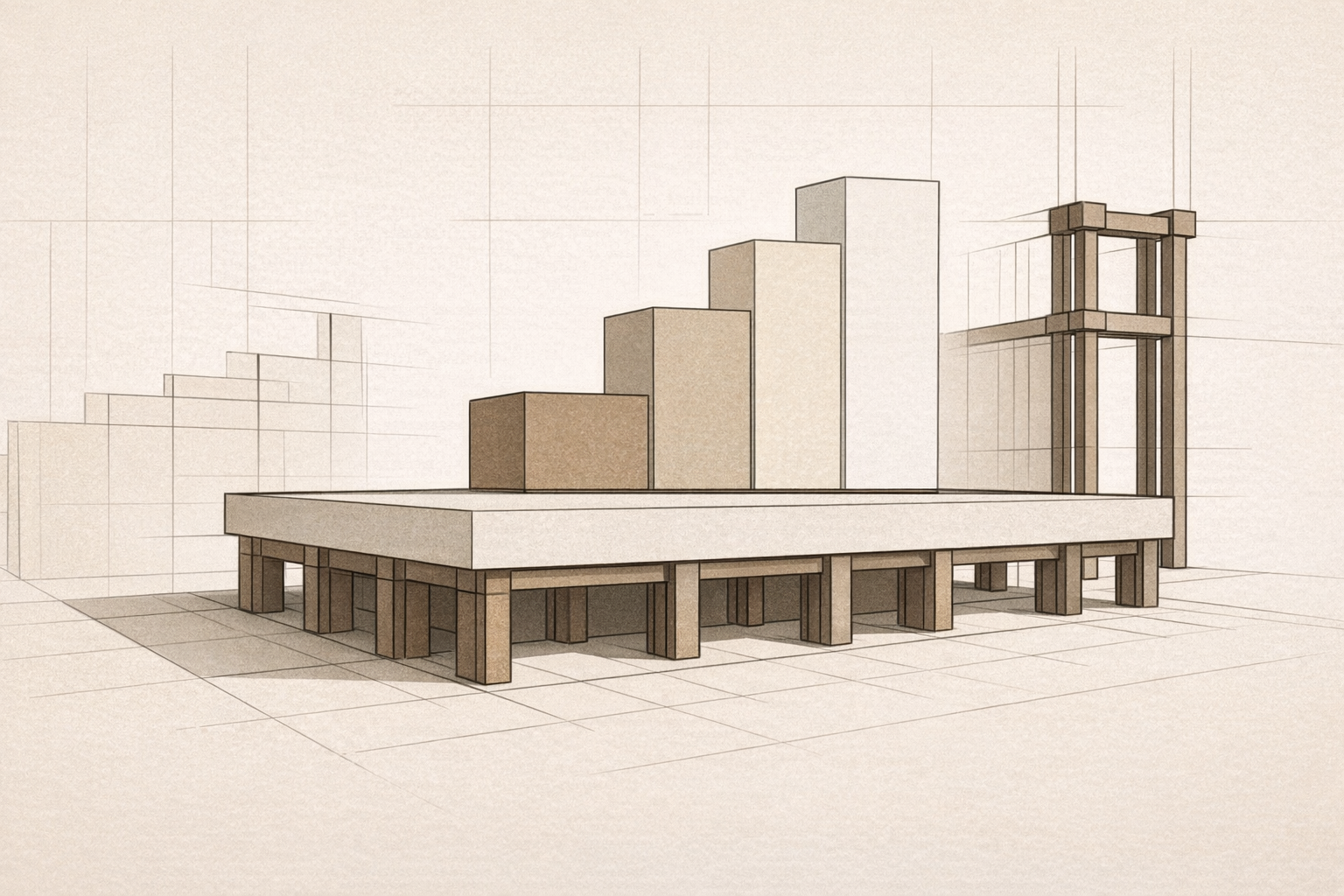
Economic infrastructure for Black sovereignty begins with a simple distinction: economic activity is not the same as economic control.
Black households, businesses, workers, and consumers generate enormous economic activity. Yet income can rise while ownership remains thin. At the same time, spending can grow while productive assets sit somewhere else. In many cases, a business can open its doors while still lacking enough capital to survive a downturn.
Meanwhile, a family can earn more and still have little margin between an emergency and a financial crisis. In other words, purchasing power alone cannot tell us whether economic position is actually getting stronger.
The Real Question Is What Remains
The harder question is more useful: What structures allow value to remain after the transaction is over?
To answer it, we have to look beyond spending. Specifically, land, enterprise, household surplus, liquidity, institutions, governance, and intergenerational transfer all need to be treated as parts of one system.
Therefore, the objective is not economic isolation. Instead, it is stronger bargaining power, greater resilience, and enough internal capacity to make consequential decisions from a position of greater control.
Control
Economic Infrastructure for Black Sovereignty Starts With Control
A community can participate heavily in an economy without controlling much of the infrastructure underneath that participation.
Therefore, participation cannot be our only measure of power.
Spending
creates activity
Income
creates capacity
Ownership
creates a claim
Control
determines direction
Where Participation Stops and Ownership Begins
For example, a building can be occupied without being owned. Likewise, a business can generate revenue without owning its location. A family, meanwhile, may hold an asset while carrying obligations that make it difficult to keep.
At the neighborhood level, commercial activity can be strong even while much of the rent, appreciation, financing income, and business equity accumulate elsewhere.
Still, none of those arrangements is automatically wrong. Renting can be rational, borrowing can be productive, and outside capital can accelerate growth.
Even so, the mistake is treating participation as though it automatically produces control.
Economic activity moves money. Economic infrastructure determines where value can remain.
Groundwork Daily’s Ownership Equation makes this distinction explicit. In practice, ownership only becomes meaningful once rights, obligations, control, risk, and transfer are understood together.
Architecture
The Capital Architecture Behind Black Economic Power
Economic infrastructure for Black sovereignty develops through a sequence. Because of that, no single purchase, program, investment, or policy can substitute for the whole structure.
From Activity to Acquisition
01 · ACTIVITY
Economic Activity
First, work, production, commerce, entrepreneurship, contracts, and consumer demand create the initial flow of money.
02 · SURPLUS
Usable Margin
Next, some portion of that flow must remain after ordinary obligations. Otherwise, there is little capital available for the next layer.
03 · CAPITAL
Capital Formation
Then savings, retained earnings, pooled resources, deposits, and reserves convert surplus into deployable capital.
04 · ACQUISITION
Productive Assets
Once capital exists, it can in turn acquire land, housing, businesses, equipment, intellectual property, and equity.
From Ownership to Continuity
05 · CONTROL
Decision Authority
Afterward, contracts, ownership structures, financing terms, and governance rights determine who can actually direct the asset.
06 · PROTECTION
Pressure Capacity
Meanwhile, liquidity, insurance, maintenance, legal structure, and reserves help prevent forced liquidation after acquisition.
07 · TRANSFER
Continuity
Finally, succession plans, beneficiary designations, trusts, wills, agreements, and prepared successors determine whether value survives the original builder.
Skip too many layers and the structure becomes fragile.
Land
Land Gives Economic Infrastructure a Fixed Base
Land matters because place matters.
Housing, commercial corridors, schools, warehouses, community facilities, farms, cultural institutions, and small businesses all operate somewhere. As a result, whoever controls the underlying property has influence over what can remain there and under what terms.
However, that does not mean every family needs to own property, nor should every community strategy begin with real estate. In fact, property can be expensive, illiquid, overleveraged, poorly governed, or purchased at the wrong time.
Even so, durable land control can create forms of stability that temporary access cannot.
Three Different Positions
ACCESS
Use Without Permanent Control
For example, leasing and temporary access can provide flexibility and lower upfront cost. However, the underlying terms remain controlled elsewhere.
OWNERSHIP
Control With Obligations
By contrast, ownership may provide permanence, appreciation, collateral value, and transfer capacity. At the same time, it carries maintenance, taxes, debt, and risk.
GOVERNED OWNERSHIP
Control Protected by Structure
Ultimately, the stronger position combines ownership with sustainable financing, maintenance capacity, clear rights, and a credible transfer plan.
The Model Has to Match the Purpose
Community land trusts offer one model. Cooperative structures offer another. In addition, nonprofit ownership, family ownership, institutional acquisition, development partnerships, and conventional private property can serve different purposes.
Therefore, the question is not which model sounds best. Rather, it is whether the structure protects the purpose.
Enterprise
Enterprise Converts Demand Into Productive Capacity
Land can anchor a system. Enterprise, however, makes it productive.
A durable economic base needs businesses capable of doing more than producing revenue for one owner. For instance, strong enterprises create payroll, purchase from suppliers, develop talent, acquire equipment, and build intellectual property.
More importantly, some businesses accumulate retained earnings. Over time, those earnings can fund expansion, property acquisition, new ventures, or additional investment.
The Difference
Revenue is movement.
Retained capital is capacity.
Growth Requires More Than Sales
Many businesses operate too close to the edge. Although revenue arrives, little may remain after payroll, debt, rent, inventory, taxes, insurance, and ordinary operating costs.
Consequently, a business can appear active without becoming durable.
That is why Discipline Before Dollars matters beyond the household, since resources amplify the operating structure already present.
In other words, growth without governance can simply produce a larger version of the same instability.
Liquidity
Liquidity Protects Black Economic Infrastructure
Ownership gets most of the attention. Yet liquidity often determines whether ownership can be kept.
A property owner needs money for taxes, insurance, repairs, and debt service. Similarly, a business needs working capital when customers pay late, while a household needs accessible cash when income is interrupted.
Without reserves, a temporary disruption can force a permanent decision.
Therefore, margin is an economic condition, not merely a budgeting preference. In effect, margin protects usable reserve between current demand and reliable capacity.
Liquidity Exists at More Than One Level
Household Reserve
At the household level, emergency savings and accessible cash reduce the need to sell assets or borrow under pressure.
Business Liquidity
For businesses, working capital allows an enterprise to absorb slow payments, unexpected expenses, and operating volatility.
Institutional Capital
At institutional scale, deposits, loan funds, credit unions, CDFIs, investment pools, and revolving funds can expand deployable capacity.
Liquidity Still Requires Rules
Yet money alone does not solve the problem. For example, who contributes, who decides, what qualifies for financing, how risk is priced, and who absorbs losses all require rules.
As a result, liquidity eventually leads us to the next layer: governance.
Position
The Wealth Gap Changes the Starting Position
Economic infrastructure for Black sovereignty cannot be reduced to household behavior.
Instead, the racial wealth gap reflects accumulated differences in asset ownership, housing, inheritance, earnings, access to capital, historical policy, and other structural conditions.
What the Data Actually Shows
For example, data from the Federal Reserve Survey of Consumer Finances continues to show substantial differences in household wealth across racial groups.
Why Wealth Matters
Wealth changes the cost of risk.
A household with reserves can survive a job loss differently from one without them. Likewise, an entrepreneur with collateral can approach financing differently from one whose business must grow entirely from current cash flow.
Inheritance Changes the Starting Line
In addition, inheritance changes the starting point. Specifically, a family receiving productive assets begins from a different position than a family rebuilding assets each generation.
Similarly, Brookings research has examined the persistent Black-white wealth gap and the structural forces that shape asset accumulation.
Ultimately, individual discipline matters inside that environment, but it does not erase the environment.
Households
Household Surplus Is the First Layer of Capital Formation
Structural barriers do not remove the need for household discipline. Instead, they make usable financial margin more valuable.
A household cannot control interest rates, housing markets, employment cycles, discrimination, or the broader cost of living. Even so, households can still govern what enters the system, what leaves it, what obligations are accepted, what gets protected, and what gets accumulated when margin exists.
The Objective
The objective is not austerity.
It is usable surplus.
What Surplus Can Actually Do
First, surplus can fund an emergency reserve. Beyond that, it can reduce expensive debt, become a down payment, provide business capital, or pay an insurance premium.
Just as importantly, surplus creates decision room. For example, it can allow a family to repair the roof without selling the house, or give someone enough financial distance to leave a bad arrangement.
Spending Is Not the Enemy
Spending, of course, is not moral failure. After all, people need housing, food, transportation, clothing, rest, celebration, entertainment, and ordinary pleasure.
However, a financial system that consumes every available dollar has no room to capitalize itself. That is simply arithmetic.
Institutions
Institutional Capacity Makes Economic Power Durable
Strong households matter, and strong businesses matter. However, neither is a substitute for institutions.
Institutions allow capital, knowledge, rules, and purpose to survive individual turnover. For example, banks, universities, foundations, pension systems, corporations, religious institutions, and governments all serve this role in their own way.
Therefore, economic infrastructure for Black sovereignty becomes more durable when some capital and institutional memory sit inside organizations designed to continue beyond one personality.
What Institutions Preserve
Capital
At scale, institutions aggregate resources beyond one household.
Knowledge
Likewise, institutions preserve records, procedures, expertise, and memory.
Governance
In addition, governance defines how decisions are made and reviewed.
Continuity
Ultimately, continuity allows function to survive the original carrier.
Institutions Turn Individual Success Into Collective Capacity
As a result, community development corporations, credit unions, investment organizations, land trusts, foundations, nonprofit property holders, cooperatives, and educational institutions can all serve different functions inside the architecture.
Personal success can create assets.
Institutions create continuity.
Governance
Economic Infrastructure Needs Governance, Not Just Cooperation
Calls for group economics often move too quickly from cooperation to contribution.
However, the hard part begins after the money arrives. At that point, good intentions must become operating rules.
Questions Every Shared Capital System Must Answer
Shared Ownership Requires Clear Boundaries
Cooperation does not eliminate the need for boundaries . Instead, shared ownership increases the importance of clear limits around access, authority, obligation, responsibility, and consequence.
Consequently, sustainable group ownership needs accounting, written rules, defined authority, contribution standards, dispute mechanisms, exit provisions, and a process for changing the rules.
Governance Principle
Trust matters. Documentation, however, protects trust from having to carry everything by itself.
Transfer
Black Economic Infrastructure Must Survive Transfer
Acquisition is not the final stage.
Ultimately, transfer is.
Assets Can Be Lost After They Are Acquired
Families lose assets for many reasons. Often, the causes involve insufficient income, taxes, debt, maintenance, unclear ownership, probate, poor planning, family conflict, undocumented agreements, or heirs who inherit responsibility without preparation.
Businesses face a similar problem. For example, if every important relationship, password, contract, operating process, customer history, or financing decision lives inside one person’s head, succession becomes fragile.
Three Layers of Transfer
Ownership Records
First, deeds, titles, shareholder records, membership interests, and inventories establish what exists and who controls it.
Transfer Documents
Next, wills, trusts, beneficiary forms, operating agreements, and succession provisions determine where ownership moves.
Prepared Successors
Finally, assets are more likely to survive when successors understand both the value and the obligations attached to what they receive.
Continuity Is the Final Ownership Test
This is where Continuity becomes practical, since essential function, knowledge, standards, and purpose must survive when the carrier changes.
Likewise, Structure Builds Freedom becomes tangible when a family knows what it owns, who controls it, what obligations travel with it, and how it should move forward.
Measurement
How to Measure Economic Infrastructure for Black Sovereignty
A serious economic strategy needs indicators that reveal whether underlying capacity is actually changing.
Therefore, spending totals are not enough. Instead, measures should also show whether assets, reserves, businesses, institutions, and transfer systems are becoming stronger.
Indicators That Reveal Capacity
Measure Retention, Not Just Motion
No single statistic proves sovereignty. Taken together, however, these measures can show whether economic activity is becoming durable economic infrastructure.
Leverage
Internal Capacity Makes Coalition Stronger
Economic sovereignty should not be confused with economic isolation.
After all, every modern community depends on systems larger than itself. For instance, capital markets, governments, employers, universities, transportation networks, supply chains, hospitals, utilities, and technology systems all cross community boundaries.
Strength Changes the Terms of Engagement
Therefore, the objective is not withdrawal. Instead, the goal is to enter those relationships from a stronger position.
A community with functioning businesses, organized capital, property, institutions, skilled labor, and liquidity can consequently negotiate differently from one that contributes primarily through consumption.
Contribution creates leverage.
Greater capacity creates options.
Durable ownership gives some of those options permanence.
The Groundwork
Economic Infrastructure for Black Sovereignty Must Leave Something Behind
The work does not begin with a slogan.
Instead, it begins with a ledger.
The Questions That Matter
Run the Pressure Test
These questions work at the level of a household, a business, an institution, or a community alike.
To begin, pick one asset, account, business, property, institution, or family financial structure that is supposed to create long-term value.
Then ask the question that exposes the entire architecture:
If pressure arrived tomorrow, what part of this structure would still belong to us five years from now?

Continue Building
Follow the Capital Deeper
Ownership, discipline, and collective capital become clearer when they are examined as connected systems.
RESOURCE DISCIPLINE
Discipline Before Dollars
Start here to see why additional resources do not repair weak financial structure by themselves.
OWNERSHIP
The Ownership Equation
Next, examine the difference between access, rights, obligations, control, and transfer.
GROUP CAPITAL
The Rise of Group Economics
Then explore how shared capital can expand economic capacity beyond one household.
GOVERNANCE
Group Economics Governance
Finally, see why pooled ownership requires authority, records, contribution rules, and exit mechanisms.
Receipts
Sources Behind the Structure
FEDERAL RESERVE BOARD
Survey of Consumer Finances
The survey provides household wealth, asset, liability, income, and financial-characteristic data.
View source →BROOKINGS INSTITUTION
Black Wealth in the United States
This research examines racial wealth disparities and structural barriers to asset accumulation.
Read research →U.S. SMALL BUSINESS ADMINISTRATION
Small Business Credit Survey
In addition, the SBA source addresses small-business capital access and credit conditions.
Review source →INTERNAL REVENUE SERVICE
Statistics of Income
Finally, federal tax statistics provide additional context for income and capital-income patterns.
Review source →Groundwork Architecture
Where This Article Sits
CORE PRINCIPLE
Discipline Before Dollars
At the principle level, resources become more useful when operating structure is strong enough to direct and protect them.
PRIMARY CONDITION
Structure
At the Condition level, durable economic power requires defined ownership, pathways, institutions, authority, and decision architecture.
SUPPORTING CONDITIONS
Keep Building
Money Should Leave You With More Structure Than It Found
Ultimately, Groundwork Daily examines money, ownership, discipline, family, institutions, and the systems that determine whether progress can survive pressure.
Builder
Marcus Vaughn
Economy, Ownership & Generational Structure
Through Money Monday and Legacy In Motion, Marcus Vaughn writes about ownership, financial discipline, family structure, and generational continuity.