Garrett Morgan belongs in this archive because he repeatedly identified moments when existing systems became dangerous under pressure and redesigned the transition between one condition and the next.
Garrett Morgan helped shape the architecture of modern public safety. His importance is larger than a list of inventions. Morgan repeatedly encountered environments in which people were being asked to make dangerous decisions inside systems that gave them too little protection, too little time, or too little breathable space.
His response was remarkably consistent.
He changed the structure around the decision.
In traffic, that meant creating a controlled interval between competing streams of movement. In hazardous environments, it meant reaching cleaner air from a safer part of the room. Across both problems, Morgan’s engineering logic was similar: identify the failure point, understand the operating environment, and insert enough structure to make survival less dependent on improvisation.
That distinction matters.
Modern cities are held together by systems most people barely notice. Signals allocate movement. Intersections separate competing flows. Pedestrian phases create protected time. Emergency protocols control access. Ventilation, fire protection, transportation timing, and evacuation systems all do some version of the same work.
They reduce uncertainty before uncertainty becomes danger.
Architects of Modern Life examines innovators whose work became so embedded in ordinary systems that the public often remembers the function more clearly than the person who helped build it.
Morgan is one of those builders.
When Urban Movement Outgrew Urban Coordination
The automobile did not enter an empty city.
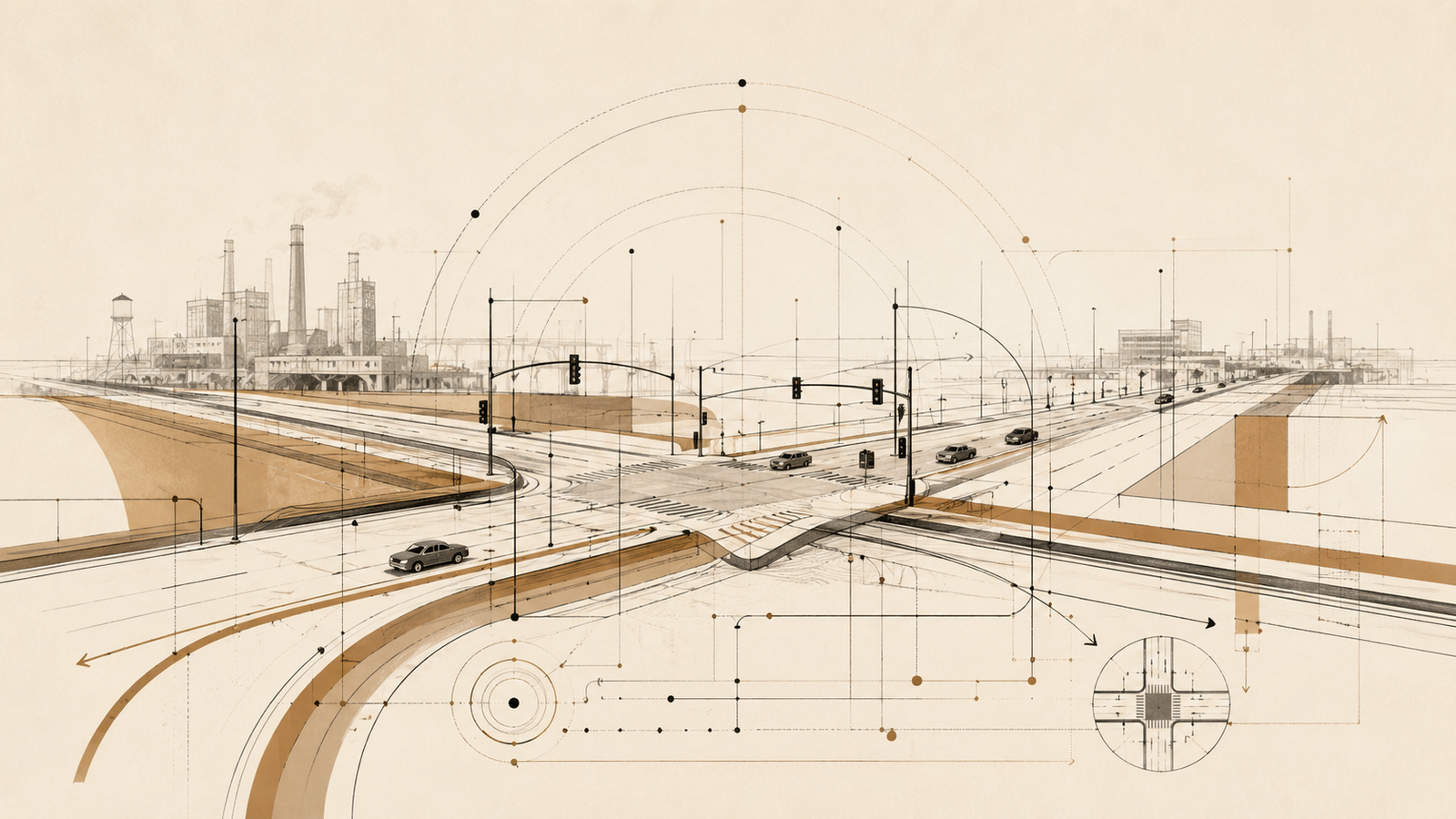
It entered streets already carrying pedestrians, bicycles, horse-drawn wagons, streetcars, delivery vehicles, and other forms of movement. As American cities expanded in the early twentieth century, intersections became places where older movement patterns and newer machines collided.
That created a coordination problem.
A busy intersection contains several competing claims on the same physical space. One direction wants to move. Another direction wants to cross. Pedestrians need time. Turning vehicles need clearance. Everyone cannot occupy the intersection simultaneously.
Once traffic volume increases, individual judgment stops being enough.
The system needs rules.
More precisely, it needs sequence.
Early traffic control included police officers, manual signs, and other signaling devices. Morgan did not invent the concept of controlling traffic. His contribution was more specific. He developed a three-position traffic signal that included an intermediate stage capable of stopping movement in all directions.
That third condition mattered because it acknowledged something binary systems often miss.
Transition itself carries risk.
Garrett Morgan Was a Pattern Reader Before He Was a Public-Safety Inventor
Morgan was born in Kentucky in 1877 and moved north while still young. He eventually settled in Cleveland, where his mechanical ability became central to his working life.
Sewing machines gave him an education that classrooms had not.
A machine makes failure visible. Something catches. Something overheats. A component falls out of alignment. Friction appears. Through repair work, Morgan developed the practical habit of tracing a visible problem back to its mechanical cause.
That habit later moved across industries.
While experimenting with a liquid intended to prevent sewing-machine needles from scorching fabric, Morgan discovered that the substance could alter hair texture. He reformulated the product and developed what became the G.A. Morgan Hair Refining Company.
The episode reveals something more important than entrepreneurial versatility.
Morgan noticed transferable mechanisms.
A solution developed in one operating environment could expose an opportunity in another. That kind of lateral thinking would become visible again when he approached smoke protection and traffic safety.
His inventions did not all solve the same problem.
His way of seeing problems was the common thread.
Commercial Independence Created Room to Keep Building
Morgan was not working inside a modern research laboratory with institutional financing waiting behind him.
He built businesses.
His garment operations and hair-care enterprise gave him commercial experience, income, manufacturing knowledge, marketing discipline, and a degree of independence uncommon for a Black inventor navigating the racial barriers of early twentieth-century America.
That environment matters to the history.
Inventing a useful device is only one stage of innovation. The inventor also has to patent it, manufacture it, demonstrate it, persuade buyers, protect the intellectual property, and survive long enough for the idea to reach the market.
Morgan had to do all of that while confronting customers and institutions that could judge the product differently once they knew its inventor was Black.
The United States Patent and Trademark Office documents how Morgan sometimes separated his identity from the marketing of his safety hood. A white salesman could serve as the public-facing representative while Morgan demonstrated the device under an assumed identity.
That is not a side note.
It shows that innovation occurs inside markets, institutions, and power structures. A device may be technically sound while the pathway to adoption remains socially distorted.
Morgan learned to engineer both.
He built the product.
Then he built a route around the barrier.
The Traffic Signal Changed the Transition
On November 20, 1923, Morgan received U.S. Patent No. 1,475,024 for a traffic signal.
The device used movable arms to control traffic and included an intermediate position in which traffic could be stopped in all directions.
That is the crucial point.
Morgan did not invent the first traffic signal. Traffic-control devices existed before his patent. His contribution was a specific improvement to the operating sequence.
Previous systems could treat traffic as a simple binary:
Morgan inserted another state into that logic:
The machine was not merely deciding who could move.
It was accounting for what remained in the intersection after movement had supposedly stopped.
That is a much more sophisticated understanding of system behavior.
Instructions can change instantly.
Physical reality does not.
A driver needs time to react. A vehicle needs distance to stop. A pedestrian may already be crossing. A carriage may still be clearing the intersection.
The transition requires margin.
Predictability Became Public Safety Infrastructure
The deeper significance of Morgan’s traffic signal is easier to see when the device is treated as a coordination system rather than an object.
Large populations cannot negotiate every movement individually.
The rules have to arrive before the people do.
That is what infrastructure accomplishes.
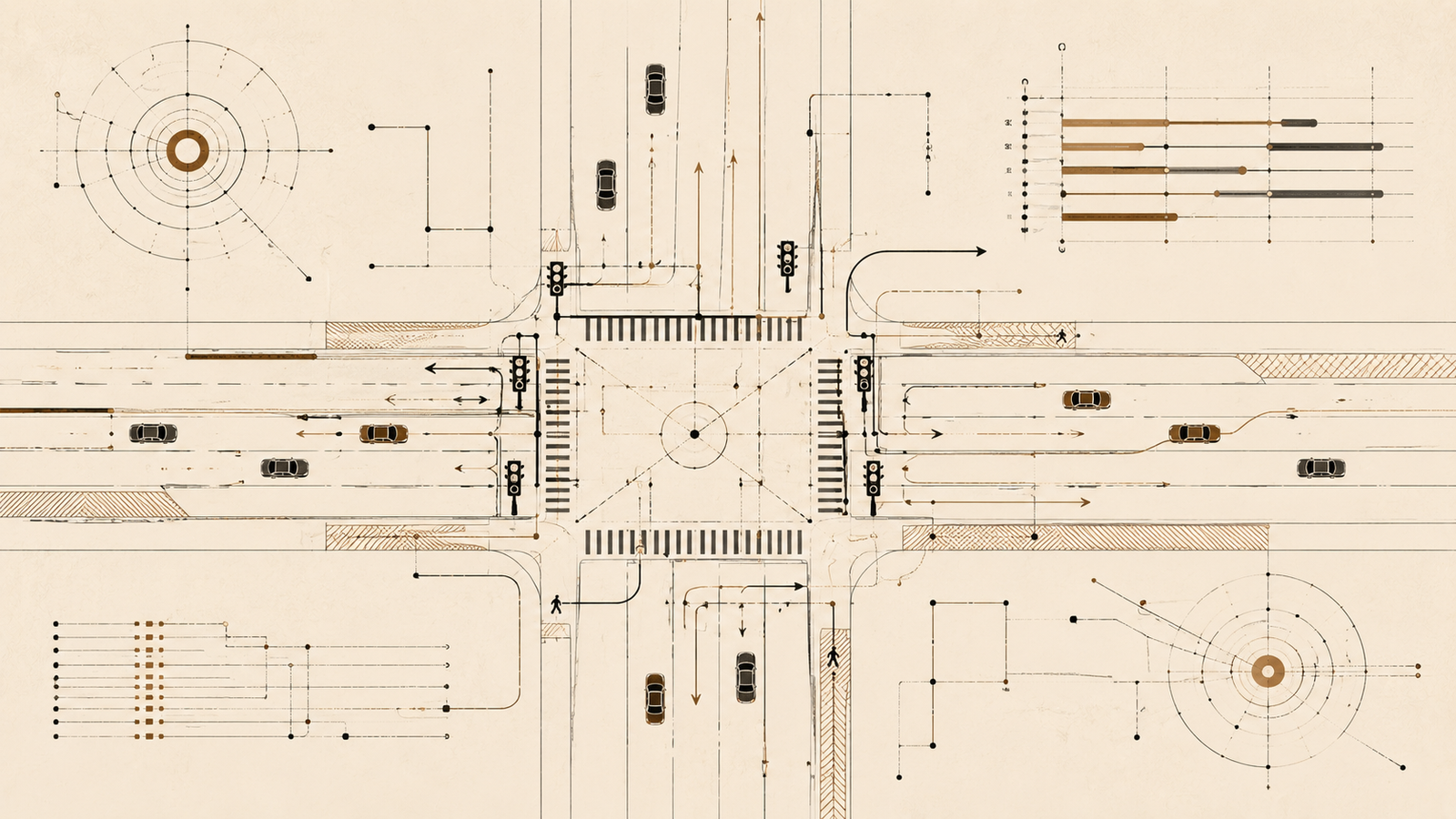
A functioning signal establishes expectations among strangers. Drivers trust that opposing traffic will be constrained. Pedestrians depend on protected intervals. Turning vehicles receive defined opportunities to move. The intersection becomes understandable because everyone is responding to the same sequence.
This is not merely traffic control.
It is distributed coordination.
Millions of people who do not know one another can move through the same urban system because the rules are externalized into infrastructure.
The individual no longer has to personally negotiate every crossing.
The system negotiates first.
The Safety Hood Solved the Environment, Not Just the Symptom
Morgan applied similar thinking to a very different danger.
Smoke.
In 1914, he received two patents related to a breathing device commonly associated with the Morgan Safety Hood and Smoke Protector.
The underlying idea was practical.
Hot smoke and harmful fumes tend to rise. Air closer to the floor can be comparatively cleaner. Morgan’s apparatus used a hood and an intake tube extending downward so the wearer could draw air from a lower level.
Again, the important move was structural.
Morgan did not begin with the assumption that the entire dangerous environment had to be neutralized.
He asked where survivable conditions still existed inside it.
Then he created a path to them.
The design gained national attention in July 1916 after an explosion and gas emergency during construction of a Cleveland waterworks tunnel beneath Lake Erie. Morgan and others entered the hazardous tunnel using the safety hood and participated in the rescue operation.
The episode turned engineering theory into operational proof.
The device mattered because it functioned where ordinary breathing did not.
Do not demand perfect behavior from people trapped inside a badly designed system.
Change the operating conditions so the safer behavior becomes easier, clearer, and more predictable.
When Structure Absorbs the Danger
Morgan’s work connects naturally to a larger Groundwork principle: Structure Is Mercy .
The principle is not sentimental.
It describes what good systems do.
They absorb preventable disorder before human beings have to absorb it themselves.
An intersection clearance phase absorbs some of the risk that would otherwise fall on drivers and pedestrians.
A breathing apparatus absorbs some of the environmental danger that would otherwise fall directly on the lungs.
Guardrails, evacuation routes, circuit breakers, pressure valves, building codes, fire doors, emergency lighting, and countless other safety systems follow related logic.
They do not eliminate every hazard.
They create margin between hazard and consequence.
Morgan’s legacy belongs inside that tradition.
Infrastructure Memory
Successful infrastructure has a strange relationship with memory.
The better it works, the easier it becomes to forget.
People rarely celebrate an intersection because opposing traffic stopped when expected. Nobody arrives home and announces that the traffic-control system performed correctly all afternoon.
Reliability disappears into normal life.
That is one reason inventors like Morgan can become smaller in public memory than the systems their work helped advance.
Once a useful idea becomes standardized, society stops experiencing it as an invention.
It becomes expectation.
Architects of Modern Life calls this infrastructure memory: a society continuing to use the logic of an innovation even after most people no longer know where that logic entered the system.
The purpose of an archive like this is not to claim that every modern traffic technology descends directly from a single Morgan device.
That would turn history into mythology.
The stronger point is that Morgan’s work belongs to the lineage of engineering ideas that made controlled transitions, intersection clearance, and predictable public movement central to traffic safety.
That contribution is substantial enough without exaggeration.
The Modern Echo
Today’s transportation systems would be unrecognizable to a driver from Morgan’s era.
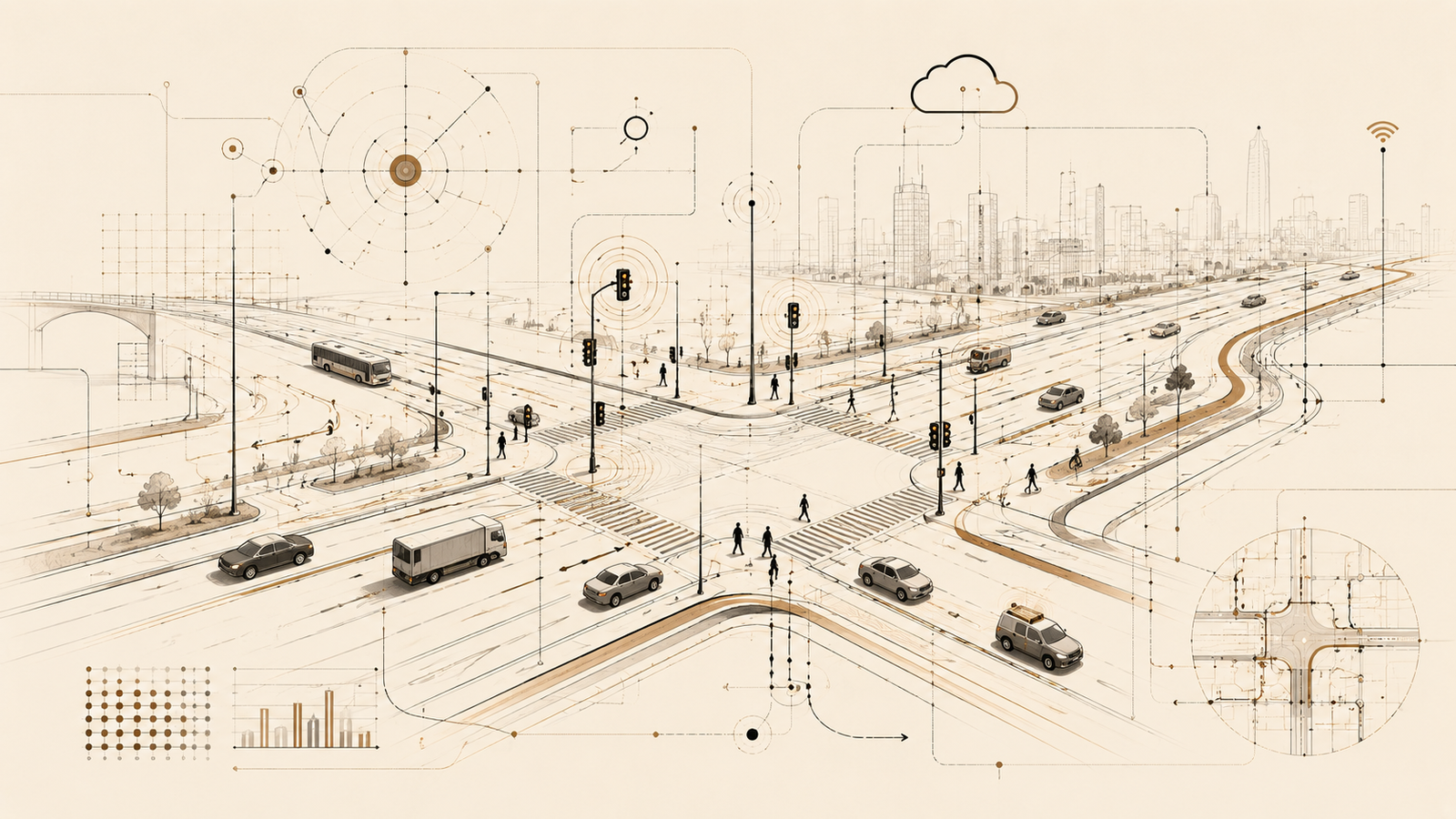
Signals can be coordinated across entire corridors. Sensors can measure traffic volume. Pedestrian phases can change based on demand. Transit vehicles may receive priority. Emergency vehicles can interact with signal systems. Adaptive controls can alter timing as conditions shift.
The technology changed.
The underlying problem did not.
Different users still compete for limited space.
Movement still has to be sequenced.
Intersections still require clearance.
Human reaction time still matters.
Safety still depends on making transitions legible before competing movements collide.
That is Morgan’s modern echo.
Not a claim that one 1923 patent mechanically produced every traffic technology that followed.
Something more durable.
An engineering principle that still makes sense.
What Garrett Morgan Actually Built
Historical recognition becomes weaker when praise outruns evidence.
Morgan does not need that treatment.
He did not invent traffic itself. He did not create the first traffic-control device. His safety hood was not a modern self-contained breathing apparatus. Every contemporary signal system does not descend directly from his patent.
None of those qualifications diminish him.
They sharpen the achievement.
Morgan developed practical safety technologies that addressed real operating failures. He patented them. He commercialized them. He demonstrated them publicly. He navigated racial barriers that affected how his products could be sold. In the case of the safety hood, he personally entered a dangerous rescue environment in which the device was put to use.
His traffic signal added a valuable intermediate condition to traffic-control logic.
His breathing apparatus used the physical behavior of smoke and air to improve the wearer’s chance of reaching breathable air.
These are not trivia facts.
They are examples of applied systems thinking.
Morgan’s lasting contribution was not simply teaching machines when to stop. It was recognizing that people become safer when systems give them enough structure, space, and time to transition.
Frequently Asked Questions About Garrett Morgan
Did Garrett Morgan invent the traffic light?
No. Traffic-control signals existed before Morgan’s invention. Morgan patented an important three-position traffic signal in 1923 that included an intermediate all-directional stop condition. His contribution should be understood as an improvement to traffic-control sequencing rather than the invention of traffic signaling itself.
What was different about Garrett Morgan’s traffic signal?
Morgan’s design included a third position between ordinary movement states. That position could stop traffic in all directions, giving the intersection time to clear before another stream of traffic proceeded.
What was the Garrett Morgan Safety Hood?
The Morgan Safety Hood and Smoke Protector was an early breathing apparatus. Its design used a hood and low-hanging air intake so the wearer could draw comparatively cleaner air from closer to the floor in smoke-filled environments.
Did Garrett Morgan use his safety hood in a real rescue?
Yes. In July 1916, Morgan and others used the safety hood during rescue efforts following a deadly gas and explosion emergency in a Cleveland waterworks tunnel beneath Lake Erie.
Why does Garrett Morgan matter to modern infrastructure?
Morgan’s importance lies in the way he approached dangerous operating environments. His inventions added structure where uncoordinated movement, smoke, limited reaction time, or environmental conditions created risk. That systems logic remains central to modern safety engineering.
Continue Building
Morgan’s story belongs to a larger architecture of innovators whose work became embedded in modern life.
→ Archive: Architects of Modern Life
→ Core Principle: Structure Is Mercy
→ Foundation: Structure Builds Freedom
Receipts
→ U.S. Patent and Trademark Office: Garrett Morgan, Of Courage and Caution
→ National Park Service: Garrett Morgan, An Uncommon Inventor
We remember the invention because it solved a problem.
We remember the architect because he saw the system underneath it.