
Bus stops are usually treated as places to wait. That is too small.
A bus stop is public infrastructure. It connects people to work, school, healthcare, grocery stores, libraries, parks, services, and local businesses. It sits at the point where the pedestrian city meets the transit city.
As part of Urban Logic, this article studies bus stops as one of the everyday systems people use but rarely examine. A transit route can look strong on paper. However, if the stop is unsafe, exposed, confusing, or inaccessible, the system fails at the curb.
That failure is not minor.
The stop is where the trip begins. People wait there in heat, rain, snow, darkness, and uncertainty. Parents stand there with children. Workers begin early mornings there. Older adults measure distance, time, and safety there. Public transit becomes real at the stop.
A bus stop is not just a marker beside the road.
It is a civic threshold.
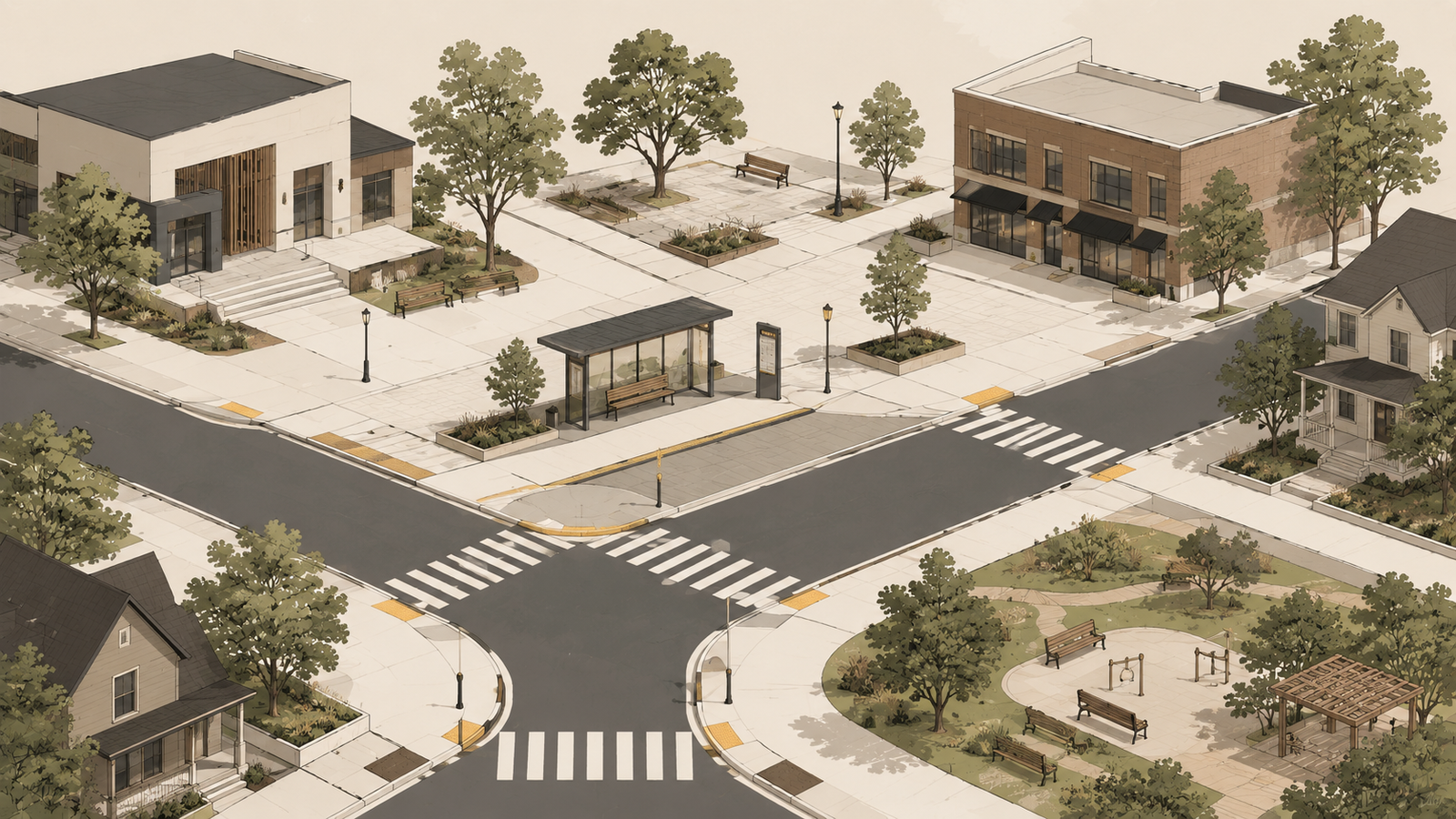
Bus Stops Are More Than Waiting Areas
A weak bus stop says the rider can wait anywhere.
Beside traffic. Under direct sun. In the rain. Near a dark corner. Without seating. Without clear information. Without a safe crossing nearby. Without a sidewalk that actually reaches the stop.
That is not infrastructure.
It is neglect with a signpost.
A strong bus stop does something different. It organizes the space around waiting. It gives the rider a clear place to stand. It connects to sidewalks. It aligns with crosswalks. It provides visibility. When possible, it offers shelter. It supports accessible boarding. It also gives people information about the route.
Most importantly, a strong stop treats the rider as part of the public system, not an afterthought.
This distinction matters because public transit is not only a vehicle network. It is also a ground-level experience. Riders do not teleport onto buses. They walk. They wait. They cross. They stand. They navigate. Then they board.
If the city ignores that full sequence, the route may exist, but the system remains incomplete.
Visit one bus stop you know. Notice the walk to reach it, the nearest crossing, the shade, the seating, the lighting, and the information available. The stop will tell you whether the city respects waiting.
Public Transit Starts Before the Bus Arrives
Public transit starts before the bus arrives.
It starts with the walk to the stop. It starts with the sidewalk condition. It starts with whether the crossing feels safe. It starts with whether the rider can see the stop from a distance. It starts with whether the stop is lit, marked, and reachable.
Too often, transit is discussed as route maps, schedules, fleet size, and service frequency. Those issues matter. Yet they do not carry the whole experience.
The rider experiences transit as a chain.
First, the rider must reach the stop. Then the rider must wait. After that, the rider must board. Finally, the rider must connect to the next destination. If any link is weak, the whole trip becomes harder.
This is why bus stops deserve more attention. They are small parts of the system, but they hold large consequences. A poorly placed stop can make a short trip feel difficult. A stop without shade can make summer waiting punishing. Meanwhile, a stop without seating can exclude people who cannot stand comfortably. A stop without safe crossings can turn transit access into a risk.
Service does not begin when the vehicle doors open.
Service begins when the city asks someone to wait.
Bus Stops Are Transit Infrastructure
Transit infrastructure is not only rails, depots, buses, signals, and maintenance yards.
It is also the curb.
A bus stop is where infrastructure becomes human-scale. It is the fixed point that tells riders where the system will meet them. Because of that, the stop needs design, care, and maintenance.
At minimum, a functional bus stop needs clear signage, safe access, and a visible boarding location. Better stops include shelters, benches, lighting, route information, trash receptacles, real-time arrival displays, and protection from traffic where possible.
However, the strongest stops go beyond amenities. They are integrated into the surrounding street network. Sidewalks lead into them. Crosswalks support them. Curb ramps make them accessible. Street trees provide shade. Nearby buildings and public spaces create natural visibility.
Clear navigation belongs in that system too. As explained in Wayfinding Is Public Infrastructure, signs, maps, landmarks, and route information help people understand where they are and where they can go next. A bus stop without clear wayfinding asks riders to solve the system before they can use it.
That integration is the point.
A bus stop should not feel like leftover space beside a road. It should feel like a planned connection inside the neighborhood.
When bus stops are treated as transit infrastructure, cities plan them with the same seriousness given to other public assets. They inspect them. They maintain them. They improve them. They measure their performance. Above all, they understand that waiting is part of mobility.
Weak systems treat the stop as cheap.
Strong systems treat it as a node.
Accessibility Begins at the Curb
Accessibility is not optional.
A bus stop that cannot be used by disabled riders is not a complete bus stop. A stop without an accessible path, level boarding area, curb ramp, or usable waiting zone creates a barrier before the bus even arrives.
That barrier is practical, not theoretical.
A wheelchair user needs a stable surface. A person using a cane needs clear space. A rider with low vision needs legible cues. An older adult may need seating. A parent with a stroller needs room to maneuver. A person recovering from injury may need a shorter, safer route to the stop.
Designing for accessibility makes the system stronger for everyone.
This is one of the basic laws of good infrastructure. When the design serves people with less margin, it usually improves the experience for the wider public. Clear paths help everyone. Better lighting helps everyone. Seating helps more people than planners admit. Reliable information reduces stress for all riders.
Wayfinding is also accessibility. A sign that is easy to see, a route map that is current, and a clear marker for boarding can reduce uncertainty for riders who do not have time, energy, language fluency, or digital access to guess their way through the system.
Bad accessibility is not just inconvenient. It can shrink a person’s city.
If a stop is technically nearby but practically unusable, the rider has lost access. The map may show connection. The body experiences exclusion.
That gap is where infrastructure has to be judged.
Shelter Is Not Decoration
A bus shelter is not a luxury feature.
That idea needs to be retired.
Shelter protects people from sun, rain, wind, and snow. It makes waiting more tolerable. It can reduce heat exposure. It gives riders a defined place to stand or sit. It also signals that the stop matters.
Of course, every stop may not be able to support the same level of shelter. Space, visibility, maintenance, and ridership all matter. Even so, the principle holds. Where riders wait in high numbers, harsh weather, or difficult conditions, shelter becomes a basic infrastructure question.
Shade matters. Seating matters. Lighting matters. Cleanliness matters. Route information matters.
These details are not soft.
They shape whether public transit feels reliable, dignified, and usable. They also shape who can use it comfortably. A young, healthy rider may stand in the sun for twenty minutes and recover. An older adult may not. A worker coming off a long shift may experience the same wait differently. A parent with children may feel exposed in ways a solo rider does not.
Good infrastructure does not pretend every rider has the same capacity.
It designs for the actual public.
Bus Stops Support the Neighborhood Economy
Bus stops support local economies because they bring people to ground level.
A stop near a commercial corridor can increase foot traffic. It can make small businesses more reachable. It can connect workers to jobs and customers to services. It can also support errands that do not require a car.
However, this only works when the stop is well placed and well connected.
A stop surrounded by hostile crossings, poor sidewalks, and no shade does less for local commerce than it should. People may still use it, but they will move through the area quickly. They may avoid lingering. They may not cross to reach nearby stores. They may treat the stop as something to endure rather than a connector within the neighborhood.
By contrast, a well-designed stop can strengthen the street around it. It can support nearby cafés, pharmacies, markets, libraries, clinics, barbershops, and public spaces. It can make short trips easier and help businesses benefit from regular movement.
This is why transit planning and economic development should talk to each other more often.
Wayfinding strengthens that economic link. Riders should be able to leave a bus and understand where the library, clinic, store entrance, park path, bike lane, or public square sits. If the stop delivers people to confusion, it weakens the value of the district around it.
Bus stops are not only mobility assets. They are neighborhood assets.
They help determine whether people can reach opportunity without needing a private vehicle. That has economic meaning. It has household meaning. It has civic meaning.
Safety and Visibility Shape the Stop
A bus stop must feel visible enough to be usable.
Visibility does not mean surveillance as spectacle. It means basic public legibility. Riders should be able to see the stop. Drivers should be able to see riders. People nearby should understand that the stop is active public space.
Darkness, isolation, broken lighting, unclear markings, and poor placement make stops feel more vulnerable. As a result, riders may avoid certain stops. They may choose longer routes. They may pay for more expensive transportation. They may reduce trips altogether.
Safety is not only about crime. It is also about traffic speed, turning vehicles, sidewalk gaps, poor drainage, blocked sightlines, and confusing street geometry.
A stop placed near a dangerous crossing forces riders into risk. A stop without a sidewalk may push riders into the street. Meanwhile, a stop near fast-moving traffic without a buffer can make waiting feel exposed.
That is not a rider problem.
It is a design problem.
Cities should judge bus stops from the position of the person waiting there. Can the rider stand safely? Can the rider board without conflict? Can the rider cross the street after exiting? Can the rider find the stop at night? Can the rider understand the route?
If the answer is no, the stop is not doing its job.
Unequal Bus Stops Create Unequal Mobility
Not all bus stops are treated equally.
Some neighborhoods get shelters, seating, lighting, real-time information, maintained sidewalks, and safe crossings. Other neighborhoods get a pole in the ground.
That difference is not cosmetic.
It creates unequal mobility.
The people most dependent on transit often receive the least comfortable transit environment. That is a structural failure. Riders who depend on buses for work, school, care, and daily errands should not be asked to absorb the highest burden at the point of waiting.
This is where the city shows its priorities.
Transit equity is not only about where the route goes. It is also about the quality of access along the route. A bus line may serve a neighborhood, but if the stops are unsafe, exposed, inaccessible, or poorly maintained, the service is incomplete.
Equity lives in the details.
Who gets shade? Who gets seating? Who gets a safe crossing? Who gets lighting? Who gets reliable information? Who gets maintenance after storms? Who gets wayfinding that makes the system readable? Who gets a stop that looks like it belongs to the public?
Those questions are not symbolic. They determine how much friction people carry before the bus even arrives.
Bus Stops Connect the Urban Logic Series
Bus stops sit at the intersection of several Urban Logic themes.
They depend on sidewalks because riders need a safe path to reach them. They depend on crosswalks because riders often need to cross before or after boarding. They benefit from street trees because shade changes the waiting experience. They also depend on street lighting because many riders travel before sunrise or after sunset.
In addition, bus stops connect to third places because transit makes libraries, parks, plazas, cafés, and community spaces reachable. They can also reduce the hidden cost of travel when the system works well.
Wayfinding belongs in the same network. A rider needs to know which direction the bus travels, which route serves the stop, how far the next destination is, where the nearest crosswalk sits, and how to continue after exiting. Without that information, the stop becomes less useful than the route map claims.
That is why bus stops are not isolated objects. They are part of a larger urban network. When that network is aligned, the city becomes easier to use. When the network breaks, the rider feels every gap.
A good bus stop does not solve every transit problem. It cannot fix poor frequency, unreliable service, weak regional planning, or underfunded operations by itself.
Still, a bad bus stop can make every transit problem worse.
It adds discomfort to delay. It adds risk to uncertainty. It adds exposure to waiting. It adds confusion to movement.
That is the blunt truth.
The curb is not secondary. The curb is where the promise of transit meets the public.
Better Bus Stops Require Governance
Better bus stops do not appear because everyone agrees they would be nice.
They require governance.
Someone has to decide which stops get upgraded first. Someone has to inspect conditions. Someone has to coordinate transit agencies, transportation departments, public works teams, disability advocates, local businesses, and residents. Someone has to maintain shelters, benches, lighting, signs, sidewalks, and curb areas.
Without governance, bus stops drift.
One agency controls the route. Another controls the sidewalk. Another controls the road. Another handles shelters. Another handles sanitation. Another handles lighting. Everyone owns a piece, and no one owns the rider’s full experience.
That fragmentation is common. It is also costly.
A rider does not experience agencies separately. The rider experiences one trip. If the bus comes on time but the stop is unusable, the system still failed. If the shelter exists but the sidewalk is broken, the system still failed. If the route is strong but the crossing is dangerous, the system still failed.
Governance is how cities close those gaps.
Good transit stop planning needs standards, inventories, maintenance cycles, equity criteria, accessibility audits, wayfinding updates, and public feedback. Otherwise, upgrades become uneven and reactive.
Infrastructure without governance becomes a wish list.
Read Your City
Choose one bus stop you pass often. Ask whether it works for a child, an older adult, a disabled rider, a night-shift worker, and someone carrying groceries. If the answer changes by person, the stop is revealing its design limits.
Reading a bus stop means looking beyond the sign.
Does the sidewalk actually reach it? Is there a safe crossing nearby? Can someone sit? Is there shade? Is there lighting? Does water pool near the curb? Can a wheelchair user board without a struggle? Does the stop feel visible, or does it feel abandoned?
Then check the information layer. Is the route clear? Does the stop show direction? Can a visitor understand where the bus goes? Can a rider find the next transfer, crosswalk, sidewalk, or destination without guessing?
These questions expose the full system.
A bus stop may look small, but it holds the whole transit promise in one place. It tells riders whether the city has planned for their bodies, schedules, weather exposure, safety, navigation, and dignity.
That is why the stop matters.
The Groundwork Principle
Bus stops are public infrastructure because they connect private lives to public systems.
They make jobs reachable. They make schools reachable. They make healthcare reachable. They make local businesses reachable. They make parks, libraries, civic buildings, and public squares part of everyday life.
But they only do that work well when they are designed with seriousness.
A bus stop should not punish the rider for needing transit. It should not ask people to wait in unsafe conditions, stand without support, guess at route information, or navigate broken sidewalks and dangerous crossings.
Urban Logic asks readers to see what the city makes ordinary. Bus stops are ordinary because they are everywhere. That does not make them minor. It makes them essential.
The lesson is simple.
A city that values transit must value the place where transit begins.
Bus stops are not just places to wait. They are the front door to public mobility.
Keep Seeing the Systems Around You
Most people move through cities without noticing the systems shaping their choices. Urban Logic helps you read the built environment differently, from bus stops and sidewalks to crosswalks, street trees, wayfinding, public space, and transit networks.
Subscribe to the Groundwork Daily newsletter for weekly essays that reveal the hidden systems behind modern life and help you navigate them with greater clarity, capability, and intention.
→ Urban Logic: Understanding the Hidden Systems That Shape Cities
→ The Hidden Cost of Long Commutes
→ Sidewalks Are Economic Infrastructure
→ Crosswalks Are Civic Infrastructure
→ Wayfinding Is Public Infrastructure
→ Street Trees Are Public Infrastructure
→ Street Lighting Is Public Infrastructure
Receipts:
→ Federal Transit Administration
→ American Public Transportation Association
→ National Association of City Transportation Officials
→ National Complete Streets Coalition