
Article Guide

Real Talk Blueprint · Media Authority, Trust & Digital Behavior
Real Talk Blueprint examines what happens when the people who report information, the people who explain it, and the systems that distribute it no longer occupy the same institution.
The new gatekeeper is not one person. Modern information authority is distributed across source, verification, interpretation, personality, distribution, trust, and the ongoing relationship between messenger and audience.
Social media news influencers are changing how people encounter, understand, and decide whether to trust the news. The old gatekeeper did not disappear when publishing became easier. Instead, the work that once lived largely inside media institutions was split among journalists, creators, experts, platforms, recommendation systems, and audiences.
That change brought real gains. Communities that had been ignored, misrepresented, or treated as permanent guests inside traditional media gained more ways to document their own experiences. Specialists can speak directly to the public. Journalists can build independent audiences. Someone with useful information no longer needs a television producer, newspaper editor, radio station, or publishing company to grant permission before speaking.
However, fewer old gates did not produce a world without gatekeepers. New forms of authority grew around distribution, attention, familiarity, and trust. The person explaining a story may not be the person who reported it, while the system deciding whether you see that explanation may not have produced any information at all.
That is why the useful question is no longer simply, “Is this person a journalist?” The better question is, “What job am I trusting this person to do?”

Why Social Media News Influencers Matter Now
The direct answer is scale. According to Pew Research Center’s News Influencers Fact Sheet, a meaningful share of U.S. adults regularly get news from news influencers on social media. The share is even larger among younger adults.
More importantly, audiences are not using these voices only for entertainment. People also turn to them for breaking developments, explanation, context, and information they believe differs from what other sources provide. That gives social media news influencers a role that can overlap with functions traditionally associated with journalism.
Overlap does not mean equivalence. A creator may explain a court case brilliantly without doing the original reporting. A journalist may produce excellent reporting while somebody else becomes far more effective at explaining why that reporting matters. Meanwhile, a subject expert may offer insight neither person possesses.
Once those jobs separate, the audience has to become more precise about what kind of authority each person has actually earned.
What Counts as a News Influencer?
The category itself deserves some discipline. A large audience does not automatically make somebody a reporter, and posting about current events does not automatically make someone a journalist.
Pew’s research focuses on prominent individuals who regularly post about news, current events, politics, or civic issues. That group can include journalists, former journalists, commentators, creators, experts, and independent media personalities.
So the phrase describes a role in the information ecosystem, not one professional credential.
How Social Media News Influencers Unbundle Media Authority
The traditional newsroom bundled several jobs under one institutional roof. A reporter gathered information. Editors reviewed it. Other staff might fact-check, verify documents, assess legal risk, shape headlines, and decide how prominently the story should appear.
That system was never perfect. News organizations have missed stories, excluded communities, repeated stereotypes, followed bad incentives, and made serious factual errors. Institutional prestige does not erase institutional failure.
Still, the structure kept several information functions visibly connected. Digital media separated them.
Today, one person may find the source, another verifies it, a third interprets it, a creator packages it for an audience, and a platform decides whether millions of people get another opportunity to encounter it. The audience then decides what to trust, share, challenge, save, or ignore.
The result is more open, but it is also more complicated.
Reporting Authority Is Not Interpretive Authority
Someone who produced original reporting has authority over what they directly discovered, documented, or verified. That does not automatically mean they are the best person to explain every larger implication of the story.
Likewise, a creator can be excellent at interpretation without having performed the reporting underneath it. The problem begins only when audiences stop seeing the distinction.
A summary becomes detached from its source. The explanation becomes more memorable than the evidence. Soon everyone remembers the messenger, while the reporting that made the explanation possible disappears from view.
Distribution Authority Is Different Again
Another layer decides whether the information reaches anybody at all.
Publishers once controlled scarce distribution through printing presses, broadcast channels, and physical circulation. Today, platforms, search engines, recommendation systems, follower networks, newsletters, sharing patterns, and audience behavior all participate in distribution.
That means the person with the loudest reach is not necessarily the person with the strongest evidence.
The Information Authority Stack
The word gatekeeper becomes less useful if we imagine one person holding one gate. The stronger model is a stack in which different actors can control different parts of the information process.
The Information Authority Stack separates those jobs so readers can see where authority actually enters the chain.
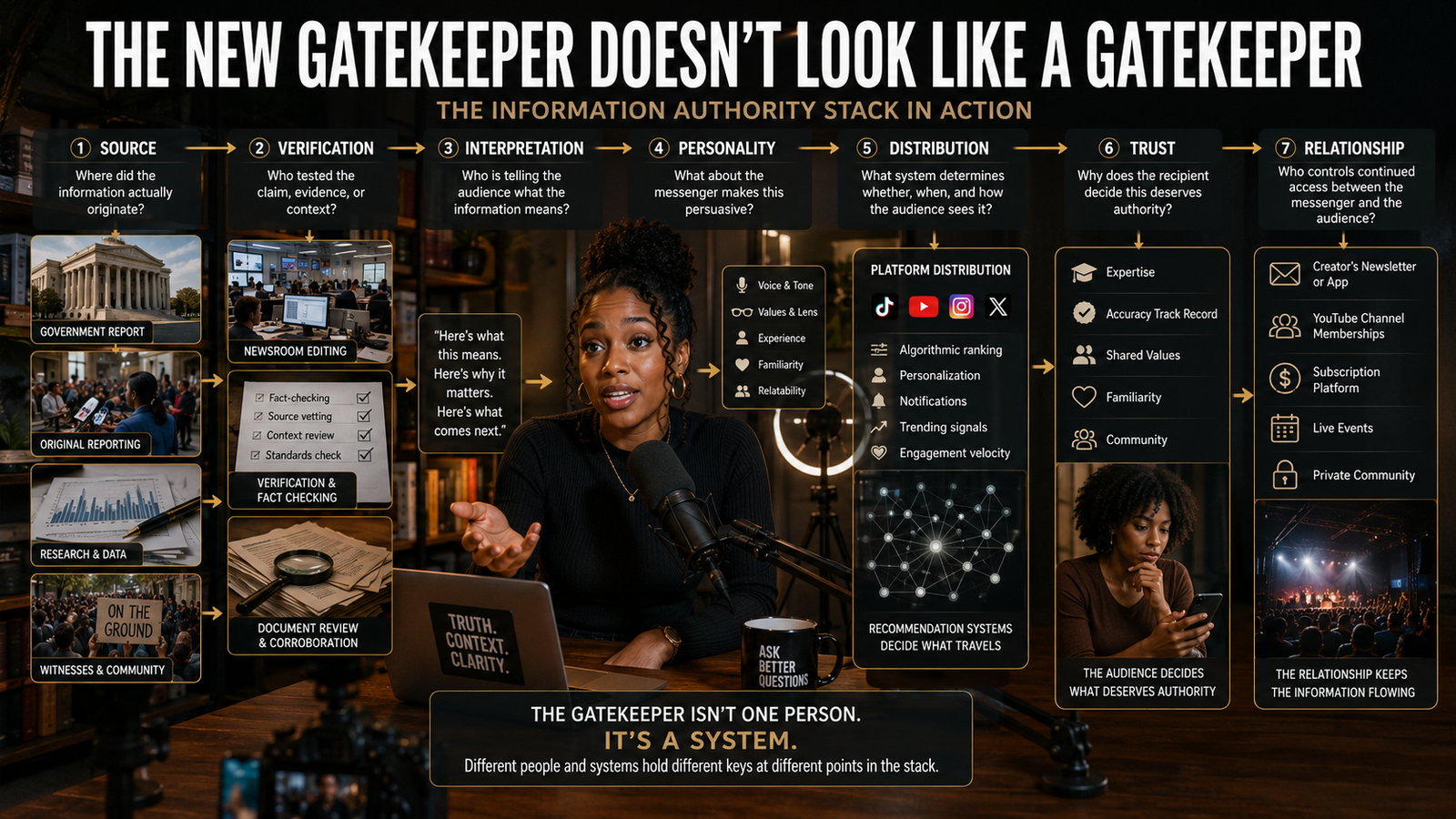
Source and Verification
Start with origin. Where did the underlying information actually come from? It might be a court filing, public record, scientific paper, firsthand interview, original reporting, video evidence, government release, or another identifiable source.
Next comes verification. Who checked whether the information is authentic, complete, current, and represented accurately? A claim can originate somewhere real and still be misread, stripped of context, or repeated after circumstances have changed.
Source tells you where the information began. Verification tells you what happened before somebody asked you to believe it.
Interpretation and Personality
Most readers do not have the time or expertise to personally analyze every legal filing, research paper, financial report, transcript, or policy document entering public debate. Interpretation therefore performs a legitimate job.
A strong interpreter identifies what matters, explains complexity, and distinguishes evidence from inference. Personality then shapes how that explanation feels. Humor, familiarity, confidence, cultural fluency, tone, and communication style can make difficult information more accessible.
Those qualities can improve communication. They still cannot verify the claim by themselves.
Distribution, Trust, and Relationship
Distribution asks why a particular message reached you. Perhaps you follow the creator, a friend shared the post, you searched for the subject, or a recommendation system predicted that the content would interest you.
Trust asks a different question: why do you believe the messenger? The answer may involve expertise, evidence, a track record, institutional reputation, familiarity, shared identity, political agreement, or simply repeated exposure.
Finally, relationship measures continuity. Who controls whether that messenger can reach you again? The creator may own the work while a platform still controls much of the road to the audience.
Authority should follow the function.
Source tells you where information began.
Verification tests the claim.
Interpretation explains what it means.
Distribution determines whether it reaches you.
Trust determines what authority you give it.
Why Social Media News Influencers Can Feel More Trustworthy
Authenticity has become a real source of media authority because many audiences find direct communication easier to trust than institutional language.
A creator can speak plainly, show uncertainty, answer questions, respond quickly, and explain why something matters in language that feels human. By comparison, institutional communication can sometimes sound so carefully managed that every sentence appears to have survived a committee meeting.
That difference matters. Yet authenticity should not be asked to prove more than it can.
A person can be completely sincere and completely wrong. Someone can also sound detached and institutional while presenting accurate reporting. Tone tells us something about communication style. It does not settle the evidence.
Familiarity Can Quietly Become Credibility
Repeated exposure adds another layer. When someone appears in your feed every day, you begin to know their rhythms. You understand their humor, worldview, priorities, and likely reaction to a developing story.
Over time, that familiarity can become legitimate trust if the person consistently shows reliable methods. However, familiarity can also become a shortcut. “I have followed them for years” begins doing work that should sometimes belong to “I checked where this claim came from.”
Those are different forms of evidence.
Independent Does Not Automatically Mean More Reliable
Independent creators can offer enormous value. They may cover ignored subjects, specialize more deeply than general newsrooms, challenge institutional assumptions, or serve communities that traditional media has not served well.
At the same time, independence may mean working without editors, formal correction procedures, legal review, or institutional verification systems. Some creators build rigorous processes on their own. Others do not.
Likewise, institutional affiliation does not guarantee accuracy. The cleaner standard is method, not branding.
Platforms Influence Which News Influencers Reach You
The distribution layer deserves its own scrutiny because many people do not intentionally choose every piece of news they encounter.
Pew’s research has found that many people who get news from news influencers often encounter that information while doing something else rather than deliberately searching for it. In other words, discovery itself can be partially incidental.
This matters because repeated exposure can make a subject feel more important, common, or urgent before the reader has evaluated the underlying evidence. A recommendation system does not have to dictate belief to influence the information environment.
Recommendation Is Not Mind Control
The correction should stay proportional. Platforms do not install beliefs directly into users. People bring existing values, relationships, interests, political identities, habits, and information networks to the feed.
Users also make choices. They follow accounts, search topics, join communities, share stories, mute creators, leave platforms, subscribe to newsletters, and seek additional sources.
Therefore, distribution power matters without explaining everything.
The Audience Trains Part of the Environment Too
Audiences are not passive in this system. We click, share, comment, replay, search, follow, argue, save, subscribe, and send links to people who were trying to enjoy lunch.
Those actions become part of the distribution environment. As a result, the information system reflects not only what platforms prioritize but also what people repeatedly reward with attention.
That makes audience behavior part of the gate.
What We Lose When Popularity Gets Confused With Authority
The most obvious cost is weak judgment.
Followers measure following. Views measure viewing. Shares measure distribution. Comments measure interaction. Virality can tell us that something has captured attention quickly.
None of those metrics independently measures truth.
Yet digital interfaces place those numbers right beside the message. A claim surrounded by millions of views can acquire the visual appearance of importance before the reader evaluates whether the claim deserves it.
Confidence Can Outrun Evidence
Short-form media also rewards compression. Complicated stories get reduced to a clean explanation because clean explanations travel well.
Sometimes that is excellent communication. Other times, uncertainty, context, competing evidence, and legitimate disagreement get removed because they make the story harder to package.
The audience receives greater confidence precisely because some of the complexity disappeared.
Original Reporting Can Become Invisible
Another cost appears when audiences remember the interpreter but forget the source.
A creator may spend five minutes explaining a six-month investigation conducted by reporters elsewhere. If the explanation travels farther than the reporting, the creator may become the authority figure in the audience’s mind.
There is nothing inherently wrong with translation. The problem is losing track of who performed which work.
Credit matters because information systems depend on people continuing to produce the evidence everyone else later interprets.
Groundwork Principle
Stillness Is Strategy
Fast information environments create pressure to decide before the information chain becomes visible. A headline arrives, an interpretation follows, reactions multiply, and hesitation begins to feel like being uninformed.
Stillness creates a small amount of decision space. Sometimes ten additional minutes reveal the original document. Sometimes a fuller clip changes the interpretation. Sometimes a developing story simply needs more reporting before confidence is warranted.
This does not mean ignoring urgent information. Instead, it means matching the speed of your conclusion to the quality of the evidence available.
What it means here: Do not let the speed of distribution decide the speed of belief.
How to Evaluate Social Media News Influencers Before Trusting the Claim
You do not need to conduct a forensic investigation every time someone explains a headline. The level of scrutiny should rise with the stakes.
A celebrity rumor and a claim about your health, money, legal rights, public safety, or an election do not deserve the same verification burden. Proportion is part of discernment.
Start With the Original Source
Ask where the underlying information began. If somebody cites a study, identify the study when the claim matters. If the creator is discussing a court filing, government report, or newspaper investigation, move upstream when practical.
A screenshot of a headline is not the article. Commentary about a study is not the study. A clipped interview is not necessarily the entire exchange.
Identify the Job the Messenger Is Performing
Are they reporting original information, summarizing somebody else’s reporting, offering expert analysis, giving political commentary, aggregating developments, or reacting?
Those are all legitimate media functions. They simply require different evidence and different forms of trust.
Separate Evidence From Interpretation
Strong communicators make that distinction visible.
“The document says this” is different from “I think this means this.” Likewise, “officials confirmed this” differs from “this seems likely based on what we know.”
Language that preserves uncertainty is often evidence of stronger reasoning, not weaker confidence.
Watch the Correction Behavior
Everybody gets things wrong. The useful question is what happens next.
Does the person correct the record clearly? Do they update the original content when possible? Can they acknowledge what changed without pretending the original statement never happened?
A messenger’s response to error tells you something important about whether trust is attached to truth or attached to maintaining an image of being right.
Audit Why You Trust Them
Trust may come from expertise, evidence, institutional reputation, a strong track record, or transparent sourcing. It can also come from familiarity, shared identity, political agreement, cultural fluency, or the satisfying experience of hearing somebody articulate what you already believed.
Those sources of trust are not equivalent.
One of the best tests is simple: would you demand more evidence if the same claim came from someone you disliked?
If the answer is yes, your standard is probably attached to the messenger more than the claim.
The Better Standard Is Traceable Information Authority
We are not going back to an information environment where a small number of institutions control nearly every route to a mass audience. Nor should we.
More people can publish now. Experts can communicate directly. Independent journalists can build sustainable audiences. Communities can document their own experiences. Creators can translate complicated information for people traditional media never reached well.
The answer is not rebuilding the old gates.
The answer is becoming more precise about authority.
Sometimes the person explaining the story will not be the person who reported it. That is fine when the distinction remains visible. Sometimes an independent expert will know far more about the subject than a general reporter. Meanwhile, a professional newsroom may possess reporting resources, source networks, editors, legal support, and verification infrastructure that an individual creator cannot easily reproduce.
Those facts can coexist without forcing us to crown one side as the permanent winner.
The better standard is traceability. Can you identify the source, understand the verification, separate interpretation from evidence, recognize the distribution system, and explain why the messenger deserves the amount of trust you are giving them?
The Real Talk
Social media news influencers are not evidence that journalism is dead, and traditional journalism is not evidence that institutional authority still operates exactly as it once did.
The information system changed. More people can publish, explain, investigate, specialize, translate, and build direct relationships with audiences. That expanded access is valuable.
However, access to a microphone did not eliminate power. It redistributed it.
The person explaining the story may not have reported it. The reporter may not control distribution. The platform distributing the content may not know whether it is accurate. Meanwhile, the audience may be responding to the personality or interpretation more strongly than the underlying evidence.
Once those jobs separate, trust has to become more precise.
Do not ask only whether you trust the person. Ask what you trust them to do. Maybe they are excellent at discovering stories. Maybe they explain research well. Perhaps they have deep subject expertise. Maybe they have shown, repeatedly, that their reporting can be traced and corrected.
The new gatekeeper does not look like a gatekeeper because there is no longer one gate. Media literacy now means knowing which layer you are looking at, what authority that layer has actually earned, and where you need to look next before familiarity becomes belief.
Continue Building
Keep Going From Here
Follow the incentive underneath modern media and examine why human attention became one of the most valuable resources in digital distribution.
Algorithms and Cultural Polarization
Examine how recommendation systems interact with audience behavior, identity, repeated exposure, and the incentives shaping what continues to circulate.
The Economics Behind Viral Content
Continue into the distribution layer and the difference between information earning attention and information earning authority.
Keep examining the gap between public explanations, private incentives, attention, trust, and the behavior people actually reinforce.
Receipts
Evidence Behind the Framework
- Pew Research Center: News Influencers Fact Sheet . Survey findings on Americans who regularly get news from news influencers, why audiences use them, and how people encounter that content.
- Pew Research Center: America’s News Influencers . Research examining prominent individual accounts that regularly post about current events and civic issues across major social platforms.
- Pew Research Center: Internet & Technology . Research examining digital behavior, social platforms, technology use, and the broader online environment through which audiences encounter information.
- Reuters Institute Digital News Report . International research examining changes in digital news consumption, platform use, personalities, creators, trust, and audience behavior.
Evidence Note: These sources support narrower claims that social media news influencers are part of the contemporary news environment, that audiences use them for multiple news-related functions, and that digital platforms influence how people encounter information. They do not establish that independent creators are inherently more or less accurate than traditional journalists, prove that authenticity predicts truth, show that recommendation systems independently determine belief, or establish the Information Authority Stack as an academic model. The stack is a Real Talk Blueprint framework for separating the different forms of authority operating between a source and an audience.
Real Talk Blueprint
See the pattern before it becomes the habit.
Groundwork Daily examines relationships, culture, accountability, communication, and the behavior underneath the performance.


About the Builder
Rochelle “Ro” Hayes
Rochelle “Ro” Hayes is the Groundwork Daily builder behind Real Talk Blueprint, a series focused on culture, relationships, accountability, communication, and the behavior people often explain away before they examine it.
Ro works primarily inside Culture, Media & Leadership, with strong overlap into relationship systems, public behavior, gender expectations, attention incentives, and modern social performance.
Real talk creates structure where avoidance creates confusion.
Ro builds frameworks that make ordinary behavior harder to ignore. The work is direct, observational, and culturally grounded. Rather than performing outrage, it names the pattern, identifies the incentive, and asks what people are really protecting.
Real Talk Blueprint examines the gap between what people say they value and what their behavior actually reinforces.
Meet Rochelle “Ro” Hayes · Explore Real Talk Blueprint · Explore Culture, Media & Leadership