
Groundwork Framework · Foundation
An accountability framework is a structured way to keep standards real after pressure, mistakes, competing priorities, and ordinary human inconsistency enter the system.
Accountability is often treated as punishment. That definition is too small.
A strong accountability system does something more useful. It makes the standard visible, identifies meaningful deviation, assigns responsibility, creates a path for correction, and verifies whether the repair actually worked.
The Architecture
Standard → Evidence → Responsibility → Correction → Verification
Accountability is strongest when the system can explain what should have happened, what actually happened, who owns the response, what must change, and how the return will be confirmed.
Start With the Definition
What Is an Accountability Framework?
An accountability framework is a repeatable system for comparing behavior or performance with a defined standard, assigning responsibility for meaningful deviation, requiring correction, and confirming that the correction occurred.
That definition matters because accountability becomes unstable when it depends on mood, status, memory, or personal frustration.
If nobody knows the standard, correction feels arbitrary.
If responsibility is vague, everyone can agree that something went wrong while nobody owns what happens next.
If correction is never verified, a promise can be mistaken for a repair.
Therefore, accountability is not simply about identifying failure.
It is about creating a reliable architecture for returning to the standard.
Accountability Is Not a Personality Trait
People often describe someone as accountable or unaccountable. That can be useful shorthand, but it can also hide a systems problem.
A person may want to follow through while operating inside unclear expectations, conflicting authority, weak communication, or a process that never confirms completion.
Personal responsibility still matters. However, durable accountability asks a larger question:
What structure makes responsible behavior easier to define, observe, correct, and sustain?
Groundwork Architecture
The Principle and the Condition Do Different Work
Groundwork Daily uses the word accountability in two connected ways. They should not be collapsed into one idea.
Core Principle
Accountability Is a Form of Strength
The principle explains why correction is strength. Strong systems do not hide meaningful failure or protect comfort at the expense of the standard. They face the gap and do the work required to close it.
Groundwork Condition
Accountability
The Condition explains how correction operates. It compares reality with the standard, establishes ownership, defines the response, and confirms the return.
In practical terms, the Core Principle gives Groundwork its position.
The Condition gives the system its mechanism.
Supporting Architecture
Accountability Cannot Work Alone
Correction requires something to compare against. It also requires a structure capable of carrying the repair.
Accountability becomes arbitrary when nobody clearly defined what acceptable behavior, performance, or responsibility looked like beforehand.
Responsibility needs somewhere to live. Roles, authority, communication, and decision rights determine who can actually make the correction.
Once the standard and responsibility are clear, accountability identifies what moved and requires an appropriate response.
Some deviations affect more than performance. Trust, relationships, processes, safety, or resources may need restoration after the immediate correction.
The Four-Part Framework
Four Parts of an Accountability System That Holds
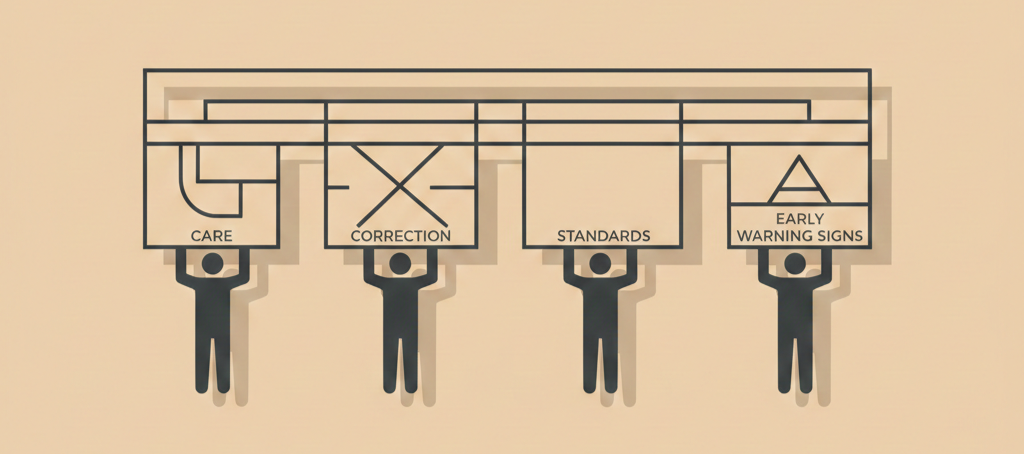
The Accountability Framework moves through four connected jobs.
Each post isolates one part of the system. Together, they explain how accountability can protect trust without becoming punishment, humiliation, surveillance, or empty promises.
Part 01 · Care
Accountability Is Care
Care is not only reassurance. It also means taking commitments seriously enough to notice when behavior no longer matches what was promised.
This opening piece establishes accountability as maintenance rather than accusation.
Structural job: make follow-through visible before inconsistency becomes normal.
Part 02 · Correction
Correction Without Shame
Correction becomes less useful when the conversation attacks identity instead of addressing behavior.
This piece separates what happened, what impact it created, and what standard needs to be restored.
Structural job: keep the correction specific enough that people can act on it.
Part 03 · Standards
Standards Create Safety
People cannot reliably protect an expectation that remains invisible.
Clear standards reduce guesswork. They also make accountability less personal because the conversation can return to an agreed threshold rather than one person’s changing preference.
Structural job: define the line before pressure tests it.
Part 04 · Warning Signs
When the Structure Starts to Crack
Accountability rarely disappears all at once.
More often, warning signs accumulate. Important conversations get delayed. Workarounds replace correction. Exceptions multiply. Responsibility becomes harder to locate.
Those patterns are not a new Condition. They are signals that the accountability system may no longer be doing its job.
Structural job: detect weakening before deviation becomes the accepted standard.
The Operating Mechanism
How the Accountability Loop Works
A strong accountability framework does not stop when someone admits that something went wrong.
Recognition is only the beginning.
Accountability Loop
Standard → Evidence → Ownership → Correction → Verification
1. Define the Standard
What behavior, outcome, responsibility, or threshold was supposed to be protected?
If that cannot be answered clearly, the system may have an expectation problem before it has an accountability problem.
2. Establish the Evidence
What actually happened?
Accountability should distinguish observable behavior from assumption, frustration, preference, or interpretation whenever possible.
3. Name the Owner
Who owns the next action?
Shared responsibility can be real. Even so, specific corrective work still needs a specific owner.
4. Define the Correction
What must change?
A vague promise to “do better” may express good intent. It does not yet describe a repair.
5. Verify the Return
How will anyone know that the correction worked?
Verification closes the loop. Without it, the system can confuse intention with completion.
Necessary Distinction
Accountability Without Blame Does Not Mean Accountability Without Standards
There is a false choice that weakens many accountability conversations.
One side assumes that high standards require humiliation, aggression, or fear.
The other side assumes that respect requires avoiding difficult correction.
Neither approach is structurally strong.
Accountability can be direct without becoming degrading.
A useful correction stays close to the behavior, the impact, the responsibility, and the required next step.
Correction Pattern
Behavior: What happened?
Impact: What did that behavior affect?
Standard: What was supposed to happen instead?
Next action: What correction now belongs to whom?
This keeps the conversation anchored to something more useful than character judgment.
Accountability Is Not Punishment
Consequences and Correction Solve Different Problems
Some situations require consequences. Serious misconduct, repeated refusal to correct behavior, safety violations, abuse, fraud, or major breaches of responsibility may justify formal action.
Still, consequences alone do not prove that the underlying system has been repaired.
Consequence
What follows the violation?
Consequences address what happens because the standard was crossed.
Correction
What restores the system?
Correction addresses what must change so the same failure is less likely to continue or repeat.
A system can punish someone and still remain structurally weak.
Practical Tool
The Groundwork Accountability Diagnostic
When the same problem keeps returning, do not begin with another lecture.
Test the architecture.
| Question | What it tests | Warning sign |
|---|---|---|
| Was the standard clear? | Standards | People disagree about what was expected. |
| Can the deviation be described specifically? | Evidence | The conversation stays vague or personality-based. |
| Is responsibility clearly assigned? | Ownership | Everyone agrees, but nobody acts. |
| Does the owner have authority and capacity to act? | Structure | Responsibility is assigned without enough control or resources. |
| Is the correction specific? | Repair | The response is only “do better.” |
| Will anyone verify the result? | Follow-through | The promise is treated as completion. |
Structural Warning Signals
How Accountability Systems Quietly Weaken
The failure usually begins before anyone announces that accountability is gone.
Instead, the operating behavior changes.
What counted as unacceptable last month becomes normal because addressing it is inconvenient.
Everyone owns the problem in theory, which means nobody owns the repair in practice.
Other people quietly compensate for the recurring failure rather than addressing its source.
The system repeatedly accepts intention as evidence that the problem has been solved.
These are signals of weakening accountability. They are not separate Groundwork Conditions.
Applied Groundwork
Where the Accountability Framework Applies
The mechanism remains useful across different kinds of systems because the underlying questions stay similar.
Personal Discipline
Personal accountability compares stated priorities with actual behavior.
The point is not self-attack. It is to notice where repeated behavior no longer supports the standard a person claims to value.
Relationships
Relationship accountability works when agreements, responsibilities, and repair remain visible to both people.
It becomes unhealthy when accountability turns into surveillance, coercion, domination, or one person becoming the permanent supervisor of the other.
Families
Household accountability makes contribution, responsibilities, promises, and recurring maintenance easier to see.
That reduces the likelihood that one reliable person quietly becomes the repair system for everyone else.
Teams and Workplaces
Teams need clear ownership, decision rights, deadlines, quality standards, and review.
When those elements are missing, leaders may try to manufacture accountability through pressure even though the actual problem is structural ambiguity.
Institutions
Institutional accountability requires more than reports, audits, statements, or public acknowledgment.
The system has to connect authority to decision, decision to review, review to responsibility, responsibility to correction, and correction to verification.
Examples
What Accountability Looks Like in Practice
Example One: A Missed Commitment
Two people agree that an important task will be completed by Friday.
Friday passes, and nothing happens.
Weak accountability turns the moment into an argument about whether the person cares.
Stronger accountability starts with the actual agreement, identifies what prevented completion, names who owns the next action, resets the commitment, and confirms completion.
Example Two: The Reliable Employee Who Keeps Rescuing the Team
One team member repeatedly finishes work that other people leave incomplete.
The immediate problem appears solved because the deliverable still gets finished.
Structurally, however, the rescue may hide a weak accountability system. The missed work never becomes visible enough to correct.
Eventually, the reliable person absorbs the cost of everyone else’s inconsistency.
Example Three: The Apology Without Changed Behavior
An apology can matter. It can acknowledge impact and reopen the door to repair.
Yet an apology is not the same as verification.
When the same pattern continues unchanged, the accountability question becomes less about the quality of the apology and more about whether the correction ever entered behavior.
Common Questions
Accountability Framework FAQ
What is an accountability framework?
An accountability framework is a repeatable system for comparing behavior or performance with a defined standard, assigning responsibility, requiring correction, and confirming whether the correction worked.
What are the main parts of accountability?
A strong accountability system needs a clear standard, reliable evidence, named responsibility, a specific correction, and verification that the required change occurred.
Is accountability the same as punishment?
No. Punishment focuses on the consequence that follows a violation. Accountability focuses on identifying meaningful deviation and restoring the required standard. Some situations may require both.
How do you hold someone accountable without shaming them?
Keep the conversation focused on observable behavior, its impact, the relevant standard, responsibility, and the next corrective action rather than attacking someone’s identity or worth.
Why does accountability fail?
Accountability often fails because standards were unclear, responsibility was diffused, authority did not match responsibility, correction remained vague, or nobody verified whether the problem was actually fixed.
What is the difference between standards and accountability?
Standards define the threshold the system intends to protect. Accountability compares actual behavior or performance with that threshold and requires correction when meaningful deviation occurs.
Can accountability improve relationships?
Yes, when expectations are mutual, responsibility is clear, concerns can be raised safely, and correction does not become surveillance or control. Accountability cannot substitute for safety where coercion or abuse is present.
The Groundwork
Accountability Is the Architecture of Return
Every system experiences deviation.
People miss commitments. Teams lose clarity. Relationships absorb mistakes. Institutions make poor decisions. Standards weaken when pressure arrives.
The question is not whether deviation will ever happen.
The question is whether the system knows what to do next.
Strong accountability makes the standard visible. It identifies what moved. It places responsibility where meaningful action is possible. It requires correction. Then it verifies the return.
Accountability is not the architecture of blame. It is the architecture that prevents a missed standard from quietly becoming the new standard.
Continue Building
This framework sits inside Groundwork Daily’s larger architecture for standards, responsibility, correction, and systems that can restore alignment after something moves.
→ Core Principle: Accountability Is a Form of Strength
→ Condition: Accountability: The Condition That Corrects Deviation
→ Threshold: Standards: The Threshold Strong Systems Must Hold
Receipts
→ Harvard Business Review: When Feedback Crosses the Line
→ Harvard Business Review: Psychological Safety and Accountability Can Coexist
→ Center for Creative Leadership: Building a Culture of Accountability
Build Better. Every Day.
Strong systems know how to correct themselves.
Groundwork Daily builds practical frameworks for structure, standards, discipline, accountability, ownership, relationships, leadership, and institutional durability.
The Foundation
Accountability becomes durable when standards, responsibility, correction, and verification operate as one system.