

There is a difference between not being there and not being part of the story people remember.
That distinction matters when we talk about Black fathers.
We have spent generations hearing a familiar story about Black families. The father is gone. The mother carried everything. And the child made it anyway. Sometimes that story is true. Plenty of mothers have done extraordinary work under circumstances they never should have had to carry alone. That deserves respect without qualification.
But what happens when the father was there?
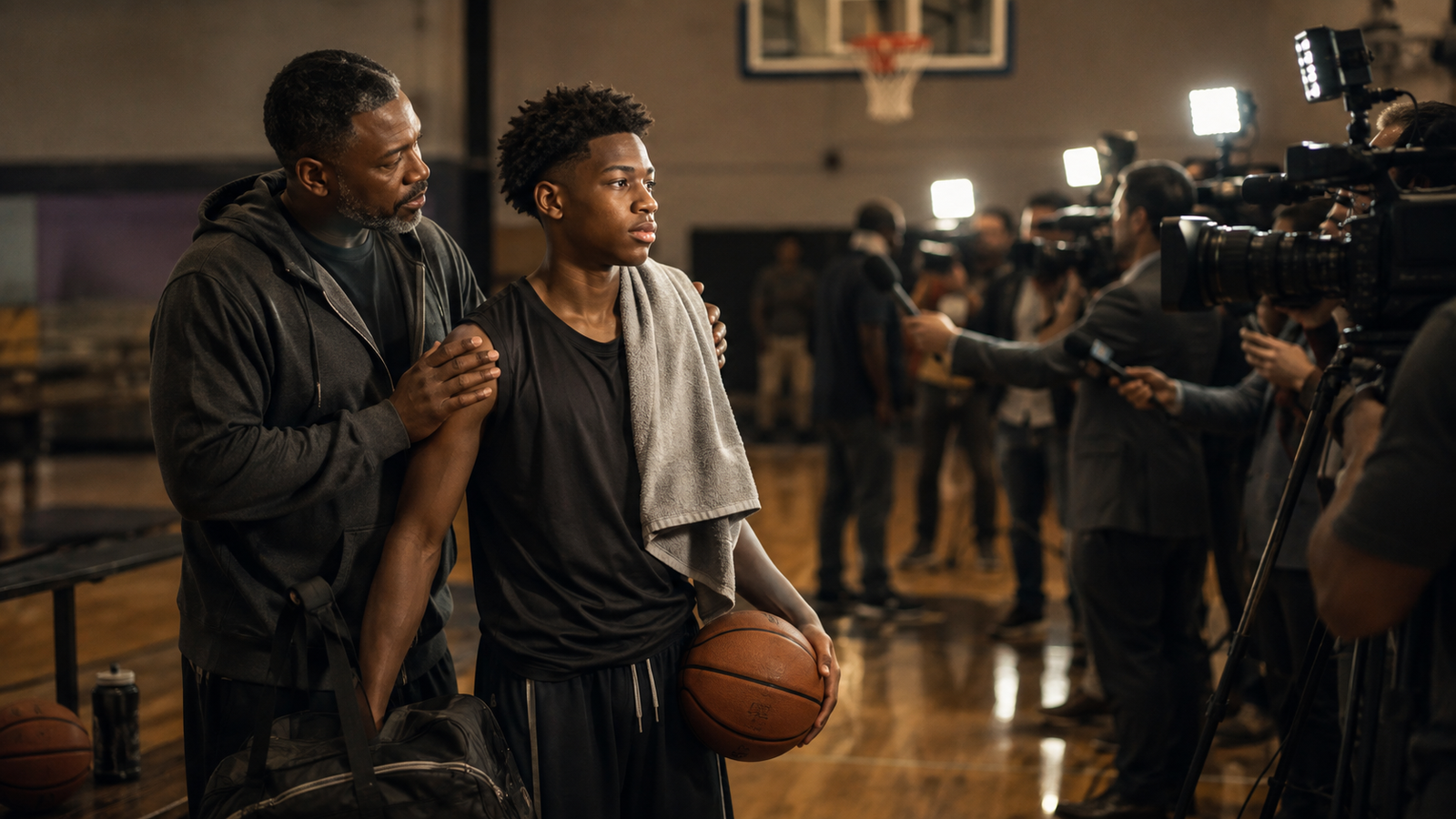
What happens when he coached, drove, paid, corrected, encouraged, practiced, sacrificed, argued, protected, taught, stayed up late, woke up early, and did the ordinary work that does not make a good television package?
Does the public story make room for him too?
That question is bigger than whether one father appears in one television segment. It is about a habit of judgment. We notice what gets placed in front of us, then we start treating visibility as proof of importance and silence as proof of absence.
That is where the audit begins.
Who Gets Credit for the Person Who Shows Up?
Sports gives us a clean place to see the problem because success becomes public so quickly. A young person can spend ten or fifteen years being developed in kitchens, gyms, driveways, school parking lots, weight rooms, AAU tournaments, cramped hotel rooms, and long car rides. Then draft night arrives and that entire history has to fit inside a few minutes of television.
Somebody has to decide what makes the package.
That is where narrative credit comes in.
Editors choose the photograph. Producers choose the interview. Hosts decide which family member gets the follow-up question. Writers decide which detail becomes the emotional center of the profile. None of those choices by itself proves prejudice. Television has time limits, and every story leaves something out.
But repeated choices still create patterns.
A culture learns from what it sees over and over again. If a broadcast repeatedly makes one kind of family contribution visible while treating another as background information, viewers eventually start treating the visible version as the normal version.
This is where discernment matters. The presence of a mother in the story does not prove the absence of a father. A father appearing less often does not prove he was ignored deliberately. The record has to carry the conclusion.
The Cameron Boozer Example Is More Complicated Than the Viral Version
Cameron Boozer was selected third overall by the Memphis Grizzlies in the 2026 NBA Draft. His father is Carlos Boozer, a two-time NBA All-Star and former Duke national champion.
So this is not a case where the official basketball record somehow forgot who Cameron’s father is. NBA and Memphis draft materials identify Carlos Boozer directly. Anyone looking at the basic record can find the connection.
That correction matters.
The stronger question is not whether Carlos Boozer was erased from history. He was not. The question is how much narrative weight his role received within particular broadcasts, interviews, profiles, and human-interest stories compared with other parts of Cameron’s family story.
Those are two very different claims.
The internet usually prefers the bigger accusation because the bigger accusation travels faster. Somebody was erased. Somebody hates Black fathers. Someone deliberately ignored what was obvious. Once the argument reaches that temperature, evidence becomes almost secondary.
That is not an audit. That is a verdict looking for exhibits.
A proper audit asks narrower questions. Was the father acknowledged? How often? In what context? Who was interviewed? Which family contribution became the emotional center of the segment? Was the same editorial pattern repeated across comparable players and comparable broadcasts?
Those questions are slower. They are also useful.
Media Framing Does Not Have to Be False to Be Incomplete
This is where arguments about Malika Andrews and ESPN often get messy.
In 2023, former NFL receiver Dez Bryant publicly criticized Andrews over what he viewed as different treatment of controversies involving Black and white players. He contrasted her coverage of Brandon Miller around the 2023 NBA Draft with what he believed was slower attention to allegations involving Josh Giddey.
That criticism traveled because people already had a theory about sports media. They believed they were seeing one standard for Black athletes and another for everybody else.
But a theory is not proof.
The Giddey case itself demonstrates why comparisons need care. Allegations circulated online in late 2023. Newport Beach police opened an investigation and closed it in January 2024 without pursuing charges after saying investigators were unable to corroborate criminal activity. The NBA later closed its own investigation after reaching a similar conclusion and finding insufficient evidence for disciplinary action.
Those developments happened at different stages. Coverage during an active investigation cannot fairly be compared with coverage after investigators have reached a conclusion, unless someone accounts for the timeline.
There is another complication. Andrews did address the Giddey allegations on air while the matter was active. That does not settle every question about emphasis, timing, framing, or comparison, but it does matter when evaluating claims that she simply refused to cover the story.
That does not mean media bias is impossible. It means proving it requires more than noticing that two segments felt different.
You would need comparable cases, comparable stages of investigation, comparable broadcast circumstances, and enough examples to identify a pattern. Otherwise, we are judging a system from a handful of clips selected precisely because somebody found them irritating.
That is worth remembering even when we agree with the underlying concern.
The Absent Black Father Story Has Had a Long Life
The concern about Black fathers does not come out of nowhere.
Public discussion has often collapsed several different things into the word absent: unmarried, nonresident, uninvolved, inconsistent, disconnected, and completely gone. Those conditions are not interchangeable.
Living in another household certainly changes the opportunities a father has for daily participation. Older Pew Research Center data found that Black fathers were more likely than white fathers to live apart from their children.
But that same research also found something that rarely receives the same cultural repetition. Among fathers living apart from their children, Black fathers were more likely than white or Hispanic fathers to report talking with their children several times a week about their day. Pew reported 49 percent among Black fathers in that group, compared with 30 percent among white fathers and 22 percent among Hispanic fathers.
More recent research makes the picture even harder to reduce to one stereotype. Research published in the 2025 volume of Social Development examined 2,040 unmarried, low-income non-Hispanic Black fathers and identified four distinct patterns of involvement. The largest group, just over half of the sample, was classified as highly involved.
The researchers’ larger point was not that every Black father is highly involved. It was that Black fatherhood is heterogeneous. Treating millions of families as one uniform experience produces bad analysis before it produces anything else.
In plain language, family structure is complicated.
Some fathers are not doing the work, and neither are some mothers. Other fathers are present every day; others are present from another household entirely. Still other families are being held together by grandparents, stepparents, uncles, aunts, coaches, siblings, and combinations that do not fit neatly inside the television version of a family tree.
Accuracy requires telling the story that is actually there.
What an Accurate Record Requires
If a mother carried the family, say that; if a father coached every season, say that too. When both parents sacrificed, do not build a cleaner story by reducing one of them to scenery. And if a grandparent made the whole thing possible, that belongs in the record too.
The goal is not to manufacture positive representation. It is to stop manufacturing incomplete representation.
What Should We Actually Audit?
I am less interested in whether one television host likes Black fathers than in what the machinery of storytelling rewards.
Sports television needs emotion. Draft coverage needs a backstory. Producers want sacrifice, struggle, triumph, tears, and a person the camera can cut to when a name gets called. That makes sense as television. It also means producers are constantly compressing complex family histories into one clean emotional lane.
Sometimes the mother becomes that lane.
There is nothing wrong with honoring her. The problem begins if viewers start treating her visibility as evidence that nobody else was carrying weight.
Think about how easily we recognize fathers when their presence already fits the public sports narrative. Dell Curry is part of the Steph Curry story. LaVar Ball became impossible to separate from the rise of Lonzo and LaMelo Ball. Rick Brunson’s basketball history has been discussed alongside Jalen Brunson’s career. Michael Jordan’s relationship with his father, James Jordan, became part of the public story surrounding Jordan’s life and first retirement.
Black fathers are clearly capable of appearing in the story. So the useful question is not, “Why does the media never show Black fathers?”
It does.
The better questions are when, how, and for what purpose.
Is the father visible because he is famous? Because he is controversial? Because he played professionally? Does an ordinary father who quietly handled years of transportation, discipline, training, bills, and emotional support receive the same narrative curiosity?
That is where the issue becomes bigger than basketball.
Our culture is good at noticing spectacle. It is less reliable at noticing maintenance.
The parent who makes noise is visible, and so is the one whose own career provides a recognizable television hook. A parent involved in conflict becomes visible very quickly too.
Steady contribution is easier to miss because it often looks ordinary: rides, meals, fees, correction, encouragement, and showing up again next Thursday when there is no camera around.
Most lives are built on exactly that kind of ordinary.
The same distinction sits underneath another Front Porch question: knowing what is yours to carry and what belongs to somebody else. Credit works the same way. Give people the load they actually carried. Do not hand them somebody else’s, and do not take theirs away because the cleaner story is easier to tell.
Accountability Applies to the Audience Too
Media companies should be accountable for the stories they construct, especially when familiar cultural stereotypes can make incomplete framing feel natural.
The audience has work to do too.
We cannot demand fair representation while rewarding the most reckless interpretation of every clip. We cannot complain that media organizations simplify Black life and then build our own arguments from thirty seconds of video with no context around it.
If we believe the record is incomplete, complete it.
Find the father. See what he actually did, look at the mother too, and consider the family structure as a whole. Read beyond the broadcast package. Compare coverage before accusing someone of a double standard. Check whether a person truly went unmentioned or simply received less emphasis than we thought was deserved.
That is where accountability is a form of strength. A serious standard has to survive correction. If the evidence weakens our first accusation, we change the accusation instead of changing the standard.
Accountability loses its meaning when it becomes another word for accusing somebody we already dislike.
The standard has to work even when the facts complicate our preferred argument.
The Groundwork
Black fathers do not need fictional credit.
They need accurate credit.
That means fathers doing nothing should not be romanticized. Fathers doing the work should not have to become celebrities, coaches, loud personalities, or former professional athletes before their contribution becomes narratively interesting.
The same standard belongs to mothers, grandparents, guardians, mentors, and everybody else who helped carry the load.
Tell the story that happened.
Do not bend it around an old stereotype, and do not clean it up for easier emotional television. Do not build it around the villain social media wants, either, before checking whether the evidence can carry that weight.
The real family story may be messier.
Good. Real life usually is.
That’s the truth, from the front porch. Now go build.

Continue Building
Groundwork Architecture
The Principle and Condition Beneath This Work
This article applies one governing principle and one structural condition from the Groundwork Daily architecture.
Core Principle
Accountability Is a Form of Strength
Accountability protects the integrity of a standard by requiring our claims to stay connected to the record and requiring correction when the record changes.
Primary Condition · Weighs
Discernment
Discernment gives evidence, context, comparison, and consequence the weight they deserve before an incomplete story becomes a confident verdict.
See the full Core Principles and Conditions architecture.
Receipts
- NBA and Memphis Grizzlies, 2026 NBA Draft: Cameron Boozer was selected third overall by the Memphis Grizzlies. NBA and Memphis materials identify him as the son of two-time NBA All-Star and 2001 Duke national champion Carlos Boozer. Memphis Grizzlies Draft Central · NBA 2026 Draft Notes
- Newport Beach police reporting on Josh Giddey: Newport Beach police closed their investigation in January 2024 without pursuing charges after stating that investigators were unable to corroborate criminal activity. ESPN, January 17, 2024
- NBA investigation into Josh Giddey: Reporting in May 2024 said the NBA closed its investigation after reaching a similar conclusion and finding insufficient evidence to support disciplinary action. ESPN, May 23, 2024
- Pew Research Center, “A Tale of Two Fathers”: Pew found large differences in father involvement based on living arrangements. Among fathers living apart from their children, 49 percent of Black fathers in the study reported talking with their children several times a week about their day, compared with 30 percent of white fathers and 22 percent of Hispanic fathers. Pew Research Center
- Yoon et al., Social Development, 2025: The study examined 2,040 unmarried non-Hispanic Black fathers with low income and identified four distinct involvement profiles. The high-involvement profile represented 50.60 percent of the sample, and the authors emphasized substantial variation in Black fathering experiences. PubMed
- Public criticism involving Malika Andrews, Dez Bryant, Brandon Miller, and Josh Giddey: Bryant publicly accused Andrews of applying different standards to Miller and Giddey. Contemporary reporting also documented that Andrews addressed the Giddey allegations on air. This article treats the dispute as an example of arguments about framing and comparison, not proof of discriminatory intent. Complex
External sources were reviewed for factual context and claim verification. External links were live and accessible when this article was published or last substantively updated. Third-party pages may change, move, or be removed over time.