
Community power and responsibility grow when more people can carry the work. A neighborhood may have history, talent, pride, relationships, and people who care deeply about what happens there, but those strengths do not automatically create the shared capacity required to keep a community functioning.
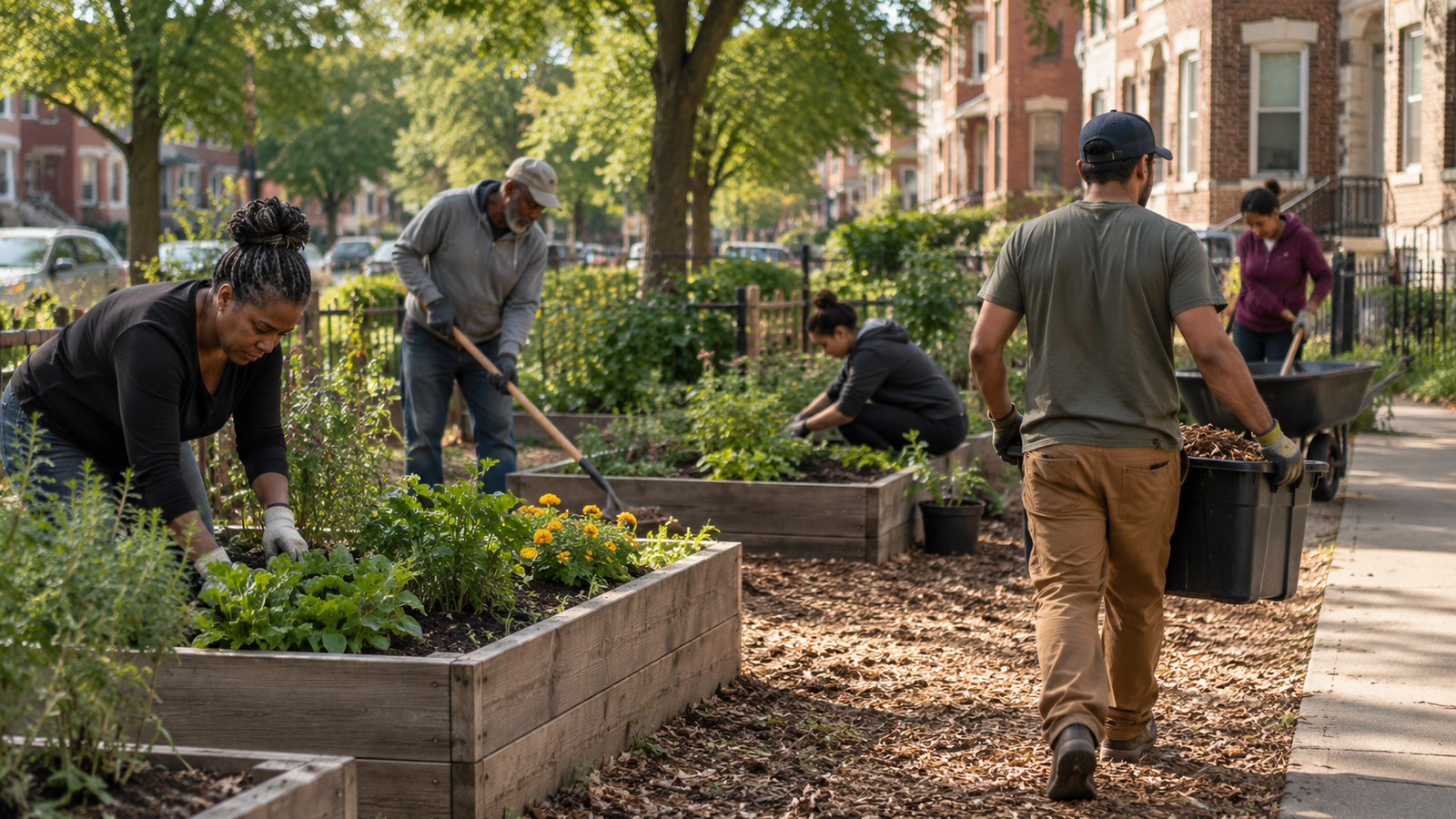
You can see the difference almost anywhere people share something. A garden needs watering. The block association needs somebody to keep the list. A youth program needs adults who actually arrive. The community room needs chairs put back after the meeting.
Meanwhile, somebody has to remember which vendor was called last time, who has the key, where the paperwork went, and what still needs to happen before Saturday.
Usually, somebody handles it. The problem is that it is often the same somebody.
Because the work keeps getting done, everybody gets used to the system working. Over time, that success can create the illusion that the work is somehow taking care of itself.
It is not. Someone is carrying it.
Community strength becomes more durable when responsibility is visible, understood, and distributed before the people carrying most of the load finally reach their limit.
The Architecture
Belonging → Participation → Shared Responsibility → Distributed Load → Capacity → Durability
Belonging creates connection. Participation converts that connection into contribution. Shared responsibility keeps contribution from becoming the permanent burden of the same few people.
01 / Belonging
Community Power and Responsibility Start Before the Work Is Shared
People usually like the idea of community. It suggests connection, familiarity, support, safety, shared history, and having somewhere you belong.
All of that matters. Still, belonging and contribution are not the same thing.
For example, you can enjoy a clean block without joining a cleanup. You can appreciate a neighborhood garden without knowing who waters it in August. You can value a community organization without attending a meeting, volunteering, donating, making introductions, or helping it solve a problem.
None of those choices automatically makes someone a bad neighbor. The structural problem appears when too many people make the same choice at the same time.
At that point, the community continues receiving value while the number of people producing that value gets smaller. Eventually, somebody pays the difference in time, energy, money, attention, or frustration.
02 / Participation
Community Power and Responsibility Begin With Contribution
Participation does not require everybody to do everything. In fact, that expectation would fail almost immediately.
People have jobs, families, health limitations, financial constraints, caregiving responsibilities, transportation problems, and different amounts of available time.
Therefore, a durable participation system has to work with those differences rather than pretend they do not exist.
One person may have two hours. Another may have twenty dollars. Somebody else knows the city agency that needs to be called. A retiree may have daytime availability, while a parent may know nearly every family on the block.
Someone else may have tools, a vehicle, a professional skill, or a relationship that makes one difficult task much easier.
As a result, contribution becomes stronger when the system can use more than one kind of help.
Communities often make participation too narrow. Come to this meeting. Join this committee. Volunteer for this shift. Show up at this exact time.
When people cannot meet that one requirement, they disappear from the participation system entirely.
Better systems create more doors. More importantly, they make smaller contributions usable.
That is how community power and responsibility begin moving from intention into operating capacity.
03 / Distributed Load
Community Power and Responsibility Break Down When the Load Stays Concentrated
Every functioning community has people who are known for showing up.
They know where the extra folding tables are, remember who needs a call, keep the contact information, arrive early, and stay late. When something goes wrong, somebody texts them.
Their reliability makes them valuable. Unfortunately, it also makes them easy to overload.
Once a person becomes known as dependable, the system naturally sends more work in that direction. In the short term, the logic makes sense because the work needs to get done.
Over time, however, the pattern becomes dangerous.
What looked like community capacity may actually be one person’s capacity being repeatedly borrowed by the community.
Then life changes. The person gets sick, moves away, takes on caregiving, changes jobs, becomes exhausted, or simply decides there is no more room.
Suddenly, the weakness becomes visible.
The community did not lose strength overnight. Instead, it discovered where much of that strength had been sitting all along.
04 / Reliability
Reliability Becomes Infrastructure When More Than One Person Can Carry It
Infrastructure is usually imagined as something physical: roads, pipes, buildings, electricity, transit.
Communities have human infrastructure too. It is the network of people who understand what needs to happen and can be counted on to carry some part of it.
One reliable person is an asset. By contrast, several reliable people who understand their roles and can cover for one another begin to form a system.
That system does not require everybody to contribute equally. Equal contribution is rarely realistic.
What matters more is whether responsibility has enough distribution that normal absence does not become a crisis.
Someone should be able to miss a meeting without the work disappearing. A volunteer should be able to take a vacation. Another person should be able to say no this month without the program stopping.
Once ordinary human limitations can be absorbed without collapse, reliability has moved beyond personality.
At that point, community power and responsibility are no longer sitting in the same pair of hands.
05 / Participation Gap
Shared Responsibility Does Not Mean Equal Sacrifice
Conversations about responsibility can become moral very quickly: who is doing enough, who is lazy, who takes more than they give?
Those questions may feel satisfying, but they can distract from the system itself.
Communities are made up of people with unequal time, money, health, mobility, knowledge, access, and influence. Therefore, contribution will never be perfectly balanced.
It does not need to be.
The stronger question is whether the participation system keeps creating useful ways for people to contribute what they reasonably can.
A person who cannot spend Saturday cleaning a vacant lot may be able to supply bags. Someone without money may be able to make calls. A person who cannot attend evening meetings may be able to handle a daytime errand.
Meanwhile, somebody else may know the person who can solve a problem the group has been stuck on for weeks.
Flexibility matters because community power and responsibility do not grow from demanding identical sacrifice. They grow when useful contribution becomes easier to enter and harder to disappear from.
06 / Participation Diagnostic
Four Questions Reveal Whether Responsibility Is Actually Shared
If the answer is one person, knowledge has not been distributed yet.
Repeated dependence on the same person reveals where excess load is collecting.
Narrow participation systems lose people whose available resources do not match the requested format.
A durable system should bend under ordinary absence without losing its basic function.
Together, these questions reveal whether participation is distributed or merely assumed.
More importantly, they shift the conversation away from whether people care and toward whether the community has built a structure that makes caring usable.
07 / Capacity
Community Power and Responsibility Become Real Through Capacity
Power is often discussed as though it begins with influence: who has the vote, who controls the money, who has access, who can get a meeting, and who can make somebody listen?
Those forms of leverage matter. However, a community that wins attention but cannot organize its own work remains dependent on someone else for execution.
Capacity comes first.
Can people coordinate? Can records be maintained? Do commitments survive beyond one enthusiastic week? Can responsibility move from one person to another? Can small amounts of money be handled properly?
Likewise, can information survive turnover? Can somebody new enter the system and understand what is happening without calling the same longtime volunteer for every answer?
None of those tasks looks especially powerful.
Yet they are the groundwork of power.
Once a community can reliably carry more of its own work, it becomes harder to ignore because relationships are no longer the only asset it possesses.
The community now has operating capacity.
The Groundwork
Community Power and Responsibility Grow When More People Can Carry the Work
Community does not become strong because everybody feels the same way about it. Instead, strength grows when enough people can carry some part of what keeps the place functioning.
That does not mean equal work. It means visible work, usable roles, multiple ways to contribute, and enough transfer that one reliable person’s absence does not create a crisis.
Start by noticing where the load actually sits.
If one person knows everything, move some knowledge. When the same three people do nearly everything, make smaller forms of participation useful.
If people want to help but do not know how, make the entry point clearer. Likewise, if somebody has carried the system for years, build a way for that person to step back without the work disappearing.
Ultimately, community power and responsibility begin reinforcing each other when participation becomes easier to share than to avoid.
The community gets stronger when helping no longer requires knowing the one person who knows everything.
Participation becomes power when responsibility can be carried, shared, and transferred.
Groundwork Daily
Build Better. Every Day.
Groundwork Daily examines the systems underneath ordinary life. Join the Groundwork List for essays and frameworks on structure, responsibility, institutions, ownership, community, and the work that makes stability possible.
Continue Building
Follow the Community System
Participation
Community Participation
Follow the work on contribution, reliability, shared responsibility, and community durability.
Shared Systems
Cultivating the Commons
Examine what happens to shared environments when responsibility becomes distributed, neglected, or invisible.
Observed Behavior
Block Logic
Follow the incentives, informal rules, and behavior that reveal how community systems actually operate.
Groundwork Architecture
Shared Responsibility Needs Structure to Become Capacity
Community participation works best when contribution is not left to goodwill alone. Clear roles, usable entry points, distributed knowledge, and repeatable systems make responsibility easier to carry and easier to transfer.
Core Principle
Structure Builds Freedom
Structure makes participation easier to enter, easier to understand, and less dependent on one person’s memory or availability.
Primary Condition
Capacity
Capacity expands when responsibility, knowledge, relationships, and useful work are distributed across more than one person.
Supporting Condition
Alignment
Alignment helps people understand what needs to be protected, how they can contribute, and where their effort fits into the larger system.
Territory
Community Groundwork
Community Groundwork examines maintenance, stewardship, participation, informal systems, shared responsibility, and the behavior that determines whether communities hold.
Explore Groundwork Daily Core Principles and The Conditions .
Meet the Builder
Cyrus Mbeki
Builder · Community Groundwork
Cyrus Mbeki examines how communities actually function. His work follows maintenance, participation, informal rules, shared responsibility, public behavior, and the people who quietly keep common systems alive.
Rather than beginning with what communities say they value, Cyrus watches what people repeatedly do, who carries the work, where pressure collects, and what happens when reliable systems are missing.
“You can learn what a community values by watching what people are willing to maintain.”
Reader Promise: See the system hiding inside ordinary community behavior.
Receipts
→ Indiana University Ostrom Workshop · Design Principles for Robust Institutions
→ National Academies · Civic Engagement and Social Cohesion
→ Centers for Disease Control and Prevention · Promoting Social Connection
Source availability: External links are provided for verification and additional context. Third-party pages may move, change, or become unavailable after publication. Groundwork Daily does not control external websites.