
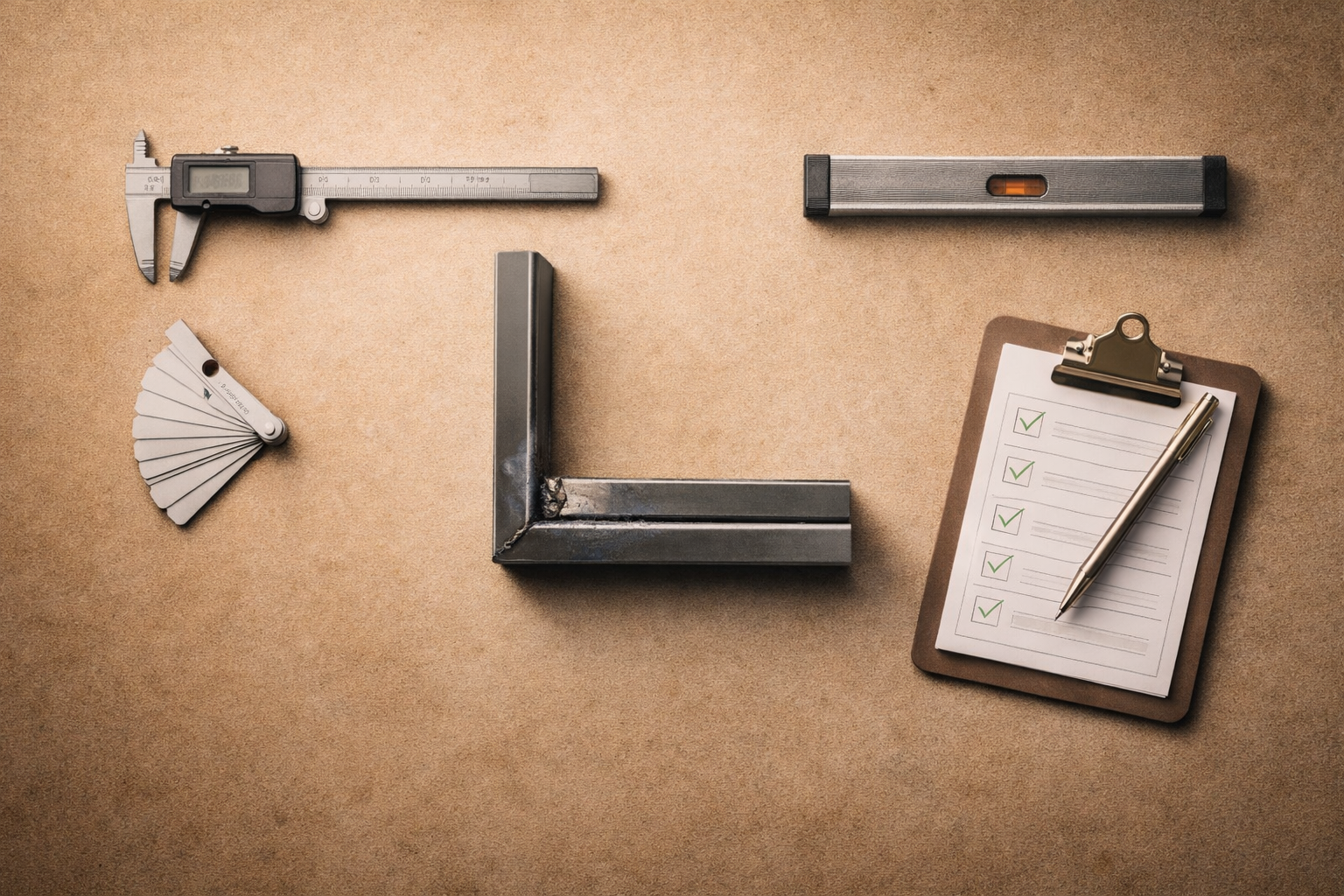
Work Hands · Entry 05 — Skilled labor inspection turns standards into evidence. Experience may tell a worker where to look, but verification determines whether the finished work actually meets the requirement.
Entry 04 placed tools inside a system of standards.
That creates the next question:
How do we know the result is right?
A connection may look clean. An assembly may appear square. A reading may seem reasonable. Experienced workers may even recognize the familiar signs of a job done well.
Those signals matter.
However, they are not the same thing as verification.
Skilled labor inspection exists to compare the actual condition against an agreed requirement. It turns “looks right” into something stronger: measured, tested, observed, documented, or otherwise confirmed.
Confidence can begin the judgment. Evidence has to close it.
Why Skilled Labor Inspection Exists
Inspection exists because producing the work and verifying the work are different functions.
The person making a cut concentrates on making the cut. Meanwhile, the installer manages fit, access, sequence, tools, and surrounding conditions. A mechanic may listen for behavior while also completing the repair.
Attention is finite.
For that reason, a deliberate verification step creates a different moment in the work.
The question changes from:
“Can I complete this?”
to:
“Does what I completed meet the requirement?”
Skilled Labor Inspection Is Comparison
At its core, skilled labor inspection compares an actual condition with a defined one.
The requirement may involve:
- a dimension,
- a tolerance,
- an alignment,
- a test value,
- a torque requirement,
- a surface condition,
- a safety condition,
- a manufacturer’s specification,
- an approved drawing, or
- another documented acceptance criterion.
Without a reference, inspection becomes opinion.
With one, the worker can compare the finished condition against something outside personal confidence.
Inspection Does Not Eliminate Judgment
The phrase “inspection beats intuition” can be misunderstood.
Inspection does not remove judgment from skilled work.
OSHA’s own field guidance describes effective inspection as requiring judgment in identifying, evaluating, and documenting conditions.[1]
The stronger distinction is this:
Judgment identifies what deserves attention. Verification determines what the evidence supports.
An experienced worker may notice that a connection looks wrong before a measurement confirms it.
That intuition has value.
However, the next step should strengthen the conclusion rather than stop at the feeling.
Confidence Is Useful — Until It Becomes the Standard
Experience builds pattern recognition.
Over time, skilled workers see thousands of normal conditions. As a result, abnormal ones stand out faster.
This is one reason experienced workers can often move efficiently without appearing to deliberate over every decision.
Yet experience creates another risk.
Familiarity can make an assumption feel like evidence.
“I Know What Right Looks Like” Has Limits
A worker may know what right usually looks like.
That does not guarantee that every important condition is visible.
For example, a joint can appear tight while failing another requirement. A surface can look flat while falling outside tolerance.
An electrical condition may also seem normal until measurement shows otherwise, while a fastener can feel secure without meeting a specified torque requirement.
Therefore, visual appearance and tactile judgment should be used where they are appropriate, but not asked to prove what they cannot prove.
Familiar Work Still Needs Control Points
Repetition does not make inspection unnecessary.
In fact, repetitive work can make certain checks more important because familiar tasks invite automatic behavior.
The solution is not to inspect every action equally.
Instead, the process should identify the places where verification carries the most value.
Those are the control points where an error could affect safety, fit, function, durability, downstream work, or costly rework.
What Skilled Labor Inspection Actually Checks
Inspection should follow the risk and the requirement.
Different trades therefore inspect different things.
A fabricator may verify dimensions and geometry. An electrician may test electrical conditions. A mechanic may verify settings, clearances, or operation. Likewise, a construction crew may check alignment, placement, fasteners, materials, or finished conditions before another operation covers the work.
The method changes.
The logic remains stable.
Check the Result
The obvious inspection question concerns the finished product.
Does the dimension meet tolerance?
Does the assembly fit?
Does the connection meet its requirement?
Does the system operate as intended?
Finished-result inspection matters because the work ultimately has to perform.
Still, waiting until the end can be expensive.
Check the Process Before the Result Is Hidden
Some defects become difficult to inspect after the next operation begins.
A connection may become enclosed. A surface may be covered. An embedded component may disappear from view.
Likewise, a setup condition may no longer be reconstructable once the equipment moves.
Therefore, effective inspection often happens during the process rather than only at the end.
NIST’s manufacturing work emphasizes production-line monitoring and measurement for exactly this broader reason: useful information has more value when it can still influence the process.[3]
Check the Conditions That Affect the Measurement
Inspection is not simply reading a tool.
The reference point, setup, access, environment, instrument, method, and acceptance criterion can all influence the result.
That is why selecting measurement equipment is itself a technical decision.
NIST’s work on dimensional inspection planning treats equipment selection as connected to design information and measurement requirements rather than as an arbitrary choice.[4]
The tool has to be capable of answering the question the standard asks.
Skilled Labor Inspection Should Happen Before Error Travels
Timing determines the value of inspection.
An inspection that finds a problem before another operation depends on the work can prevent the defect from traveling.
The same inspection performed three stages later may still identify the problem. By then, however, correction can require demolition, disassembly, replacement, delay, or another mobilization.
Inspection is therefore not only about detection.
It is about detection at the right time.
Place Verification at Irreversible Steps
A useful control point often appears immediately before work becomes hard to reverse.
For example, verification may belong before concrete covers embedded work, before a wall closes, or before material is cut permanently.
It may also belong before equipment enters operation, before a system becomes energized, or before another trade builds on top of the condition.
Those moments deserve deliberate verification because the cost of uncertainty rises sharply afterward.
Do Not Inspect Everything With the Same Intensity
More inspection is not automatically better inspection.
NIST has made this point directly in discussing inspection quality: completing a high number of inspections does not replace following established procedures, identifying deficiencies, and understanding the requirements.[2]
The same principle belongs in the field.
If workers inspect every trivial detail with equal intensity, the process becomes slow and noisy.
On the other hand, if they inspect nothing, the process becomes trust without evidence.
Good inspection focuses attention where failure matters.
Skilled Labor Inspection Needs a Clear Acceptance Standard
A measurement by itself does not tell the worker whether the work passes.
The number needs context.
Is 0.125 acceptable?
Is five degrees acceptable?
Does the observed gap fall within tolerance?
Does the tested value sit inside the manufacturer’s required range?
Those questions cannot be answered by the instrument alone.
Define Pass, Fail, and Escalate
A mature inspection process defines more than pass and fail.
Some conditions are clearly acceptable. Others are clearly outside the requirement.
Between them, however, there may be conditions that require clarification, engineering review, additional testing, supervisor approval, or another designated decision-maker.
That third category matters.
Without an escalation path, workers may feel pressure to convert uncertainty into an unofficial pass.
A good system allows the worker to say:
“I cannot verify this condition against the current requirement.”
That is useful information, not failure.
Do Not Change the Standard After Seeing the Result
One of the easiest ways to weaken inspection is to redefine acceptance after the work is complete.
A dimension misses tolerance, so the tolerance suddenly feels too strict.
Elsewhere, a test produces an unexpected result and the method suddenly becomes negotiable.
Sometimes a standard genuinely needs revision.
However, revision should follow evidence and authorized review—not convenience after a failed check.
Documentation Makes Skilled Labor Inspection Transferable
Not every inspection requires a formal record.
However, high-consequence checks often benefit from documentation.
Documentation creates continuity because it tells another worker what was checked, when it was checked, what requirement controlled the decision, and what the result was.
Document the Evidence, Not Just the Word “Pass”
A check mark can be useful.
Still, some conditions deserve stronger evidence.
Depending on the task, that might include:
- a measured value,
- a test result,
- a photograph,
- an inspection date,
- the drawing or procedure revision,
- the instrument or method used,
- the person performing the verification, or
- a note describing an exception and its disposition.
The level of documentation should match the consequence of the work.
The objective is not bureaucracy.
It is traceability.
Good Records Reduce Argument Later
When a downstream problem appears, memory becomes unreliable quickly.
One person may remember checking the condition, while another remembers a different measurement.
Meanwhile, the shift may have changed and the work may now be covered.
Clear records cannot prevent every disagreement, but they improve the quality of the investigation.
Instead of asking only what people remember, the team can examine what the process recorded.
Self-Inspection and Independent Inspection Serve Different Purposes
Workers should inspect their own work.
That is part of discipline.
Yet some work also benefits from another set of eyes.
The reason is not that the original worker cannot be trusted.
Instead, the second review changes perspective.
Self-Inspection Keeps Quality Close to the Work
The worker completing the task has immediate context.
They know what changed, what required adjustment, where access was difficult, and which condition deserves another look.
Therefore, self-inspection can catch problems quickly.
It also reinforces ownership.
The job is not finished simply because the last fastener turned or the tool stopped.
The result still has to be checked.
Independent Review Can Break Familiarity
A second person approaches the condition without exactly the same assumptions.
That can reveal errors the original worker stopped seeing.
Independent inspection becomes especially valuable when consequences are high, requirements are complex, work will become inaccessible, or procedures require another review.
The goal is not duplication for its own sake.
The goal is an appropriate level of assurance.
Checklists Support Skilled Labor Inspection
Inspection depends on attention.
Attention, however, is vulnerable to interruption and repetition.
For that reason, checklists can help make inspection more consistent.
The OSHA-NIOSH Small Business Checklist resources use self-inspection checklists to help employers identify workplace hazards.[5]
The broader principle applies beyond safety.
A structured list can protect critical inspection points from memory.
A Checklist Should Follow the Standard
The checklist should not invent the requirement.
Instead, it should make important requirements easier to verify consistently.
A useful inspection checklist might ask:
- Was the correct drawing or revision used?
- Was the tool or measuring device appropriate?
- Was the correct reference point established?
- Does the measured condition fall inside tolerance?
- Was the safety-critical condition verified?
- Is documentation required before the work becomes inaccessible?
- Does any exception require escalation?
Each question should connect to an actual risk or requirement.
A Long Checklist Can Hide the Important Check
Inspection systems can become bloated.
Every unusual event may add another item.
Eventually, the critical check sits between dozens of low-value prompts.
Workers can then end up completing the form instead of inspecting the work.
That is process failure disguised as compliance.
Good checklists stay focused enough that the important questions remain visible.
When Skilled Labor Inspection Finds a Problem
Finding a defect is not the end of inspection.
It starts the correction loop.
The worker or team needs to determine what happens next.
Can the condition be corrected immediately?
Does it require another measurement?
Must work stop?
Does engineering need to review it?
Does the defect suggest a larger process problem?
Do Not Hide a Failed Inspection
A failed check creates schedule pressure because the work cannot continue as planned.
That pressure makes failed inspections operationally important.
If crews learn that reporting a defect produces punishment while passing work keeps the schedule moving, the inspection system will eventually become ceremonial.
The organization may still have forms.
However, it will no longer have reliable verification.
A strong system makes correction easier than concealment.
Repeated Failures Point Upstream
One failed inspection may result from an isolated mistake.
A recurring pattern suggests something else deserves attention.
The standard may be unclear. The tool may be unsuitable. The sequence may create unnecessary variation.
Training may also be weak, or the inspection point may come too late.
Repeated failures should therefore travel back into the process rather than ending as repeated repairs.
Skilled Labor Inspection Is a Learning System
The immediate purpose of inspection is verification.
Over time, however, inspection produces another asset: information about the process itself.
Which conditions fail most often?
Where does variation appear?
Which requirement creates repeated confusion?
What gets corrected before completion?
What keeps escaping downstream?
Those patterns can improve the work.
Measure What Helps Decisions
Inspection data should not exist simply because data can be collected.
The useful measures are the ones that help a team decide what to improve.
For example:
- Which defects recur?
- At what stage are they detected?
- How often does rework follow a failed inspection?
- Which checks prevent downstream correction?
- Where do workers repeatedly request clarification?
- Which tolerances or requirements create the most variation?
That information turns inspection from a gate into a feedback system.
Inspection Should Improve the Standard
If inspection repeatedly finds the same problem, simply inspecting harder is a weak response.
The stronger response asks why the process keeps creating the condition.
Perhaps the work sequence should change.
Maybe a fixture can prevent the error.
A drawing may need clarification, or training may need another demonstration.
The tool-standard relationship may also need revision.
When verified evidence changes the process, inspection becomes part of continuous improvement rather than merely final approval.
Commit to a Framework
Inspection converts a requirement into evidence before another person has to trust the result.
- Define — establish what acceptable work means.
- Position — place the inspection before error becomes difficult to correct.
- Measure — use an appropriate method, reference, or test.
- Compare — judge the actual condition against the requirement.
- Document — preserve evidence when consequence or continuity requires it.
- Correct — resolve failed conditions rather than hiding them.
- Learn — feed recurring inspection findings back into the process.
Where Entry 05 Leaves the Work
Entry 01 begins with discipline.
Next, Entry 02 makes discipline repeatable.
Entry 03 allows the field to challenge the process.
Then Entry 04 connects tools to standards.
Entry 05 now closes the verification loop.
The result no longer depends only on confidence because it has been compared against the requirement.
However, verified work still creates another problem.
Somebody has to teach the method to the next person.
A standard that cannot transfer will eventually disappear with the worker who understands it best.
That is where Entry 06 begins.
Inspection proves the work. Training teaches another set of hands how to produce it again.
Source Ledger
- Occupational Safety and Health Administration, Field Operations Manual — Chapter 3. OSHA states that effective inspections require judgment in identifying, evaluating, and documenting safety and health conditions and practices. View source →
- National Institute of Standards and Technology, “Quantity Versus Quality of Inspections — Taking Shortcuts,” September 2022. NIST notes that inspection quality involves following established procedures, searching for deficiencies, and understanding applicable requirements rather than focusing only on inspection volume. View source →
- National Institute of Standards and Technology, Manufacturing. NIST explains that measurement science, calibrations, reference materials, and production-line monitoring help manufacturers demonstrate and maintain the quality of materials, equipment, processes, and products. View source →
- National Institute of Standards and Technology, Rule Model for Selecting Dimensional Measurement Equipment in Inspection Planning. NIST research treats dimensional measurement-equipment selection as a function of design information and measurement requirements. View source →
- National Institute for Occupational Safety and Health, OSHA-NIOSH Small Business Checklist App. The OSHA-NIOSH resource provides self-inspection checklists designed to help employers systematically identify workplace hazards. View source →
Last verified August 14, 2026.
Frequently Asked Questions About Skilled Labor Inspection
What is skilled labor inspection?
Skilled labor inspection is the deliberate comparison of completed or in-process work against a defined requirement. Depending on the trade, that may involve visual review, dimensional measurement, testing, alignment checks, documented criteria, or another verification method.
Why is skilled labor inspection better than relying on experience alone?
Experience helps workers recognize patterns and identify where problems may exist. However, verification strengthens that judgment by comparing the actual condition against a standard. Effective inspection still requires skilled judgment; it simply prevents confidence from becoming the only evidence.
When should skilled labor inspection happen?
Inspection should happen where it can meaningfully control risk or quality. High-value checkpoints often occur before an irreversible operation, before work becomes inaccessible, before another trade depends on the result, or before a system enters service.
Does every inspection need documentation?
No. Documentation should match the consequence and continuity needs of the work. High-risk, regulated, hidden, complex, or handoff-dependent conditions may justify stronger records, while routine low-consequence checks may require less formal evidence.
Are inspection checklists useful?
Yes, when they protect meaningful control points. A checklist should reflect real requirements rather than record every obvious movement. NIOSH and OSHA use self-inspection checklists as structured tools for identifying workplace hazards.[5]
Related Groundwork
Accountability Is a Form of Strength examines the broader principle behind inspection: clear responsibility and visible evidence protect both the work and the people who depend on it.
Work Hands Field Manual
Entry 05 examines how skilled labor inspection turns standards, measurements, and judgment into evidence.

This entry is part of the Work Hands Field Manual , documenting how skilled labor discipline becomes process through real work.