Contents
Walk through a modern American supermarket and the abundance feels undeniable.
One aisle may contain 20 kinds of chicken. Another offers dozens of egg cartons covered with green lettering, red barns, open fields, and reassuring language about nature. Cream cheese appears under several brand names. Lettuce comes in different bags for different stores, restaurants, and price points.
The shelves suggest competition. Meanwhile, the packaging suggests distinct values, and the prices imply meaningful differences.
However, much of what appears to be choice is variation at the surface.
Choice Begins Before the Shelf
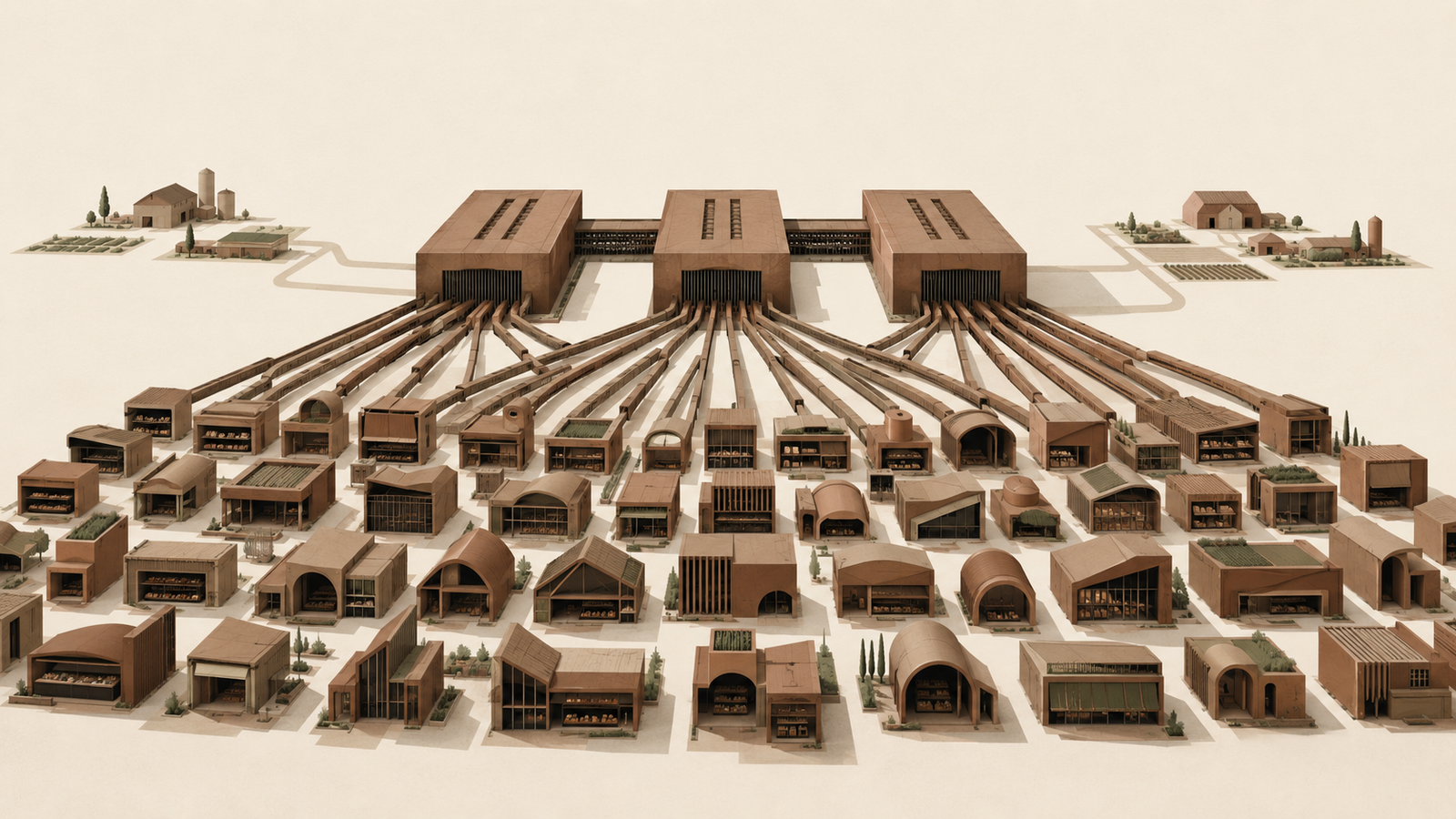
Behind the labels, the American food system is more concentrated, interconnected, and standardized than most consumers realize. Different brands may depend on the same processors, distributors, farms, slaughterhouses, manufacturers, or ingredient suppliers. Products presented as rivals can emerge from shared infrastructure before entering separate packages.
That does not mean every product from the same facility is identical. A processor can follow different recipes, sourcing requirements, quality standards, and contractual specifications. Claims that every brand sells the exact same product are usually too broad to survive scrutiny.
The stronger argument is also the more important one.
Consumers are being asked to make increasingly complicated food decisions while receiving remarkably little information about the systems behind those decisions. A crowded shelf gives them dozens of visible labels but hides ownership, processing, sourcing, labor, and distribution.
The result is an illusion of choice. There may be many products to select, yet relatively few production systems to support.
The Grocery Store Is a Theater of Abundance
Modern grocery stores are designed to make abundance visible.
Long aisles, overflowing displays, seasonal promotions, competing colors, and carefully arranged products communicate a simple message: you have options.
In one narrow sense, that message is true. Shoppers can choose among flavors, package sizes, prices, nutritional profiles, and brand identities. The modern store offers more variations than a neighborhood market could have carried several generations ago.
Yet product variation is not the same as economic independence.
A shopper may choose between 15 packages without realizing that several brands share a parent company. Other products may use the same contract manufacturer. Still others may depend on the same ingredient supplier, meat processor, distribution network, or agricultural region.
The consumer sees the final stage of the system. The shelf shows where products separate. It rarely shows where they converge.
This matters because brands have become the public face of food while infrastructure remains largely invisible. The label tells a story about identity. The supply chain determines what can actually be produced, at what price, and at what scale.
That gap between visible identity and hidden infrastructure is where the illusion grows.
A supermarket does not need hundreds of independent food systems to display hundreds of products. It needs enough branding, formulation, packaging, and pricing differences to make shared infrastructure look like broad competition.
Brand Variety Is Not Systemic Variety
A food company does not need to own a farm or factory to sell food under its name.
It may create the product concept, establish specifications, approve ingredients, manage quality controls, and market the final item. Another company can grow, process, manufacture, package, or distribute it.
That arrangement is common across the economy. It is not automatically deceptive. Specialization can make production more efficient. It can also help smaller brands enter the market without building expensive facilities.
Still, shared infrastructure changes the meaning of competition.
Several brands may compete for shelf space while relying on the same production bottleneck. They can disagree about price, packaging, and positioning while remaining dependent on a narrow group of suppliers.
This creates a two-layer market.
The first layer is visible. Brands compete for attention, loyalty, and household spending.
The second layer is structural. Processors, manufacturers, distributors, and retailers determine which products can reach the shelf at scale.
Competition may remain fierce in the first layer while shrinking in the second.
As a result, a shopper can gain more brand choices while the food economy becomes less diverse underneath. The shelf expands. The foundation narrows.
This is one reason the wider question of whether food is fake in America cannot be answered by inspecting the package alone. Most food is not counterfeit. Instead, familiar products are often reformulated, repositioned, or produced through systems that consumers cannot see.
The label remains recognizable. The internal structure changes.
What a Shared Processor Does and Does Not Mean
Claims about shared suppliers require discipline.
If the same processor supplies lettuce to a fast-food restaurant and a premium grocery chain, that fact does not prove the final products are identical. Buyers can establish different standards for variety, size, handling, testing, packaging, freshness, or farming practices.
The same plant can produce multiple products with different ingredients and quality requirements. Likewise, one slaughterhouse can process animals raised under different systems. A manufacturer can also make a value product and a premium product on separate production runs.
Therefore, “same processor” should never be treated as conclusive evidence of “same product.”
That shortcut weakens the argument because it confuses shared infrastructure with identical output.
However, shared processing still reveals something important. It shows how much apparent variety depends on centralized capacity. When many competitors need the same facility, a disruption there can affect all of them. Moreover, if the processor changes its requirements, smaller farms may have little leverage. Rising costs may then force several brands to adjust at once.
Shared infrastructure can also limit how far a brand can separate itself from the dominant system. A company may promise higher standards. Yet it still needs enough processing capacity, refrigeration, transportation, and dependable volume to fulfill those promises.
The processor does not erase every product difference. It establishes the operating boundaries within which those differences must exist.
Concentration Shapes Choice Before Food Reaches the Shelf
Consumers tend to think of choice as something that happens in the store. In reality, most choices have already been made.
Farmers decide what to raise based on land, climate, contracts, financing, input costs, processing access, and available buyers. Manufacturers choose formulas based on ingredient prices, equipment, shelf-life targets, transportation, and retailer requirements. Distributors decide which products can move efficiently. Retailers determine which items receive space.
By the time a shopper enters the aisle, thousands of upstream decisions have narrowed the field.
This is why concentration matters.
When a small number of processors or retailers control access to large markets, they gain the power to establish terms. Farmers may have multiple brands to sell through but only a few practical buyers. Small manufacturers may create distinctive products yet struggle to secure distribution. Regional producers may lack the volume, certifications, insurance, or logistics needed to enter a national chain.
Consumer demand cannot easily create alternatives when the necessary infrastructure does not exist.
A household may want pasture-raised poultry, but demand alone cannot produce more regional hatcheries, feed systems, processing facilities, refrigerated trucks, and trained labor. Those systems require capital, time, regulation, and stable purchasing commitments.
Choice begins long before the checkout line. It begins with ownership, financing, production capacity, and market access.
Private Labels and Manufactured Competition
Private-label products make the separation between brand and producer especially clear.
A retailer can hire a manufacturer to produce food under the store’s own label. The manufacturer may also make products for other retailers or national brands. Each package enters the market with a different identity, price, and marketing strategy.
Again, the products are not necessarily identical. Formulas and specifications may differ. However, private labeling demonstrates how easily one production network can support the appearance of several competitors.
Retailers benefit because they control the customer relationship. They can offer a lower-priced alternative, capture more margin, and reduce dependence on famous brands. Manufacturers benefit because they keep equipment running and gain larger production contracts.
Consumers may benefit from lower prices. Yet they usually receive little information about who made the product or whether that supplier changed.
The store brand can remain constant while the manufacturer behind it changes. The package creates continuity even when the production relationship shifts.
This arrangement turns branding into a curtain. The consumer evaluates the visible retailer while the actual producer remains backstage.
That invisibility becomes more important when a product changes. A different ingredient, altered texture, smaller serving, or weaker flavor may appear without a meaningful change to the front of the package.
The shopper recognizes the brand. The body recognizes the difference.
Packaging Has Become a Substitute for Knowledge
Most consumers cannot visit every farm, factory, and distribution center involved in producing their food. They need the package to translate an enormous system into a decision that can be made in seconds.
That creates an extraordinary opportunity for marketing.
Earth tones imply simplicity. Green packaging suggests environmental care. Illustrations of barns evoke small farms. Images of open fields imply outdoor access. Words such as “natural,” “wholesome,” “fresh,” and “farm raised” create emotional impressions that may extend far beyond their technical meaning.
The package does not merely describe the product. It builds a world around it.
That world may contain a rustic farm, a responsible company, a healthy family, or a simpler form of production. The consumer buys the product while also buying access to that story.
Sometimes the story reflects a real difference. Sometimes it stretches a narrow claim into a broad moral identity.
A package may correctly state that a product contains no artificial colors. Consumers can then infer that the animals lived differently, the farm used better environmental practices, or the ingredients received less industrial processing. None of those conclusions necessarily follows from the original claim.
This is not always a direct lie. It is often strategic ambiguity.
The company allows color, imagery, and carefully selected words to carry more meaning than the regulated claim can support. The consumer completes the story.
That is how greenwashing works at the shelf. The manufacturer does not need to transform the whole production system. It only needs to make the product feel separated from that system.
Some Food Labels Matter, but Their Meaning Must Be Examined
It would be reckless to claim that every food label is meaningless.
Some claims follow federal requirements. Others depend on certification programs, audits, documentation, or defined production standards. A premium product can differ meaningfully from a lower-priced alternative, even when both pass through the same processor.
The problem is not that labels never communicate value. The problem is that consumers often assign them more value than they guarantee.
“Natural,” for example, does not automatically explain how an animal lived, what it ate, how much outdoor access it received, or how the farm treated its soil.
“Free range” should not be casually interpreted as an animal spending most of its life roaming across open pasture. Outdoor access can exist in forms that bear little resemblance to the pastoral image on the package.
“Pasture raised” may offer more useful information, but consumers should still ask which standard applies and whether an independent organization verified the claim.
“Organic” follows a defined regulatory framework. Even so, it does not guarantee that a product is local, minimally processed, nutritionally ideal, or produced by a small farm.
Every claim has boundaries.
The useful question is not, “Does this package look responsible?”
The useful questions are more precise:
What practice does this claim require?
Which practices does it leave unaddressed?
Who verifies the claim?
Can the supporting standard be reviewed?
Does the higher price support a different production method or a stronger marketing position?
Good labels compress trustworthy information. Weak labels compress atmosphere.
Consumers must learn the difference.
Corporate Promises Must Survive Industrial Scale
Large restaurant and grocery chains often announce sourcing commitments that appear to reflect a change in values. Some commitments are serious. Some improve production practices. Others function mainly as reputation management.
In every case, the promise must survive contact with scale.
A national company needs enormous and dependable volume. It must secure food at a manageable price, transport it across long distances, meet safety requirements, standardize the customer experience, and maintain availability across hundreds or thousands of locations.
Those demands narrow the field of possible suppliers.
A regenerative farm may raise an exceptional product. That does not mean it can supply a national restaurant chain. The farm may lack sufficient volume, processing access, transportation, insurance, or year-round production.
A large company can combine several smaller suppliers, but coordination introduces new costs. Product consistency becomes harder. Logistics become more complex. A disruption at one supplier must be covered by another.
As companies grow, procurement teams usually move toward fewer suppliers that can deliver larger volumes with predictable results.
This explains why mission-driven companies can become less distinctive as they expand.
A small grocery chain can work with regional farms. By contrast, a national chain needs a national or international procurement system. Local restaurants can adapt their menus to seasonal availability. However, national brands usually promise the same item in many places throughout the year.
Growth creates a strategic conflict.
The company can protect its original sourcing model and limit expansion. Or it can expand and redesign sourcing around suppliers capable of serving a larger network.
Most companies choose growth.
The public identity may remain rooted in localism, health, sustainability, or quality. Meanwhile, the operating model moves toward centralized purchasing. Because customers still value the language, it survives even when the original structure does not.
Why Food Quality Declines Under Cost Pressure
The illusion of choice is connected to another consumer experience: familiar food no longer tastes the same.
Many people remember products as richer, denser, or more satisfying. They notice thinner textures, weaker flavors, smaller packages, and ingredient lists that seem more complicated.
Memory can be unreliable. Preferences also change over time. Still, cost pressure creates real incentives for manufacturers to alter products.
Companies face rising expenses for ingredients, labor, energy, packaging, storage, transportation, insurance, and retail placement. When costs increase, a manufacturer has several options.
A company can raise the price, reduce the package size, or accept a smaller margin. Alternatively, it can alter the recipe and replace expensive ingredients. It may also add stabilizers or sweeteners that preserve texture and shelf life.
Reformulation is often attractive because it is less visible than a dramatic price increase.
The package can remain familiar while the brand preserves its position. In addition, the product can continue meeting legal requirements. Yet the experience changes.
This is the central argument explored in Fake Food in America: How Reformulation Replaced Standards. A product does not need to become counterfeit to become less faithful to the food consumers remember.
Instead, the product becomes optimized for a different set of priorities.
Flavor must compete with shelf stability. Ingredient quality must compete with margin. Traditional preparation must compete with production speed. Local differences must compete with national consistency.
As food quality declines under cost pressure, manufacturers often use formulation to preserve the appearance and performance of the original product.
Texture systems replace expensive fats. Flavoring compensates for weaker base ingredients. Sweetness creates immediate intensity. Stabilizers help products survive storage and transportation. Smaller portions conceal higher unit costs.
The result may remain safe, legal, and commercially successful. That does not mean it delivers the same quality.
Why Food Tastes Different Even When the Brand Has Not Changed
A familiar logo creates an expectation of continuity.
Consumers assume that the product inside the package remains stable because the brand name remains stable. However, recipes can evolve gradually. Suppliers change. Ingredient sources shift. Manufacturing equipment improves. Shelf-life targets expand. Portion sizes shrink.
Each change may be defensible on its own. Together, they can create a product that looks familiar but behaves differently.
This helps explain why food tastes different now. The change is not always a single dramatic substitution. It can emerge from years of small decisions that move the product toward efficiency and away from its earlier character.
Taste is also more than sweetness, salt, or flavoring.
Fat carries flavor. Protein affects structure. Water content changes density. Fermentation shapes complexity. Freshness affects aroma. Ingredient quality influences how long a flavor remains present.
A reformulated product can reproduce the first second of flavor while losing the deeper experience that made the original satisfying.
That is why consumers often struggle to explain what changed. The product may taste recognizable at first. Then it feels thin, overly sweet, waxy, flat, or strangely incomplete.
The sharper examination of why food tastes worse now reveals the underlying trade-off. When cost replaces care as the governing priority, the product can retain its identity while losing part of its substance.
Why Concentration Can Make Food Shortages Worse
Centralization creates efficiency. It can also create fragility.
A large processing facility can produce extraordinary volumes at a low unit cost. Similarly, a national distribution network can move food quickly across long distances. Together, these concentrated systems can standardize safety, packaging, and quality controls.
However, the same system can transmit disruption across many brands at once.
If several retailers depend on one processor, a fire, contamination event, labor dispute, disease outbreak, equipment failure, or transportation problem can affect products that appear unrelated on the shelf.
The brands look independent. The disruption reveals their shared foundation.
This is why food shortages often seem confusing. A store may carry several labels, yet all of them disappear together. Consumers assume several companies failed at the same time. In reality, the brands may have relied on the same producer, region, ingredient, or distribution route.
The deeper mechanics are examined in Why Food Shortages Happen. Shortages are rarely caused by a single empty farm or absent product. They emerge when tightly connected systems lose enough capacity at a critical point.
Efficiency removes redundancy because redundancy appears expensive during normal operations.
Then disruption arrives, and the missing redundancy becomes priceless.
A resilient food system needs more than high output. It needs multiple processors, regional capacity, adaptable transportation, diverse production areas, storage, and suppliers that can step in when another fails.
Those capabilities may cost more during stable periods. Yet they protect the system during unstable ones.
Cheap abundance and durable abundance are not the same thing.
“Buy Local” Is Directionally Right but Operationally Incomplete
The most common response to industrial food concentration is simple: buy directly from local farmers.
That advice has value.
Farmers’ markets, community-supported agriculture programs, food cooperatives, regional farm directories, and direct farm purchases can improve traceability. Consumers may be able to ask who raised the food, how it was produced, which inputs were used, how animals lived, and where the money goes.
Direct relationships can replace vague branding with real knowledge.
However, “buy local” is not a complete food policy.
Local food is not equally accessible to everyone. It can cost more. Markets may operate during limited hours. Some communities have few nearby producers. Seasonal availability affects selection. Transportation, storage, cooking time, and household income shape what families can realistically buy.
Geography matters too.
Not every region can produce every food efficiently. Some areas lack sufficient farmland, water, processing capacity, or suitable weather. Dense cities depend on wider networks. Low-income communities may have convenience stores but no direct market. A household working multiple jobs may need predictable hours and one-stop shopping.
Telling every consumer to bypass supermarkets transfers a structural problem onto individual households.
That is not reform. It is an escape route for people with enough time, money, transportation, knowledge, and geographic access.
Local purchasing should be part of the strategy. It should not become an excuse for leaving the mainstream food system opaque, concentrated, and difficult to challenge.
The goal is not to force every family to become a supply-chain investigator. The goal is to build a system in which trustworthy information and meaningful options are available without extraordinary effort.
A Better Framework for Grocery Decisions
Consumers cannot investigate every item in the cart. That would turn ordinary shopping into unpaid regulatory work.
Still, they can make stronger decisions by focusing on high-impact categories and asking better questions.
1. Read the Product Name, Not Just the Brand
The legal or descriptive product name can reveal more than the logo.
Terms such as “frozen dairy dessert,” “chocolate-flavored coating,” or “cheese product” can signal that the item does not fit the traditional standard consumers may expect.
The wording is often small. It matters.
2. Compare Ingredient Structure
Do not assume that a longer ingredient list automatically makes a product harmful. Some foods require several legitimate ingredients.
Instead, look for the product’s structural foundation.
Which fats does it use? Where does sweetness appear? Are expensive ingredients present in meaningful amounts? Do gums, starches, oils, or flavoring systems appear to compensate for something that was removed?
3. Separate Regulated Claims From Visual Suggestions
A green package is not a production standard. A barn illustration is not evidence. The word “farm” in a brand name does not establish farm size, ownership, or animal conditions.
Identify the actual claim. Then determine what that claim requires.
4. Look for Verification
Independent certification does not solve every problem. Standards vary, audits can fail, and certification can be expensive for small producers.
Still, third-party verification usually offers more value than an unverified company promise.
5. Investigate the Categories You Buy Most
Start with products that consume the largest share of your food budget or appear most often in your household.
For one family, that may be meat and eggs. For another, it may be cereal, dairy products, frozen meals, or snacks.
A focused investigation produces more value than trying to decode the entire store.
6. Ask What the Premium Price Buys
A higher price may support better ingredients, stronger labor practices, improved animal welfare, smaller-scale production, or independent verification.
It may also support packaging, advertising, retailer positioning, and brand prestige.
The premium is not proof. It is a prompt for investigation.
7. Use Direct Purchasing Strategically
Consumers do not need to replace every supermarket purchase.
They can begin with one category where local or regional sourcing makes the clearest difference. Eggs, produce, meat, dairy, or bread may offer practical starting points, depending on location and budget.
The aim is not purity. The aim is increased knowledge and control.
What Meaningful Choice Would Require
Consumer discipline helps, but individual shopping habits cannot repair structural concentration alone.
Real choice requires information, infrastructure, competition, and access.
Clearer Labeling
Claims should communicate defined practices rather than broad impressions. Regulators should require companies to support animal-raising, environmental, sourcing, and production claims with accessible evidence.
Important information should not be hidden behind vague language or difficult websites.
Greater Supplier Transparency
Retailers and brands should make it easier to determine who produced or processed food. Supplier relationships may change, but that does not justify permanent opacity.
Traceability should serve consumers, not only internal compliance departments.
Stronger Competition Policy
When too much processing, distribution, or retail capacity sits inside too few institutions, consumer education will not create missing alternatives.
Competition policy must examine the infrastructure beneath the brands. Market power can exist even when the shelf looks crowded.
Regional Processing Capacity
Small and midsize farms need slaughterhouses, commercial kitchens, cold storage, aggregation centers, transportation, financing, and trained labor.
Without those systems, local food remains limited by bottlenecks.
Investment must reach the middle of the supply chain, not only the farm and the final retailer.
Institutional Purchasing
Schools, hospitals, universities, public agencies, and large employers can provide stable demand for regional producers.
Long-term purchasing commitments give farms and processors the confidence to invest in capacity. Occasional promotional programs do not provide the same foundation.
Honest Pricing
Cheap food can carry costs that do not appear at checkout.
Environmental damage, low wages, public health burdens, animal conditions, and rural economic decline can be shifted onto workers, communities, and future taxpayers.
A serious food policy must ask who pays when the sticker price stays low.
The Groundwork
The modern grocery store is not necessarily filled with fake products.
It is filled with incomplete stories.
A premium product may meet a genuinely higher standard. At the same time, a private-label product may offer excellent value. National brands may also impose specifications that distinguish their food from another item produced in the same facility.
None of those possibilities can be established through packaging aesthetics alone.
Consumers have been trained to compare labels when they should be learning to compare systems.
Who owns the brand?
Who produced the food?
Which companies control processing and distribution?
What does the central claim require?
Was that claim independently verified?
What portion of the higher price supports better production, and what portion supports better marketing?
These questions make grocery shopping less effortless. That is precisely the point.
Convenience depends on compression. The industrial food system compresses farms, factories, labor, transportation, regulation, ownership, and corporate power into a package that can be judged in seconds.
The package makes the decision easy by making the system invisible.
Meaningful choice begins when we stop confusing a crowded shelf with a diverse food economy.
Meaningful choice grows when consumers learn what labels can and cannot prove. Next, it becomes durable when regional producers gain the infrastructure required to compete. Finally, it becomes democratic when families can access better food without needing wealth, spare time, or specialized knowledge.
The problem is not that the grocery store offers no choice.
The problem is that the most visible choices are often the least important ones.
Flavor, packaging, and brand identity matter. Ownership, processing, resilience, and transparency matter more.
The shelf is the final display. The system behind it is the real product.
Frequently Asked Questions
Is grocery store choice an illusion?
Not entirely. Products can differ in formula, sourcing, quality, price, and production standards. However, many brands rely on shared processors, manufacturers, distributors, or parent companies. This makes the underlying food system less diverse than the shelf appears.
Does the same processor mean two products are identical?
No. A shared processor can produce items under different recipes, contracts, sourcing rules, and quality standards. Shared processing reveals infrastructure concentration, but it does not prove that the final products are identical.
Are private-label foods the same as national brands?
Sometimes they are similar, but consumers should not assume they are identical. A manufacturer can produce several products with different formulations and specifications. Ingredient lists, nutritional information, legal names, and certifications provide better evidence than package appearance.
Are terms such as “natural” and “free range” meaningless?
No, but their meaning may be narrower than consumers expect. Each claim should be evaluated according to its actual requirements, supporting documentation, and verification process.
Why does familiar food taste different now?
Companies may change ingredients, suppliers, production methods, package sizes, or shelf-life targets in response to cost and supply pressures. Those changes can affect flavor, texture, density, and satisfaction even when the brand remains familiar.
Is buying local the best solution?
Buying directly from local or regional producers can improve traceability and support alternative food infrastructure. However, it is not accessible or affordable for every household. Structural reform must also improve transparency, competition, and quality within mainstream grocery systems.
How can consumers identify meaningful differences?
Read the legal product name, compare ingredient structures, examine the exact meaning of claims, look for independent verification, investigate frequently purchased categories, and ask what a premium price actually supports.
What would create more genuine food choices?
Clear labeling, supplier transparency, stronger competition policy, regional processing facilities, institutional purchasing, and investment in small and midsize producers would create more meaningful options than branding alone.