
Bike lanes are usually pulled into argument before they are understood as infrastructure. That is the first mistake.
A bike lane is not a lifestyle statement. It is not decoration for progressive streets. It is not a favor to cyclists. At its best, a bike lane is transportation infrastructure. It organizes movement, assigns space, reduces conflict, and gives one mode of travel a clear place within the street.
As part of Urban Logic, this article studies bike lanes as one part of a larger city system. The better question is not whether someone personally rides a bike. The better question is how cities manage movement when many people need the same public street for different purposes.
Cars need space. Buses need space. Pedestrians need space. Delivery vehicles need space. Emergency access needs space. Bikes need space too.
When that space is undefined, conflict rises. However, when it is designed clearly, the street becomes easier to read.
That is the core function of bike lanes.
They make movement more predictable.
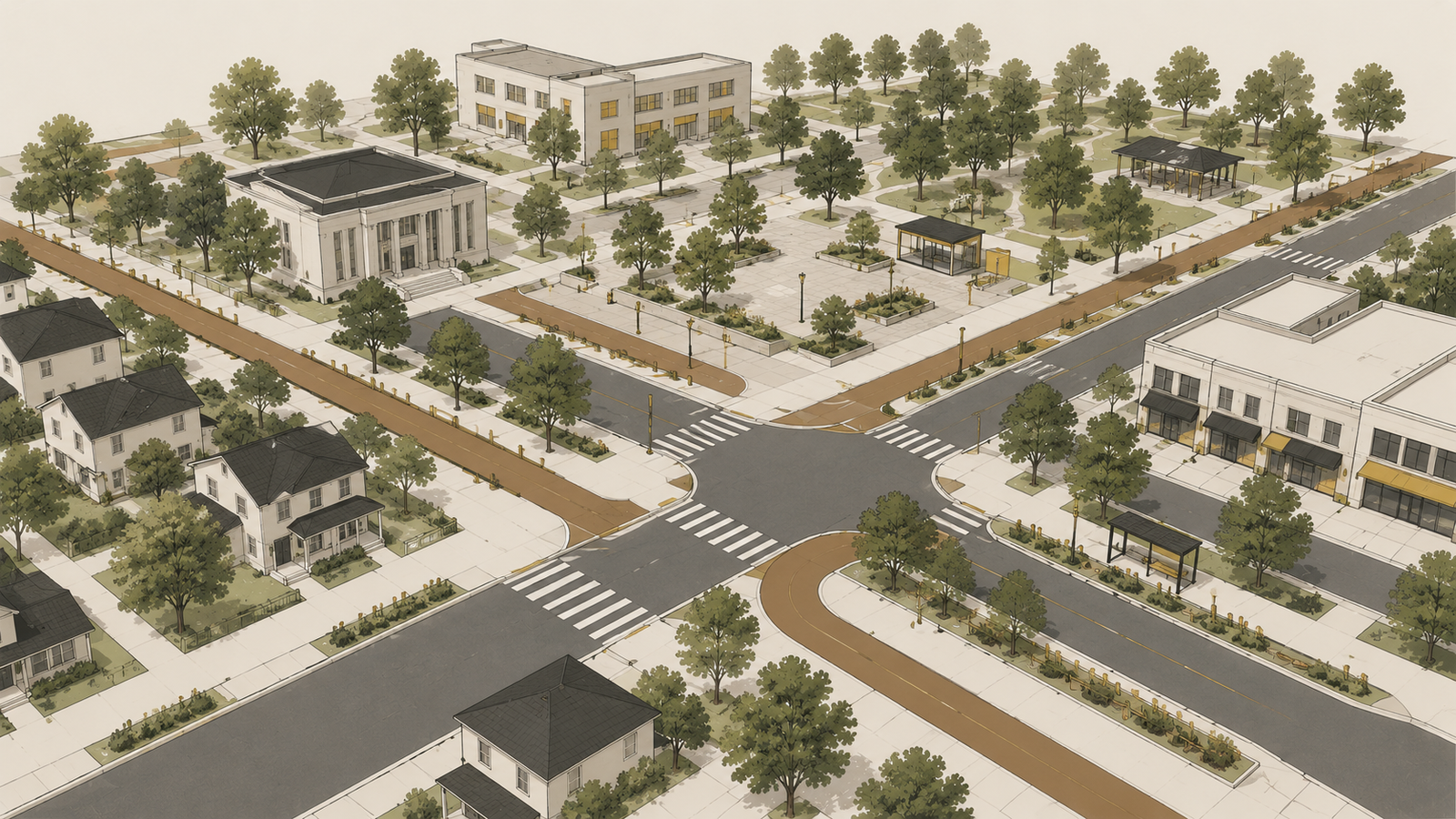
Bike Lanes Are More Than Painted Stripes
Paint is not infrastructure by itself.
Paint can guide. Paint can signal. Paint can mark intention. However, paint alone does not automatically create safety, predictability, or confidence.
This is where weak thinking enters the public conversation. A city paints a narrow lane beside fast traffic and calls the job complete. Then riders avoid it, drivers resent it, and pedestrians remain confused about how the space is supposed to work.
That is not serious transportation design.
A strong bike lane fits into the whole street. It considers speed, width, visibility, intersections, parking, drainage, loading zones, transit stops, sidewalks, crosswalks, and wayfinding. In some places, it may need physical protection. In others, it may need clear markings, signal timing, or separation from turning vehicles.
The point is not that every street needs the same bike lane. Instead, every design should match the actual condition.
Bike lanes fail when they are treated as symbols. They work when they are treated as systems.
Look at one bike lane you know. Does it clearly tell riders, drivers, pedestrians, and delivery vehicles where each movement belongs? If not, the street is asking people to improvise.
Transportation Infrastructure Organizes Movement
Transportation infrastructure exists to organize movement.
Roads organize vehicles. Sidewalks organize pedestrians. Crosswalks organize crossing. Bus stops organize transit access. Bike lanes organize bicycle movement.
That sounds obvious, but cities often forget it. Streets become overburdened because too many movements are forced into the same undefined space. Drivers guess what cyclists will do. Cyclists guess what drivers will do. Pedestrians guess whether turning vehicles will yield.
Guesswork is not a transportation strategy.
A clear bike lane reduces ambiguity. It tells riders where to travel. It tells drivers where to expect them. It helps pedestrians understand the movement pattern at crossings. It gives the street a more legible operating system.
This matters because streets are not static. They are moving environments. A small moment of confusion can become a serious conflict when speed is involved.
Good infrastructure lowers the amount of improvisation required.
That is the standard. Not ideology. Not aesthetics. Function.
Cycling Infrastructure Reduces Conflict
Cycling infrastructure is strongest when it reduces conflict before conflict begins.
The most dangerous street moments often happen where movements intersect. A driver turns across a bike path. A cyclist passes a parked car. A pedestrian crosses near a bike lane. A bus pulls toward the curb. A delivery vehicle blocks a lane.
Each moment asks people to make quick decisions.
If the design is unclear, everyone absorbs more risk.
Protected bike lanes can reduce that risk by separating movements. Intersection markings can clarify where riders continue. Dedicated signal phases can reduce turning conflicts. Raised crossings or curb extensions can slow vehicle movement near vulnerable users.
None of these tools are magic. Bad design can still create confusion. Poor maintenance can still undermine safety. Even so, the principle is sound.
When modes have defined space, the street becomes easier to negotiate.
This does not mean cyclists become the priority everywhere. That would be another weak reading. It means the street should stop pretending that cars are the only legitimate users.
A city that recognizes multiple modes must design for multiple modes.
Streets Carry More Than Cars
Cars matter. That should not need to be said, but transportation debates often collapse into bad binaries.
One camp acts as if every street should serve cars first, last, and always. Another sometimes speaks as if cars can be designed out of reality overnight. Both positions are too blunt.
Urban life is more complicated.
Cars carry families, workers, deliveries, tools, groceries, and people with mobility needs. Buses carry riders at scale. Bikes carry people across short and medium distances. Sidewalks carry the most basic form of mobility. Crosswalks connect the network. Street trees protect the experience. Bus stops expand reach. Wayfinding helps people understand how those pieces connect.
The street has to hold all of that.
Bike lanes force cities to admit that transportation is not one thing. It is a layered system. Different trips require different tools.
Some trips make sense by car. Some make sense by bus. Some make sense by bike. Some make sense on foot.
A strong city does not force every trip into one mode. It creates choices that match distance, capacity, weather, safety, cost, and need.
Bike lanes are part of that choice architecture.
Good Bike Lanes Connect Networks
A bike lane that goes nowhere is not a network.
This is one of the most common failures. A city installs a few disconnected segments and then wonders why ridership remains limited. But people do not move in fragments. They move from origin to destination.
Homes to schools. Apartments to transit stops. Parks to libraries. Jobs to commercial corridors. Public squares to neighborhood shops.
A single bike lane may help. A connected bike network changes the transportation system.
Connectivity matters because riders need continuity. A safe lane for five blocks loses value if it suddenly drops someone into fast traffic. A protected route loses value if the intersection treatment is dangerous. A neighborhood lane loses value if it does not connect to transit or commercial destinations.
Infrastructure works as a system or it leaks value.
This is the same lesson that shows up across Urban Logic. Sidewalks need crosswalks. Bus stops need sidewalks. Street trees improve public movement. Third places need access. Bike lanes need networks.
Wayfinding also belongs inside that network. As explained in Wayfinding Is Public Infrastructure, clear signs, maps, route markers, and public information help people understand where they are and where they can go next. A bike lane that is hard to find, hard to follow, or unclear at intersections is not fully working.
The city functions through connection.
Designing Streets Around Choice
Transportation choice is not abstract.
It becomes real only when the infrastructure exists.
Telling people they can bike is meaningless if the street feels unsafe. Telling people they can use public transit is thin if the bus stop is exposed and inaccessible. Telling people they can walk is dishonest if the sidewalk network is broken.
Choice requires conditions.
Bike lanes create one of those conditions. They give people another way to move through the neighborhood without relying on a car for every trip. That can matter for workers, students, families, older teens, delivery riders, and people managing transportation costs.
This is not about romanticizing bicycles. It is about reducing dependency on a single mode.
When every trip requires a car, households absorb more cost. Streets absorb more congestion. Parking becomes more contested. Short trips become heavier than they need to be.
Bike lanes do not solve all of that. Anyone claiming they do is overselling the product.
Still, they can reduce pressure within the system. They can make short trips easier. They can support multimodal travel. They can help people reach transit, parks, schools, local businesses, and civic spaces.
That is a practical function.
Maintenance Matters
Infrastructure that cannot be maintained eventually becomes a liability.
Bike lanes are no exception.
A protected lane can collect debris. Flexible posts can break. Paint can fade. Drainage can fail. Snow can block access. Delivery vehicles can occupy the lane. Construction can erase the route without providing a safe alternative.
When maintenance fails, confidence falls.
This is why cities should not build infrastructure they are not prepared to care for. The ribbon cutting is not the system. The maintenance cycle is the system.
Bike lanes need inspection, cleaning, repair, enforcement, and seasonal planning. They also need clear responsibility. If one agency paints the lane, another maintains the street, another manages parking, and another handles enforcement, riders experience the gaps.
Wayfinding has to be maintained too. If bike route signs fade, pavement markings disappear, detour information is missing, or construction blocks the route without a clear alternative, the system becomes harder to trust.
The public does not experience departments. The public experiences the street.
Good governance closes the distance between design and upkeep. Without that, bike lanes become another example of civic ambition without operational discipline.
Bike Lanes Affect Local Economies
Bike lanes can also shape local commerce.
That claim needs to be handled carefully. Bike lanes do not automatically save a business district. They do not guarantee more customers. They do not replace strong retail strategy, fair rents, clean streets, reliable foot traffic, or real demand.
However, they can improve access.
When neighborhood shops are easier to reach by bike, more short trips become possible without a car. Riders can stop at cafés, markets, barbershops, bookstores, pharmacies, libraries, parks, and civic spaces. That matters in dense areas where parking is limited and distances are manageable.
Street design influences whether people pass through a corridor or participate in it.
If the street feels hostile, people move quickly. If it feels legible and safe, people are more likely to linger, stop, and return.
Clear navigation strengthens that effect. A rider needs to know where the bike lane continues, where to turn, where to park a bike, where to cross safely, and how to reach storefronts without confusion. Better wayfinding can turn a bike route into a usable commercial connection rather than a strip of infrastructure people pass through.
That is not lifestyle fluff. That is the economics of access.
Local economies depend on movement. Bike lanes are one tool for organizing that movement at neighborhood scale.
Design Tradeoffs Are Real
Here is where the analysis has to stay honest.
Bike lanes require tradeoffs.
They may reduce parking. They may change loading patterns. They may require curb management. They may affect traffic flow. They may require new signal timing. They may need more maintenance funding. They may force difficult choices on narrow streets.
Pretending otherwise is bad strategy.
But tradeoffs do not mean the idea is weak. Every piece of infrastructure has tradeoffs. Roads require land. Parking consumes curb space. Bus lanes reassign street priority. Sidewalk widening changes vehicle space. Crosswalk improvements may slow turns.
The question is not whether there is a tradeoff.
The question is whether the tradeoff produces a stronger street system.
That requires data, observation, design discipline, and community engagement that does not collapse into shouting. A city should know who uses the corridor, where crashes happen, where demand exists, where transit stops sit, where deliveries happen, and where walking and cycling connections are broken.
Then it should design accordingly.
Opinion is not enough. Neither is paint.
Green Paint Is a Tool, Not the Whole Strategy
Many people associate bike lanes with green paint.
That association makes sense. In many North American cities, green markings are used to highlight bike lanes, especially near intersections, driveways, and other conflict zones. The color helps call attention to places where riders and other street users may cross paths.
However, green paint is not the infrastructure itself.
The real work is in the design. Width matters. Separation matters. Visibility matters. Intersection treatment matters. Signal timing matters. Maintenance matters. Network continuity matters.
A poorly designed green bike lane is still poorly designed. A well-designed lane with restrained paving, physical separation, clear intersections, and useful wayfinding may perform better than a bright lane that only looks safe.
For Urban Logic, the lesson is simple.
Color can communicate priority, but structure determines performance.
Read Your City
Choose one street with a bike lane. Follow it through an intersection, a bus stop, a loading zone, and a commercial block. If the lane disappears at the hard parts, or the route becomes unclear, the design is not finished.
Bike lanes become easier to understand when you stop reading them as political symbols.
Ask practical questions instead. Does the lane connect useful places? Does it protect riders where conflict is most likely? Does it help drivers know what to expect? Does it interact clearly with bus stops, crosswalks, parking, loading zones, and wayfinding signs?
Then look for the weak points.
Where does the lane suddenly end? Where does delivery activity block it? Where do turning vehicles cross it? Where does paint replace protection? Where does maintenance fall apart? Where does the route stop explaining itself?
Those questions reveal whether the city designed a system or simply marked a space.
The Groundwork Principle
Bike lanes are transportation infrastructure because they help cities organize movement across multiple modes.
They are not only for cyclists. They affect drivers, pedestrians, transit riders, local businesses, and the overall logic of the street. When designed well, they reduce ambiguity. They expand mobility. They make short trips easier. They help connect neighborhoods without forcing every movement into a car.
When designed poorly, they create confusion and resentment. That is not a reason to dismiss them. It is a reason to design them seriously.
Urban Logic asks readers to look beneath the argument and see the system.
A street is not just pavement. It is a negotiation of public space. Every lane, curb, crosswalk, stop, tree, signal, sign, and sidewalk tells people how the city expects them to move.
Bike lanes belong in that conversation because bikes are part of urban movement.
The principle is clear.
Transportation infrastructure succeeds when every mode understands where it belongs.
Keep Seeing the Systems Around You
Most people move through cities without noticing the systems shaping their choices. Urban Logic helps you read the built environment differently, from bike lanes and bus stops to sidewalks, crosswalks, street trees, parking, wayfinding, and public space.
Subscribe to the Groundwork Daily newsletter for weekly essays that reveal the hidden systems behind modern life and help you navigate them with greater clarity, capability, and intention.

→ Urban Logic: Understanding the Hidden Systems That Shape Cities
→ The Hidden Cost of Long Commutes
→ Bus Stops Are Public Infrastructure
→ Sidewalks Are Economic Infrastructure
→ Crosswalks Are Civic Infrastructure
→ Wayfinding Is Public Infrastructure
→ Parking Shapes Cities More Than You Think
Receipts:
→ NACTO Urban Bikeway Design Guide
→ Federal Highway Administration Bicycle Safety
→ League of American Bicyclists
→ National Complete Streets Coalition