Public conversation collapse is not just a communication problem. It is a systems problem. Modern platforms reward reaction faster than reflection, certainty faster than context, and performance faster than truth.
That changes how people speak.
It also changes what people hear.
Most people still treat public disagreement as a personal failure. They blame tone, ego, ignorance, or disrespect. Those factors matter, but they do not explain the full pattern.
When the same kind of argument repeats across platforms, politics, culture, relationships, and institutions, the issue is no longer isolated behavior. The issue is the environment producing the behavior.
The system changed the conversation before the conversation began.
Conversation Became Performance
Public conversation used to require some relationship to context.
That relationship is weaker now.
Online, the audience often arrives before understanding does. A person does not only speak to another person. They speak to followers, critics, strangers, screenshots, algorithms, and imagined enemies.
That changes the purpose of speech.
The goal shifts from clarity to visibility.
People stop asking whether a statement is accurate. Instead, they ask whether it will travel.
That is where the damage begins.
Once conversation becomes performance, the most useful sentence is not always the truest one. It is the sentence that gets the strongest reaction.
That is not a small cultural shift. It is a structural shift.
Algorithms Reward Escalation
Digital platforms are not neutral containers.
They are behavioral systems.
Every platform rewards certain actions and weakens others. If emotional intensity increases engagement, emotional intensity becomes more visible. If conflict extends watch time, conflict becomes more profitable.
The platform does not need to tell users to escalate.
The reward structure teaches them.
Over time, people adapt their language. Posts get sharper. Responses get faster. Claims get cleaner than reality allows. Certainty becomes a performance tool.
That is how public conversation collapse accelerates.
People are not simply arguing more. They are arguing inside systems that make escalation feel useful.
Case Study: The Platform Argument Cycle
A familiar pattern now repeats across public life.
A short clip appears online. It lacks context, but it carries emotional charge. Someone reacts quickly. Another person responds with outrage. A third person turns the moment into a broader claim about society.
Then the cycle expands.
People begin debating the reaction more than the original issue. Screenshots replace context. Personal identity enters the conversation. Soon, the argument is no longer about what happened. It becomes a public test of loyalty.
That is the platform argument cycle.
It has stages:
- A fragment gets attention.
- Reaction creates visibility.
- Visibility rewards stronger reaction.
- Stronger reaction attracts opposition.
- Opposition turns the moment into identity conflict.
- Context arrives too late to matter.
This cycle appears in politics, celebrity discourse, gender debates, workplace controversies, school conflicts, and neighborhood disputes.
The subject changes. The structure stays familiar.
That is the point.
Public conversation collapse is not only about bad actors. It is about a system where the fastest, sharpest, most emotionally charged interpretation often outruns the most accurate one.
Identity Replaced Inquiry
Once public conversation becomes performance, identity slowly replaces inquiry.
People enter discussions to defend position rather than test understanding.
Agreement becomes social protection.
Disagreement becomes betrayal.
That makes honest analysis harder.
Questions begin sounding hostile. Nuance begins sounding suspicious. Complexity begins sounding like weakness.
Eventually, people stop asking whether information is true. They ask whether it threatens the group.
At that point, conversation becomes tribal maintenance.
That is not communication.
That is identity management under pressure.
Speed Beat Accuracy
Modern systems reward immediacy.
React first. Respond quickly. Decide now.
That pressure punishes careful thought.
Understanding needs time. Context needs patience. Verification needs discipline.
However, speed-based platforms reward the first strong response. By the time better information arrives, the emotional frame has already hardened.
This is why correction rarely travels as far as the original claim.
The system already rewarded the first reaction.
Accuracy arrives late to a room that has already chosen sides.
Attention Became Infrastructure
Attention is no longer a side effect of communication.
It is the economy around communication.
Visibility now influences money, reputation, influence, reach, and institutional pressure. That means communication systems operate under market logic.
Under that logic, calm analysis is often disadvantaged.
Conflict moves faster.
Outrage performs better.
Simplified narratives scale more easily than difficult truths.
This does not mean people are uniquely irrational. It means the environment rewards a narrow version of communication.
Once attention becomes infrastructure, public speech becomes engineered for capture.
Systems Shape Communication Behavior
Most people still think communication problems are mostly personal.
That is incomplete.
Communication environments shape communication behavior.
UNO makes this easier to see.
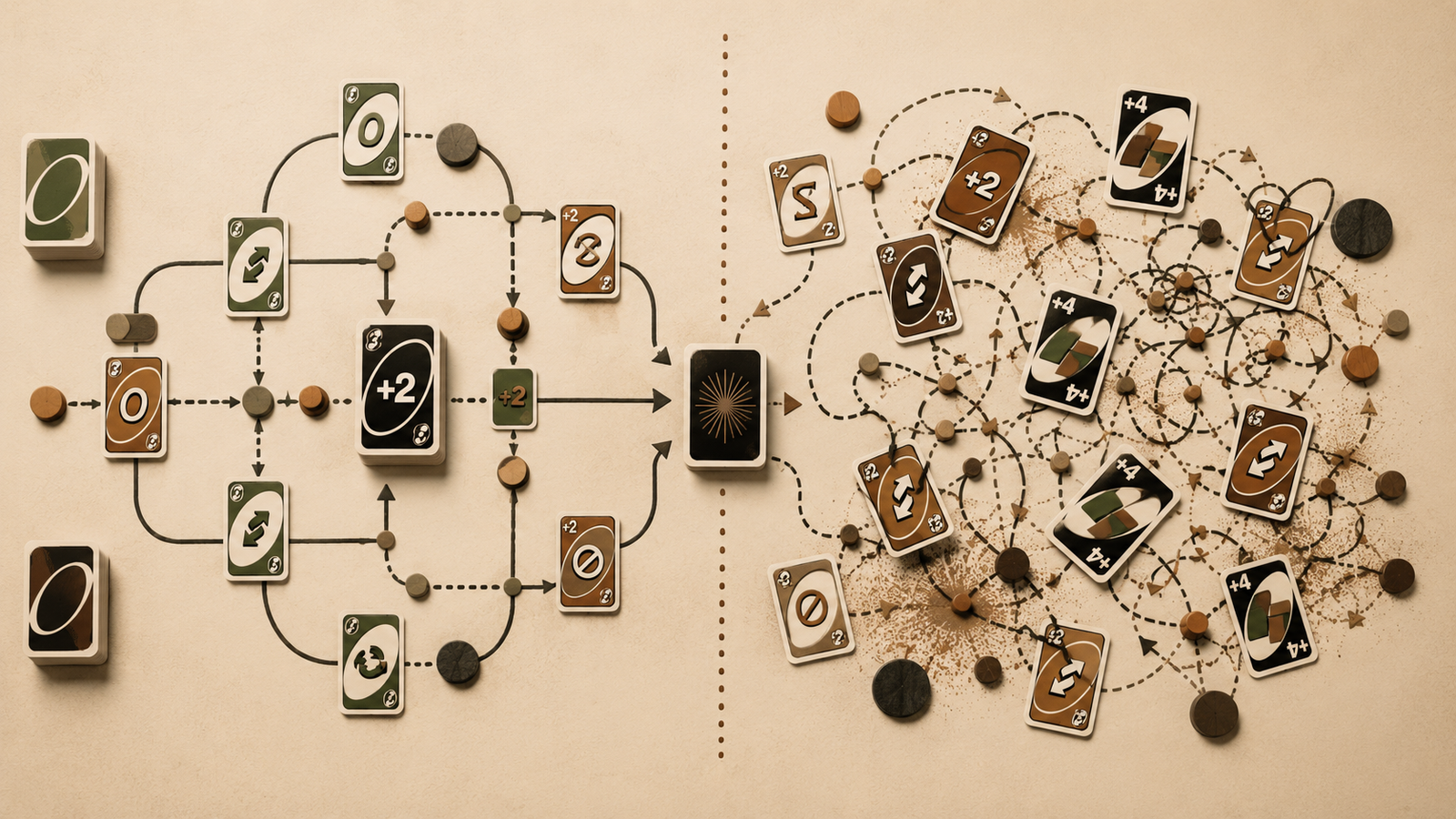
If one table allows stacking Draw 2 cards, the whole game changes. Pressure increases. Risk changes. Aggression becomes rational.
Same cards. Different incentives.
Mattel may print the official rules, but most tables still create their own rhythm.
Public conversation works the same way.
People think they are debating ideas. Often, they are adapting to the incentives of the room.
The structure changes the behavior before the discussion even begins.
Shared Reality Keeps Fragmenting
Healthy societies need enough shared reality for disagreement to remain useful.
That becomes harder when systems reward emotional segmentation.
Different groups now consume different narratives, incentives, sources, and emotional frames. Each group begins to see the other as irrational.
Sometimes both sides are reacting rationally to different information systems.
That is the deeper problem.
The communication environment has fragmented.
Once that happens, public trust weakens. Institutions lose credibility. Expertise becomes politicized. Shared language breaks down.
The result is not simple disagreement.
It is interpretive collapse.
The Strategic Shift
Once the system becomes visible, the strategy changes.
Every failed conversation does not need the same diagnosis.
Some failures are personal. Some are relational. Others are structural.
The sharper questions are simple:
What behavior is this environment rewarding?
What emotional response is this platform encouraging?
Who benefits when reaction outruns understanding?
Those questions create leverage because they reveal the architecture beneath the behavior.
You cannot repair public conversation without studying the systems shaping it.
The System: Updated
Public conversation collapse is not primarily a failure of manners.
It is a failure of incentives.
Modern communication systems reward reaction faster than reflection, certainty faster than context, and visibility faster than truth.
That does not erase personal responsibility. People still choose how they speak, share, argue, and respond.
But serious analysis must also examine the environment shaping those choices.
Study the incentives. Study the structure. Study who benefits when emotional reaction keeps outrunning understanding. That is where the system starts explaining itself.