
Behavior follows environment more often than most discipline advice admits. People blame themselves for patterns that their surroundings repeatedly cue, reward, simplify, or normalize, then call the repetition a motivation problem.
Personal responsibility still matters. But responsibility becomes more useful when it includes the design of the conditions surrounding a choice. Discipline is not only controlling what you do after temptation arrives. It is also deciding how easily temptation gets access to you in the first place.
A phone beside the bed creates a different evening from a phone charging across the room. A calendar open to every request creates a different workday from one with protected focus time. Food that is visible and ready creates a different decision environment from food that requires twenty minutes of preparation.
None of those conditions guarantees behavior. Each one, however, changes the friction attached to the next decision.
Behavior Follows Environment Before It Becomes Identity
Repeated behavior has a dangerous way of becoming personal language. Someone scrolls every night and eventually says, “I have no attention span.” Another person repeatedly overspends and concludes, “I am terrible with money.” Someone struggles to exercise inside a chaotic schedule and begins describing themselves as inconsistent.
Those statements can turn a repeated pattern into an identity before the conditions producing the pattern have been examined.
A repeated behavior is real. It is not automatically a permanent personality trait.
Context matters because behavior can become associated with familiar cues, locations, times, preceding actions, and routines. Research on habit formation has examined how repeated behavior in stable contexts can become increasingly automatic. Familiar environments can therefore make familiar actions easier to repeat.
That means changing the surrounding conditions can sometimes reveal that what looked like identity was partly a rehearsed response to a familiar environment.
Before turning a repeated behavior into a permanent identity, inspect the conditions that keep rehearsing it.
Why Discipline Gets Blamed for a Design Problem
People reach for the language of discipline because it gives them something concrete to control. They say they need to lock in, focus harder, stop procrastinating, or become more consistent.
Sometimes that diagnosis is correct. There are moments when the right action is already clear and the person simply needs to do it.
Discipline becomes inefficient, however, when it is forced to compensate every day for an environment built in the opposite direction.
Consider a person trying to complete focused work while keeping a phone within reach, notifications active, email open, messaging software visible, and several browser tabs competing for attention. That person can still concentrate, but the environment continually introduces opportunities to abandon concentration.
Each hour now contains more small acts of resistance than necessary.
The question is no longer only whether the person possesses willpower. The better question is why the system requires so much willpower to perform ordinary work.
Mind as Discipline
Willpower should not be doing work that architecture can do better. Remove unnecessary decisions first. Then use discipline where judgment and effort are actually required.
A stronger design reduces unnecessary battles. The phone can move to another room. Notifications can be disabled. Distracting tabs can close. A block of time can be protected before the work begins.
None of those changes performs the work for you.
They preserve discipline for the parts of the task that actually require discipline.
Your Environment Is Training You Every Day
Behavior follows environment because environments contain repeated cues and repeated opportunities. What stays visible, what remains within reach, what happens automatically, and what receives social reinforcement all influence which behaviors are easiest to repeat.
Over time, those repetitions can become familiar enough that you stop noticing how much the environment participates in the pattern. What feels spontaneous may have been rehearsed hundreds of times.
Look at an ordinary day without moralizing it. Notice what is immediately available when boredom arrives. Notice what appears on the screen when work becomes difficult. Notice what kind of behavior receives approval from the people around you.
Then look in the other direction. Which actions require preparation, planning, travel, equipment, permission, or an uncomfortable conversation?
Those differences reveal part of the architecture of behavior before motivation enters the analysis.
Scrolling can become practiced behavior because the cue and response appear together repeatedly. Planning can also become practiced behavior when the same time and place repeatedly lead into planning. Saving money can become less dependent on memory when transfers happen automatically. Reading becomes easier to begin when the book is already visible where the habit usually starts.
Repetition still teaches, whether you intended to practice the behavior or not.
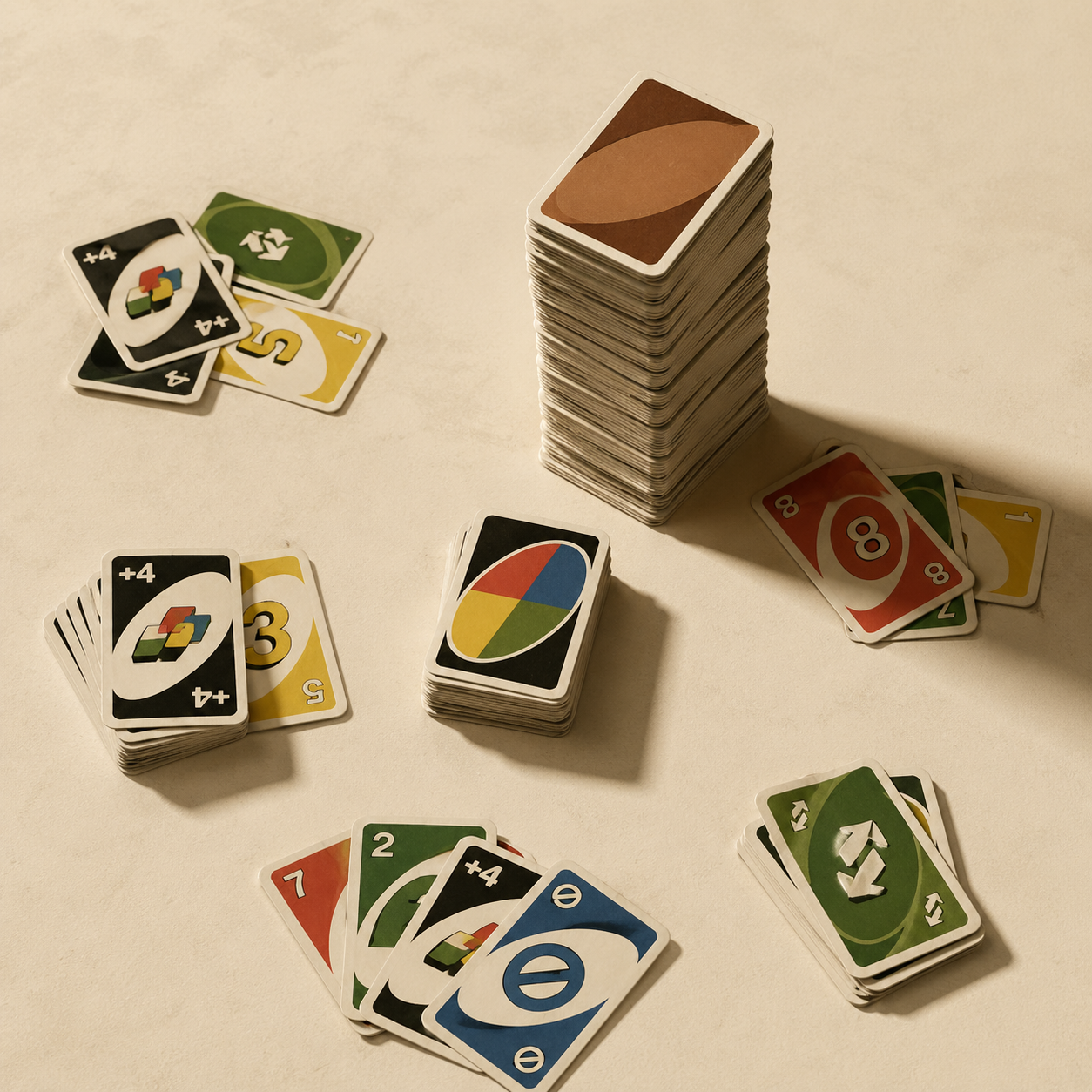
Behavior Follows Environment Because House Rules Matter
A useful way to understand this is through the house rules that develop around familiar games.
Families and friend groups often develop local interpretations of what counts, what is allowed, what can be stacked, and how a particular move works. The official rules may still exist somewhere, but the immediate table is governed by whatever rules the people sitting there consistently enforce.
Everyone adapts because successful play requires responding to the game that is actually being played.
The House-Rules Test
Do not ask only what a system says it values. Ask what behavior the system repeatedly rewards, tolerates, punishes, simplifies, or makes expensive.
That distinction matters well beyond a game.
People do not respond only to rules printed in a handbook, written in a mission statement, or announced during orientation. They also respond to what gets rewarded, ignored, punished, celebrated, or quietly tolerated.
A workplace may say work-life balance matters while consistently rewarding employees who answer messages at all hours. The stated rule is balance. The operating house rule is constant availability.
A family may claim to value honesty while responding defensively whenever someone raises an uncomfortable issue. The stated value is openness. The repeated consequence teaches silence.
A social circle can work the same way. Everyone may say they support growth, yet ridicule begins when one person changes enough to disrupt the established group dynamic. The language says growth is welcome. The reward structure says belonging has conditions.
The operating rule is often revealed more clearly by consequences than by slogans.
Friction Is One of the Hidden Rules of Behavior
Friction is the amount of effort standing between an intention and an action. Small differences matter because people make hundreds of decisions inside ordinary days, and each decision competes with limited time and attention.
An app that opens instantly has less friction than a book stored in another room. Food sitting on the counter has less friction than a meal that still needs preparation. A stored payment method has less friction than a purchase that requires you to find your wallet and enter every number.
The easier path does not always win.
It does enter the decision with an advantage.
Many personal systems are unnecessarily hostile to their own goals. The unwanted behavior remains one tap away while the preferred behavior requires several steps, planning, equipment, memory, or inconvenience.
Then the person tries to overcome the difference through motivation every day.
Eventually, motivation is being asked to solve a design problem.
Good discipline does not maximize the number of decisions you must win. It reduces unnecessary decisions so the important ones receive more attention.
Change the Friction
Move the distracting application away from the first screen. Prepare what you need before the moment of decision. Automate a financial transfer. Put the book where the phone usually sits. Remove unnecessary steps from the behavior you want to repeat.
At the same time, add one or two steps to behaviors you want to interrupt.
These changes do not remove agency.
They change how much resistance surrounds each choice.
Behavior Changes When Pressures Stack
One difficult variable may be manageable. Six difficult variables operating at once can change what ordinary behavior costs.
Consider one late night followed by an early meeting, a long commute, financial pressure, constant phone interruptions, family responsibility, and no protected time to recover.
The visible result might be impatience, procrastination, convenience spending, missed exercise, or another decision the person later regrets.
Analyzing only the final decision ignores the stack that preceded it.
The more useful question is what combination of conditions made the unwanted behavior increasingly likely, attractive, or difficult to resist.
This does not mean poor decisions should simply be excused by circumstances. Accountability still matters because people retain agency inside imperfect conditions.
Accurate accountability, however, examines the whole decision environment instead of pretending every action occurred under ideal conditions.
Direction Changes When Conditions Change
A change in environment can change behavior without requiring a dramatic change in personality.
A new job changes waking hours, commute patterns, food access, and available attention. Moving to a new neighborhood may change transportation, social contact, shopping routines, and opportunities for physical activity. A new relationship, financial shock, caregiving role, or major project can restructure the day before you have had time to redesign your habits around it.
People often interpret these behavior changes as character changes.
Someone who once exercised regularly may assume they became lazy after a job change, even though the old exercise routine depended on a schedule that no longer exists. Another person may wonder why reading disappeared after becoming a parent, although the quiet evening cue that once supported reading disappeared too.
The disciplined response is to study the new operating environment before demanding that an old routine perform unchanged inside it.
Sometimes the habit needs a new time, trigger, location, or smaller starting point. In other cases, the behavior may need to be temporarily reduced because the surrounding conditions genuinely changed available capacity.
Calibration is more useful than nostalgia.
Access Changes the Behavior Equation
Environment is not only about personal organization. People move through daily life with different levels of time, money, transportation, information, support, quiet space, safety, schedule control, and access to resources.
Those differences do not determine every outcome.
They do change the conditions under which behavior has to occur.
Someone living near a grocery store faces a different food environment from someone whose options require significant transportation. A person with predictable work hours faces a different exercise environment from someone working rotating shifts. Someone with a private room for concentration faces a different attention environment from someone sharing limited space with several other people.
The desired behavior can remain identical while the execution cost changes dramatically.
Do not confuse unequal friction with unequal commitment.
Identify the constraint accurately. Then ask whether it can be removed, reduced, substituted, shared, or designed around.
Why the Reset Keeps Failing
Many personal resets begin with new intentions while leaving the operating environment almost untouched.
A person decides to read more, but the phone still sleeps beside the bed. Someone decides to spend less, yet every shopping notification remains active and payment information stays stored everywhere. Another person decides to protect focus while keeping a calendar that allows anyone to claim any open space.
The new goal enters the old system.
At first, motivation may overpower the environment because novelty creates extra energy. Once the novelty fades, familiar cues and low-friction behaviors regain their advantage.
The person concludes that motivation disappeared, restarts the goal, and repeats the same architecture.
If the same reset has failed several times, the next experiment should not automatically be a stronger promise.
Change something upstream.
Change the Conditions Before Demanding More Willpower
Environmental design begins with the parts of the system you can actually influence.
You may not control the workplace, neighborhood, economy, household, platform, or schedule in full. Smaller areas of control can still matter because repeated decisions often happen in the same locations and at the same times.
The objective is not total control.
It is better leverage.
Move something that keeps triggering the wrong action. Remove one unnecessary cue. Automate one useful choice. Schedule one behavior before the week becomes crowded. Create a boundary around one part of the day.
You can also change visibility, access, default settings, or who is permitted to interrupt a particular block of time.
Each adjustment changes the architecture surrounding future decisions.
This connects directly to Control the Structure, Control the Outcome. Goals describe a destination. Systems shape the repeated behavior that determines whether movement toward that destination actually occurs.
Environmental design is therefore not separate from discipline.
It is one of discipline’s highest-leverage applications.
Behavior Follows Environment, but Environment Is Not Destiny
The opposite mistake is using environmental influence as an excuse to surrender agency.
That conclusion is just as weak as pretending conditions do not matter.
Human behavior is influenced by context, but people can still reflect, resist, plan, seek help, leave environments, create boundaries, and deliberately practice different responses.
The point of understanding environmental influence is to increase usable agency, not reduce it.
Some environments are inherited. Others are imposed through work, family, economics, institutions, or circumstance. Certain conditions may take years to change, while others may never come fully under personal control.
Even then, the relevant question remains: what territory is actually movable?
Which defaults can change? Which cues can move? Which access points can close? Which boundaries can become clearer? Which behavior needs a different trigger?
Where the environment cannot change, ask what support or strategy can make the desired behavior more workable inside that reality.
Agency becomes stronger when it operates with an accurate map.
The Behavior Follows Environment Audit
Do not redesign your entire life in one weekend.
Choose one recurring behavior that matters enough to investigate and narrow the problem until it becomes observable.
“I have no discipline” is not observable. It describes identity.
“I scroll for forty minutes after getting into bed” gives you something concrete enough to redesign.
Environment Audit
Audit one behavior, not your entire personality.
What specific action keeps repeating, and when does it usually happen?
What tends to happen immediately before the behavior begins?
Where does the behavior usually occur, and what cues are consistently present?
How easy is the unwanted behavior to begin compared with the behavior you prefer?
What immediate relief, pleasure, approval, convenience, or escape does the behavior provide?
What does the surrounding environment reward in practice, regardless of what you say you value?
Who reinforces the current behavior, intentionally or unintentionally?
What one extra step could make the unwanted behavior less automatic?
What one step could make the desired action easier to begin?
What can happen automatically instead of requiring another decision?
Which part of the environment cannot realistically change right now?
What single environmental change will you test for seven days before judging the redesign?
Build Better Defaults
Defaults matter because many decisions repeat too often to deserve full negotiation every time.
A recurring transfer can move money before spending begins. A recurring calendar block can preserve focus before meetings consume the week. A prepared workspace can reduce the effort required to begin.
The best default does not make the desired behavior inevitable.
It makes the first step less dependent on mood.
Poor defaults quietly tax good intentions. If every healthy meal requires improvisation, every workout requires finding equipment, and every focused session begins by clearing distractions, the preferred behaviors start at a disadvantage.
One practical form of discipline is deciding in advance what should no longer require a fresh decision.
Design for the Bad Day, Not Only the Ideal Day
Behavior systems often fail because they are designed around a person’s best day.
The plan assumes high energy, plenty of time, no interruptions, stable emotions, and perfect memory. Then ordinary life arrives and the system appears to fail unexpectedly.
The failure was not unexpected.
The design simply never accounted for predictable variability.
A better system has a lower gear. The exercise plan has a shorter option. The writing practice has a minimum viable session. The budget has automatic protections. The focus system still functions when motivation is average.
This does not mean making every goal easier.
It means preserving continuity when ideal conditions disappear.
A robust behavior system survives an ordinary Tuesday.
If the system works only when you are rested, inspired, uninterrupted, and ahead of schedule, it is not yet designed for real life.
Further Groundwork
The Groundwork: Behavior Follows Environment
Behavior follows environment, but that principle should make you more responsible, not less.
Once you recognize that cues, access, defaults, social reinforcement, timing, and friction influence repeated behavior, ignoring those conditions becomes a decision of its own.
Start with the behavior that keeps returning. Identify what triggers it, what makes it easy, what reward it provides, and what rule the surrounding environment is enforcing.
Then change one part of that architecture instead of demanding a completely different personality by Monday.
Watch what repeats after the redesign.
Do not make willpower fight battles that a better default could prevent. At the same time, do not use environmental influence to avoid accountability for the choices that remain yours.
Good discipline holds both truths together: conditions matter, and agency matters inside those conditions.
Your environment does not control every decision. But it can place weight on one side of the decision long before you notice yourself choosing.
Learn where the weight is. Then move what you can.
Receipts
- Gardner, B., Lally, P., & Wardle, J. Research overview examining habit formation and the relationship between repeated behavior and contextual cues. Review the research .
- NCBI Bookshelf. Educational overview addressing behavior modification, lifestyle behavior, habit formation, and strategies used to support behavioral change. Review the NCBI overview .
- Habit and contextual-cue research. Additional peer-reviewed literature examining the relationship among habit, context, repeated cues, and health-related behavior. Review the research .