
Street lighting is usually treated as a utility. That is too narrow.
A streetlight does more than brighten pavement. It extends the usable life of public infrastructure after sunset. It makes sidewalks easier to read. It makes crosswalks more visible. It helps transit riders wait with more confidence. It supports evening commerce, public benches, bike lanes, parks, plazas, wayfinding, and civic buildings.
Without lighting, a city may still exist after dark. However, much of it becomes harder to use.
As part of Urban Logic, this article studies street lighting as one of the systems people pass every day without fully seeing. Street lighting reveals a basic truth about cities: infrastructure has operating hours unless design extends them.
A sidewalk in darkness is not the same sidewalk. A bus stop in darkness is not the same bus stop. A public square in darkness is not the same public square. Light changes how people move, wait, gather, navigate, and decide.
That does not mean brighter is always better.
The point is not excess.
The point is legibility.
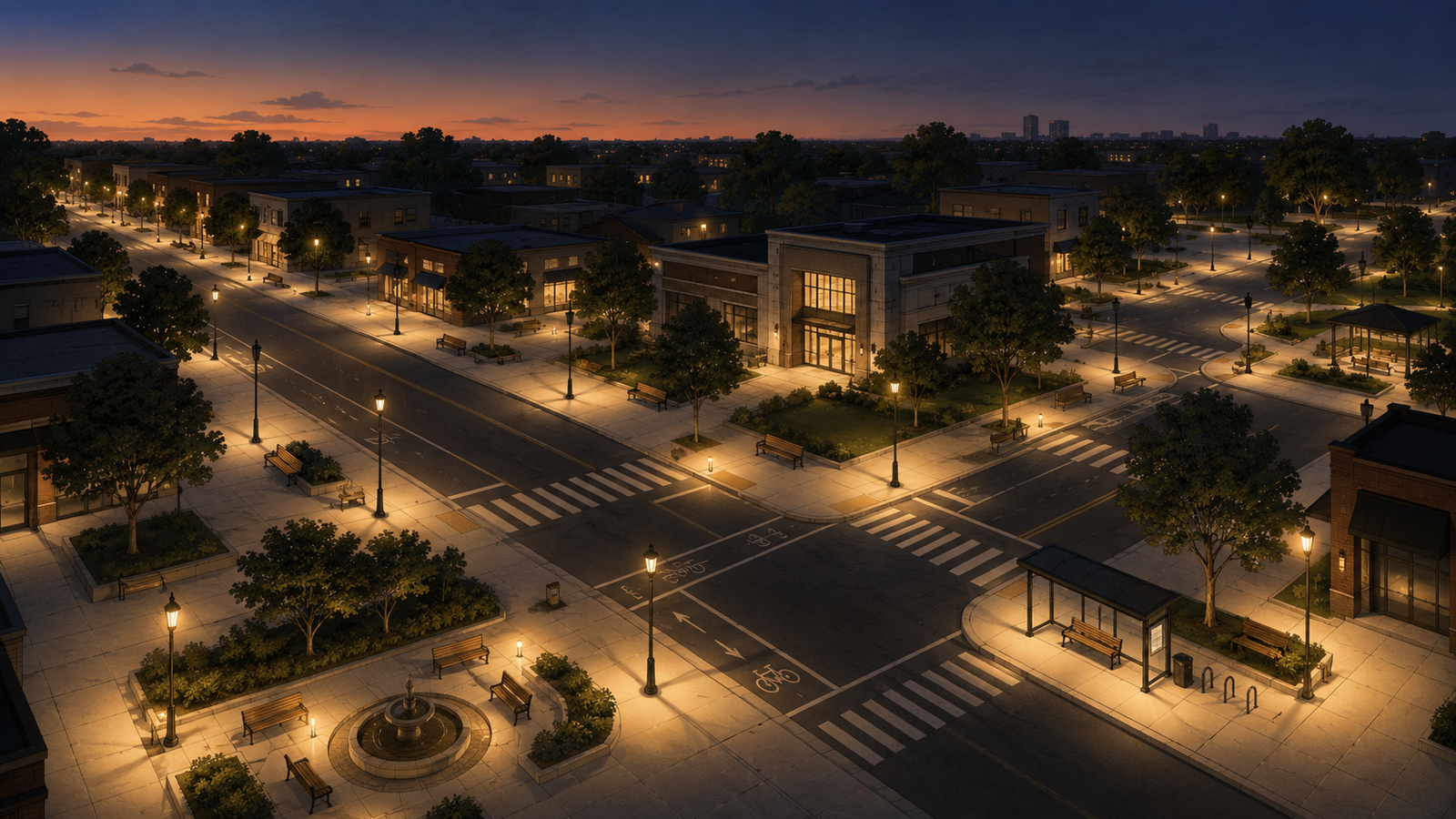
Street Lighting Is More Than Electricity
Street lighting is not just poles, bulbs, wires, and power bills.
It is public infrastructure.
That distinction matters. Electricity is the input. Public confidence is part of the output. Visibility is part of the output. Walkability is part of the output. Safer crossings, clearer routes, stronger wayfinding, and more usable public space are part of the output.
A poorly lit street creates friction. People slow down. They avoid certain blocks. They choose different routes. They leave earlier. They pay for rides they might not otherwise need. They avoid transit stops that feel exposed.
Those choices shape the city.
Good lighting does not solve every safety problem. Anyone selling that story is oversimplifying the system. Even so, lighting does affect whether public space feels usable after sunset.
A serious city does not treat that as decoration.
It treats lighting as part of the street’s operating system.
Walk one familiar block at dusk. Notice what becomes easier to read and what disappears into shadow. The missing details are not just visual. They are civic information.
Public Lighting Extends the Day
Public lighting extends the day because it keeps infrastructure legible after natural light fades.
This is the core argument.
Cities do not shut down at sunset. People still work. Students still commute. Parents still run errands. Elders still return from appointments. Transit riders still wait. Small businesses still serve customers. Neighbors still walk home.
If the public realm is not lit well, those ordinary activities become harder.
The city may have invested in sidewalks, crosswalks, benches, bike lanes, bus stops, parks, storefront corridors, and wayfinding systems. Yet after dark, weak lighting reduces the value of those investments.
That is bad asset management.
Street lighting protects the usability of other infrastructure. It helps the public realm remain active beyond daylight hours. It supports the night-shift worker, the evening student, the late bus rider, the closing cashier, and the neighbor walking back from the pharmacy.
Public lighting is how a city says the public realm still counts after dark.
Street Lighting Supports Walkability
People walk where they can see.
That sounds obvious. Still, too many streets fail this basic test.
Walkability is not only about sidewalk width. It is not only about distance. It is not only about crosswalks, street trees, benches, and destinations. Walkability also depends on whether a person can read the path in front of them.
Lighting helps people see uneven pavement, curb edges, steps, puddles, trash, tree roots, driveway crossings, signs, building entrances, and other people moving through the same space. It also helps drivers see pedestrians near crossings and corners.
This is where street lighting becomes practical.
A well-lit sidewalk can expand a person’s comfort zone. A dark sidewalk can shrink it. A well-lit crosswalk can feel like part of the street system. A dark crosswalk can feel like a gamble.
Bad lighting turns short distances into harder decisions.
Good lighting does not remove every risk. However, it lowers the amount of guesswork required. That is what infrastructure is supposed to do.
Street Lighting Supports Local Commerce
Local businesses depend on more than customers.
They depend on the conditions that allow customers to arrive.
Street lighting shapes evening commerce because people are more likely to visit corridors that feel visible, readable, and maintained. Restaurants, cafés, corner stores, pharmacies, bookstores, barbershops, cultural venues, and small retail corridors all benefit when streets remain usable after dark.
This does not mean lighting alone creates economic life.
That would be weak analysis.
Businesses still need demand, pricing, service, cleanliness, safety, transit access, clear wayfinding, and strong street conditions. Still, lighting supports the environment where those businesses operate.
A dark commercial block sends the wrong signal. It can make a corridor feel closed even when stores are open. It can reduce foot traffic. It can shorten visits. It can make people move quickly instead of comfortably.
By contrast, thoughtful lighting gives evening public life a frame.
It helps people see entrances, signs, sidewalks, benches, crosswalks, and transit stops. It gives the corridor continuity. It helps the street feel active without needing spectacle.
Commerce follows usable public space.
Street Lighting Improves Wayfinding
Wayfinding is not only signage.
It is the ability to understand where you are and where you can go next.
Street lighting helps people navigate by making routes clearer. A connected pattern of lights can guide movement along sidewalks, through plazas, toward transit stops, across crosswalks, and between civic destinations.
This matters more than people admit.
At night, the city loses visual information. Landmarks become less obvious. Corners look different. Side streets can feel uncertain. Parks and plazas change character. A route that feels simple during the day can feel confusing after dark.
Lighting restores part of that lost structure.
It can highlight pedestrian routes. It can mark crossings. It can define public squares. It can support bus stops and bike lanes. It can make a library, park entrance, or civic building easier to locate.
As explored in Wayfinding Is Public Infrastructure, navigation is not a soft feature. It is part of access. Lighting strengthens wayfinding because people need to read signs, entrances, paths, transit information, and public landmarks in real conditions, not only in daylight.
Good lighting helps the city explain itself.
Bad lighting makes people work harder than they should.
Maintenance Is Part of Illumination
A broken streetlight is not a small issue.
It is a public signal.
One dark pole can change the feel of a block. Several broken lights can change how people use an entire corridor. A pattern of outages can tell residents that the area is not being watched, repaired, or taken seriously.
Maintenance is part of illumination.
Street lighting requires inspection, replacement, cleaning, wiring, energy management, outage response, and coordination across departments. It also needs accountability. Residents should know how to report outages. Agencies should know how fast repairs are expected. Data should show which neighborhoods wait longest.
Without maintenance, lighting becomes another civic promise that fades over time.
This is where governance matters.
A city can install beautiful lights and still fail if it cannot maintain them. A streetlight is not complete when it is installed. It is complete when it works reliably.
Public infrastructure lives or dies in the maintenance cycle.
Light Pollution Requires Balance
Good lighting is intentional.
It is not excessive.
This distinction matters because cities can overcorrect. Too much light can create glare, waste energy, disturb sleep, affect wildlife, and wash out the night sky. Brightness without control can make a street feel harsh rather than safe.
The goal is not to flood every block with light.
The goal is to place the right light in the right location for the right purpose.
Sidewalks need visibility. Crosswalks need clarity. Transit stops need legibility. Bike lanes need route definition. Public benches and plazas need comfort without glare. Parks need careful lighting that supports safety without destroying the character of the space.
Better lighting uses direction, shielding, color temperature, placement, and maintenance discipline.
That is the grown-up version of the conversation.
More light is not always better. Better light is better.
Street Lighting Connects the Urban Logic Network
Street lighting connects nearly every layer of Urban Logic.
Sidewalks need lighting because walking does not end at sunset. Crosswalks need lighting because visibility shapes safety. Bus stops need lighting because waiting in darkness changes the experience of transit. Bike lanes need lighting because routes must remain readable. Public benches need lighting because rest points feel different after dark. Wayfinding needs lighting because signs, maps, entrances, landmarks, and route cues must remain legible. Third places need lighting because social infrastructure often extends into the evening.
That is why street lighting cannot be treated as a separate utility question.
It is a system connector.
Lighting makes other infrastructure more usable. It extends the public value of investments the city has already made. Without it, the network weakens after sunset.
This is the operating-hours problem.
Every city has infrastructure. Better cities understand when that infrastructure actually works. If people avoid a sidewalk at night, the sidewalk is not fully working. If people skip a bus stop after dark, transit access is not fully working. If a plaza empties because it feels illegible, public space is not fully working.
Lighting does not create public life by itself.
But it allows public life to continue.
Unequal Lighting Creates Unequal Access
Lighting is not distributed evenly.
Some neighborhoods have well-maintained lighting, clear pedestrian routes, bright crossings, and active commercial corridors. Other neighborhoods live with broken poles, dark sidewalks, weak intersections, and slow repair cycles.
That difference matters.
Unequal lighting creates unequal access after dark. It affects who feels comfortable walking. It affects who can wait for transit with confidence. It affects which businesses receive evening foot traffic. It affects whether parks and public spaces remain usable.
This is not just a design issue.
It is an equity issue.
A city should know where lighting is failing. It should know which outages last longest. It should know which corridors need better pedestrian lighting. It should know whether upgrades follow need or politics.
Without that knowledge, lighting decisions drift.
When lighting drifts, people with the least margin often absorb the most friction.
Lighting Should Serve People, Not Just Roads
Many lighting systems were designed around vehicles first.
That is the wrong default for a walkable city.
Roadway lighting helps drivers see lanes, signals, signs, and intersections. That matters. However, public lighting must also serve pedestrians, transit riders, cyclists, elders, children, workers, and people using public space at human speed.
Light aimed only at the roadway can leave sidewalks feeling weak. Bright vehicle corridors can exist beside dark walking paths. That imbalance tells the truth about design priorities.
Human-scale lighting works differently.
It considers eye level. It considers benches. It considers crossings. It considers bus shelters. It considers storefronts, trees, curb ramps, public squares, signs, and building entrances. It reduces glare and improves legibility where people actually move.
A city built only for headlights is not enough.
Public lighting should serve the public.
Read Your City
Choose one route you use after dark. Notice where the light helps you understand the street and where it fails. Then ask whether the lighting serves people walking, waiting, crossing, navigating, and gathering, or only vehicles moving through.
Reading street lighting means looking past brightness.
Ask what the light is trying to do. Does it illuminate the sidewalk? Does it clarify the crosswalk? Does it help a transit rider find the stop? Does it make a bench feel usable? Does it help people read signs and entrances? Does it reduce glare? Does it guide movement without washing out the whole block?
Then ask where the system breaks.
Which lights are out? Which corners feel dark? Which bus stops feel abandoned after sunset? Which public spaces stop functioning when daylight disappears? Which signs become unreadable? Which entrances become unclear?
Those questions reveal whether lighting is being treated as infrastructure or as an afterthought.
The Groundwork Principle
Street lighting is public infrastructure because it keeps the city usable when daylight is gone.
It supports walking. It supports transit. It supports local business. It supports public seating. It supports wayfinding. It supports confidence, maintenance, and civic presence.
But lighting must be designed with discipline.
Too little light creates uncertainty. Too much light creates waste and glare. Poorly placed light misses the people who need it most. Broken light tells residents that maintenance is optional.
The best lighting does not shout.
It clarifies.
It helps the city remain readable. It gives people enough confidence to keep moving, waiting, gathering, navigating, and returning. It extends the useful life of streets, sidewalks, crosswalks, bus stops, bike lanes, benches, parks, commercial corridors, and wayfinding systems.
The principle is simple.
A city remains public after dark only when people can confidently use it.
Keep Seeing the Systems Around You
Most people move through cities without noticing the systems shaping their choices. Urban Logic helps you read the built environment differently, from street lighting and sidewalks to bus stops, bike lanes, public benches, wayfinding, and third places.
Subscribe to the Groundwork Daily newsletter for weekly essays that reveal the hidden systems behind modern life and help you navigate them with greater clarity, capability, and intention.

→ Urban Logic: Understanding the Hidden Systems That Shape Cities
→ Wayfinding Is Public Infrastructure
→ Sidewalks Are Economic Infrastructure
→ Crosswalks Are Civic Infrastructure
→ Bus Stops Are Public Infrastructure
→ Bike Lanes Are Transportation Infrastructure
→ Public Benches Matter More Than You Think
→ Why Third Places Matter More Than Ever
Receipts:
→ Illuminating Engineering Society
→ Federal Highway Administration Pedestrian and Bicyclist Safety
→ National Association of City Transportation Officials
→ DarkSky International