Who should own community history is not merely a legal question. It is a question of power, responsibility, access, interpretation, and long-term institutional control.
Last updated: September 2026
A community may create the history. Families may preserve the records. Volunteers may organize the archive. Later, a museum, university, library, nonprofit, government agency, or private collector may hold the materials. However, possession does not settle the larger issue.
Who decides what gets preserved? Who controls public access? Which party may publish, license, describe, restrict, transfer, or remove the records? More importantly, who receives the economic and reputational value created by the collection?
These are not minor administrative questions. Instead, they determine whether community history remains a living public asset or becomes material controlled by an institution the community cannot influence.
The strongest answer is rarely unlimited private ownership or informal community control. Durable cultural ownership requires a structure that separates legal title, physical custody, intellectual property, governance authority, public access, and long-term stewardship.
Accordingly, this guide examines the major ownership models, the risks inside each structure, and the governance system most likely to preserve community authority across generations.
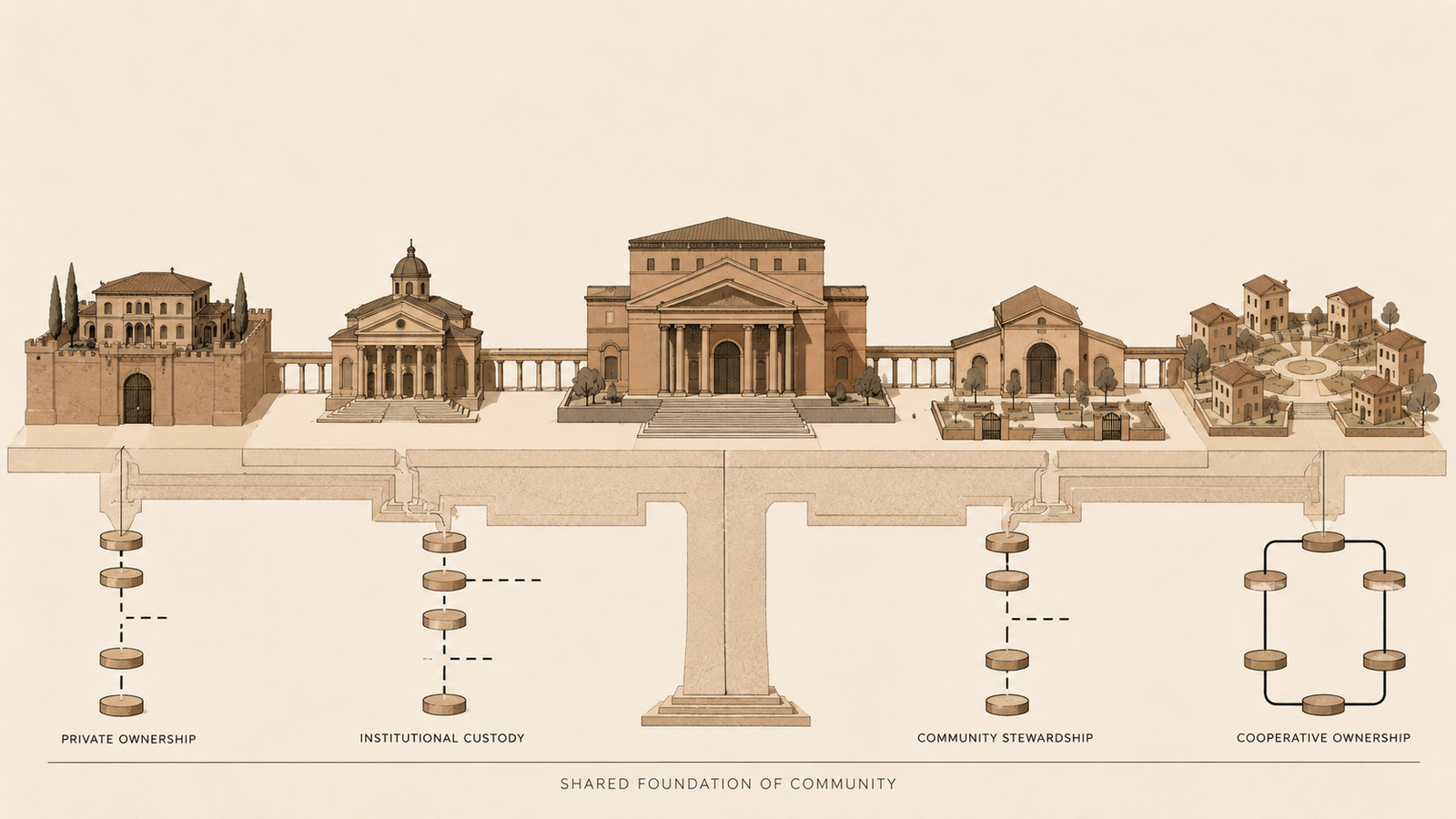
Table of Contents
- What Community History Ownership Means
- Why Ownership and Custody Are Different
- Model 1: Private Ownership
- Model 2: Institutional Custody
- Model 3: Community Organization Ownership
- Model 4: Shared Stewardship
- Model 5: Community Trust or Cooperative Ownership
- Which Ownership Model Works Best?
- The Community History Ownership Test
- A Governance Blueprint
- Planning for Transfer
What Community History Ownership Means
People often use the word ownership as though it describes one complete form of control. In archives, however, several rights may exist at the same time.
One person may own a physical photograph. Another person may hold the copyright. Meanwhile, a repository may store the photograph, and a donor agreement may limit public access. The people represented in the image may also retain a legitimate cultural interest in how the photograph is described and used.
Therefore, asking who should own community history requires more than identifying whose name appears on a deed, contract, or database account.
Five Forms of Control Over Community History
Every community archive should distinguish among five forms of authority:
- Legal title: Who legally owns the physical or digital materials?
- Physical custody: Who stores, protects, and maintains the materials?
- Intellectual property: Who controls copyright, reproduction, publication, and licensing?
- Governance authority: Who establishes policies and resolves disputes?
- Cultural stewardship: Who has a legitimate voice in interpretation, sensitivity, access, and long-term use?
These rights can belong to one institution. They can also be divided through written agreements.
That division is not automatically a weakness. In many cases, it creates stronger protection because no single party controls every decision without accountability.
Groundwork Principle
Ownership determines who holds the asset. Governance determines whose interests the asset continues to serve.
Why Community History Ownership and Custody Are Different
An organization can protect a collection without owning it.
For example, a family may retain legal title while a library stores the material under a deposit agreement. A university may digitize records without receiving copyright. Likewise, a museum may display an artifact for a defined period without gaining permanent ownership.
Custody changes where a collection is kept. Ownership changes who holds legal authority over it.
The Society of American Archivists describes a deposit agreement as an arrangement that transfers physical custody without necessarily transferring title. By contrast, a deed of gift generally transfers ownership and any additional rights specified in the agreement.
Neither model is automatically superior. A custody agreement may preserve community ownership, but the repository may hesitate to make major preservation investments without long-term control. Full transfer may strengthen institutional capacity, yet it may also reduce the community’s future authority.
Ultimately, the correct structure depends on the collection, the institution, the community, and the protections written into the agreement.
Questions to Answer Before Transferring Community History
- Does the agreement transfer custody, legal title, copyright, or all three?
- Who pays for preservation and storage?
- Who approves digitization and publication?
- Can the receiving institution sell, transfer, or remove material?
- Can the community appoint representatives to governance?
- What happens if the receiving institution closes?
- Can restrictions change, and who approves those changes?
- How will the collection remain discoverable to its community of origin?
Without written answers, a transfer can look collaborative while quietly surrendering long-term authority.
Model 1: Private Ownership of Community History
Private ownership is often where community history begins.
Families hold photographs, letters, church programs, business records, recordings, films, artwork, organizational papers, and personal collections. In addition, a founder may create an archive independently before any formal institution exists.
This model can protect material during periods when established organizations show little interest. Private owners may also understand the collection’s context better than anyone else. Often, they know the names, relationships, events, and unwritten history surrounding each record.
At the same time, private ownership concentrates risk.
Strengths of Private Ownership
- Decisions can be made quickly.
- Personal knowledge remains close to the collection.
- Owners retain direct control over access.
- Material can be protected from harmful institutional interpretation.
- Families can respond directly to cultural or privacy concerns.
Risks of Private Ownership
- Collections may be lost through death, relocation, conflict, or inheritance.
- Preservation funding may remain limited.
- Succession may be unclear.
- Public discovery may remain restricted.
- Context may depend on one person’s memory.
- Records may eventually be sold outside the community.
The weakness is not private ownership by itself. Rather, the weakness is private ownership without a preservation and succession plan.
A family-controlled archive can remain durable when ownership documents, storage standards, access rules, digital backups, and inheritance instructions are clear. Otherwise, the next generation may receive valuable records without understanding their purpose or stewardship obligations.
Model 2: Institutional Custody of Community History
Universities, museums, public libraries, historical societies, and government archives often possess greater preservation capacity than families or volunteer organizations.
For instance, these institutions may provide climate-controlled storage, trained archivists, cataloging systems, conservation services, insurance, cybersecurity, research access, and stable operating infrastructure.
Those advantages matter. At the same time, institutional custody introduces a different concern: does the community retain meaningful authority after the transfer?
What Institutions Can Provide
- Professional preservation
- Stable storage environments
- Cataloging and finding aids
- Research access
- Digitization capacity
- Legal and administrative support
- Institutional continuity
What Communities Can Lose
- Control over description and interpretation
- Authority over culturally sensitive material
- Direct access to original records
- Influence over exhibitions and licensing
- The ability to prevent future transfer or removal
- Economic value created through reproduction or publication
An institution may preserve a collection perfectly while weakening its relationship to the people whose history it contains. Consequently, institutional prestige should never replace governance review.
Rather than asking only whether the institution is respected, ask what enforceable authority the community will retain after the institution accepts the collection.
A Composite Example
This scenario combines common patterns in institutional transfers. It does not describe one specific donation.
Because the library has a conservation lab and permanent staff, a neighborhood association donates forty years of newsletters, photographs, and meeting records to a regional university.
Although the deed of gift transfers legal title outright, it says nothing about consultation. Two years later, the university licenses several photographs to a documentary production without contacting the association.
Afterward, a new archivist rewrites the collection’s descriptions using academic language that community members find alienating.
Nothing violated the agreement. The university owns the material and can exercise the rights it received. However, the association failed to request the protection that mattered most: a clause requiring community review before licensing or major reinterpretation.
When Institutional Custody Works Well
Institutional custody works best when the written agreement defines access, attribution, restrictions, community consultation, licensing, digital copies, future transfers, and dispute resolution.
Moreover, the agreement should explain what happens if the institution changes its mission or can no longer support the collection.
Friendly promises are not enough. Leadership changes, budgets tighten, and priorities move. Therefore, the agreement must survive the people who negotiated it.
Model 3: Community Organization Ownership
A nonprofit, cultural center, church, neighborhood association, tribal government, lineage organization, or local historical society can own an archive on behalf of a defined community.
This model keeps legal authority closer to the people represented in the collection. It can also connect preservation with education, programming, public events, oral history projects, and local research.
Nevertheless, community ownership does not automatically create strong stewardship. A small organization may possess moral legitimacy while lacking stable funding, technical systems, staff capacity, insurance, legal support, or succession planning.
Community Ownership Requires Institutional Discipline
The organization must function as more than a symbolic custodian. It needs:
- a legally authorized governing body;
- a written collecting policy;
- documented acquisition and rights procedures;
- preservation standards;
- financial controls;
- public access policies;
- conflict resolution procedures;
- succession and dissolution plans.
Defining Who the Community Includes
Beyond formal ownership, the organization must define who counts as the community.
That question can become difficult when neighborhoods change, descendants disagree, organizations divide, or one group claims authority over a history shared by several groups.
For that reason, community legitimacy requires transparent representation rather than vague language about serving everyone.
Structural Insight
Community ownership without accountable governance can reproduce the same concentration of power it was created to prevent.
Model 4: Shared Stewardship of Community History
Shared stewardship divides authority between a community and a professional repository.
The repository may provide preservation, storage, cataloging, and access infrastructure. Meanwhile, the community retains defined authority over description, sensitivity, cultural protocols, interpretation, or selected uses.
As a result, this structure can create a stronger balance between technical capacity and community authority.
What Shared Stewardship Can Include
- joint approval of descriptions and finding aids;
- community review of culturally sensitive materials;
- restrictions on reproduction or commercial licensing;
- community representation on an advisory council;
- shared authority over exhibitions and public interpretation;
- digital copies returned to the community;
- scheduled reviews of the agreement;
- clear procedures for correcting harmful or inaccurate descriptions.
Shared stewardship is not the same as informal consultation.
Consultation allows an institution to listen and then proceed independently. By contrast, shared stewardship assigns documented authority and responsibility to more than one party.
That distinction determines whether community participation is advisory or structural.
The Main Risk of Shared Stewardship
Ambiguity can make the arrangement fragile.
For example, an agreement may say both parties will “work together” without defining approval rights, deadlines, decision procedures, or dispute resolution.
Under those conditions, the institution with physical custody usually retains practical control.
For that reason, shared stewardship succeeds only when shared authority is specific and enforceable.
Model 5: Community Trust or Cooperative Ownership
A community trust or cooperative can separate the archive from any one founder, family, nonprofit, university, or government office.
Under this model, a legally recognized entity holds the collection for a defined public or community purpose. Governance authority is distributed across representatives rather than concentrated in one owner.
The entity may preserve the materials directly. Alternatively, it may contract with a professional institution for storage and conservation.
Because ownership and operational responsibility can remain separate, this model offers a strong path toward durable community control. However, it also requires mature governance.
What a Community Trust Can Protect
- the archive’s mission;
- community representation;
- restrictions on sale or transfer;
- long-term preservation obligations;
- public access commitments;
- cultural protocols;
- succession beyond one organization.
These protections matter because leadership, funding, and institutional partnerships will change over time. Even as those conditions shift, a durable trust can keep the collection’s purpose intact.
What Cooperative Governance Must Define
- who appoints governing members;
- which communities receive representation;
- how conflicts of interest are handled;
- which decisions require a supermajority;
- how future generations enter governance;
- how the entity funds preservation;
- what happens during dissolution;
- which institutions may receive custody.
Without those controls, a cooperative structure can become slow, political, or captured by a small internal group.
Shared Control Still Requires Clear Authority
Distributed governance does not mean every person must approve every decision.
Instead, the structure should distinguish routine operations from decisions that could permanently change the collection. Staff may manage storage, cataloging, and ordinary access requests. However, major licensing agreements, transfers, sales, restrictions, or changes in purpose may require broader approval.
This division keeps daily work moving while protecting the decisions that carry lasting consequences.
Therefore, the goal is not to distribute every decision to everyone. It is to prevent irreversible cultural decisions from resting with one unaccountable owner.
Which Community History Ownership Model Works Best?
No ownership model solves every problem.
Private ownership may protect context but weaken continuity. By comparison, institutional custody may strengthen preservation while reducing community authority.
Community ownership may strengthen legitimacy, although it can strain limited capacity. Shared stewardship may balance those interests, yet vague agreements can create uncertainty.
A trust may protect long-term purpose more effectively. Still, it requires reliable funding and disciplined governance.
Because each structure solves a different problem, the strongest arrangement often combines several models.
A Hybrid Community History Ownership Structure
A durable arrangement may work as follows:
- A community trust legally owns the collection.
- A university provides physical custody and preservation.
- A community council governs culturally sensitive access.
- A nonprofit manages programming and public education.
- A written agreement controls licensing, transfer, and succession.
This arrangement separates responsibilities according to institutional capacity while preserving community authority.
In other words, ownership does not require one organization to do everything alone. It requires enough enforceable power to protect the collection’s purpose.
The Groundwork Daily Community History Ownership Test
Before transferring, accepting, or restructuring a cultural collection, evaluate the proposed model across eight dimensions.
| Dimension | Core Question | Failure Risk |
|---|---|---|
| Title | Who legally owns the collection? | Ownership remains disputed or undocumented. |
| Custody | Who stores and protects the materials? | No institution accepts operational responsibility. |
| Rights | Who controls copyright and reproduction? | The archive cannot use or license its holdings. |
| Governance | Who makes binding decisions? | Informal influence replaces accountable authority. |
| Access | Who can use the collection, and under what conditions? | Preservation produces practical invisibility. |
| Community Voice | Does the community retain defined authority? | Consultation occurs without decision power. |
| Funding | Who pays for long-term stewardship? | Permanent obligations rely on temporary grants. |
| Succession | What happens when leadership or institutions change? | The collection becomes stranded or transferred without consent. |
A strong agreement should answer every question in writing.
Otherwise, unresolved authority may later default to the party with the most money, legal capacity, physical control, or institutional leverage.
A Governance Blueprint for Community History Ownership
Communities do not need a complex legal structure before preserving their first record.
However, they do need a clear path from informal custody to durable governance.
Start With Purpose and Existing Rights
1. Define the Community and Purpose
State whose history the archive preserves, why the collection exists, and which public or community interests it must serve.
A vague mission makes later ownership disputes harder to resolve.
2. Inventory Existing Rights
Next, document who owns each collection, who created the materials, what copyright exists, which restrictions apply, and whether written agreements already govern use.
Do not assume possession equals ownership.
3. Choose the Ownership Structure
Then decide whether the archive will remain privately owned, transfer to a nonprofit, enter a trust, use institutional custody, or adopt a shared stewardship arrangement.
The decision should match the archive’s capacity and long-term purpose.
Build Authority, Funding, and Continuity
4. Document Community Authority
Identify which decisions require community representation or approval.
For example, these may include culturally sensitive access, commercial licensing, major exhibitions, removal, transfer, renaming, and changes to restrictions.
5. Separate Preservation From Control
A professional institution may provide storage without receiving unrestricted ownership.
Therefore, agreements should assign technical responsibilities while protecting governance rights.
6. Establish Economic Rules
Define how reproduction fees, licensing revenue, publication income, grants, or commercial partnerships will support preservation and community benefit.
As a result, cultural value will not leave the archive without a clear return path.
7. Build Succession Into the Structure
Determine how governing members change, how descendants or community representatives participate, and where the collection goes if the current organization dissolves.
Above all, succession should protect the mission rather than simply replace personnel.
8. Review the Structure Regularly
Communities, technologies, institutions, and legal conditions change.
For that reason, ownership and stewardship agreements should be reviewed on a fixed schedule so written governance remains durable without becoming frozen.
Ownership Principle
The strongest owner is not the party with the tightest grip. It is the structure most capable of protecting purpose, access, context, and continuity at the same time.
How Community History Ownership Should Transfer
No institution lasts forever in its original form.
Some organizations close. Universities may merge. Families divide estates, while museums change priorities. Elsewhere, nonprofits lose funding or buildings become unavailable.
Because these changes are predictable, every community history ownership structure needs a responsible transfer plan.
What a Transfer Plan Should Protect
First, the plan should identify an order of preferred successor institutions. It should also prohibit transfers that conflict with the archive’s mission, donor agreements, cultural restrictions, or community access commitments.
- collection integrity;
- provenance and metadata;
- donor agreements;
- copyright and licensing records;
- culturally sensitive restrictions;
- community consultation rights;
- public access commitments;
- digital copies and preservation records.
Most importantly, owners should not wait until financial collapse to decide what happens next.
Emergency transfers usually favor speed. Planned transfers, by contrast, can protect values.
Who Should Own Community History?
Who should own community history depends on who can protect it without severing it from the people who gave it meaning.
Possession alone does not establish legitimate authority. A private collector, family, nonprofit, university, museum, library, or government agency must also demonstrate responsible stewardship.
The Strongest Practical Model
In many cases, the strongest model is a community-governed trust or nonprofit that owns the collection while partnering with a capable archival institution for physical preservation and access.
That structure is not universally available. It requires legal capacity, funding, governance, and sustained participation.
Where such a model cannot be built immediately, communities should still protect their position through donor agreements, deposit agreements, shared stewardship rules, representation rights, access commitments, and succession plans.
Ownership Must Serve Stewardship
The goal is not ownership as symbolism. Instead, communities need enough control to protect context, access, dignity, economic value, and continuity across generations.
Community history should not become property locked away from the public. At the same time, it should not become open material stripped of cultural accountability.
Ultimately, institutions capable of care should preserve the collection. Structures accountable to the people represented in the history should govern it.
History survives through preservation. Community authority survives through ownership designed as stewardship.
Continue Building
Ownership is one layer of cultural continuity. Continue through the Cultural Structures framework to understand why archives matter, how durable archives are built, and why institutional systems fail.
→ Framework: Culture Is Infrastructure, Not Performance
→ Mechanism: How Communities Build Cultural Archives That Last
→ Mechanism: Why Cultural Archives Fail Even When the Records Survive
Build cultural systems that retain ownership, memory, and authority.
Groundwork Daily examines how governance, institutions, ownership, and stewardship determine whether communities preserve cultural influence or surrender control of it.
Receipts
→ Society of American Archivists: A Guide to Deeds of Gift
→ Society of American Archivists Dictionary: Deposit Agreement
→ National Archives: Gift Collection Acquisition Policy for Still Pictures
→ Library of Congress: Access Policy for Culturally Sensitive Materials
→ UNESCO: Recommendation on Preservation and Access to Documentary Heritage
About Adrian Cole

Adrian Cole is the Groundwork Daily builder behind Cultural Structures, a series examining culture as economic and institutional infrastructure.
His work studies the systems that shape how communities preserve values, transfer knowledge, establish legitimacy, protect ownership, and maintain cultural continuity across generations.
Rather than treating culture as entertainment or symbolism alone, Cole examines the governance structures, incentives, institutions, and ownership arrangements that determine whether cultural influence becomes durable community power or value captured elsewhere.