Last updated: September 2026
Why cultural archives fail is often misunderstood. Most people picture fire, flooding, theft, corrupted files, or physical neglect. Many archives fail while every photograph, recording, document, and storage box remains intact.
The records survive. The institution around them does not.
One person may still know the passwords, but that person has left. Donor agreements may exist somewhere, yet nobody can locate them. Digital backups may also exist, though no one has tested whether the files can be restored.
Photographs remain preserved even as their names, dates, origins, and relationships disappear.
Nothing looks destroyed. Yet the archive can no longer explain what it holds, prove what it owns, govern how records are used, or transfer responsibility to the next steward.
This is why cultural archives fail in their most dangerous form: the evidence remains visible while the systems that make the evidence usable quietly disappear.
How Communities Build Cultural Archives That Last explains the systems required for long-term preservation. This article examines the reverse: how governance, documentation, rights, preservation, funding, and succession gradually stop working.
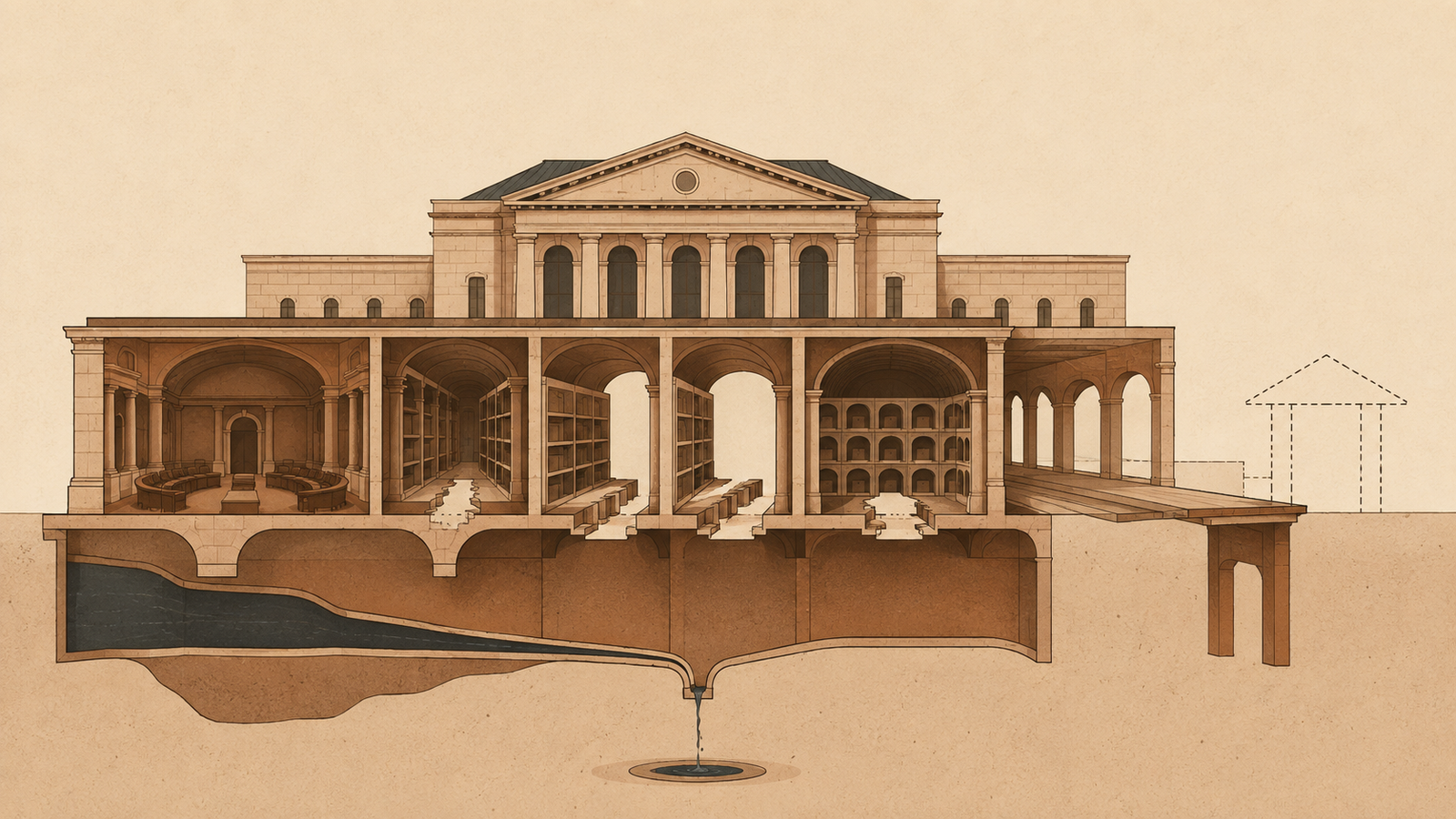
Table of Contents
- Why Records Can Survive While an Archive Fails
- 1. Founder Dependence Weakens the Institution
- 2. Metadata Slowly Disappears
- 3. Rights Become Unclear
- 4. Technology Outlives Documentation
- 5. Funding Ends After the Launch
- 6. Governance Quietly Stops
- The Groundwork Daily Archive Failure Audit
- How an Archive Recovers Before Collapse
Why Cultural Archives Fail While Records Survive
A record is an individual object. It may be a photograph, oral history, newspaper, meeting minute, letter, video, artifact, or digital file.
An archive is different. It is the institutional system that connects those records to provenance, meaning, rights, context, preservation, and access. That distinction explains why cultural archives fail even when their contents remain physically safe.
A box of photographs can survive for fifty years. However, if no one knows who appears in the images, when they were taken, where they came from, or whether they may be reproduced, their institutional value has already weakened.
A hard drive can also remain functional while the archive itself stops working. The files may open, but no one can determine which version is authoritative, which interviews contain restrictions, or how one folder relates to another.
Preservation cannot be measured only by survival.
The Five Relationships an Archive Must Preserve
A durable archive must maintain five essential relationships:
- the relationship between a record and its creator;
- the relationship between a record and its historical context;
- the relationship between custody and ownership;
- the relationship between preservation and access;
- the relationship between current stewards and future stewards.
Once those relationships break, the records may remain visible while the archive becomes institutionally silent.
Groundwork Principle
Records preserve evidence. Institutions preserve the ability to interpret, govern, and transfer that evidence.
1. Why Cultural Archives Fail Through Founder Dependence
Many cultural archives begin because one person refuses to let important history disappear.
That founder may collect records, build donor relationships, select software, write descriptions, create the website, manage funding, answer research requests, and remember every informal agreement.
At first, this concentration creates speed. Decisions move quickly because one person understands the entire system. Over time, however, the advantage becomes a liability.
The founder is no longer supporting the archive. The founder has become the archive.
Knowledge Concentration Creates Institutional Fragility
When one person controls essential knowledge, several risks appear at once:
- Passwords remain personal instead of institutional.
- Donor relationships remain undocumented.
- Procedures live inside memory.
- Technical decisions cannot be explained.
- Other volunteers never receive full authority.
- Succession feels threatening instead of normal.
The problem often stays hidden because the founder continues solving every issue. As long as that person remains present, the archive appears stable.
Once the founder retires, relocates, becomes ill, or dies, the institution discovers that it never built continuity.
This does not mean founders should step away prematurely. Instead, the institution must convert their expertise into shared systems while they are still available to explain the work.
A healthy archive turns personal knowledge into institutional knowledge. Staff document procedures, distribute authority, train more than one person, and place accounts under organizational control.
Founders create archives. Succession systems prevent those archives from ending with them.
A Composite Example
This scenario combines common patterns found in small cultural archives. It does not describe one specific institution.
A local history society operates for a decade under one dedicated volunteer. That person builds the collection, negotiates donor agreements by handshake, and manages the website through a personal email account.
After the volunteer experiences a serious medical emergency, the board discovers there is no complete list of what the archive owns. It also cannot identify which oral histories contain publication restrictions or recover the website login.
For the next eighteen months, the organization adds nothing to the collection. Instead, it tries to reconstruct what it already had. Nothing was destroyed. The knowledge that made the collection usable simply left the institution with one person.
2. Why Cultural Archives Fail When Metadata Disappears
Metadata loss rarely looks dramatic.
One photograph enters without a complete caption. Later, an oral history receives an unclear filename. Someone moves a folder but forgets to update the location record. Eventually, a volunteer creates a second spreadsheet rather than using the central register.
Each shortcut appears small. Together, they dissolve institutional memory.
Context Usually Disappears Before Content
A digital file can survive perfectly while its meaning deteriorates.
Consider a photograph labeled only:
community-event-final-2.jpg
The image may remain technically healthy. Yet future users may not know who appears in it, where the event occurred, who created the image, when it was taken, why it mattered, or whether permission exists to publish it.
The file survives. Its usefulness does not.
Metadata should connect each item to its origin, date, creator, subjects, location, donor, rights status, restrictions, and related records.
Without those relationships, an archive becomes a warehouse of unidentified evidence.
This is why cultural archives matter as institutions rather than storage containers. They preserve what happened while also protecting the evidence needed to explain how, when, where, and through whom it happened.
Small Metadata Failures Compound
Metadata quality often declines under routine pressure.
Staff members become busy. Volunteers plan to return later. New acquisitions arrive faster than the team can process them. Different people also begin using different naming systems.
Eventually, the backlog becomes too large to correct easily.
At that stage, the archive may still know what it owns in general terms. However, it can no longer manage individual records with confidence.
Common warning signs include:
- multiple collection lists that do not match;
- unidentified people, events, or locations;
- missing donor information;
- duplicate files with unclear status;
- broken links between physical and digital records;
- descriptions that depend on personal memory.
Metadata failure is not merely clerical. It is the gradual separation of evidence from meaning.
Structural Insight
An unidentified record is not fully preserved. It has survived without remaining connected to the system that explains it.
3. Why Cultural Archives Fail When Rights Become Unclear
An archive may physically possess a record without owning the right to publish, reproduce, modify, license, or distribute it.
That distinction is easy to ignore during collection. Years later, however, it becomes difficult to resolve.
A donor may give an organization a box of photographs while the photographer still owns the copyright. An interview participant may consent to preservation but not online publication. A family may also deposit material while retaining ownership.
Unless the archive documents those terms, future stewards inherit uncertainty.
Unclear Rights Restrict Preserved Records
When rights cannot be confirmed, responsible institutions become cautious.
They delay publication, decline licensing requests, avoid exhibitions, and limit researcher access because the risks remain unclear.
As a result, the archive technically preserves the records but cannot use them confidently.
The Society of American Archivists recommends deeds of gift and related agreements because they define the legal relationship between donors and repositories.
Those documents should clarify:
- who owns the physical or digital record;
- who owns copyright;
- which uses are permitted;
- which restrictions apply;
- how sensitive material will be handled;
- what happens if the archive closes or transfers custody.
Rights documentation protects both the archive and the community whose history it holds.
Without that documentation, preservation may produce possession without authority.
4. Why Cultural Archives Fail When Technology Outlives Knowledge
People often blame technology when an archive fails. In practice, undocumented technology usually causes the deeper problem.
The platform may still exist. The files may remain stored. The website may continue loading.
Yet nobody knows how the system was configured, who controls the administrator account, how backups operate, or what will happen if the vendor closes.
The technical system has outlived the knowledge required to manage it.
Backups Can Exist Without Providing Recovery
Many organizations say they have backups. Far fewer have restored one successfully.
A backup may be incomplete, corrupted, outdated, inaccessible, encrypted, or tied to an account no one can recover.
Therefore, another copy does not automatically provide resilience.
The National Digital Stewardship Alliance Levels of Digital Preservation encourages institutions to improve storage, integrity, control, metadata, and content management in practical stages.
At minimum, a community archive should maintain:
- multiple copies in separate locations;
- documented administrator access;
- scheduled integrity checks;
- tested restoration procedures;
- preferred preservation formats;
- an exit plan for each vendor;
- clear ownership of domains and online accounts.
The Digital Preservation Coalition’s Community Archives Digital Preservation Toolkit also emphasizes manageable systems that organizations can maintain over time.
Complexity without documentation is not sophistication. It is deferred failure.
5. Why Cultural Archives Fail After Project Funding Ends
Launches attract attention.
A new website, digitization project, exhibition, anniversary, or oral history campaign creates visible momentum. Funders can clearly see what their support produced.
Maintenance is harder to photograph.
Storage renewals, metadata cleanup, rights review, cybersecurity, conservation, training, account management, and succession planning rarely create dramatic public moments.
Nevertheless, those recurring functions determine whether the archive survives.
Project Funding Can Hide Operational Weakness
An archive may receive a grant to digitize five thousand photographs. The project succeeds, the images go online, and the organization celebrates.
Then the grant ends.
No budget remains for annual storage, website maintenance, metadata correction, security updates, or future format migration. Volunteer capacity declines. Broken links go unfixed, and new records enter without full processing.
The project itself did not fail.
Instead, it created permanent obligations without permanent operating capacity.
A Council on Library and Information Resources review identified this sustainability problem in digital cultural heritage. Institutions often build initiatives as temporary projects even though preservation creates long-term responsibilities.
Questions a Sustainable Archive Must Answer
A durable financial plan separates startup funding from recurring stewardship.
It should answer:
- What must the institution fund every year?
- Which costs increase as the collection grows?
- What happens if the largest grant ends?
- Which responsibilities cannot depend on unpaid labor forever?
- How much reserve is needed for technical or physical emergencies?
Archives rarely disappear because communities stop caring.
More often, care remains while the operating system runs out of money.
6. Why Cultural Archives Fail When Governance Quietly Stops
Some archives never experience a clear leadership crisis. Instead, governance slowly becomes ceremonial.
The board still exists. The committee still has a name. Policies remain inside a shared folder. However, no one checks whether those systems still work.
Meetings become less frequent. Staff accept acquisitions informally. Different people interpret restrictions differently. Preservation priorities remain outdated, and conflicts of interest go unrecorded.
Nothing dramatic happens.
The institution simply stops governing itself.
Policy Drift Produces Unequal Decisions
When policies become outdated, authority shifts toward whoever is present.
One volunteer approves access while another refuses it. One donor receives special treatment, but another must follow the written rules. Sensitive material receives different treatment depending on personal judgment.
That inconsistency damages trust.
The Society of American Archivists’ Core Values and Code of Ethics emphasizes accountability, transparency, access, privacy, professional judgment, and responsible stewardship.
Those principles require active governance. Documents alone cannot protect them.
At minimum, an archive should review its core policies on a fixed schedule. Governance, collecting, rights, preservation, access, emergency response, finance, and succession all require periodic attention.
Maintenance is governance made visible over time.
The Groundwork Daily Archive Failure Audit
Cultural archive failure rarely comes from one weakness alone.
Several small failures begin reinforcing one another. Founder dependence blocks shared knowledge. Weak documentation creates rights uncertainty. Funding instability delays preservation work. Governance drift leaves those problems uncorrected.
The Groundwork Daily Archive Failure Audit evaluates six areas of institutional durability.
| Dimension | Audit Question | Warning Sign |
|---|---|---|
| Governance | Does authority survive personnel changes? | Decisions depend on one person. |
| Documentation | Can future stewards understand each collection? | Meaning depends on personal memory. |
| Rights | Are ownership, consent, and permissions clear? | Records cannot be used confidently. |
| Preservation | Can the archive recover after technical failure? | Backups exist but remain untested. |
| Funding | Can core stewardship continue next year? | Maintenance depends on temporary funding. |
| Succession | Can responsibility transfer without interruption? | No trained successor exists. |
An archive does not become fragile because one category receives a weak score.
Fragility grows when several weaknesses begin interacting.
Poor documentation may remain manageable while the founder is present. Once that founder leaves, the same gap becomes a succession crisis. If funding is also unstable, the institution may lack the capacity to rebuild what it lost.
Institutions should repeat the audit rather than complete it once and forget it.
How Cultural Archives Recover Before Collapse
Institutional failure is not inevitable.
Most archives can recover when leaders act before fragmentation becomes irreversible.
1. Audit What the Institution Actually Knows
Begin with a practical inventory.
Identify every collection, agreement, storage location, account, vendor, password recovery method, policy, and unresolved rights question.
Do not assume the institution knows more than it can prove in writing.
2. Document Critical Workflows
Record how material enters, how staff describe it, where the archive stores it, who approves access, how backups operate, and how the institution escalates problems.
The documentation should allow a trained successor to follow the process without relying on oral explanation.
3. Distribute Institutional Knowledge
At least two authorized people should understand every critical function.
This includes governance, collection control, account access, donor agreements, preservation routines, financial responsibilities, and emergency procedures.
Bridgespan’s research on nonprofit leadership transitions makes a related point about organizational roles. Succession planning works best as an ongoing organizational system rather than a one-time response to a departure. The same principle applies to archive stewardship.
4. Review Rights and Restrictions
Separate what the archive owns from what it merely holds.
Identify missing agreements, unclear permissions, expired restrictions, sensitive records, and materials that should not remain publicly accessible.
When necessary, seek qualified legal guidance instead of guessing.
5. Test Preservation and Recovery
Open files. Verify storage. Restore a backup. Recover an administrator account. Confirm that the institution owns its domain, software, and cloud services.
Recovery tests reveal weaknesses that written plans often miss.
6. Build an Operating Budget
Calculate the annual cost of keeping the archive functional.
Include staffing, storage, security, software, conservation, insurance, rights review, training, public access, and emergency reserves.
Then compare those obligations with the reliability of current revenue.
7. Approve a Succession and Transfer Plan
Determine who assumes authority during a leadership change.
Also decide what happens if the current organization can no longer care for the collection.
A responsible transfer plan should protect provenance, rights, restrictions, community interests, and access commitments.
Recovery Principle
The goal is not to make the archive dependent on better people. The goal is to build systems that allow responsible people to continue the work.
Why Cultural Archives Fail Quietly
Why cultural archives fail is ultimately a governance question.
Physical preservation can keep records intact. Only institutional stewardship can keep those records understandable, lawful, usable, recoverable, and transferable.
Communities rarely lose their historical record in one dramatic moment.
Instead, they lose one relationship at a time: a missing password, an undocumented donor agreement, an unidentified photograph, an outdated policy, a temporary grant, or a founder who never trained a successor.
Eventually, the records remain while the institution loses its ability to speak through them.
A healthy archive is not measured only by how much history it holds. It is measured by how confidently the next generation can understand, govern, preserve, and continue using that history.
The archive survives when the responsibility survives.
Continue Building
This article examines institutional failure. Continue through the Cultural Structures framework to understand why archives matter and how communities can build them for long-term stewardship.
→ Framework: Culture Is Infrastructure, Not Performance
→ Mechanism: Why Cultural Archives Matter
→ Mechanism: How Communities Build Cultural Archives That Last
Build institutions that remain useful after leadership changes.
Groundwork Daily examines the governance, ownership, preservation, and stewardship systems that turn cultural memory into durable community infrastructure.
Receipts
→ Digital Preservation Coalition: Community Archives Digital Preservation Toolkit
→ National Digital Stewardship Alliance: Levels of Digital Preservation
→ Society of American Archivists: A Guide to Deeds of Gift
→ Society of American Archivists: Core Values and Code of Ethics
→ Council on Library and Information Resources: Sustainability of Digital Cultural Heritage
About Adrian Cole
Adrian Cole is the Groundwork Daily builder behind Cultural Structures, a series examining culture as economic and institutional infrastructure.
His work studies the systems that shape how communities preserve values, transfer knowledge, establish legitimacy, protect ownership, and maintain cultural continuity across generations.
Rather than treating culture as entertainment or symbolism alone, Cole examines the governance structures, incentives, institutions, and ownership arrangements that determine whether cultural influence becomes durable community power or value captured elsewhere.