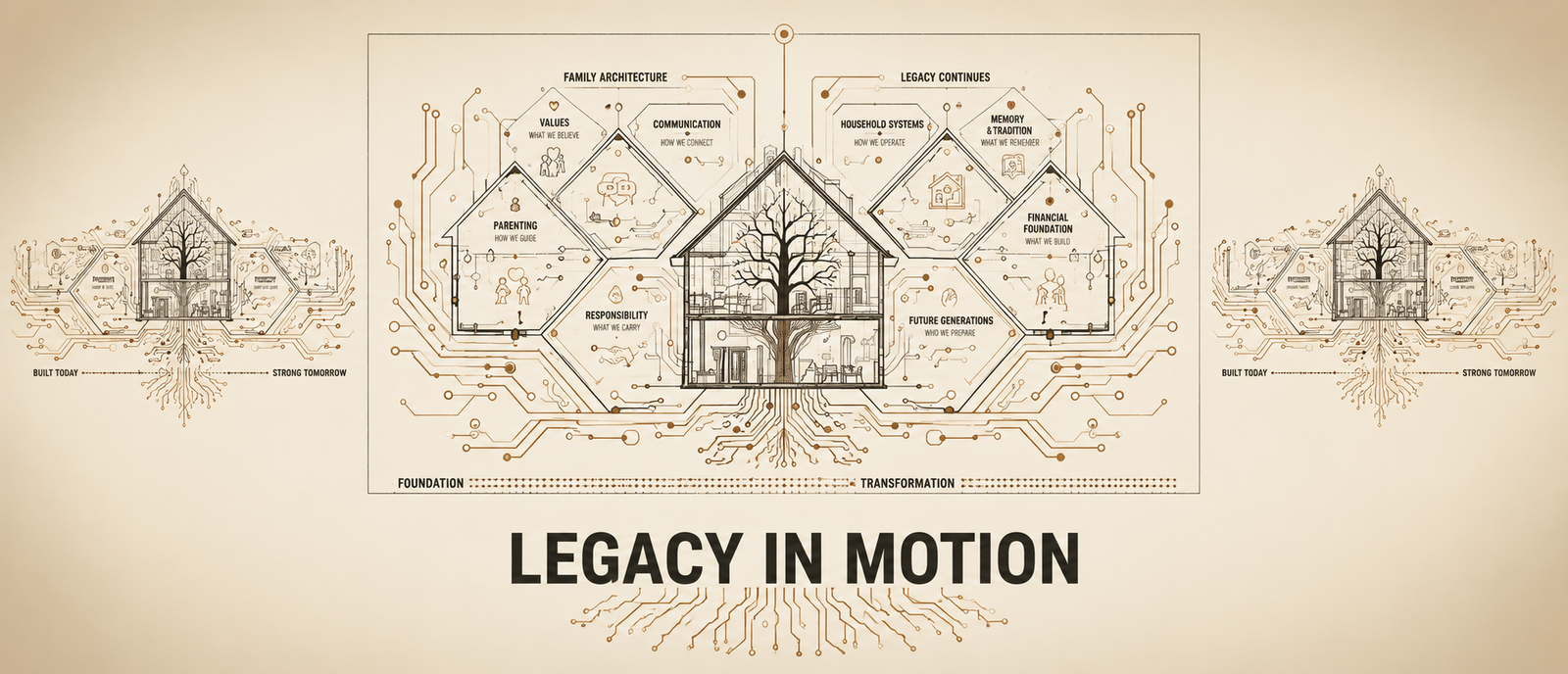
Series: Legacy in Motion | Family Architecture
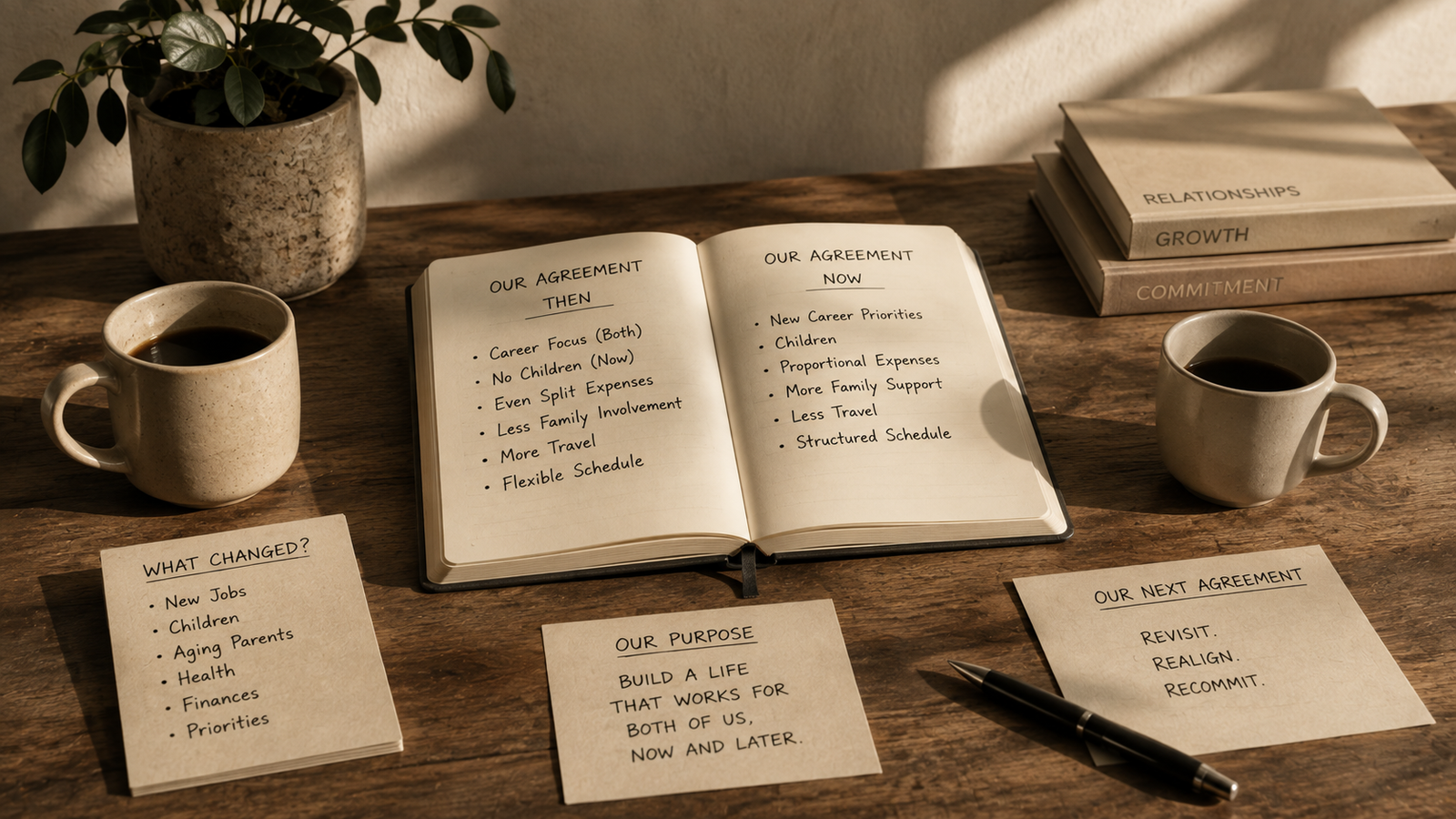
Renegotiating relationship agreements becomes necessary when the life underneath an agreement changes. An arrangement can be clear, mutual, and fair when two people make it, then become completely wrong for the life they are living three years later.
That does not mean somebody broke a promise.
It may mean the conditions changed.
A couple agrees to split expenses evenly when their incomes are similar. Then one person’s earnings double while the other reduces work to care for a child. Two people divide household responsibilities around predictable schedules. Then one takes a job requiring travel. They agree to live near one family, then an aging parent on the other side begins needing daily support.
The original agreement may have been perfectly reasonable.
The mistake is assuming that because an agreement was fair once, keeping it unchanged must still be fair now.
A good agreement can become a bad system when the conditions that made it fair no longer exist.
That is where mature partnership requires something harder than keeping the old arrangement alive. It requires knowing when to rebuild it.
Relationship Agreements Are Built for Conditions
Every agreement rests on assumptions, whether the couple names them or not.
An expense split assumes something about income. A childcare arrangement assumes something about work schedules. A decision about where to live assumes something about jobs, family, transportation, and priorities. An intimacy rhythm assumes something about health, energy, time, and connection.
When those underlying conditions remain stable, the agreement may continue working without much attention.
When the conditions change, the agreement starts carrying a different load.
This is basic structural thinking. You do not judge a system only by whether its original design made sense. You ask whether the design still fits its present operating environment.
Relationships deserve the same discipline.
This Is Different From an Agreement You Never Made
There is an important distinction between this problem and the one explored in The Agreements You Never Made.
An unspoken expectation creates conflict because one person believes an agreement exists when the other person may never have accepted it.
Here, the agreement was real.
Both people understood it. Both accepted it. The arrangement may have served them well.
Then life moved.
That changes the question.
The issue is no longer, Did we agree to this?
It becomes, Does what we agreed to still fit what our lives require?
Why Couples Keep Outdated Agreements
If an arrangement is no longer working, changing it should be simple.
Usually, it is not.
Agreements accumulate meaning. People attach them to fairness, sacrifice, identity, trust, independence, and character.
As a result, requesting a change can sound like rejecting the original commitment.
“But this is what we agreed to.”
That sentence can be legitimate. Agreements should matter. A relationship where commitments change whenever they become inconvenient cannot build trust.
However, there is a difference between abandoning an agreement because discipline became uncomfortable and revisiting an agreement because the conditions materially changed.
Those are not the same thing.
The Structural Principle
Stability does not require preserving every old arrangement. Stability requires preserving trust while the arrangement adapts to reality.
Renegotiating Relationship Agreements Is Not Moving the Goalposts
People often resist renegotiation because they fear the rules will never stop changing.
That concern is reasonable.
If every uncomfortable season becomes grounds for rewriting responsibilities, the relationship loses predictability. One person can end up carrying the consequences of the other’s constant preference changes.
Renegotiation therefore needs a threshold.
The question is not simply, “Do I still like this agreement?”
A better question is, “Have the conditions changed enough that the original agreement now produces a materially different burden or outcome?”
That is a higher standard.
Money Is Often the First Agreement to Age
Financial agreements can become outdated quickly because income, expenses, debt, caregiving, and household needs rarely remain static.
Imagine two people who earn roughly the same amount and agree to divide shared expenses equally.
That arrangement may be fair.
Then one person’s income rises substantially. The other person’s income falls after taking on more childcare. Housing costs increase. A parent needs financial assistance. The couple decides to prioritize retirement savings.
Keeping the original 50/50 split may still be possible.
But possibility is not the only measure of fairness.
The couple has to ask whether the old arrangement still reflects their current capacity, contribution, and shared goals.
This is precisely why Fairness vs Equality in Relationships matters. Equality can preserve the same numerical split while fairness asks whether the distribution remains legitimate under changed conditions.
Parenthood Can Rewrite the Operating System
Children do not simply add another task to a household.
They change time, sleep, money, schedules, mobility, emotional capacity, domestic labor, and career decisions.
An arrangement built for two adults with relatively independent schedules may not survive the arrival of childcare, school schedules, medical appointments, nighttime responsibilities, and reduced flexibility.
Yet couples can keep trying to operate the old system.
That is where resentment begins to grow.
The person carrying more may believe the imbalance should be obvious. The other may believe the household is simply continuing the arrangement both people originally accepted.
Neither interpretation solves the structural problem.
The household changed.
The agreement needs to catch up.
Career Growth Can Create Shared Costs
A promotion can look like an individual win while creating household costs nobody priced into the original agreement.
More money may arrive with longer hours. A better title may require travel. Entrepreneurship may offer future upside while creating present uncertainty. Graduate school may increase long-term earning potential while reducing current income and available time.
Ambition is not the problem.
The question is who absorbs the operational consequences.
If one person’s opportunity requires the other person to carry more household labor, childcare, financial risk, or schedule disruption, then an individual career change has altered the shared system.
That deserves a new conversation.
Caregiving Changes Capacity
Life eventually asks many households to care for someone beyond the couple itself.
Aging parents may need transportation, money, housing, medical coordination, or daily attention. A child may need additional support. A family member may become ill. Someone inside the relationship may experience a health change that reduces capacity.
Caregiving does not respect old spreadsheets.
It changes what people can carry.
A fair partnership recognizes that capacity is not fixed. There will be seasons when one person carries more because the other genuinely cannot.
The danger appears when a temporary redistribution becomes invisible, permanent, or unacknowledged.
That is the bridge to When Responsibility Becomes Resentment. Responsibility often becomes corrosive not because someone had to carry more for a season, but because the relationship stopped noticing that the load had shifted.
Intimacy Agreements Change Too
Not every agreement is written like a household responsibility.
Couples also develop expectations around affection, sex, privacy, emotional access, time together, and independence.
Those patterns can change after children, stress, health changes, grief, aging, medication, demanding work, or prolonged caregiving.
The wrong response is pretending nothing changed because acknowledging the change feels threatening.
The other wrong response is treating every change as permanent.
Instead, couples need enough honesty to distinguish a difficult season from a new reality.
That conversation can protect intimacy from becoming another old agreement nobody knows how to revisit.
The Four Questions for Renegotiating an Agreement
Renegotiation works best when two people can separate history from current conditions.
Four questions create that structure.
1. What Did We Actually Agree To?
Start with the record, not the grievance.
What was the original arrangement?
What did each person understand?
What responsibilities did each accept?
This prevents revisionist history. A difficult present does not justify pretending the original agreement never existed.
2. What Conditions Made the Agreement Work?
Look underneath the arrangement.
Perhaps incomes were similar. Work schedules were predictable. Neither person had caregiving responsibilities. Both had substantial free time. Housing was cheaper. Health was stable.
Those conditions matter because they explain why the agreement once made sense.
3. What Materially Changed?
Be specific.
“This doesn’t work for me anymore” may be emotionally true, but it is not enough to diagnose the system.
What changed?
Income?
Time?
Health?
Children?
Caregiving?
Location?
Workload?
Capacity?
Priorities?
The clearer the changed condition, the less likely renegotiation becomes a referendum on someone’s character.
4. What Would a Fair Agreement Require Now?
This is where the real work begins.
Do not ask how to preserve the old arrangement at all costs.
Ask what arrangement best protects the purpose both people were trying to serve.
That may require a different financial split. A new division of household labor. More outside support. Different boundaries with family. A revised schedule. A temporary sacrifice with a defined review date.
The new agreement does not have to resemble the old one to honor the same commitment.
Renegotiate the Structure, Not the Person
This distinction can change the entire tone of the conversation.
“You never help anymore” turns the problem into identity.
“Your work schedule changed, and our old household split is no longer covering what needs to happen” identifies a structural condition.
“You don’t care about our time together” attacks motive.
“We used to have three evenings together each week, and now we rarely have one” gives both people something observable to examine.
Structure creates room for accountability without unnecessary humiliation.
That does not mean avoiding hard truths. Sometimes the changed condition is not external. Sometimes one person stopped honoring the agreement.
If that is what happened, call it what it is.
Renegotiation should not become a polite word for escaping responsibility.
Not Every Request Deserves a New Agreement
This is where discipline matters.
A changed preference is not always a changed condition.
Wanting more discretionary spending does not automatically justify abandoning a savings agreement. Becoming tired of a household responsibility does not automatically make the division unfair. Feeling attracted to a different lifestyle does not erase commitments already made.
Adults should be able to distinguish inconvenience from structural change.
Otherwise, “renegotiation” becomes a mechanism for making commitment permanently provisional.
That destroys trust.
A durable relationship needs both adaptability and predictability.
Too little adaptability creates rigidity.
Too little predictability creates instability.
The work is holding both.
Temporary Agreements Need Review Dates
Some changed conditions are temporary.
A demanding project lasts six months. Graduate school ends. A newborn eventually sleeps differently. A parent recovers from surgery. One partner searches for new employment.
When the household redistributes responsibility for a temporary season, attach a review point to the arrangement.
Not because the relationship needs bureaucracy.
Because temporary arrangements have a habit of becoming permanent when everybody gets used to them.
A review date answers three questions:
- Is the condition that required this arrangement still present?
- Is the current distribution creating strain we did not anticipate?
- Do we continue, modify, or retire the agreement?
This is relationship maintenance in practice. As explored in The Relationship Maintenance Gap, the purpose of maintenance is to notice changing conditions before accumulated strain requires reconstruction.
Research Supports Adaptation, Not Rigidity
Long-term relationships operate inside changing economic and family conditions. Research from the Pew Research Center has documented how married and cohabiting adults divide responsibilities, make financial decisions, and evaluate satisfaction within their partnerships.
Relationship research also consistently emphasizes the importance of responding constructively to changing circumstances rather than treating conflict as proof that the relationship itself is defective. The Greater Good Science Center offers accessible research-based work on the behaviors and relational practices associated with durable connection.
The practical lesson is straightforward: long-term partnership does not occur under laboratory conditions. Jobs change. Families change. Bodies change. Money changes. Responsibilities change.
The relationship has to be capable of responding.
The Agreement Review
Before changing an important agreement, work through the structure rather than negotiating from frustration alone.
- Name the agreement: What did we actually decide?
- Name its purpose: What problem was the agreement designed to solve?
- Name the old conditions: What made the arrangement reasonable when we created it?
- Name the change: What is materially different now?
- Name the strain: What is the old agreement producing under current conditions?
- Name what must remain protected: Trust, fairness, financial stability, intimacy, autonomy, family care, or another shared priority.
- Build the revision: What arrangement fits the current reality better?
- Set a review point: When should we determine whether the new agreement is working?
The purpose is not to negotiate until everybody gets exactly what they want.
The purpose is to make the structure legitimate again.
Keeping Your Word Can Require Changing the Arrangement
Commitment is often described as refusing to change course.
That is incomplete.
Sometimes commitment means staying faithful to the purpose while changing the mechanism.
If two people agreed to build financial stability, the exact contribution formula may need to change when income changes.
If they agreed to share responsibility, the task list may need to change when capacity changes.
If they agreed to protect their connection, the rhythm may need to change when children, work, health, or caregiving alter their time.
The arrangement serves the commitment.
The commitment should not become trapped inside an obsolete arrangement.
Keeping your word does not always mean keeping the arrangement. Sometimes it means honoring the purpose of the agreement enough to rebuild it for the life you have now.
Build for the Life You Have Now
Renegotiating relationship agreements should not be constant. If every commitment remains permanently open for revision, there is eventually nothing solid enough to build on.
But the opposite is just as dangerous.
An agreement should not survive simply because changing it feels uncomfortable.
Strong relationships need memory. They need people who remember what they promised and why.
They also need awareness.
When the underlying conditions change, pretending the old structure still fits does not protect commitment. It can slowly turn commitment into resentment.
So preserve what should remain stable.
Honor what was genuinely agreed to.
Identify what changed.
Then have enough discipline to rebuild the arrangement without rewriting the history that came before it.
The goal is not to keep the old agreement alive forever.
The goal is to keep building a life that still works for both people living inside it.
Further Groundwork
The Agreements You Never Made
Before an agreement can be renegotiated, it helps to know whether both people actually agreed to it in the first place.
The Relationship Maintenance Gap
Why changing conditions need attention before small strains become expensive repairs.
Fairness vs Equality in Relationships
Why a durable partnership requires proportional responsibility rather than rigid 50/50 accounting.
When Responsibility Becomes Resentment
How a necessary shift in responsibility can become invisible load when the relationship never revisits the arrangement.