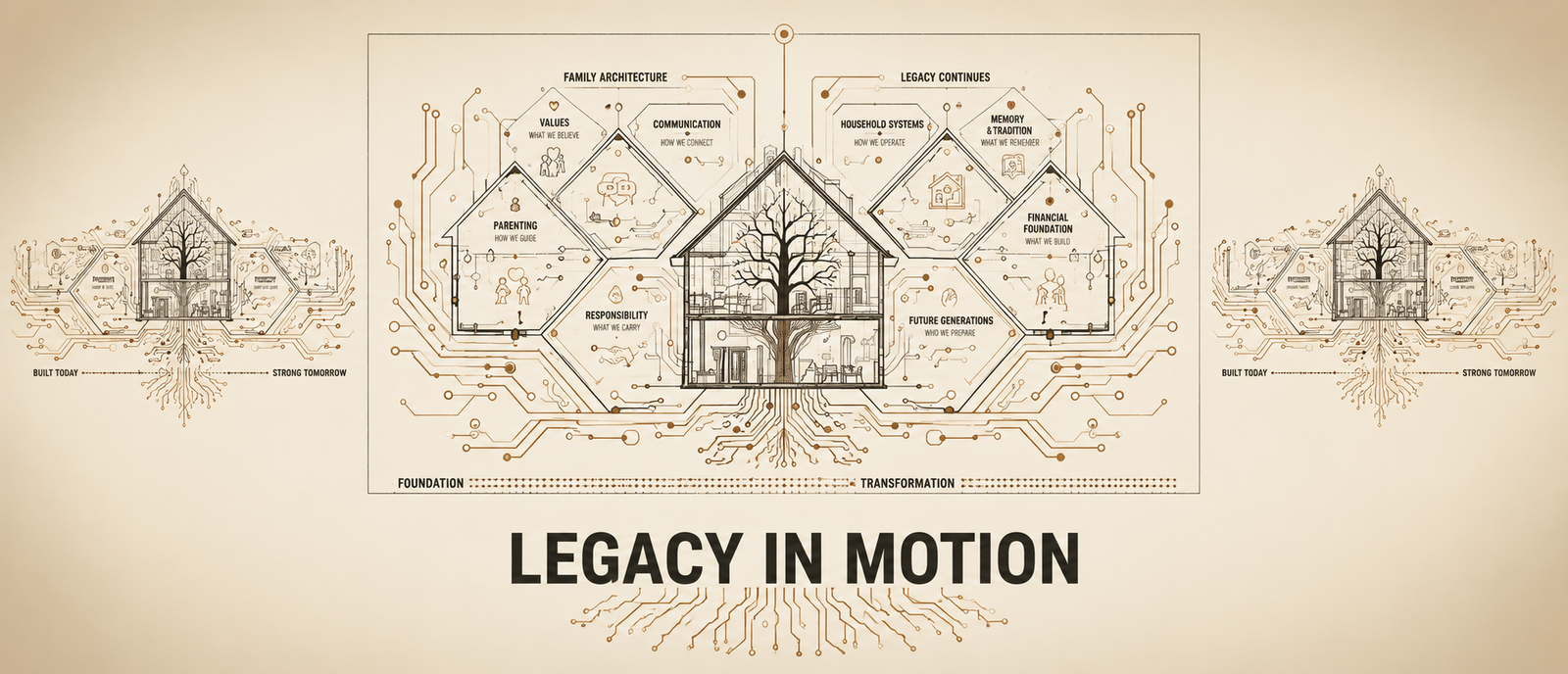
Series: Legacy in Motion | Family Architecture
Unspoken expectations in relationships create some of the most frustrating conflicts because both people can believe they are right while operating from completely different agreements.
Except there is a problem.
There may never have been an agreement.
One person assumes finances will eventually merge. The other assumes financial independence will remain intact. One believes holidays should rotate between families. The other grew up believing Christmas always belongs to one side. One assumes earning more means contributing more. The other believes household expenses should remain evenly divided.
Nobody necessarily lied. Nobody necessarily changed the rules.
The rules may never have been written.
You cannot hold someone accountable to a contract they never knew they signed.
That does not mean expectations are wrong. Relationships require expectations. The problem begins when one person’s expectation quietly becomes another person’s obligation without conversation, consent, or negotiation.
That is the invisible contract.
Where Unspoken Expectations in Relationships Come From
Very few people enter relationships without a blueprint.
We arrive carrying ideas about what partners are supposed to do, even when we have never consciously written those ideas down.
Some expectations come from our parents. Others come from grandparents, previous relationships, religion, culture, gender expectations, friendships, television, social media, or the households we watched growing up.
Sometimes we inherit a model because it worked.
Sometimes we inherit one because it was simply the only model we knew.
Then adulthood creates a strange collision. Two people bring separate blueprints into the same relationship and begin building as though the plans already match.
They often do not.
The Invisible Contract
Every long-term relationship develops rules. Some are spoken. Others simply emerge.
It helps to separate them into three categories.
1. Explicit Agreements
These are the strongest agreements because both people know they exist.
You discussed the issue. Both people understood what was being decided. Each person had an opportunity to agree, disagree, or negotiate.
Perhaps you agreed to maintain separate bank accounts while contributing to a shared household account. Maybe you agreed that neither person would discuss private relationship conflicts with friends. Perhaps one partner handles school pickup while the other handles mornings.
The exact arrangement matters less than the clarity.
Both people know the agreement.
2. Working Assumptions
Working assumptions are more complicated.
These are patterns that developed through repetition but were never necessarily negotiated.
One person starts grocery shopping because the other has a demanding month at work. Months later, that temporary arrangement has become normal. Someone handles birthday gifts for both families once, then quietly becomes responsible for remembering every birthday thereafter.
The system works, so nobody discusses it.
Until it stops working.
This is one reason When Responsibility Becomes Resentment matters. Temporary responsibility can quietly harden into permanent expectation when nobody revisits the arrangement.
3. Inherited Expectations
This is where the invisible contract becomes most powerful.
Inherited expectations are the rules we consider obvious because they were normalized before the current relationship ever existed.
A person may believe a husband should automatically handle certain financial responsibilities. Someone else may believe domestic work should naturally divide another way. One person may assume grandparents will have unrestricted access to future children. Another may consider household privacy nonnegotiable.
Neither person has to be manipulative for conflict to develop.
Each may simply be enforcing a different blueprint.
The Invisible Contract
An expectation is not automatically unreasonable because it was unspoken. However, it cannot become enforceable merely because one person assumed it was obvious.
Money Carries More Assumptions Than Numbers
Money exposes invisible contracts quickly because money carries ideas about responsibility, security, power, independence, generosity, and adulthood.
Who pays for dates?
When should finances merge?
Should finances merge at all?
Does the higher earner contribute more?
How much spending requires discussion?
Do you support extended family financially?
What counts as irresponsible debt?
How much should be saved before lifestyle improves?
People can have strong answers to every one of those questions without ever realizing their partner has equally strong answers pointing in another direction.
Money conflict is therefore not always about money. Sometimes two financial philosophies are colliding inside one household.
The answer is not determining which person’s upbringing was correct. The work is deciding what financial architecture this household will deliberately build.
Household Labor Creates Quiet Contracts
Domestic responsibility is another place where unspoken expectations in relationships become structural.
Cooking, cleaning, laundry, appointments, repairs, shopping, transportation, calendars, bills, childcare, family communication, travel planning, and dozens of other tasks have to land somewhere.
Couples often distribute this work organically.
That can work well.
However, organic systems can become invisible systems. The person who consistently notices a need may become permanently responsible for meeting it.
Eventually, competence becomes assignment.
This is why fairness in relationships cannot be reduced to identical output. What matters is whether both people can see the load, understand the arrangement, and renegotiate it when circumstances change.
Family Access Needs an Agreement Too
When two people form a serious relationship, they do not arrive alone. Families, traditions, obligations, loyalties, and histories arrive with them.
That creates questions many couples postpone.
How often do relatives visit?
Who gets holidays?
What information stays private?
When does helping family become a household financial decision?
Can relatives arrive without notice?
What happens when a parent needs care?
Who gets a voice in decisions involving children?
These questions may feel premature when everything is easy. Later, they can become fault lines.
Family loyalty does not eliminate the need for boundaries. In fact, strong family ties make explicit boundaries more important because more relationships are interacting with the household.
Intimacy Has Invisible Expectations
People also carry assumptions about affection, sex, emotional availability, privacy, reassurance, initiation, and what closeness should feel like.
One person may experience frequent communication as connection. Another may experience the same frequency as pressure.
Someone may expect physical affection to happen naturally without discussion. Their partner may need intentionality and emotional connection before desire appears.
Neither experience automatically defines the correct relationship.
The question is whether two people understand each other’s expectations well enough to build something that protects both dignity and connection.
Assumption is especially dangerous here because silence invites interpretation. People begin assigning meaning to behavior without checking whether the meaning is accurate.
Career Ambition Changes the Household Contract
Ambition sounds individual until somebody shares a life with it.
A promotion may require longer hours. Entrepreneurship may reduce income temporarily. Graduate school may shift household responsibility. Relocation may accelerate one person’s career while interrupting the other’s.
That means career decisions eventually become relationship decisions when they alter shared time, money, geography, responsibility, or risk.
This does not mean either person needs permission to have ambition.
It means individual decisions can create shared consequences.
A durable relationship makes those consequences discussable before sacrifice becomes resentment.
Privacy and Autonomy Need Definition
Commitment does not automatically answer how much independence two people should retain.
Do partners share passwords?
Are private conversations with friends private?
How much individual time does each person need?
Can either person travel independently?
How are friendships with former partners handled?
What financial decisions remain individual?
There is no universal answer that fits every healthy couple.
But there is a bad answer: assuming your definition of commitment is so obvious that discussion should be unnecessary.
Healthy interdependence allows two people to build a shared structure without erasing the individuals inside it. That is the distinction explored in Appreciating Interdependence.
The Future Is Full of Hidden Assumptions
Some of the most consequential expectations concern things that have not happened yet.
Children.
Marriage.
Homeownership.
Where to live.
Career sacrifices.
Caregiving.
Retirement.
Supporting parents.
Inheritance.
Faith.
Education.
What kind of life is worth building.
Two people can be deeply compatible in the present while carrying incompatible assumptions about the future.
Affection does not resolve that problem.
Clarity might.
Why “You Should Have Known” Is Weak Architecture
There are things a considerate partner should notice without receiving a detailed instruction manual. Relationships require awareness, empathy, and initiative.
But “you should have known” becomes dangerous when it substitutes for an agreement that never existed.
If an expectation matters enough to create resentment when violated, it matters enough to discuss.
That does not remove responsibility from the other person. It removes ambiguity from the system.
Clear expectations give both people something concrete to accept, reject, negotiate, or revisit.
Silent expectations offer none of those options.
Resentment Can Reveal a Missing Conversation
Resentment is not always proof that someone has treated you unfairly.
Sometimes resentment reveals that reality has failed to match an expectation you never made visible.
That is uncomfortable because it requires a different question.
Instead of asking only, “Why aren’t you doing this?” ask:
Did we actually agree that this was your responsibility?
If the answer is yes, accountability matters.
If the answer is no, the relationship may need negotiation before accusation.
That distinction can save people from turning misunderstanding into character judgment.
Turn Expectations Into Agreements
The objective is not to eliminate expectations. That would be impossible and undesirable.
The objective is to make important expectations visible enough to evaluate together.
A useful agreement has several qualities.
- It is explicit. Both people understand what is being discussed.
- It is mutual. Both people have a meaningful voice in shaping it.
- It is specific. The agreement can be translated into actual behavior.
- It is legitimate. Neither person is agreeing merely to end pressure.
- It is revisable. Changing conditions can justify changing the agreement.
This is not bureaucracy.
It is clarity.
And clarity is cheaper than resentment.
Some Agreements Need an Expiration Date
One of the biggest mistakes couples make is treating every agreement as permanent.
Life changes too quickly for that.
One person may temporarily carry more expenses while the other completes school. Someone may handle most household duties during a partner’s demanding work season. A couple may temporarily reduce travel while saving for a home.
Temporary agreements work best when both people know they are temporary.
Otherwise, the arrangement can quietly become the new baseline.
This connects directly to The Relationship Maintenance Gap. Agreements need maintenance because the conditions that produced them do not remain frozen.
The Agreement Audit
You do not need to inventory every expectation in one sitting.
Start with the places where disappointment, confusion, or recurring friction already exists.
- What do I believe my partner should already know without being told?
- Which responsibilities have we explicitly agreed to?
- Which arrangements simply developed over time?
- What did my family teach me a husband, wife, or partner is supposed to do?
- Which of those beliefs have I consciously chosen?
- Which expectations would surprise my partner if I said them out loud?
- Where am I expecting reciprocity without clearly defining what reciprocity means to me?
- What am I currently resentful about that I never clearly requested?
- Which old agreements no longer fit our current lives?
- What future decision are we assuming we agree about without actually discussing it?
Then ask the hardest question:
What am I treating as a broken promise that was never actually made?
Do Not Confuse Agreement With Compliance
An agreement is not successful merely because one person finally gives in.
If one partner repeatedly pressures the other until resistance becomes exhausting, the result may look like agreement while functioning like compliance.
That is weak structure.
Healthy agreements require room for disagreement.
Your partner may hear an expectation and say no.
That answer matters.
It may reveal a difference that requires compromise. It may reveal incompatibility. It may force both people to reconsider what they assumed partnership would require.
That is still more useful than false agreement.
You cannot build durable alignment by hiding disagreement underneath temporary peace.
Build the Relationship You Actually Agreed To
Every relationship develops a culture.
The question is whether that culture was deliberately built or accidentally inherited.
There will always be assumptions. There will always be habits that form without a meeting. There will always be things one person considers obvious that the other person never imagined.
Maturity is not eliminating that reality.
Maturity is becoming willing to inspect it.
Talk about money before money becomes accusation.
Talk about family before loyalty becomes a contest.
Talk about household labor before competence becomes permanent assignment.
Talk about ambition before opportunity becomes unilateral sacrifice.
Talk about intimacy before silence starts writing its own explanation.
Talk about the future before two people discover they have been building toward different destinations.
Unspoken expectations in relationships become dangerous when assumption is mistaken for consent.
The goal is not to create a contract for every moment of shared life.
The goal is simpler.
Make the important things visible.
Then build from what both people actually agreed to.
Further Groundwork
The Relationship Maintenance Gap
Why strong relationships require inspection, adjustment, and reinforcement before small changes become structural problems.
When Responsibility Becomes Resentment
How reliability can quietly become expectation, invisible load, and accumulated strain.
Fairness vs Equality in Relationships
Why durable partnerships need proportional responsibility rather than rigid accounting.
Reciprocity Is the Missing Relationship Skill
Why mutual responsiveness matters more than identical contribution.