

The family group chat can look ridiculous from the outside: twenty-seven unread messages, a blurry photograph of somebody’s lunch, three people answering yesterday’s question, an aunt sending a good-morning image with flowers on it, and somebody’s mother accidentally starting a video call.
A birthday message might arrive six hours early because midnight happened somewhere else first. Then, between all of that ordinary noise, somebody says the test results came back.
Suddenly the conversation changes. A relative asks who can call. Someone else says they already sent money. A sibling shares the doctor’s instructions. Meanwhile, an uncle who almost never writes anything appears in the thread.
For families spread across countries, cities, languages, and time zones, a family group chat can become more than a convenient stream of messages. It can become one of the places where the family still happens.
Not symbolically. Operationally.
Photographs go there. So do jokes, announcements, recipes, prayer requests, voice notes, school pictures, condolences, travel plans, medical updates, old photographs somebody found in a drawer, and questions nobody wants to answer in front of everybody.
The address may be digital. The family activity is not.
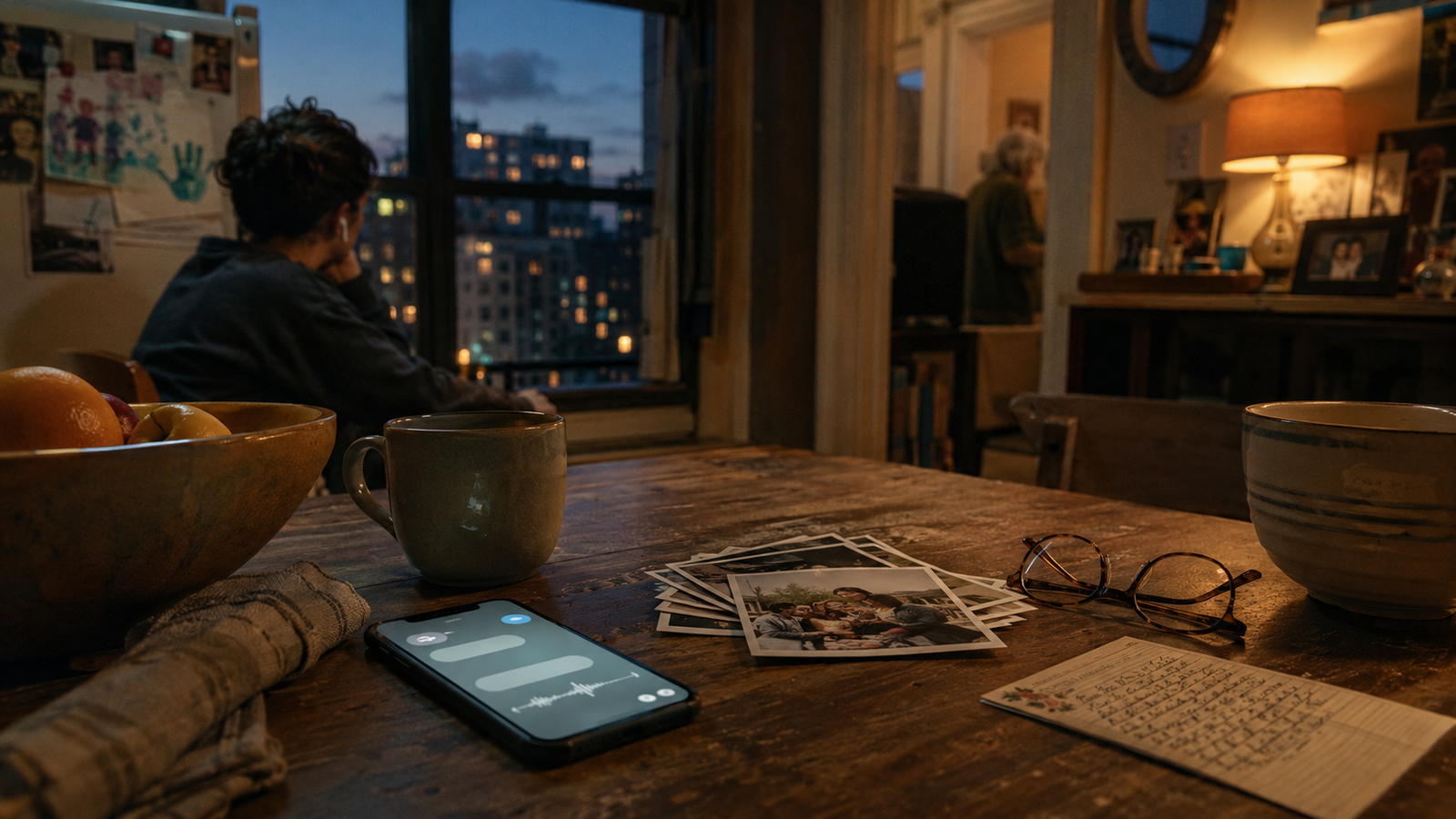
Why a Family Group Chat Can Become a Room Nobody Owns
A family group chat has no kitchen, couch, or front door. Nobody can sleep there. Even so, it can develop some of the characteristics physical family spaces have always carried.
People enter and leave. Some talk constantly, while others sit quietly and watch. Certain subjects create immediate noise. Other subjects seem to clear the room.
Over time, roles appear. One relative remembers birthdays. Another shares photographs. Someone becomes the unofficial archivist, while somebody else becomes the person everyone calls when the chat becomes too complicated for typing.
Gradually, the thread collects evidence that the family continued.
That matters when geography has separated the people producing the evidence.
Joanna Kędra studied five Polish multilingual families living in Finland and examined how digitally mediated communication helped them maintain relationships with relatives elsewhere. In those family WhatsApp spaces, children helped create and maintain groups, languages were practiced, care moved across distance, and photographs generated a sense of visual co-presence.
Kędra uses the idea of virtual proximity to describe the closeness digital communication can help sustain when relatives are physically separated.
The phrase sounds academic. In practice, the experience is ordinary.
A grandmother can watch a grandchild lose a tooth without standing in the room. Likewise, a sibling can know what dinner looks like three thousand miles away. A family photograph no longer has to wait until somebody prints it, mails it, visits, or carries an album across an ocean.
The distance remains. However, the delay changes.
That changes family life.
How Digital Family Communication Changed the Silence of Migration
Distance has always been part of migration. The technology surrounding that distance has not.
A letter once had to cross much of the same geography as the people who wrote it. International telephone calls could be expensive enough to require planning. As a result, families condensed news into the available minutes, and photographs traveled slowly.
Ordinary life could disappear between major updates because ordinary life was not always worth the cost of transmission.
Digital communication altered that rhythm.
Now a photograph can arrive before the meal in it has gone cold. A voice note preserves the cadence of someone speaking without requiring both people to be available at the same moment. Meanwhile, a video call can place several generations on one screen.
A message can leave Queens during breakfast and open somewhere else whenever another person’s day allows.
Mirca Madianou and Daniel Miller developed the concept of polymedia through research on transnational families. Their argument goes beyond the simple fact that people now have more communication tools.
Once several inexpensive platforms are available, choosing how to contact somebody can itself carry social and emotional meaning.
For example, a text may mean, I am letting you know. A phone call may signal, this cannot wait. By contrast, a video call can mean, I need to see you.
Even a reaction icon can communicate, I saw this, even if I cannot answer right now.
Sometimes, however, the absence of any response says more than anybody wanted it to.
Distance now has read receipts.
How the Family Group Chat Keeps Ordinary Presence Alive
Major family events are easy to recognize as connection: birthdays, weddings, graduations, funerals, illnesses, and births.
Yet the more interesting work of a family group chat often happens between those events.
Somebody complains about the weather. Someone forwards an old photograph. A parent asks whether everybody got home safely. Later, a cousin posts a picture of a child wearing shoes another relative mailed.
Elsewhere in the thread, two people begin an argument about a recipe nobody else wanted to discuss, while a grandmother sends a voice note too long for anyone to pretend they did not receive.
None of those messages is historically important.
Together, however, they create familiarity.
Madianou later used the term ambient co-presence to describe the continuing awareness of distant people made possible by everyday digital communication.
In other words, a relative does not need to be engaged in direct conversation every minute to remain aware of another person’s rhythms and activities.
When the relationship underneath it is strong, that low-level awareness can provide reassurance.
It may also explain why the family group chat can begin to resemble home more than correspondence.
Correspondence reports life. The group chat can accompany it.
One tells you what happened. The other lets you remain close enough to notice some of the texture around what happened.
A Family Group Chat Can Give Heritage Language Another Place to Live
For multilingual families, the group chat can also become linguistic territory.
A message moves between languages, and somebody answers in one language after reading another. Sometimes a child reaches for an emoji because the word has not arrived yet.
Elsewhere, a parent may type in English and send a voice note in the heritage language. A relative might correct a spelling. Just as often, nobody corrects it because everybody understood the message anyway.
Kędra’s research is useful here because the children she studied were not merely passive recipients of family communication. Instead, they created groups themselves, selected relatives, moved between languages, and used digital spaces for both communication and language practice.
That extends a question Borderlines has already been asking.
In The Language We Lose Before We Notice , language shift appears through ordinary decisions rather than one dramatic rejection. The language surrounding school, work, forms, friendship, and entertainment becomes faster and more available until another language occupies less conversational territory.
A family group chat can complicate that direction.
Certainly, technology cannot reverse language loss by itself. Nor can it create vocabulary nobody knows. Still, it can create another reason to encounter the language.
A voice note from an elder carries pronunciation. Meanwhile, a family joke preserves phrasing that may never appear in a textbook. Written messages also give somebody longer to sit with an unfamiliar word than live conversation does.
Pictures provide context, translation tools can reduce friction, and younger relatives may answer imperfectly instead of remaining silent.
Therefore, a language does not have to survive in exactly the same form to remain active inside a family.
Sometimes continuity begins by giving it somewhere else to be used.
When the Family Group Chat Becomes a Care Desk
Eventually, some family conversations become more serious.
Who is taking her to the appointment? Did he collect the prescription? Has anybody spoken to the nurse? Who has the paperwork? Can somebody send the money today? What time can everyone call?
This is where the idea of a portable home becomes structural rather than sentimental.
Families do not only exchange affection. They also organize labor.
Obert Tawodzera studied transnational family constellations spanning the United Kingdom and Zimbabwe and examined how WhatsApp family groups were used to coordinate care for aging parents.
In that research, the groups could operate as a virtual home where relatives planned, organized, and delivered care across distance.
The phrase is unusually useful because a home is partly where care gets coordinated.
Someone remembers what is needed. Another person buys it. Somebody knows the appointment time, while another relative checks whether the person ate. When a problem appears, somebody notices and tells everyone else.
Migration can distribute those people across continents without eliminating the responsibilities connecting them.
Digital communication, therefore, gives that responsibility an operating surface.
The family group chat can become a calendar, bulletin board, care meeting, financial coordination channel, and emotional waiting room at the same time.
This is not theoretical closeness.
Something gets done because the message was sent.
The Same Portable Home Can Carry Pressure Too
This is where the easy version of the story breaks down.
If a family group chat can carry affection, it can carry pressure. Likewise, if it can preserve relationships, it can preserve hierarchy.
Information can move efficiently while obligation remains distributed unevenly.
Tawodzera found that the same WhatsApp groups facilitating transnational elder care could also intensify pressure on migrants to remit money and reproduce gendered expectations about who should provide care.
Existing family power relationships did not disappear because the family moved onto a screen.
Why would they?
Technology changes the room. It does not automatically change the family.
For example, the person who was expected to remember everything may still be expected to remember everything. The relative believed to be earning more abroad may become the first name attached to every financial problem.
At the same time, a daughter may receive more care requests than a son. A relative who rarely contributes can still monitor everybody else’s contribution.
Someone can feel guilty after reading twenty messages while working a shift they cannot leave.
Worse, a request sent to one person can become public family knowledge the moment it enters the group.
Now obligation has an audience.
Madianou’s research on smartphones and transnational families adds another warning. Abundant communication options do not repair relationships whose problems are fundamentally social.
In some cases, increased connectivity can amplify conflict, surveillance, disappointment, and inequality.
More contact, therefore, does not automatically produce more intimacy.
Sometimes it merely produces more opportunities to discover where intimacy was already weak.
Silence Changes When the Family Group Chat Shows Who Saw the Message
Older forms of distance offered a certain amount of cover.
The letter may not have arrived. The phone call may have been missed. Perhaps the timing was bad.
Digital family life removes some of that ambiguity.
You saw the message. Your profile says you were online. Everybody else responded, yet you did not.
As a result, silence can acquire social meaning quickly.
Maybe somebody is busy. Perhaps the request feels unreasonable. Someone might be angry, exhausted, unsure what to say, or simply tired of being the relative expected to solve everything.
Of course, nothing may be wrong at all.
The problem is that digital communication creates evidence without automatically providing interpretation.
People fill the gap.
Madianou and Miller’s work on polymedia helps explain why. Once people have several readily available ways to communicate, the choice to use—or not use—a particular medium can become morally and emotionally meaningful.
Consequently, digital family space becomes unusually intimate infrastructure.
It records presence, but it can also record refusal.
The same thread that reassures one person that everybody is still nearby may make another person feel that family is always watching.
Home has always contained versions of that tension: safety and scrutiny, care and obligation, recognition and interference.
The digital version does not eliminate those contradictions.
It travels with them.
What a Family Group Chat Cannot Replace
Another boundary deserves protection: virtual proximity is still virtual.
A photograph of a birthday is not attending the birthday. Likewise, a video call from a hospital room is not holding the person’s hand. Watching a child grow through pictures is not the same as living beside that growth.
A family group chat can help a family survive distance.
It cannot abolish distance.
That distinction matters because digital connection is often described as though communication bandwidth solved separation itself.
Families know better.
Madianou’s research on smartphones and transnational family life identified what she called a care divide. Digital tools can strengthen relationships that already have enough social ground beneath them, but technology does not automatically repair relationships harmed by prolonged separation or deeper conflict.
The screen can carry care. It cannot guarantee it.
Instead, the family still has to do the work. Somebody has to call, answer, translate, remember, send the photograph, and make room for the person who communicates differently.
For that reason, continuity is not automatic simply because the app exists.
The technology merely gives continuity somewhere to operate.
What the Family Group Chat Actually Carries
Look again at what passes through an ordinary family thread.
Language, images, news, advice, sarcasm, correction, money requests, recipes, religious messages, political arguments nobody asked for, funeral information, baby photographs, addresses, voice notes, family rumors, health updates, old stories, and new grievances all share the same space.
Somewhere in there is also the name of the cousin somebody has somehow forgotten.
These things do not all carry equal weight, and they do not have to.
Culture is often transmitted through accumulation rather than ceremony.
The family group chat makes that accumulation visible.
For example, a child may learn who belongs to the family because names keep appearing. Someone may recognize an elder’s voice despite rarely seeing them in person. Meanwhile, a joke may survive another generation because somebody keeps repeating it.
An old photograph can move from one person’s drawer into twenty people’s phones in seconds. Similarly, a recipe can be questioned, corrected, photographed, and attempted in several countries on the same afternoon.
The archive is messy.
So are families.
That may be precisely why the medium works.
This is also where Build What Holds becomes useful.
What holds across distance does not have to reproduce the old household exactly.
Instead, it has to carry enough relationship, memory, knowledge, language, and responsibility forward that the family can continue functioning after geography changes.
The Groundwork
A Portable Home Works Because the Family Knows Where to Gather
A portable home is not a replacement home.
The family group chat cannot reproduce a kitchen table, a grandmother’s apartment, a cousin sleeping on the couch, or the sound of several conversations happening in the same room.
What it can do, however, is carry some of the work those places once held by themselves.
It can keep people visible to one another, give language another surface, preserve small evidence of ordinary life, and coordinate care.
In that sense, the chat can remind a scattered family that distance changed the logistics without necessarily ending the relationship.
Because the relationship remains real, the difficult parts travel too: expectation, hierarchy, guilt, silence, money, and love.
The chat carries all of it.
Therefore, the useful question is not whether digital communication makes geographic distance disappear.
It does not.
The better question is what a family learns to build when the people who once shared rooms must maintain part of their family life across screens.
For generations, migration forced families to invent ways of remaining connected after the address changed.
Letters did some of that work. Telephone calls did some of it. Photographs carried another part, while visits still do something no screen can reproduce.
Now another piece of family architecture lives in the hand.
It buzzes during meetings, wakes somebody in the wrong time zone, fills with unread messages, and carries jokes nobody outside the family understands.
Then, when something happens, everybody already knows where to gather.
There may be no front door. But the family knows how to enter.
Further Groundwork
Continue through the Borderlines questions of family mediation, language, inheritance, and the work of remaining connected across generations.
→ The Children of Translation: Growing Up Between Two Worlds
Receipts
Research informing this essay’s treatment of digitally mediated family life, virtual proximity, language, care, co-presence, and transnational relationships.
- Joanna Kędra — Performing Transnational Family with the Affordances of Mobile Apps
- Mirca Madianou & Daniel Miller — Polymedia: Towards a New Theory of Digital Media in Interpersonal Communication
- Mirca Madianou — Ambient Co-presence: Transnational Family Practices in Polymedia Environments
- Obert Tawodzera — WhatsApp, Transnational Families, and the Virtual Home of Care
- Mirca Madianou — Smartphones as Polymedia and the Care Divide in Transnational Families
Build better. Every day.
Groundwork Daily examines the structures beneath culture, institutions, relationships, identity, and everyday life. Get new Groundwork delivered directly, without noise or urgency.

Groundwork Daily Builder
Isabella Jean Ramírez
Isabella Jean Ramírez builds at the intersection of diaspora, migration, cultural identity, language, memory, family, and belonging. Her Borderlines work follows what people carry forward after geography changes and generations move.
Isabella’s Groundwork → • Explore Borderlines → • Culture, Media & Leadership →