
The image had already traveled before everyone agreed on what they were looking at.
A Korean pop star stood beneath carefully arranged stage lighting. She wore a long white skirt. A pair of black sneakers hung from one hand. The photograph was polished, commercial, global, and built to move quickly through the machinery of modern advertising.
Then another audience looked at it.
Some viewers saw something else.
A pointed white shape reminded them of a Ku Klux Klan hood. Meanwhile, the black sneakers hanging within the composition evoked, for some viewers, the visual memory of lynching. The advertisement contained no written racial message. Converse announced no such meaning, and the people who created the photograph have not been shown to have intended one.
Still, images do not arrive empty.
People bring history with them when they look.
Converse eventually removed the advertisement featuring aespa member Karina and apologized. The company said it understood why the image was deeply upsetting, acknowledged that it had gotten the image wrong, and said it should not have happened.
As a result, one question became easier to answer. The company recognized that the image could reasonably carry a meaning it apparently did not want associated with its brand.
However, the response did not settle the more interesting question.
How can Black American cultural influence become globally recognizable while the history required to fully understand that culture remains far less portable?
The question is bigger than Converse and bigger than one photograph.
Instead, it reaches a broader problem: what happens when culture travels faster than context?
How Black American Cultural Influence Travels
Black American cultural influence is difficult to contain inside the borders of the United States because it stopped behaving like a strictly national product a long time ago.
Listen to popular music across continents and its fingerprints appear. Watch choreography. Look at streetwear. Follow sneaker culture. Listen to the rhythms of online speech. Across entertainment, athletes become lifestyle brands, producers build records from familiar traditions, performers construct recognizable personas, and young people remix language that began somewhere else.
The forms became global
Hip-hop became global. So did R&B.
Jazz had already traveled the world long before either.
Black American dance traditions traveled as well. Fashion, athletic aesthetics, hair, language, gesture, humor, production techniques, performance styles, and ways of presenting cool moved across borders and industries.
Of course, none of that means Black Americans invented every modern cultural form. Such a claim would turn a serious history of influence into mythology.
The stronger argument does not require exaggeration.
Black American cultural production has exercised an extraordinary influence on modern popular culture, particularly in music, dance, fashion, language, performance, and the aesthetics surrounding entertainment and sport.
Consequently, that influence has become one of the defining stories of modern American culture.
Reach creates a different problem
Yet enormous reach created a strange condition.
The products traveled farther than the people.
Sometimes, the culture also traveled farther than the memory.
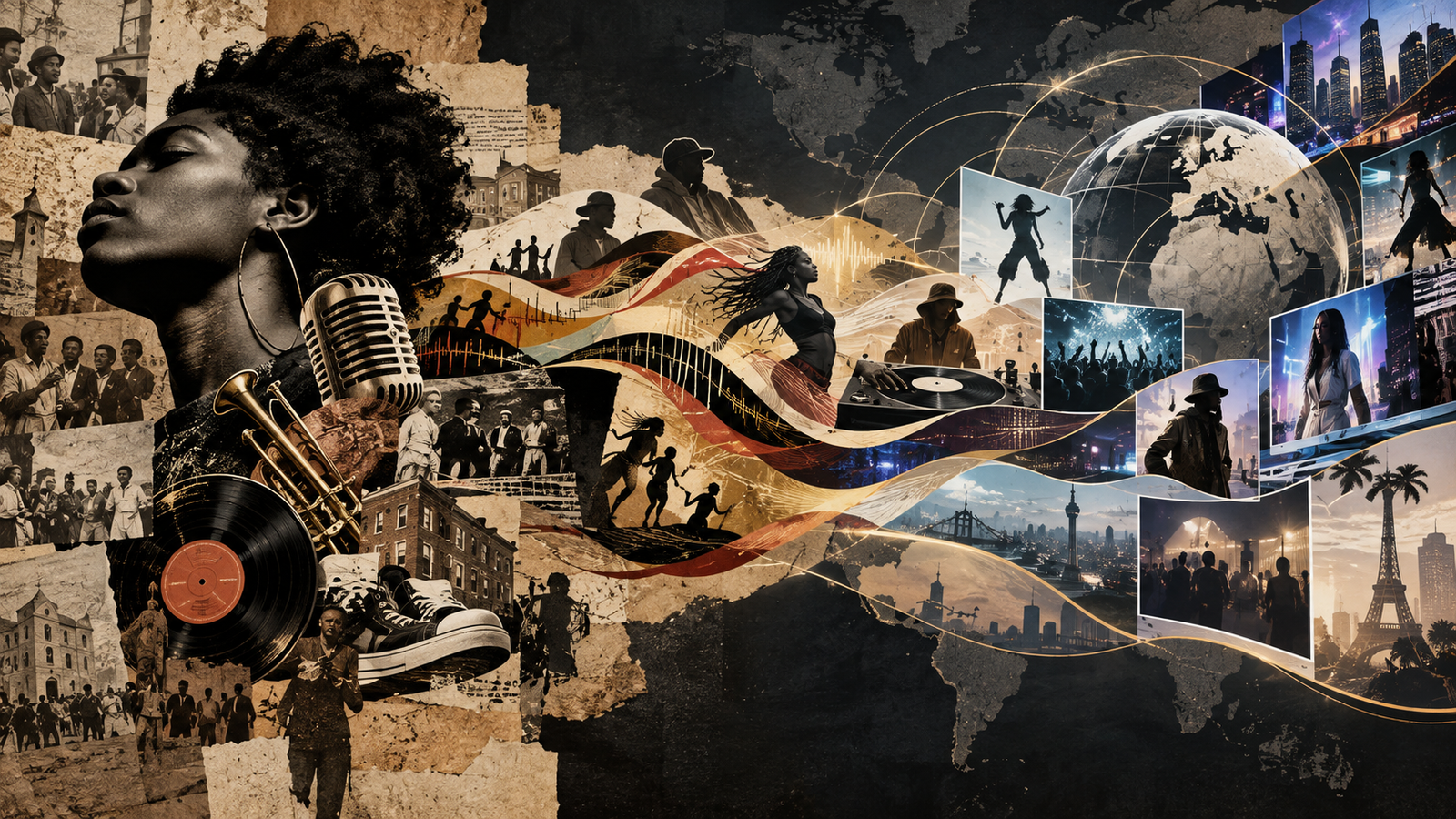
Culture Travels Faster Than Context
There is a difference between cultural transmission and historical transmission.
Cultural transmission moves the form
Cultural transmission is easy to see.
A song crosses an ocean. A dance appears on millions of phones. A fashion trend moves from one neighborhood to runways and retail chains. Elsewhere, a phrase becomes Internet vocabulary, a musical technique enters another country’s pop industry, or a pair of sneakers becomes an international symbol.
In each case, the form moves.
Historical transmission has a heavier load
By contrast, historical transmission is harder.
It requires knowing where something came from and what conditions produced it. It asks what people were responding to, which institutions surrounded them, what was forbidden, and what was mocked before it became profitable.
Moreover, historical literacy asks what was dangerous before it became fashionable and which symbols carry meanings that may not be obvious to someone encountering them without that history.
Global cultural fluency does not automatically produce historical literacy.
You can learn a rhythm without learning its lineage.
Likewise, people can learn the language without learning the conditions that produced it.
They can reproduce an aesthetic without recognizing every historical reference that an audience closer to its origin might immediately see.
None of this makes cultural exchange illegitimate.
Instead, it makes cultural literacy necessary.
Cultural literacy does not require treating every borrowed form as theft or every unfamiliar reference as offense. It requires something harder: enough historical knowledge to distinguish influence from origin, resemblance from intent, and an accidental collision from a pattern that deserves closer scrutiny.
The Converse Image
That distinction matters in the controversy surrounding Converse’s Chuck 70 X campaign featuring Karina, a member of the K-pop group aespa.
In September 2026, criticism spread online over an advertisement showing Karina in a long white skirt beneath a star-shaped spotlight while holding black sneakers. Some viewers interpreted the bright triangular shape created across the clothing as resembling a Ku Klux Klan hood. Others also interpreted the placement of the hanging shoes within the overall composition as evoking the visual history of lynching.
Meanwhile, criticism intensified as another Converse campaign image circulated showing a man on a ladder near a tree with sneakers overhead. The images were created in different contexts, but their proximity inside the public conversation amplified the reaction.
Converse removed the disputed material and apologized.
That much is documented.
Recognition is not evidence of intent
Something else needs to be equally clear.
There is no publicly established evidence that the Karina image was deliberately designed to depict the Ku Klux Klan or a lynching.
That boundary matters because recognition is not proof of intent.
An audience identifying a historical association does not establish what was inside the mind of the photographer, stylist, art director, performer, agency, regional team, or corporate executive involved in producing or distributing an image.
At the same time, the absence of proven malicious intent does not make the entire conversation disappear.
The institutional question remains
Instead, the absence of proven intent changes the question.
Rather than asking only, Who intended this?, another question becomes available:
How did an image capable of producing such an immediate and historically specific interpretation move through a global commercial system without that interpretation stopping it?
That is a cultural-literacy question.
More importantly, it is also an institutional one.
Recognition Is Learned
Human beings do not simply see. We recognize.
Recognition, in turn, is trained by memory.
Imagine two people looking at the same architectural photograph. One is an architect; the other is not. Both can see the building, but the architect may notice structural choices, materials, periods, references, and design problems invisible to the casual observer.
The difference is not eyesight. It is vocabulary.
History works the same way.
Historical vocabulary changes what we see
A symbol can appear ordinary to someone who does not possess the historical vocabulary surrounding it and immediately charged to someone who does.
Within American history, a burning cross is not simply wood and fire. Blackface is not simply dark makeup. A segregated water fountain is not simply plumbing. Likewise, a noose is not always simply rope.
Context changes what an object communicates.
However, that does not mean every rope is a noose, every triangle is a hood, every pair of dangling shoes represents a body, or every uncomfortable visual similarity proves deliberate racial messaging.
Discernment requires more than that.
Yet discernment also requires resisting the opposite mistake: pretending history has no role in how images are interpreted.
Advertising already depends on association
Advertising itself depends on viewers making associations.
For example, a luxury car advertisement does not need to write the word status across the screen. Lighting, architecture, clothing, music, camera movement, location, and casting do the work.
Similarly, a sports company does not need to write determination underneath an athlete’s face. Sweat, posture, pacing, sound, and composition communicate it.
Visual communication works precisely because audiences understand more than what is literally written.
Therefore, that principle cannot suddenly disappear when an audience recognizes an association a brand did not intend.
The Culture Did Not Arrive From Nowhere
This becomes especially important when discussing global popular culture.
K-pop is not an isolated musical universe that developed without contact with Black American music.
Over decades, hip-hop, R&B, rap, soul, funk, choreography traditions, street fashion, and other elements associated with Black American cultural production have influenced portions of Korean popular music and performance culture.
Influence does not erase transformation
That history does not make K-pop secretly American.
Nor does it erase Korean creativity or suggest that Korean artists are incapable of transforming influences into something distinct.
Culture has never worked by sealing itself inside a container.
People hear things, borrow, adapt, translate, combine, reject, reinvent, and eventually build something new.
That movement is part of how culture lives.
The problem begins when memory fades
The problem begins when the exchange becomes so successful that the influence remains visible while the people, history, and conditions behind it become increasingly abstract.
Then a strange thing happens.
The world can become highly fluent in the products of Black culture without becoming equally literate in Black history.
People know the beat, the shoe, the dance, the phrase, and the silhouette. They know what looks cool.
Meanwhile, the archive underneath all of it can become faint.
Consumption Is Not Literacy
This is where popularity can fool us.
We often assume familiarity produces understanding. It does not.
Access can imitate understanding
Someone can listen to hip-hop every day and still know very little about Black American life.
A sneaker collector may know products associated with Black athletes while knowing little about the history of race and professional sports.
Similarly, people can use language developed inside Black communities without ever asking how that language traveled to them.
They can love an artist’s sound while knowing almost nothing about the musical tradition underneath it.
Ultimately, people can consume Black creativity without developing meaningful curiosity about Black people.
Proximity to products is not proximity to people
That distinction is uncomfortable because modern culture has trained us to mistake access for intimacy.
Following people online can create the feeling that we know them. Consuming another community’s entertainment can produce a similar sense of cultural closeness.
Consequently, recognizing cultural products can begin to feel like understanding the experiences behind them.
But proximity to cultural products does not automatically create proximity to the people who created them.
You can consume a culture for years without becoming literate in its history.
Of course, that problem is not unique to Black Americans.
Every culture can be flattened when its products travel farther than its context.
Black American culture, however, presents an especially revealing case because so much of its global influence developed alongside a history of exclusion, segregation, exploitation, imitation, commercialization, and eventual mainstream adoption.
Forms once treated as dangerous, vulgar, unserious, provincial, or undesirable could later become commercially valuable after passing through different institutions and audiences.
As those transfers accumulated, the culture moved. The social meaning changed. The money changed, and so did the audience.
Sometimes the memory became thinner with every transfer.
What Happens When the Source Becomes Invisible?
Globalization is extremely good at moving products.
It is less reliable at moving provenance.
Platforms move culture without carrying the archive
A musical style can move through streaming platforms without carrying a syllabus. A dance can move through social media without carrying the name of the community that developed it.
Likewise, a phrase can become a meme without carrying its linguistic history, while a fashion aesthetic can enter luxury retail without carrying the social environment from which it emerged.
The Internet accelerates this process because digital culture rewards circulation more than origin.
What matters to the platform is that something moves.
By contrast, who created it, what it meant before it traveled, and what history sits underneath it are separate questions.
Sometimes those questions are answered. Sometimes they are not.
Eventually, influence can look originless
Over time, a cultural form can become so globally familiar that people stop experiencing it as something that came from anywhere at all.
It simply becomes popular culture.
That is one of the paradoxes of cultural success.
The more completely a community influences the mainstream, the easier it can become for the mainstream to stop seeing the source.
The Burden Cannot Be One-Way
None of this requires cultural isolation.
Black American culture does not need a border patrol.
Music, fashion, and ideas should travel.
People should encounter one another, influence one another, and create things that would not exist without that contact.
However, exchange becomes shallow when curiosity travels in only one direction.
Influence should produce curiosity
There is a reasonable expectation today that people learn how other communities describe themselves, pronounce names correctly, recognize cultural distinctions, avoid collapsing entire regions into one identity, and understand that customs have histories.
That expectation should not disappear when the culture being consumed is Black American.
If an industry regularly draws from Black American music, aesthetics, fashion, language, performance, or creative traditions, learning something about Black American history is not an unreasonable burden.
Rather, it is part of taking influence seriously.
This does not mean every artist needs to become a historian.
It does mean that institutions making money across cultural boundaries should build enough knowledge into their systems to recognize when those boundaries contain historical hazards.
Respect cannot mean knowing only what is useful to borrow.
Intent Is Not the Only Standard
The Converse controversy also reveals a weakness in the way public arguments about cultural harm often unfold.
We rush toward intent.
Was it racist? Did they mean it? Who approved it? Was someone trying to provoke people?
Those questions can matter, but they are not the only questions available.
Systems can fail without a malicious plan
A system can produce a bad outcome without anyone inside the system deliberately seeking that outcome.
Organizations fail that way every day.
For instance, a design problem can survive because everyone assumes someone else checked it. A cultural reference can be missed because nobody with the relevant knowledge has meaningful authority in the process.
Meanwhile, a global campaign can cross markets whose audiences carry very different historical memories.
A partner may create something that satisfies a local brief but produces an entirely different association somewhere else.
Moreover, an approval structure can be large enough to create the appearance of oversight while responsibility becomes increasingly diffuse.
None of those possibilities requires a secret racist meeting.
They require something far more ordinary: a blind spot.
Ordinary blind spots can still become expensive public failures.
Cultural Literacy Is Infrastructure
That is why cultural literacy cannot remain a personality trait inside global organizations.
It has to become infrastructure.
A company operating across countries, languages, histories, and demographic groups cannot depend on the luck of having one employee in the room who happens to recognize every dangerous association.
That is not a system.
A real system creates checkpoints
Instead, a system asks who has reviewed the work and which audiences have not been represented in the room.
It tests not only whether people understand the intended message but also what unintended messages they recognize.
In addition, a serious review system creates escalation paths when violence, racial symbolism, historical trauma, or other consequential associations appear during review.
It gives people permission to stop the process.
Approval is not the same as accountability
Crucially, the system does not confuse having many approvals with having meaningful accountability.
That distinction matters in global advertising because the number of people touching an asset can increase while the number of people who feel responsible for its final meaning decreases.
As a result, organizations can become sophisticated enough to distribute culture everywhere while remaining surprisingly fragile in their ability to interpret it.
This Is Not a Demand for Permission
There is another trap worth avoiding.
Conversations about cultural influence can easily collapse into arguments about who is allowed to wear, sing, dance, speak, or create what.
That is not the most useful destination here.
Permission is too small a framework for what globalization has already done.
Culture has crossed the border.
Therefore, the better question is what kind of exchange we are going to build after it crosses.
Extraction and literacy are different models
One possibility is extraction.
Take what is attractive. Remove what is difficult. Keep what sells. Forget what produced it.
Another possibility is literacy.
Enjoy the music while learning something about its lineage. Wear the fashion while understanding that style can carry history.
Participate in cultural exchange without pretending that everything begins the moment it becomes visible to you.
In other words, appreciation becomes more serious when curiosity accompanies consumption.
The goal is not cultural purity.
It is cultural memory.
The Cost of Becoming Universal
There is a strange compliment hidden inside cultural erasure.
Sometimes a community’s influence becomes so successful that the world stops identifying it as influence.
Instead, it becomes normal. Universal. Just the way things are done.
That can look like victory, and in some ways it is.
Black American creativity has helped reshape global entertainment, fashion, language, sports culture, performance, and popular aesthetics, even as Black Americans historically faced exclusion from many of the institutions that later distributed and profited from those forms.
That is not a small achievement.
Universality can weaken memory
Yet universality has a cost when origin disappears.
Once everyone speaks the language, people can forget who developed the vocabulary.
Once everyone knows the rhythm, they can forget what the rhythm carried.
Similarly, once everyone wears the style, they can forget what happened when the people who created it wore it first.
Eventually, the world becomes capable of reproducing the culture while becoming increasingly unable to read the memories embedded inside it.
That is the real danger.
Not that culture traveled, but that memory did not keep pace.
The Groundwork
Culture has always traveled.
It crosses borders, changes hands, acquires accents, and finds new rhythms. Along the way, culture gets translated, sampled, challenged, commercialized, misunderstood, loved, and rebuilt.
That movement is not the problem.
Forgetting is.
Black American culture does not need to remain inside Black America to remain connected to Black American history.
Those are different propositions.
One demands isolation. The other demands memory.
The challenge, therefore, is not stopping cultural exchange. It is building enough literacy around that exchange that influence does not become amnesia.
For creators, that means asking where their influences came from.
For audiences, it means remaining curious about the people behind the products they consume.
For global institutions, it means understanding that cultural knowledge is not decorative expertise. It is part of operating competently in a world where an image created in one context can appear everywhere within seconds.
Finally, discernment requires refusing two easy answers at the same time.
Not every offensive association proves malicious intent. At the same time, the absence of malicious intent does not make every association meaningless.
Discernment has to be strong enough to hold both.
Because when people inherit the language but lose the memory, eventually they reproduce symbols they no longer know how to read.
The culture traveled.
The history has to travel too.
The Principle and Condition Beneath This Work
This audit examines what institutions owe the histories embedded inside the culture they distribute, and how judgment should work when interpretation, intent, evidence, and consequence do not collapse into the same question.
Accountability Is a Form of Strength
Cultural influence creates responsibility when institutions profit from moving ideas, images, and aesthetics across communities. Accountability does not require proving malicious intent. It requires identifying what the system failed to recognize and improving the structure that allowed the failure through.
Discernment
Discernment gives evidence, history, context, intent, interpretation, and consequence the weight each deserves. It rejects both shortcuts: assuming every troubling association was deliberate and pretending an association becomes meaningless whenever intent cannot be established.

Nia Brooks
Narrative Auditor
Culture, Media & Leadership
Nia Brooks examines the stories culture asks people to accept before deciding whether those stories deserve belief. Her work moves through media, identity, representation, status, consumer culture, leadership, and generational change. She is skeptical without becoming cynical, sharp without becoming theatrical, and willing to let the evidence change the conclusion.
Receipts
Sources supporting the reported events, cultural history, and institutional context discussed in this article.
Associated Press “Converse apologizes and pulls sneaker ad that critics said included racist imagery.” Reporting on the disputed Karina advertisement, public criticism, Converse’s response, and questions surrounding the company’s review process. Read the report .
Reuters “Converse pulls ad, apologizes after backlash over alleged KKK imagery.” Reporting on Converse’s removal of the advertisement and response to criticism concerning the imagery. Read the report .
ADWEEK “Converse Apologizes After Roiling Social Media With Ads That Evoke a Lynching.” Reporting on the Karina campaign, the separate Converse x Palmes imagery, competing public interpretations, and Converse’s apology. Read the report .
ADWEEK “Too Many Cooks Spoiled Converse’s Global Ad Rollout.” Analysis of how global creative teams, regional markets, third-party collaborations, and fragmented approval structures can create cultural and brand risk. Read the analysis .
USC Annenberg School for Communication and Journalism “Rethinking the K-pop industry’s silence during the Black Lives Matter movement.” Discussion of the influence of Black musical traditions, including hip-hop, rap, and R&B, on K-pop and the Korean popular-music industry. Read the research overview .
USC Annenberg School for Communication and Journalism “Hiphop-Hada: PhD Grad Brings Korean Hip Hop to Los Angeles.” Background on the development of Korean hip-hop, including the influence of American hip-hop as the genre took root in South Korea beginning in the 1990s. Read the research profile .
University of California, Berkeley — Institute of East Asian Studies “K-Pop: Popular Music, Cultural Amnesia, and Economic Innovation.” Scholarly context for the development of South Korean popular music through historical foreign influence, including the impact of American culture and later globalization. Read the overview .