
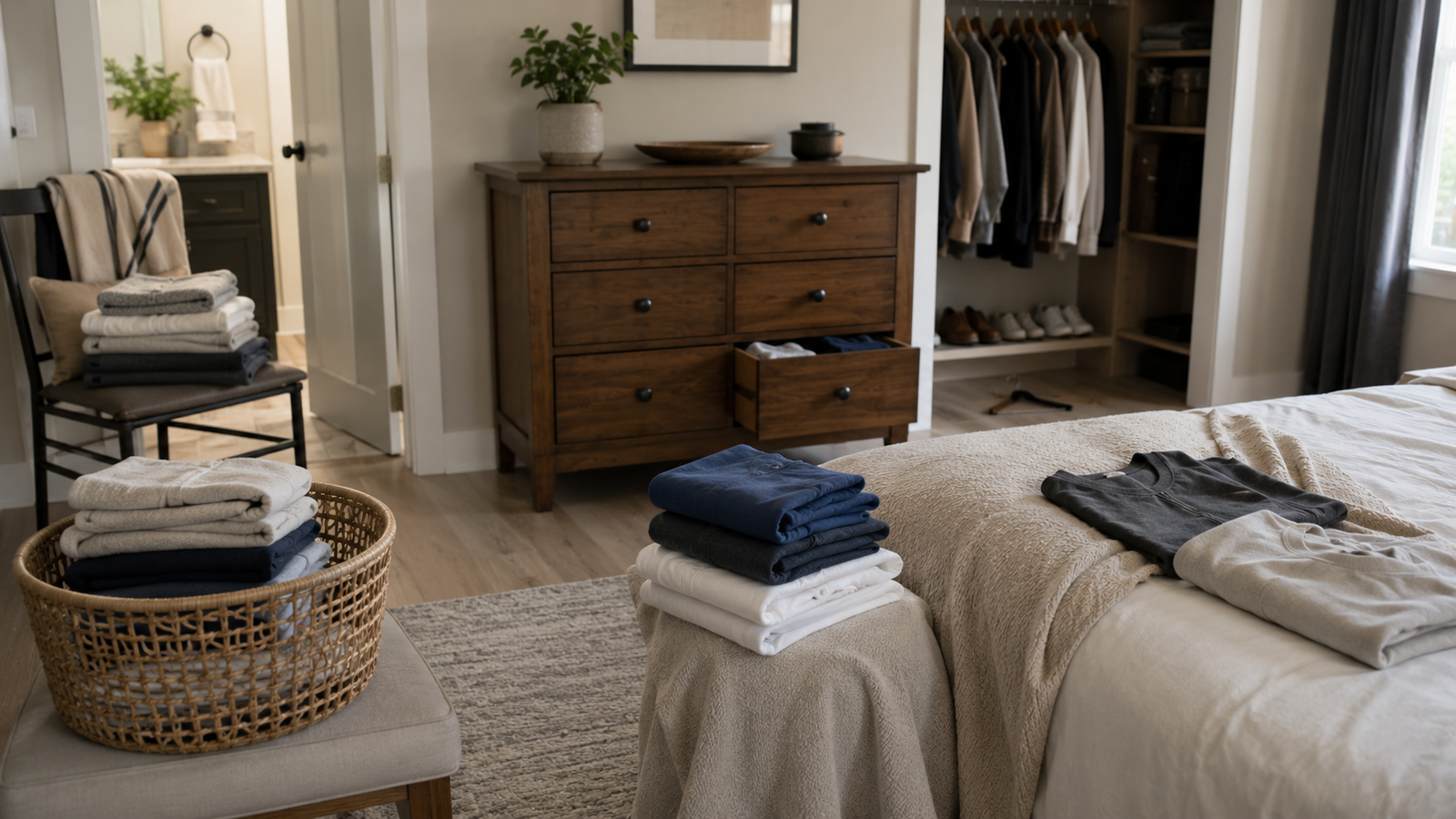
Laundry organization often breaks down after the washing machine and dryer have already done their work. The clothes are clean. They may even be folded. Yet a pile remains on the bed, a basket waits beside the dresser, or several shirts spend another night on the back of a chair.
Nothing is technically dirty, but the household task remains open.
That distinction matters. Clean laundry can create almost as much household friction as dirty laundry when no reliable sequence moves it from the machine back into drawers, closets, shelves, and hooks.
People often treat the visible pile as a motivation problem. Someone needs to stop procrastinating, fold faster, or become more disciplined about putting things away. However, a recurring clean laundry pile can point to something more practical: the household has a washing routine without a complete laundry system.
The missing piece is closure.
Laundry Organization Starts by Redefining Finished
A household can complete the mechanical portion of laundry while leaving the organizational work unresolved.
The washer cleans clothing. Afterward, the dryer removes moisture. Neither machine decides where socks belong, hangs a work shirt, returns towels to the linen closet, or places tomorrow morning’s clothes where someone can find them.
Those final movements are easy to underestimate because each one seems small. Together, however, they determine whether laundry disappears back into the household or becomes another temporary collection sitting in plain sight.
A load that moves from hamper to washer, dryer, and basket has completed only part of its route. Clothing still needs to reach its destination.
That unfinished route explains why a basket of clean clothes can remain untouched for several days inside an otherwise orderly home. The household created a strong beginning for the task but a weak ending.
Washing Is Only One Stage
The language households use can reinforce the problem. “I did the laundry” often means the clothes reached the dryer. In another home, it may mean someone folded them. Neither definition guarantees that the clothes returned to service.
A more useful definition includes the entire cycle. Dirty clothes enter the system. Clean clothes leave it only after they return to their normal locations.
This sounds like a small distinction. In practice, it changes the completion standard.
Instead of measuring success by a finished washer cycle, the household measures it by an empty clean-laundry basket.
Where Laundry Organization Usually Stalls
Clean clothes tend to stop at predictable locations.
The dryer can become temporary storage because removing the load creates another task. A basket may hold the clothes because folding requires sorting. Later, the bed becomes a folding surface until bedtime forces everything back into the basket.
Elsewhere, a chair can become a holding zone for clean clothes that have not reached the closet. A bench may collect folded towels. The top of a dresser can hold shirts that belong inside the drawers beneath it.
These locations are not random. They are points where the laundry sequence pauses.
Every Transfer Point Creates Another Restart
Each pause asks the household to restart the task later.
Suppose laundry dries on Sunday afternoon. Someone moves it into a basket, then folds it Sunday night. On Monday morning, another person sorts the clothing by room. Finally, someone puts the remaining pieces away Monday evening.
The physical work may not have increased much. Still, the household had to reengage with the same load several times.
That repeated restarting creates drag.
A household facing the same clean laundry pile each week should therefore examine where the clothes stop rather than simply demanding faster movement.
Perhaps the basket consistently moves into a room without a useful folding surface. Maybe everyone folds clothes downstairs even though the bedrooms sit upstairs. Several people’s clothing may share one load, which creates another sorting stage before anyone can put items away.
Even empty hangers can create friction when they live somewhere other than where clean hanging clothes get handled.
Each extra movement looks minor. Repeated every week, those movements become part of the household infrastructure.
Storage Can Quietly Break Laundry Organization
Sometimes the laundry sequence works reasonably well until the clothes reach their intended storage.
A tightly packed drawer creates resistance because every clean shirt requires rearranging something else. Likewise, a closet without spare hangers turns putting clothes away into a second organization project. Towels become harder to return when the linen shelf already operates at full capacity.
Under those conditions, the temporary pile becomes easier than the official destination.
That pattern provides useful information.
The Destination Has to Work
When clean clothes repeatedly remain outside their assigned storage, the household should examine the destination itself.
Can the drawer comfortably receive another normal load? Does the closet have enough working space to remove and replace clothing without reorganizing the entire rod? Can someone place fresh towels on the shelf without moving three other categories first?
Good storage needs capacity.
A drawer should accept its normal contents without negotiation. Closet space should allow ordinary movement. Frequently used linens need an obvious destination that can receive a newly washed stack with little effort.
This does not require an immaculate closet, matching containers, or a custom storage system. It requires usable space.
The Clean Laundry Pile May Be Reporting a Capacity Problem
A household can own plenty of storage furniture and still lack functional storage.
Once every drawer, shelf, and closet operates near its physical limit, ordinary maintenance gets harder. Clean clothes stay outside their assigned locations because those locations no longer accept them easily.
At that point, telling someone to “just put it away” ignores the actual operating constraint.
The system has nowhere easy to finish.
More Containers Are Not Automatically the Answer
Buying another basket can actually hide the capacity problem. The household gains another place to hold clean clothes without fixing where those clothes ultimately belong.
The same warning applies to extra bins, temporary racks, and secondary dressers. More storage can help when the household truly lacks appropriate capacity. However, additional containers can also create more intermediate destinations.
The better question is simple: does this object help clothing reach its permanent home, or does it give unfinished laundry somewhere else to wait?
That distinction prevents organization products from becoming infrastructure for delay.
Smaller Laundry Cycles Can Be Easier to Finish
Large laundry days can look efficient because several loads move through the machines in quick succession. Unfortunately, that approach can create a substantial downstream workload.
Three loads washed back-to-back eventually become three loads requiring sorting, folding, hanging, and putting away. If all that clean clothing arrives late in the day, the final stage competes with dinner, evening routines, and everything else happening in the home.
A smaller sequence changes the operating burden.
One load can move through its entire route before another load creates competition for attention. Towels can travel from hamper to shelf. Work clothes can move from basket to closet. Bedding can leave the bed, pass through the machines, and return without joining a mixed clean-laundry pile.
Measure Completion, Not Machine Activity
This approach may appear slower because fewer loads run at the same time. Yet household throughput should not depend only on how quickly clothing enters the washer.
The more useful measure is how reliably clothing reaches its final location.
A laundry routine that produces four clean baskets is busy. A routine that produces four empty baskets is complete.
That difference sits at the heart of practical laundry organization.
How to Close the Laundry Loop
A stronger sequence removes unnecessary pauses between stages.
Start with the destination. Before washing another category of clothing, make sure its normal storage has enough room to receive it. An overfilled dresser needs attention before another clean stack arrives. Likewise, a closet without usable hangers creates a predictable stopping point.
Next, reduce sorting complexity where practical. Loads containing items that return to similar locations can make the final movement easier. Towels have a limited number of destinations. Bedding returns mainly to beds and linen storage. One person’s clothing avoids the extra step of dividing a mixed pile among several rooms.
Then consider where folding happens.
Fold With the Destination in Mind
A large table may provide a convenient folding surface, but convenience changes if every folded item must then travel across the home.
The best folding location often reduces the next movement. Towels folded near linen storage have a short final trip. Bedroom clothing handled near the dresser or closet can return immediately.
Not every home allows this arrangement. The principle still holds: reduce unnecessary transfers wherever the layout permits.
Finally, protect the endpoint.
The basket should return empty.
That condition creates a visible completion standard. Clean clothing remaining inside the basket means the load is still active. Once the basket empties and returns to dirty-clothes collection, the household has closed the cycle.
Design for Interruptions
Real households interrupt themselves. Dinner needs attention. Someone needs the bathroom. A phone rings. Bedtime arrives sooner than expected.
A durable system should survive those interruptions without requiring a complete restart.
Fewer holding zones help. Clear storage helps as well. Smaller batches reduce the amount of unfinished work sitting in the room. Keeping hangers where people handle hanging clothes removes another search. Obvious destinations for frequently washed items shorten the final stage.
The objective is not speed for its own sake.
It is fewer unfinished loops.
Better Laundry Organization Reduces Tomorrow’s Work
An unfinished laundry load rarely stays confined to laundry day.
The friction returns the next morning when someone searches a clean basket for one shirt. Folded clothes get disturbed because the needed item sits beneath the stack. A bed becomes unavailable until someone moves clothing somewhere else. Meanwhile, the household cannot use the hamper for dirty clothes because clean clothes still occupy it.
One incomplete sequence begins interfering with another.
That is household drift in a very ordinary form.
Unfinished Laundry Often Migrates Into the Weekend
The timing matters too. When small laundry cycles remain open through the week, the unfinished work often migrates toward Saturday or Sunday.
Then the household reaches Sunday evening with more than Monday preparation to manage. Clean clothes still need homes. Work clothing needs locating. The hamper may already contain another load. Suddenly, laundry competes with food preparation, calendars, bags, and the final household reset.
That pattern is one reason Sunday night can start feeling like work before Monday begins. The pressure does not come from one enormous task. Several ordinary household cycles arrive at the same deadline because earlier work never fully closed.
Finishing the laundry cycle earlier removes one category from that Sunday compression point.
The Washing Machine Does Not Finish the Laundry
Strong laundry organization gives the task a clear beginning, a manageable route, and a visible endpoint.
The clothes do not need perfect folds. Closets do not need to resemble showrooms. Nobody needs an elaborate collection of matching containers.
The household needs the task to finish.
Clean clothes belong back in circulation rather than in a permanent state of waiting. When the final movements become part of the normal sequence, chairs and beds stop serving as unofficial extensions of the closet.
The room clears. The basket empties. Meanwhile, the next load can begin without inheriting unfinished work from the last one.
That is how a small domestic correction creates stability. The household does not demand more effort every week. Instead, it creates a sequence in which ordinary effort reaches an actual endpoint.
The washing machine does not finish the laundry. The household does.
Further Groundwork
The Maintenance Gap: Why Homes Get Harder to Run
Why Everything Ends Up on the Kitchen Counter
Receipts
American Sociological Review: The Cognitive Dimension of Household Labor
Allison Daminger’s research examines the cognitive work involved in household labor, including anticipating needs, identifying options, making decisions, and monitoring results. That framework helps explain why recurring domestic tasks involve more than the most visible physical action.
Build Better. Every Day.
Receive practical essays and grounded frameworks for building stronger household systems, steadier routines, and homes that require less recovery.
Subscribe to Groundwork DailyOne email. No noise. Unsubscribe anytime.

About the Builder: Celeste Monroe writes the House Rhythm and Soul Commentary series for Groundwork Daily. House Rhythm documents how homes hold order; Soul Commentary documents how people hold themselves. Both are built from direct observation, not theory: what repeats, what drifts, and what quietly costs more than it should.