

Economy & Ownership · Cost Transfer & Accountability
Who pays to fix what broke is the question a system can postpone for years, but eventually cannot escape. Damage may begin with one decision, accumulate through many others, and remain hidden behind temporary stability. Repair is different. Repair requires somebody to absorb the bill.
The Bill Usually Arrives After the Decision-Makers Have Moved On
A bridge deteriorates slowly. A pension fund becomes underfunded over many budget cycles. A building survives years of deferred maintenance. A financial institution accumulates risk until a shock makes the weakness visible.
In each case, failure appears to arrive suddenly. Usually, it did not.
Systems Can Hide Damage Longer Than They Can Avoid Cost
Weak structures often survive because the cost of deterioration is spread across time. Maintenance is delayed, reserves are reduced, staffing is stretched, borrowing fills a gap, or a temporary intervention keeps the visible system functioning.
For a while, that can look like discipline. Sometimes it is simply a bill being moved into the future.
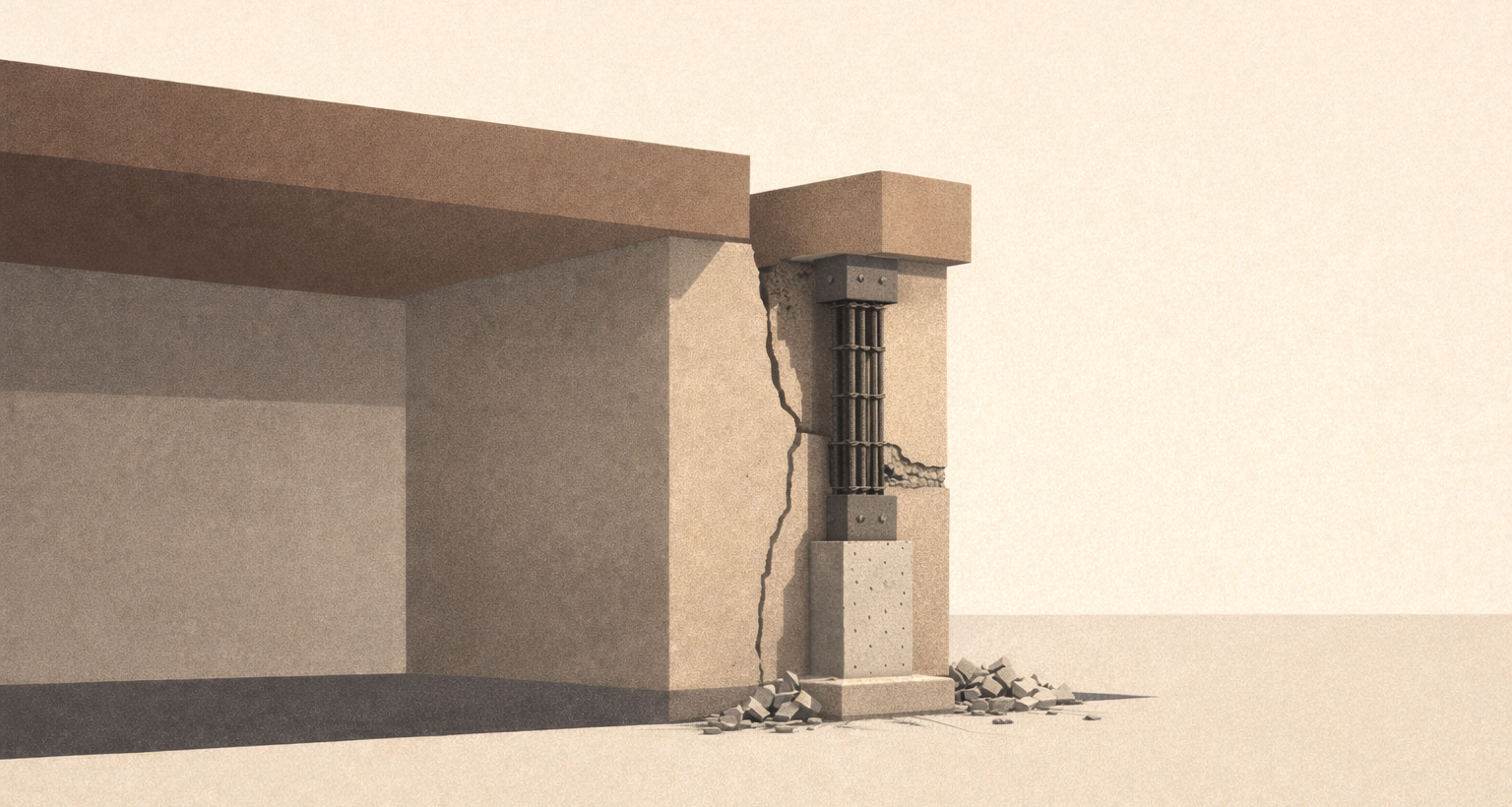
Damage Can Be Deferred. Repair Cannot.
Every system has a threshold below which weakness remains manageable.
Maintenance can be postponed for a month. A vacancy can remain unfilled for a quarter. Debt can refinance a temporary gap. An aging asset can continue operating with more inspections and temporary fixes.
None of those choices is automatically irresponsible. Good operators make tradeoffs constantly.
The Risk Begins When Temporary Becomes Structural
A short-term accommodation becomes dangerous when the organization begins depending on it as the normal operating model.
For example, one delayed repair may preserve cash. Repeated deferral, however, can turn routine maintenance into capital replacement.
Likewise, holding a position vacant may solve one budget problem. Running the department permanently understaffed can create burnout, errors, turnover, and eventually a larger operating cost.
The Price of Delay Compounds
Deferred obligations often behave like economic interest. The longer the underlying problem remains unresolved, the more expensive the eventual intervention can become.
At that point, the institution is no longer deciding whether to pay.
It is deciding who will pay.
Repair Changes the Economics
Restraint can often remain abstract. Repair cannot.
Once a damaged asset, underfunded system, failed institution, or neglected obligation reaches the repair stage, resources must move.
Repair Requires Real Capacity
Cash may have to be redirected. Taxes may increase. Rates may rise. A company may issue debt, cut another program, reduce distributions, delay expansion, or ask owners to contribute more capital.
In some cases, insurance absorbs part of the cost. In others, the public balance sheet becomes the backstop.
Regardless of the mechanism, repair consumes capacity that could have gone somewhere else.
Opportunity Cost Is Part of the Repair Bill
A dollar used to replace a failed system cannot simultaneously fund another priority.
That makes repair more expensive than the invoice alone suggests. The real cost includes the opportunity that had to be surrendered because the problem was allowed to mature.
Who Pays to Fix What Broke?
The answer depends less on abstract fairness than on the structure of claims around the damaged system.
Some parties have contracts. Others have political influence. Some can leave. Others cannot. Certain groups can shift costs through pricing, fees, taxes, layoffs, service cuts, or reduced investment.
Causation and Payment Are Different Questions
The person or institution that created the risk is not always the party that ultimately absorbs the repair cost.
A previous administration may have deferred maintenance. Future taxpayers may finance the replacement.
Executives may authorize excessive risk, while employees, shareholders, depositors, customers, or governments absorb part of the correction.
A property owner may delay investment, then transfer some repair cost through higher rent once the work finally occurs.
Responsibility Often Travels Further Than Cause
This is where public debate becomes confused. People understandably ask who caused the problem. Economic systems also require a second question: who possesses enough leverage to avoid paying for it?
The gap between those two answers is where cost transfer lives.
The Weakest Payer Is Often the Easiest Payer
Costs do not always land on the participant with the least money.
More precisely, they tend to move toward whoever has the least ability to reject the new terms.
Exit Changes Bargaining Power
A company with multiple suppliers can negotiate differently from a customer with only one local utility.
Likewise, a highly mobile investor has different options from a resident whose home, job, family, and daily life are tied to one place.
A worker with scarce skills may resist a wage concession that another worker cannot afford to reject.
Low Leverage Makes Cost Transfer Easier
When one side can walk away and the other side cannot, the cost distribution rarely begins from equal footing.
That is not proof of malicious intent. It is a structural incentive.
Organizations under pressure tend to use the options that preserve their own continuity. If the system allows costs to be moved toward parties with less leverage, that option becomes economically attractive.
Follow the Repair Money
The cleanest way to understand repair is to follow the financing path rather than the public language around it.
The Financing Method Determines the Distribution
Different repair mechanisms produce different winners, losers, and time horizons.
Borrowing may spread the cost across future budgets. A tax increase can distribute it broadly. User fees concentrate payment on the people who use a service. Equity contributions place more of the burden on owners.
Service reductions may avoid a direct charge while shifting the cost into waiting time, inconvenience, reduced quality, or lost access.
Every Repair Method Has a Price
The absence of a visible invoice does not mean the repair is free.
Someone pays through money, time, reduced service, increased risk, forgone investment, or future obligation.
“The government paid for it” does not identify the final payer.
Governments finance repair through taxation, borrowing, fees, transfers, spending reductions, or monetary and fiscal mechanisms. The relevant Power & Price question is what claim ultimately financed the intervention and who carried that claim.
The Pattern Appears Across Different Systems
The details vary, but the basic mechanism repeats.
Maintenance Becomes Replacement
Routine work is postponed until the asset requires major rehabilitation or replacement. Future budgets inherit a larger obligation.
Private Risk Can Create Public Exposure
When a financial institution becomes systemically important, policymakers may decide that allowing uncontrolled failure would impose a larger public cost than intervention.
Underfunding Travels Through Time
Contributions that are too low in one period can create larger obligations for future workers, employers, governments, or beneficiaries.
Cleanup Costs Can Outlive the Activity
Pollution or contamination may generate economic value during production while remediation costs appear years later and involve entirely different stakeholders.
Stability Can Become a Way to Hide the Bill
Institutions often defend stability for legitimate reasons.
A functioning bank, transportation system, pension plan, hospital, utility, school district, or housing system has real public value. Disorder carries costs of its own.
The problem begins when stability becomes an argument against confronting the underlying obligation.
Stabilization and Repair Are Not the Same
Stabilization stops deterioration long enough to preserve function.
Repair addresses the condition that made intervention necessary.
A system can therefore be stabilized repeatedly without ever becoming healthy.
When that happens, temporary interventions become part of the operating model and the underlying repair bill continues to grow.
This connects directly to The Price of Stability. Stability is not free. The question is whether its cost purchases time for real repair or merely finances continued deferral.
Repair Forces Structural Accountability
Accountability is often discussed as punishment.
That is too narrow for systems analysis.
Structural Accountability Asks Who Holds the Obligation
Who owns the damaged asset? Which contracts assign responsibility? Who collected revenue while maintenance was deferred? Who approved the budgets? Which insurer covers the loss?
Then the analysis has to continue.
Which parties can legally or economically transfer part of that obligation to someone else?
Accountability Should Change Future Incentives
A repair system fails when the participant taking the risk keeps most of the upside while routinely transferring the downside elsewhere.
That arrangement creates an incentive to underestimate maintenance, overuse leverage, postpone reserves, or take risks that would look different if the same party had to finance the full correction.
Good accountability therefore does more than assign blame after failure.
It changes the price of creating the next failure.
Silence Can Be Part of the Cost Structure
Some systems survive deferral because the people closest to the weakness are discouraged from making the cost visible.
Employees learn not to escalate. Residents stop reporting. Managers normalize workarounds. Boards accept optimistic forecasts because acknowledging the real obligation would force an uncomfortable decision.
In that environment, silence becomes infrastructure.
Information Has Economic Value
An accurate maintenance report, reserve study, audit, inspection, risk assessment, or actuarial projection can reveal a future bill before it becomes an emergency.
Suppressing or ignoring that information may preserve short-term comfort. It also reduces the time available to finance repair intelligently.
This is why Silence as Infrastructure belongs in the same Power & Price sequence. Information control can delay accountability, but it cannot erase the underlying obligation.
Better Repair Starts Before Something Breaks
The credible solution is not to pretend every failure can be prevented.
Complex systems will still experience mistakes, shocks, deterioration, and bad forecasts.
The stronger objective is to make the price of failure visible earlier and distribute responsibility deliberately rather than by default.
Price Maintenance Before Crisis
Reserves, inspections, lifecycle planning, insurance, stress testing, transparent financial reporting, and realistic capital budgets all make future obligations more visible.
Those tools do not remove cost. They improve the timing and quality of the decision about how that cost will be financed.
Define Responsibility Before Pressure Arrives
Contracts, governance documents, regulatory standards, funding policies, and ownership structures should establish who carries which obligations before the system reaches crisis.
Otherwise, the allocation is negotiated when everyone has less time, fewer options, and stronger incentives to push the bill somewhere else.
Do Not Confuse Reform With Free Repair
Reform itself has a price.
Higher standards require enforcement. Better infrastructure requires capital. Safer balance sheets may reduce short-term returns. More generous reserves tie up money that could have been deployed elsewhere.
That tradeoff is examined further in Reform Is Not Free.
The Break Reveals a Cost That Already Existed
Who pays to fix what broke is not merely a question about repair.
It is a question about the entire economic structure that existed before the break.
The Final Bill Contains Old Decisions
It contains the maintenance that was delayed, the reserves that were not funded, the risk that was accepted, the warning that was ignored, and the temporary stabilization that became permanent.
By the time failure becomes visible, many of those decisions may be years old.
Power Determines More Than Who Decides
Power also affects who can transfer the consequence of a bad decision.
Participants with stronger leverage may have more ways to protect themselves. Those with fewer options may absorb more of the price through money, reduced services, lost wages, higher fees, delayed investment, or future debt.
That Is Why Repair Is an Accountability Test
A healthy system does not merely fix what failed.
It examines why the obligation accumulated, how the repair was financed, who paid, and whether the new structure changes the incentives that produced the weakness.
Otherwise, the repair may restore function without fixing the system.

Price the Repair Before the Break
Every durable system should know which obligations it is accumulating.
Maintenance, reserves, insurance, staffing, compliance, infrastructure, and risk all carry costs whether the invoice is visible today or not.
Deferral Is a Financing Decision
When a system postpones an obligation, it is effectively choosing to finance part of the present through the future.
That decision can be rational. It becomes dangerous when nobody measures the accumulated claim.
Accountability Begins With the Full Money Trail
When repair becomes necessary, follow the financing all the way to the final payer.
Do not stop at the institution writing the check.
The real price of failure is revealed by who ultimately loses money, time, service, opportunity, or future capacity so the system can function again.
Where This Article Sits
This article examines what happens when deferred obligations become unavoidable repair costs.
Its central question is not merely who caused the failure, but how leverage, ownership, contracts, and institutional design determine who ultimately finances the correction.
Accountability Is a Form of Strength
Strong systems make obligations visible, assign responsibility clearly, and allow failure to change future incentives rather than merely restoring the previous arrangement.
Pressure
Pressure reveals whether a system has real reserves, clear responsibility, and enough structural strength to absorb repair without simply moving the cost toward whoever has the least leverage.
Explore the Full Groundwork Architecture
Core Principles: Structure Builds Freedom · Stillness Is Strategy · Discipline Is Emotional Governance · Structure Is Mercy · Discipline Before Dollars · Accountability Is a Form of Strength · Build What Holds
Conditions: Capacity · Discernment · Alignment · Pressure · Overload · Recovery · Clear
Browse the complete Core Principles architecture and Conditions architecture.
Meet the Builder
Samual Drayton
Samual Drayton examines the structure beneath economic activity: who owns the asset, who controls access, who sets the terms, who absorbs the cost, and where value remains after money moves.
Through Power & Price, he follows pricing, leverage, markets, institutions, supply systems, ownership, and capital retention to reveal the difference between economic activity and durable economic position.
Signature philosophy: Follow the money past the transaction. The structure tells you who controls the terms, who carries the cost, and where the value settles.
Expect practical Groundwork on economic power, ownership, pricing, leverage, market structure, cost transfer, institutions, supply systems, trust, community wealth, and capital retention.
Sources & Further Reading
- U.S. Government Accountability Office. Federal oversight and research concerning infrastructure, fiscal exposure, program risk, government liabilities, and long-term public obligations. Review GAO research .
- Congressional Budget Office. Federal analysis of public spending, debt, budget obligations, infrastructure policy, and long-term fiscal conditions. Review Congressional Budget Office research .
- Federal Emergency Management Agency. Federal resources on hazard mitigation and the economic value of reducing future losses before disasters create larger repair obligations. Review FEMA hazard mitigation resources .
- Brookings Institution. Research on governance, public institutions, infrastructure, fiscal capacity, and institutional accountability. Review governance research .
- Groundwork Daily. The Price of Stability. Companion Power & Price analysis examining what institutions spend, surrender, or transfer in order to preserve stability. Read the article .
- Groundwork Daily. Reform Is Not Free. Companion Power & Price analysis examining the real financial and institutional cost of changing a weak system. Read the article .
- Groundwork Daily. Silence as Infrastructure. Companion Power & Price analysis examining how information control, institutional silence, and normalized workarounds can allow structural weakness to persist. Read the article .
- Groundwork Daily. Accountability Is a Form of Strength. Governing Core Principle for this article’s analysis of responsibility, repair, and durable institutional structure. Explore the Core Principle .
- Groundwork Daily. Pressure. Governing Condition examining what systems reveal when demands exceed their ordinary margin for error. Explore Pressure .