
Why group economics fails is rarely about bad intent. It usually fails because the structure is incomplete. Shared ownership can create stability, but only when rules, roles, records, and accountability are designed before money starts moving.
This is the part most people skip. Groups form on trust, urgency, excitement, or shared frustration. Then the first conflict arrives, and the system has no guardrails. That is not a character problem. It is a governance problem.
Group economics does not collapse because cooperation is unrealistic. It collapses when cooperation is asked to carry more weight than the structure can hold.
The most common reason group economics fails
The most common reason group economics fails is lack of clarity. When agreements stay informal, expectations drift. When expectations drift, accountability turns personal. When accountability turns personal, relationships take the hit.
Shared ownership does not survive “everyone knows what I meant.” It survives written rules.
The problem usually begins small. One person pays late. Another person assumes an exception is allowed. Someone else believes the purpose has changed. Nobody wants to make it awkward, so the group avoids the conversation. Avoidance becomes policy by accident.
When trust replaces governance
Many groups rely on social pressure to enforce discipline. Friendship, family ties, and cultural loyalty become substitutes for clear processes. That approach works until the first missed payment, the first disagreement, or the first emergency expense.
Sustainable groups treat trust as a starting point, not a control system. Governance does the controlling. Governance keeps conflict from becoming a personal war.
Trust matters, but trust without process is fragile. People remember conversations differently. People handle pressure differently. People interpret fairness differently. Governance exists because memory is not enough.
Why money exposes unresolved issues
Money does not create dysfunction. It reveals it. Poor communication becomes avoidance. Vague leadership becomes contested authority. Small resentments become moral accusations. The group does not collapse because people are flawed. The group collapses because the structure cannot carry stress.
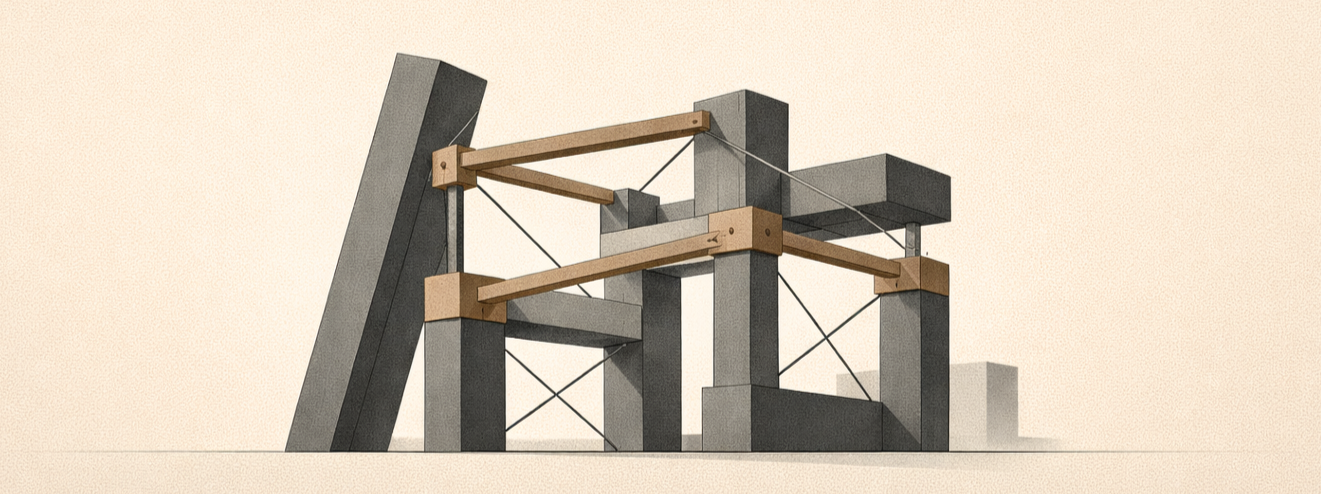
This is why shared ownership needs load-bearing design: clear decisions, clear records, and clear exits.
Without those pieces, every disagreement becomes larger than the issue itself. A missed contribution becomes a loyalty test. A disagreement over timing becomes a character judgment. A request for documentation becomes an accusation.
That is how systems break quietly before they break publicly.
Overexpansion without capacity
Another reason group economics fails is growth without upgraded structure. A model that works for five people breaks at fifteen if the group never formalizes roles, reporting, and decision rules. Scale increases risk faster than it creates opportunity when governance stays casual.
Sustainable groups expand slowly. They upgrade structure before they increase complexity.
Growth feels like proof that the idea is working. That is the trap. Growth increases communication paths, decision points, recordkeeping needs, and opportunities for misunderstanding. If the group does not upgrade the operating system, success becomes the thing that breaks it.
The danger of mixed purposes
Group economics also fails when one structure tries to do too many jobs. A housing fund, emergency fund, business fund, and personal lending circle cannot all live inside the same informal arrangement without confusion.
Purpose drift creates conflict because members begin measuring fairness by different standards. One person thinks the group exists for investment. Another thinks it exists for mutual aid. Another thinks it exists for emergencies. Each view may be reasonable, but the system cannot serve all of them at once.
A durable group defines what it is for and what it is not for. That boundary is not cold. It is protective.
What sustainable groups do differently
Groups that last share the same habits. They treat economics like infrastructure, not vibes:
- Written agreements: contributions, rights, responsibilities, and timelines are documented.
- Limited scope: one purpose per group, such as housing, business capital, or land acquisition.
- Transparent accounting: every member can see contributions, balances, and decisions.
- Defined exit rules: members can leave without drama, threats, or social punishment.
- Decision processes: voting, quorum rules, and dispute resolution are established in advance.
This is not bureaucracy. This is protection. Structure protects both the money and the relationship.
What failure looks like early
Failure rarely starts with collapse. It starts with small signals that the group ignores.
- Meetings become irregular.
- Balances are unclear.
- One person becomes the unofficial manager.
- Exceptions become normal.
- Members avoid hard questions to preserve peace.
These signals matter because they show the system is running on personality instead of process. Once that happens, the group becomes dependent on whoever is most responsible, most organized, or most willing to absorb tension.
That is not shared ownership. That is hidden labor.
Group economics is a system, not a slogan
Group economics succeeds when discipline shows up early, not after a crisis. The same principle applies across every durable system: outcomes follow structure, not emotion. For the underlying framework, see Discipline Before Dollars.
For cooperative governance context and sector coverage, review the overview materials from the National Cooperative Business Association.
For the broader context behind the trend, read The Briefing: The Rise of Group Economics. For a practical explanation of mechanics, see How Group Economics Actually Works.
For the full series framework, see Group Economics: How Shared Ownership Actually Works. For the human-scale design principle, read What Group Economics Looks Like at a Small Scale. For the governance layer, see Group Economics Governance.
Why group economics fails comes down to one reality: shared ownership requires a structure that can hold stress. Build the system first. Then the group has a real chance to last.
