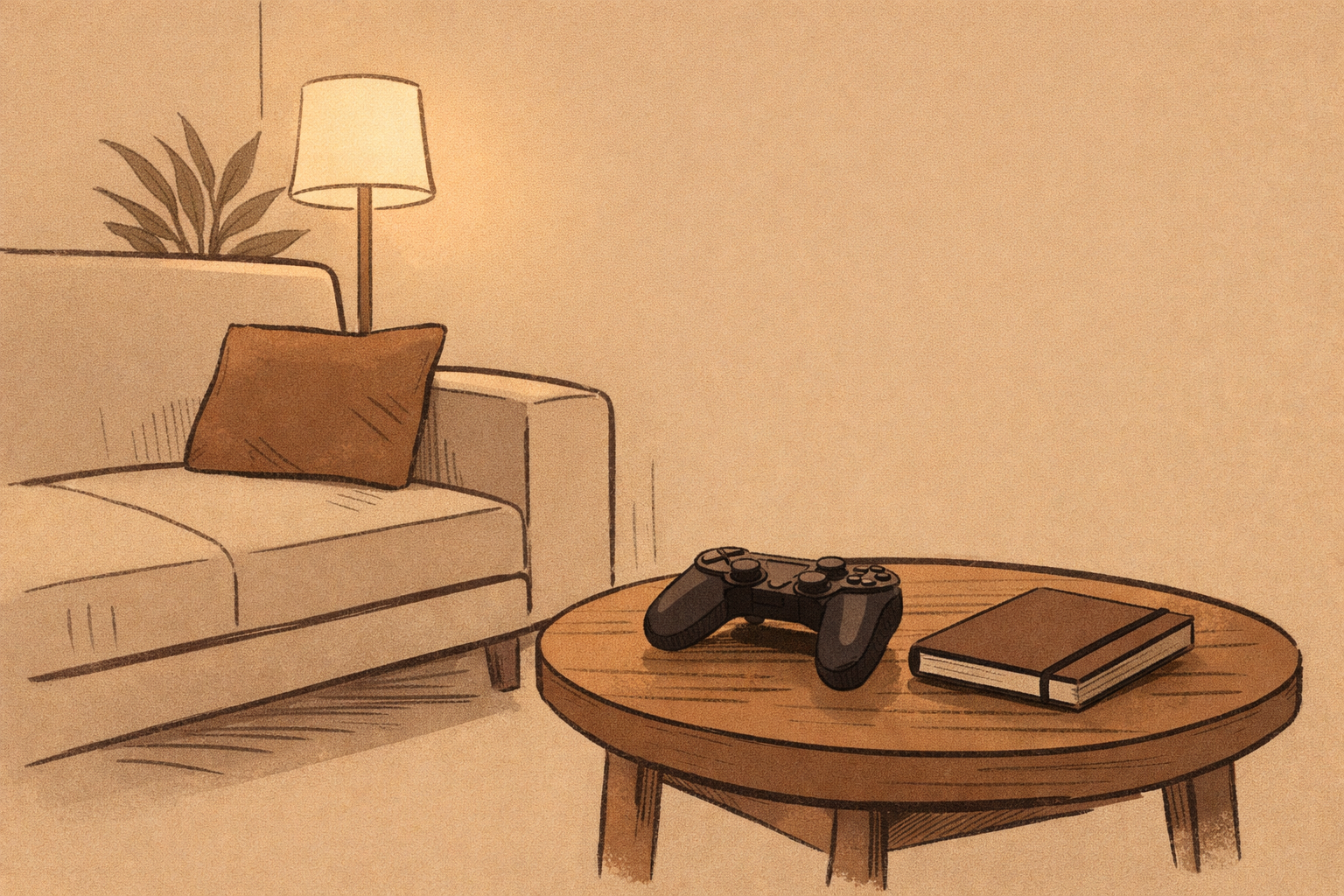
Legacy In Motion · Gaming Cluster
Family Architecture · Masculine Responsibility · Structured Leisure
Are video games bad for adult men? Not by default. A controller tells you almost nothing about a man’s maturity because what matters is the life that exists around it.
That answer is less dramatic than the argument usually becomes.
People see a grown man gaming and begin filling in the rest of the story. Maybe he is avoiding responsibility. Perhaps he lacks ambition. His partner may be tired of competing with a screen. On the other hand, he may simply be sitting in his own home after a long day, playing something he enjoys.
Any of those stories could be true, but the controller cannot tell us which one.
That is where this conversation often gets lazy. Gaming becomes shorthand for immaturity, while other forms of adult escape receive far less scrutiny.
A man can lose three hours scrolling and nobody sees an object to blame. He can spend an entire Sunday watching sports and call it normal. Likewise, he can work until he is exhausted and receive praise for dedication.
Put a controller in his hand, though, and suddenly adulthood is on trial.
That standard is too shallow.
Instead of asking whether grown men are supposed to play video games, the better question is whether gaming has a healthy place inside the life a man says he wants to build.
The Standard
Judge the structure around the gaming, not the existence of the gaming.
Start With the Right Question
Are Video Games Bad for Adult Men, or Are We Measuring the Wrong Thing?
Video games are not inherently incompatible with adulthood.
Adult life has never required the elimination of play. Instead, it requires judgment, responsibility, self-control, and the ability to return when leisure time is over.
That last part matters because gaming itself does not establish whether a man is responsible.
A man can enjoy games and still pay his bills. He can play online with friends and remain emotionally available to his family. At the same time, he can care about a fictional world while remaining fully accountable in the real one.
Of course, the opposite can happen. A man can also use games to disappear from obligations he does not want to face.
Both patterns exist. Therefore, the presence of gaming tells us very little by itself.
Function Matters More Than the Controller
A better measure is function.
What happens to work, sleep, health, relationships, money, ambition, and basic responsibility when gaming enters the schedule?
That is where adulthood becomes visible.
What Research Says When Asking If Video Games Are Bad for Adult Men
The research does not support a simple story in which more gaming automatically means worse mental health.
One of the stronger studies in this area followed 38,935 adult players across six weeks. Researchers paired self-reported well-being with objective gameplay data supplied by seven game publishers.
On average, changes in time spent playing showed little to no meaningful effect on well-being.
However, that does not prove gaming is harmless in every circumstance. It does show why an hour count by itself is a weak diagnostic.
Time Alone Does Not Tell the Whole Story
Motivation appeared more relevant.
Playing because an activity feels enjoyable and self-directed is not psychologically identical to feeling compelled, pressured, or unable to disengage.
A separate 2022 survey of 2,107 adult gamers found that many participants perceived emotional or psychological benefits from gaming. Still, that study was cross-sectional and relied on self-report.
As a result, the study can identify associations and player perceptions, but it cannot prove that gaming caused those benefits.
Research Does Not Need Gaming to Be Medicine or Poison
That distinction matters.
Groundwork does not need gaming to be either medicine or poison. Instead, it can simply be an activity whose effects depend heavily on the person, motivation, game, context, and surrounding life.
What Video Games Can Provide Adult Men
At their best, games offer something adult life often does badly: a contained challenge.
The rules are visible. Feedback arrives. Progress can be measured. Failure is usually survivable, and another attempt remains available.
Real life is rarely that considerate.
For example, a man can work hard for months without knowing whether a promotion is coming. He can save money for years before the progress feels substantial. Relationships require effort without guarantees. Parenting may take decades before the outcome becomes clear.
Games compress uncertainty because you act and the system responds.
That can feel good without pretending it replaces real accomplishment.
Gaming Can Offer Agency
Games often provide clear choices and immediate consequences. Therefore, the sense of agency can be satisfying, especially after a day filled with decisions whose outcomes remain uncertain.
Still, digital agency should supplement real-world agency, not replace it.
A man should not become powerful everywhere except his own life.
Gaming Can Provide Social Connection
For some men, gaming is also where friendships happen.
Friends who live in different cities can talk while playing. Brothers can stay connected across distance. In the same way, a regular online session can become a modern version of meeting at the same neighborhood court every week.
That connection is real even when the room is digital.
Gaming Can Create Structured Decompression
Sometimes a person does not need another growth strategy.
Instead, he may need ninety minutes in which the world asks nothing more complicated than whether he can make the next jump.
There is nothing inherently unserious about that.
The problem begins when decompression loses its exit.
Rest should help you return. If it keeps you from returning, something has changed.
That distinction is developed further in Escape vs. Rest: When Gaming Is Healthy and When It Becomes Avoidance .
When Video Games Become a Problem for Adult Men
The most useful warning sign is not enjoyment. It is repeated displacement.
In other words, gaming deserves scrutiny when the rest of life repeatedly shrinks to make room for it.
That may include:
- sleep becoming chronically inadequate
- work or school responsibilities slipping
- physical health and hygiene deteriorating
- money being spent irresponsibly
- friendships outside gaming disappearing
- a partner repeatedly feeling abandoned
- parenting or household responsibilities being displaced
- important goals being postponed without end
Patterns Matter More Than an Occasional Long Session
One late night does not establish a pattern. Likewise, a long weekend with a new release does not prove that gaming has become unhealthy.
Adults are allowed seasons of indulgence.
The concern is what happens repeatedly after the novelty is gone.
Adult Men, Video Games, and the Freedom of Single Life
Single men deserve their own part of this conversation.
A man who lives alone does not need to organize his evening around another adult’s preferences. If he wants to order dinner, put on a headset, and spend Saturday night gaming, adulthood has not been violated.
That freedom is real. However, so is the risk that comes with it.
Freedom Removes External Friction
Single life removes some external friction.
Nobody necessarily notices that bedtime quietly became 3:00 a.m. Someone may never ask why the application was not submitted. Likewise, nobody may see the workout disappear or realize that every open evening now belongs to the same activity.
Therefore, freedom increases the need for self-governance.
The Question Is What the Freedom Is Building
The issue is not whether a single man has permission to game.
He does.
The sharper question is what his freedom is building.
Are Video Games Bad for Adult Men in Relationships?
Partnership changes the equation.
That is not because a relationship cancels individual freedom. Instead, another person’s time, labor, expectations, and emotional life now overlap with yours.
From one side of the couch, gaming may feel like harmless downtime. From the other side, the same session may feel like disappearance.
Neither interpretation automatically wins.
Shared Time Changes the Gaming Question
The useful questions are practical.
Was shared time promised? Is household labor reasonably balanced? Can both people access leisure? Does one person repeatedly have to ask the other to come back?
In addition, is gaming interrupting intimacy, parenting, sleep, conversation, or responsibilities that were understood to be shared?
Those are relationship-system questions.
Boundaries Should Protect Both Freedom and Contribution
The issue is not permission. The issue is whether the system is fair enough that neither person has to become a parent to the other just to protect dinner, sleep, chores, or time together.
At the same time, an adult should not need authorization every time he wants to play.
Good agreements solve both problems.
Women do not share one opinion about gaming, and men do not share one gaming pattern. Therefore, a partner’s concern becomes more useful when the couple identifies what gaming actually means inside that relationship.
What a Partner May Actually Be Reacting To
Maybe protected time keeps disappearing. Perhaps the household workload has become uneven. One person may want more connection, or gaming may have caused conflict in a previous relationship.
In other cases, the gaming itself is fine, but expectations were never discussed.
Those concerns deserve to be heard without turning the hobby itself into a moral defect.
On the other hand, some partners may prefer leisure that happens at home. Gaming can feel predictable, relatively contained, socially connected, and easier to integrate into shared life than many alternatives.
Still, being physically home is not the same as being present.
Two people can sit on the same couch and still be miles apart.
That is why healthy gaming boundaries for couples should focus on presence, contribution, individual freedom, communication, and repair rather than control.
Video Games, Adult Men, Masculinity, and the Right to Play
There is also a larger question underneath the controller.
What are men allowed to do when they are not producing?
Male hobbies often become easier to defend when they can be attached to performance.
Lift weights and it becomes discipline. Build furniture and it becomes craftsmanship. Trade stocks and it becomes financial literacy. Play basketball and it becomes fitness.
However, play something simply because it is fun and suddenly an explanation may be required.
Not Every Hour Has to Become an Achievement
That assumption is worth challenging.
Men should not need to monetize every interest, optimize every evening, or convert every free hour into evidence of ambition before rest becomes legitimate.
Adult responsibility requires productive effort. At the same time, adult health requires recovery.
Both belong in a durable life.
Self-Governance Is the Stronger Standard
The stronger masculine standard is not endless labor. It is self-governance.
Work when work is required. Rest without apology when rest is appropriate. Then return when responsibility calls.
A Better Framework for Adult Men and Video Games
Instead of asking whether a grown man should be gaming, inspect the structure around the habit.
Purpose
Is there a meaningful life outside the screen?
Boundaries
Can gaming begin and end without a fight?
Responsibility
Are work, money, health, and obligations being handled?
Presence
Can the people who matter still reach him?
Almost Anything Can Become a Hiding Place
A man with structure can make room for gaming.
Without structure, almost anything can become a hiding place.
Work can become avoidance. Exercise can become obsession. Social media can consume attention. Nightlife can consume money. Even productivity can become a sophisticated way to avoid being emotionally available.
Therefore, the controller should not carry the entire moral burden.
The Adult Gaming Self-Audit
Cultural judgment is noisy. A self-audit is cleaner.
1. What does gaming replace?
If gaming replaces three hours of mindless scrolling, that tells one story.
If it replaces sleep, work, exercise, intimacy, parenting, household responsibility, or something you keep promising yourself you will finally handle, that tells another.
2. Can you stop when you planned to stop?
The ability to return matters.
Leisure should not require a negotiation with yourself every time real life calls you back.
3. Is your life still expanding?
Are you learning, working, maintaining relationships, handling money, caring for your body, and moving toward something outside the screen?
Your life does not need to improve every day. However, it should not keep getting smaller.
4. What version of you returns?
Do you come back calmer, clearer, and easier to be around?
Or do you return irritated, sleep-deprived, detached, and already thinking about the next session?
5. Would the people closest to you describe your gaming the same way you do?
That question can sting, but ask it anyway.
Intentions matter. So does the experience other people actually have of us.
What Maturity Actually Looks Like
Maturity is not proving that you no longer need play.
It is being able to enjoy play without asking the rest of your life to pay for it.
The Groundwork
Are Video Games Bad for Adult Men? Play Is Not the Enemy
Video games are neither a verdict nor a virtue. They are a form of leisure.
Used intentionally, gaming can provide enjoyment, challenge, social connection, and a legitimate place to decompress.
Used without limits, however, it can contribute to lost sleep, neglected responsibilities, relational distance, and a life that quietly stops moving.
That pattern is not unique to gaming. It is what happens whenever one activity starts consuming more of a life than it can responsibly hold.
Structured Leisure Is the Goal
The work is not to shame men out of play. Instead, the work is to build adult lives where play has a place without taking over the house.
A man should be able to work hard and play something ridiculous. He should be able to carry responsibility and still get excited about a new release.
At the same time, he should know when to save the game, turn off the screen, and come back to the people and commitments waiting for him.
That is the line.
Not boyhood versus manhood. Not gamers versus non-gamers.
Recreation versus drift.
The object in your hands matters less than the life waiting when you put it down.
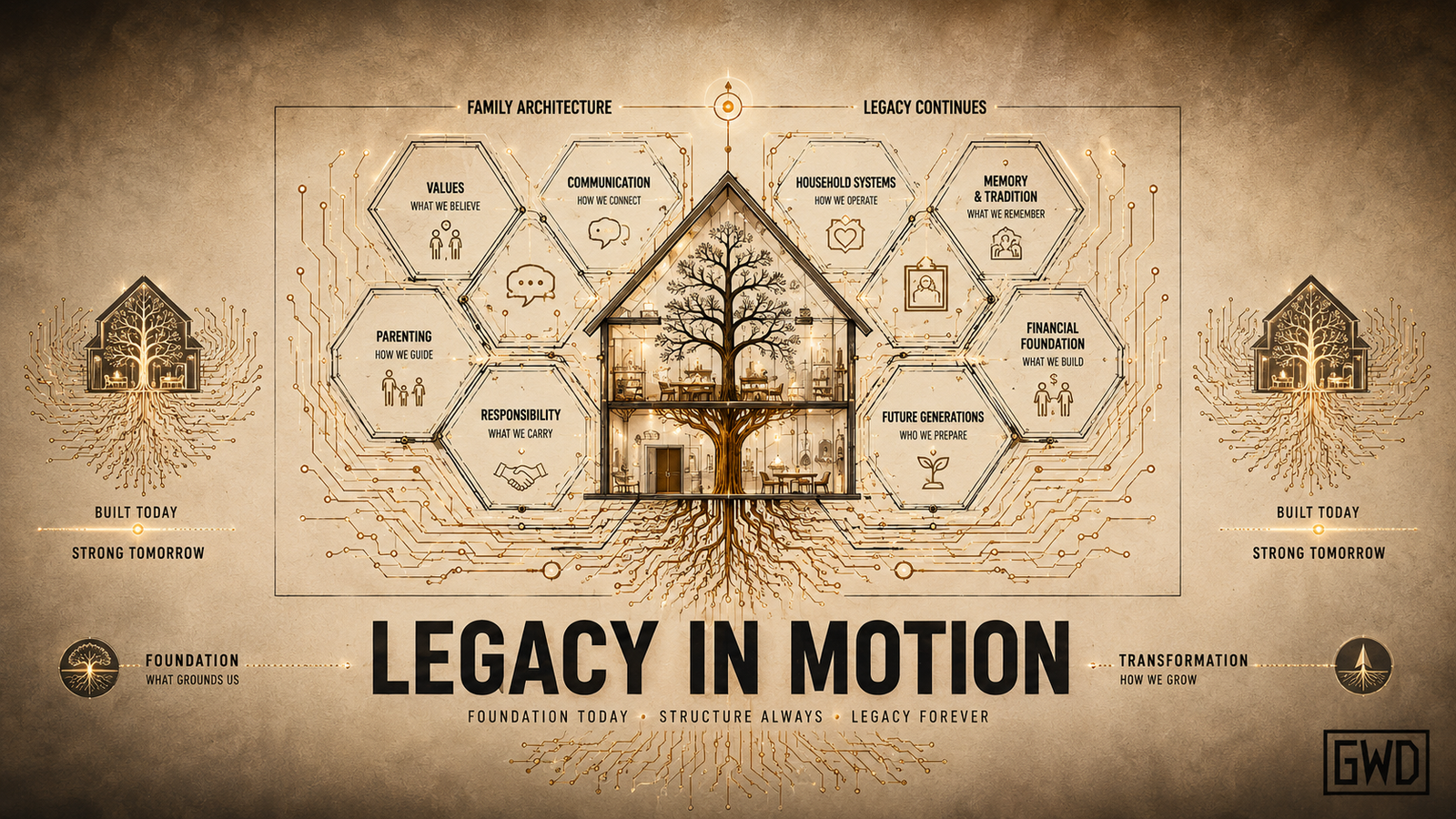
Continue Building
This anchor is part of a larger Groundwork system around structured leisure, boundaries, responsibility, recovery, and relational presence. Move from the governing principle into the mechanisms below.
→ Framework: Structure Builds Freedom
→ Mechanism: Escape vs. Rest: When Gaming Is Healthy and When It Becomes Avoidance
→ Mechanism: How Couples Can Set Healthy Gaming Boundaries Without Power Struggles