

Gaming escapism and healthy gaming can look identical from across the room. The difference appears after the session: whether play restores enough capacity to return to life or keeps moving the return farther away.
You tell yourself you are going to play for an hour.
The day was long. Your attention feels used up. Work followed you home mentally even if the laptop did not. The game turns on, the room gets quieter, and for the first time all day the demands become simple. There is a map. There is an objective. There is immediate feedback. You know what success requires.
Then you look at the clock.
It is later than you intended. The laundry is still there. The message you meant to answer is still unanswered. Tomorrow’s sleep has already become shorter. And the problem you wanted distance from is waiting exactly where you left it.
Gaming escapism and healthy gaming often use the same controller, the same chair, and the same game. Both can absorb attention. Both can create psychological distance from work, conflict, uncertainty, boredom, or stress. Both can feel good.
The distinction is functional.
What does gaming leave you able to do when the session ends?
Can you return to sleep, work, relationships, movement, money, household responsibilities, and the difficult parts of life that still require you? Or does the session keep extending because returning feels harder than staying?
That is the question underneath gaming as rest or escapism.
Discipline is emotional governance. Healthy leisure gives discomfort somewhere to settle without giving discomfort permanent authority over when you return.
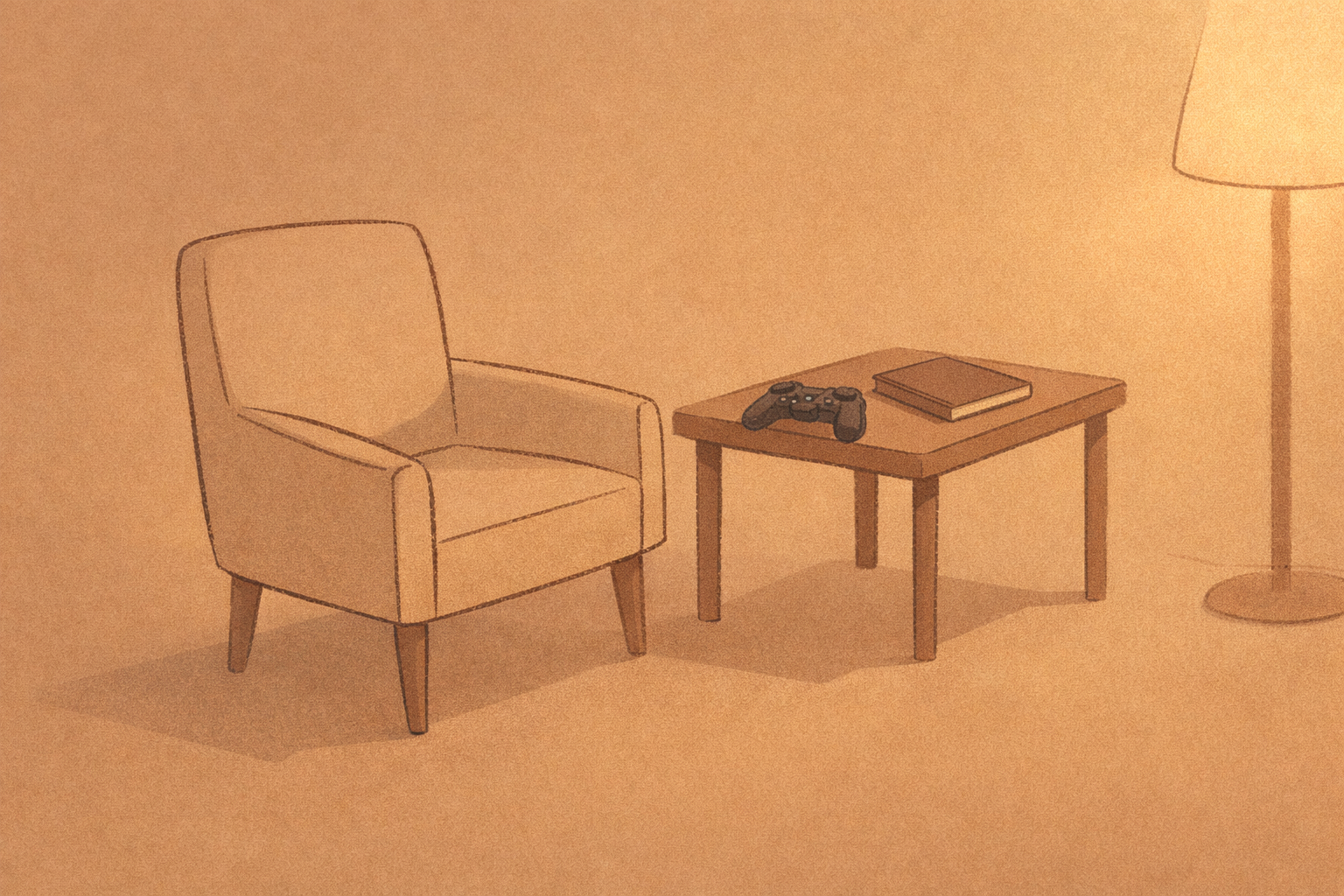
Gaming Escapism and Healthy Rest Do Different Jobs
Adults are allowed to play. Leisure does not need to improve a résumé, create a side business, burn calories, teach a marketable skill, or produce measurable personal growth before it becomes legitimate.
Gaming can provide competition, humor, immersion, challenge, storytelling, social connection, mastery, novelty, or simply an enjoyable way to stop dealing with the day’s demands for a while. None of those functions needs an apology.
Psychological distance can be useful too. Nobody can remain in direct contact with every pressure in life for every waking minute. Work ends. Conversations pause. Problems sit overnight. Attention needs transitions.
The trouble begins when distance stops functioning as recovery and starts functioning primarily as postponement.
Rest lowers demand long enough for some capacity to return. You step away, the day’s pressure loosens, and ordinary life becomes more manageable again.
Escape can also lower discomfort. The difference is that the relief increasingly depends on delaying contact with whatever created the discomfort. The task remains unfinished. The conversation remains unstarted. Bedtime moves. The bill stays unopened. The application remains untouched.
One Saturday night cannot tell you which pattern you have.
You can stay up too late once. You can ignore a chore. You can lose track of time inside an excellent game. You can get annoyed when somebody interrupts an online match that cannot be paused.
The pattern tells you more than the isolated session.
Why Gaming as Stress Relief Can Feel So Effective
Gaming becomes especially attractive when the rest of life feels ambiguous.
Adult problems are often poorly defined. Work may involve conflicting priorities. Financial stress has no progress bar. Relationships offer incomplete feedback. Grief does not come with instructions. Parenting rarely tells you whether today’s decision was correct. Career uncertainty can continue for months without resolving itself.
Games can compress that ambiguity.
There is an objective. There are rules. Your actions produce feedback. Progress becomes visible. Failure often includes another attempt. Your attention gets somewhere specific to go.
That structure matters. When attention has spent the day managing unfinished demands, competing inputs, social judgment, decision load, and uncertainty, entering an environment with clearer rules can feel unusually relieving.
This helps explain why gaming as stress relief can be legitimate without turning gaming into treatment. A game can redirect attention, provide challenge under controlled conditions, create social contact, or give the mind temporary distance from demands it has been carrying all day.
The useful correction is that temporary relief and actual recovery are not always the same thing.
A session can feel relieving tonight while making tomorrow harder.
Gaming Is Not Rest When Recovery Keeps Paying the Bill
Late-night gaming exposes the trade clearly.
The house becomes quiet. Work is finished. Notifications slow down. Nobody needs anything immediately. The game finally feels like time that belongs entirely to you.
Stopping can become difficult because you are not only leaving the game. You are leaving one of the few parts of the day that felt self-directed.
The problem is what finances the extra time.
If one hour becomes four and tomorrow still begins at the same time, the additional leisure was purchased with sleep.
Sleep is not empty time. It is part of the recovery infrastructure that supports attention, emotional regulation, learning, physical repair, judgment, and the capacity to carry tomorrow’s demands.
A recurring exchange can emerge:
You decompress tonight. You sleep less. You wake with less capacity. The next day feels heavier. You need stronger relief that evening. The session becomes easier to extend again.
An activity intended to reduce stress can then begin participating in the conditions producing more stress.
This is why hour counts alone are weak. Two hours of gaming inside an open evening may cost very little. Two hours taken from an already inadequate sleep window can carry a very different consequence.
The relevant variable is not only duration. It is displacement.
What Healthy Gaming Habits Protect Outside the Game
Healthy gaming habits are easiest to recognize by looking beyond the screen.
You can enjoy long sessions and still have a healthy relationship with gaming. You can play frequently. You can care about progression, competition, online friends, story, mechanics, rankings, or mastering a difficult system.
The larger operating system still has to function.
Sleep remains reasonably protected. Work continues moving. Promises still mean something. The household remains functional. Relationships receive actual presence. Your body still moves. Other interests still exist.
And you can stop even when stopping is disappointing.
That last point matters. Healthy leisure does not require you to be eager for the session to end. A good game should sometimes make you want another round.
The governing capacity is being able to tolerate the frustration of stopping because another part of life has a legitimate claim on you.
Leisure does not need to make you better. It needs boundaries strong enough that the activity can remain inside the life instead of slowly replacing the life.
One hobby should not carry every form of recovery
Gaming also works better when it is one recovery route among several.
Sleep restores something gaming cannot. Movement restores something gaming cannot. Conversation restores something gaming cannot. Solitude restores something conversation cannot. Time outside can change a state that another screen does not.
A broad recovery system prevents one hobby from being assigned every emotional job in your life.
How Can You Tell When Gaming Is Becoming Avoidance?
Gaming avoidance is less about the existence of gaming than the job the session repeatedly performs.
Ask what happens immediately before you start.
You were looking forward to playing with friends. You wanted to finish a game you enjoy. You deliberately scheduled downtime after work.
Those entry points are different from turning the system on every time discomfort appears.
The email feels difficult. Turn on the game.
The relationship conversation feels uncomfortable. Turn on the game.
You feel lonely. Turn on the game.
You are anxious about money. Turn on the game.
You do not know what decision to make. Turn on the game.
The game can remain genuinely enjoyable throughout this pattern. Enjoyment does not answer the functional question.
Avoidance becomes more likely when gaming repeatedly becomes the fastest route away from tasks, emotions, conversations, or uncertainties that still require engagement afterward.
Watch accumulation, not one dramatic night
Sessions regularly extend much longer than intended. Sleep becomes negotiable most nights. Responsibilities accumulate in predictable places. Other hobbies disappear. Offline relationships receive less attention. Stopping produces disproportionate agitation. Real-world goals repeatedly stop moving.
Most importantly, you continue the same pattern after recognizing meaningful consequences.
These signals do not establish a diagnosis.
They tell you to inspect function, control, and cost.
Gaming Disorder Is More Specific Than Playing a Lot
Public discussion often collapses heavy gaming, escapism, compulsive habits, and clinical gaming disorder into one category. That makes the conversation less accurate.
High involvement by itself does not establish a disorder. Someone may spend long periods practicing competitively, exploring a major release, playing with friends during vacation, or temporarily devoting more leisure time to gaming without experiencing meaningful impairment.
The more serious pattern involves impaired control over gaming, increasing priority given to gaming over other important activities, and continuation or escalation despite significant negative consequences.
Duration matters in context.
Control matters. Consequences matter. Impairment matters.
If gaming repeatedly interferes with work, education, health, relationships, finances, sleep, or other major areas of functioning and changing the pattern feels increasingly difficult, that deserves more serious attention than another argument about screen time.
Precision matters here because gaming can coexist with depression, anxiety, ADHD, loneliness, chronic stress, burnout, or relationship conflict. Sometimes gaming is the central behavioral problem. Sometimes it is one part of a larger system.
Good assessment distinguishes between those possibilities instead of deciding in advance.
The Return Test
Hour totals cannot tell you everything about the health of a leisure practice. Groundwork’s stronger question is what happens at the boundary between immersion and ordinary life.
When gaming ends, can life move again?
Can you stop while enough night remains for tomorrow’s body and attention?
Can you leave the game when something you already agreed to carry legitimately requires you?
Can you shift back into lower-feedback tasks without needing another stream of stimulation immediately?
Can you become present again without other people repeatedly having to force the transition?
Can discomfort return without automatically sending you back into another session?
Can an unfinished mission remain unfinished because something outside the game matters more right now?
The Return Test does not ask whether you enjoy gaming too much. It asks whether enjoyment still has an exit.
Healthy Gaming Needs a Return Point, Not Just a Timer
Timers can help, but a clock cannot govern every tradeoff.
A two-hour session during time already promised to a partner may create more damage than a four-hour session on an open Saturday. Ninety minutes ending at midnight may be harmless for one schedule and destructive for another beginning before sunrise.
Context determines what the session costs.
A stronger operating model asks several questions before gaming begins:
- What genuinely needs to happen today?
- What does tomorrow require from my body?
- What time does this session realistically need to end?
- Is this planned leisure or automatic avoidance?
- Am I playing because I want to play, or because I do not want to return to something else?
Those questions create a return point before immersion makes the next decision harder.
Decide what gaming comes after
Do not require every adult responsibility to disappear before leisure begins. Adult responsibilities regenerate constantly. That standard turns rest into something you can never earn.
Instead, protect the few priorities that genuinely belong to today.
Complete the task that cannot move again. Handle the conversation already postponed twice. Meet the responsibility you agreed to carry.
Then play.
The objective is not making gaming a reward for perfect productivity. It is stopping gaming from automatically getting first access whenever something uncomfortable appears.
Choose the return point before immersion
Games are good at producing natural continuation points: another match, mission, checkpoint, rank, objective, or group activity.
Decide when ordinary life resumes before those incentives begin operating.
The boundary does not need to be rigid every night. It needs to exist strongly enough that extending it becomes a conscious trade rather than an invisible default.
Protect the sleep floor
Do not build leisure by repeatedly consuming recovery.
If tomorrow requires a functioning body and a functioning mind, tonight has a stopping point whether the game does or not.
Do not make tomorrow finance tonight every night.
Build more than one recovery route
Different fatigue requires different restoration.
If you are physically exhausted, gaming does not replace sleep. If you are lonely, single-player immersion may not provide the connection you need. If you are socially overloaded, another multiplayer lobby may not provide solitude. If your body has been sitting all day, another four hours in the same position may not restore physical capacity.
If the problem is anxiety about an unfinished task, twenty minutes spent beginning that task may create more relief than three additional hours spent avoiding it.
Do not ask one leisure activity to solve every kind of tired.
Watch the after-state
The period immediately after play gives useful information.
Are you calmer? Can you shift attention? Does ordinary life feel manageable again?
Or does closing the game produce immediate resentment that reality has returned?
Healthy leisure does not guarantee happiness afterward. The stronger standard is capacity.
Did the break make re-entry possible?
Relationships Reveal the Cost of Missing Gaming Boundaries
Gaming becomes more visible when another person shares the consequences.
A gamer deserves legitimate private leisure. A partner deserves predictable contribution, presence, shared responsibility, and clarity about when the other person will be available.
The friction is usually better understood as a boundary problem than as a referendum on gaming itself.
Is Gaming a Red Flag in Relationships? Only When Structure Is Missing examines when gaming starts displacing agreed responsibilities and shared life.
How Couples Can Set Healthy Gaming Boundaries Without Power Struggles develops the practical side through agreements around timing, interruption, contribution, and shared expectations.
The Controller Is Not the Problem: Presence, Priority, and Emotional Labor focuses on the deeper question of whether physical proximity is being mistaken for emotional availability.
The point here is narrower.
If gaming is healthy leisure, the people and responsibilities around it should not have to repeatedly force the return.
Single Men May Need More Internal Governance, Not Less Leisure
For single men, leisure can have fewer external constraints. There may be no shared bedtime, partner waiting for conversation, or household negotiation making the cost of an extended session immediately visible.
That freedom is legitimate.
It also means the feedback loop can be quieter.
You have to inspect whether the larger life remains active.
Are friendships still developing? Is health being maintained? Does the home function? Are finances moving? Are you learning anything outside the game? Are real-world goals still receiving enough attention to remain real goals?
The Single Man’s Question: Is Gaming Holding Me Back or Helping Me Reset? goes deeper into that version of the problem.
Freedom does not need to become permanent productivity.
It does need to remain choice.
The Gaming Rest vs. Escapism Audit
This is not a diagnostic tool. Use it to identify what function gaming is currently performing inside your life.
1. Intention
What am I looking for when I start playing: enjoyment, competition, social connection, decompression, or distance from something I do not want to face?
2. Entry point
Do I choose gaming deliberately, or does it automatically begin whenever boredom, anxiety, conflict, uncertainty, or responsibility appears?
3. Control
Can I usually stop near the time I intended even when I strongly want another match, mission, or round?
4. Sleep
Does gaming repeatedly reduce tomorrow’s sleep below what my work, health, family, or responsibilities require?
5. Responsibility
What important obligation keeps moving because gaming regularly receives priority first?
6. Range
Do I still have other forms of leisure, movement, social connection, solitude, and recovery?
7. Relationships
Do people close to me experience my gaming as predictable leisure or repeated disappearance?
8. Emotion
Is gaming one way I regulate difficult emotion, or has it become my main way of avoiding difficult emotion?
9. After-state
Do I usually return with enough capacity to re-engage, or do I become more detached, depleted, irritated, or unwilling to leave the game?
10. Goals
Are work, health, money, learning, relationships, and personally meaningful goals still moving?
11. Consequences
Have I continued gaming in the same way despite repeated and meaningful problems I already recognize?
12. Return
When the game ends, can I come back?
13. Structural change
What one boundary would make gaming easier to enjoy without making the rest of life pay for it?
When Gaming Deserves More Serious Attention
Gaming deserves closer examination when difficulty controlling play becomes persistent and meaningful consequences continue accumulating.
Work repeatedly deteriorates. School falls behind. Relationships keep breaking around the same conflict. Sleep remains chronically shortened. Health declines. Financial or household responsibilities are neglected.
The person recognizes the damage and still feels increasingly unable to change the pattern.
That is more useful information than whether somebody else believes the total number of gaming hours looks excessive.
If gaming feels increasingly difficult to control or contributes to significant distress or impairment, a qualified mental-health professional can help clarify what is happening. The objective should be assessment before assumption.
Gaming may be the central behavioral issue. It may also be interacting with depression, anxiety, loneliness, ADHD, chronic stress, burnout, relationship conflict, or another difficulty that deserves attention in its own right.
Structural honesty means identifying the actual load rather than blaming the nearest object.
The Return Is the Measure
A healthy life should contain play.
It should contain hobbies nobody monetizes. Competition that does not advance your career. Stories, worlds, jokes, challenges, friends, and evenings where very little gets accomplished.
Permanent productivity is not the objective.
Governance is.
Enter leisure without guilt. Enjoy the game. Get absorbed. Stay for another round sometimes.
Then retain the capacity to leave.
Can you stop? Can you sleep? Can you keep promises? Can you remain connected? Can the rest of your life continue moving?
Can gaming stay one room inside a much larger structure?
If yes, play.
Let the game remain a game.
Then come back.
Frequently Asked Questions About Gaming, Rest, and Escapism
Is gaming a healthy form of rest?
Gaming can function as healthy leisure when it provides enjoyment, challenge, social connection, or decompression without repeatedly displacing adequate sleep, responsibilities, relationships, or other forms of recovery. The larger pattern matters more than whether gaming appears productive.
What is gaming escapism?
Gaming escapism describes using games to create psychological distance from uncomfortable emotions, situations, tasks, or responsibilities. Temporary escapism is not automatically harmful. It becomes more concerning when gaming repeatedly prevents engagement with problems that still require attention.
How can I tell if gaming is becoming avoidance?
Look for recurring patterns such as playing much longer than intended, sacrificing sleep, postponing important responsibilities, withdrawing from other interests, using gaming automatically whenever discomfort appears, or continuing despite consequences you already recognize.
How many hours of gaming is too much?
There is no single hour threshold that determines whether gaming is healthy or unhealthy. Duration matters in context. Control, sleep, priorities, consequences, relationships, and functional impairment usually provide more useful information than hours alone.
Can gaming help with stress?
Gaming can provide enjoyment, immersion, social interaction, challenge, and temporary psychological distance from daily stress. The useful distinction is whether that relief supports a later return to ordinary life or repeatedly substitutes for dealing with problems that still require action.
Is gaming addiction the same as playing a lot?
No. High involvement alone does not establish a clinical disorder. Persistent impaired control, increasing priority given to gaming, continuation despite significant negative consequences, and meaningful impairment deserve more attention than duration by itself.
Can gaming be healthy in a relationship?
Yes. Gaming can fit inside a healthy relationship when both people have predictable expectations around shared responsibilities, private leisure, presence, timing, and protected time together.
Why do I get irritated when someone interrupts my gaming?
Some irritation is ordinary when concentrated attention is interrupted, particularly during multiplayer activities that cannot be paused. Repeated disproportionate anger deserves closer examination when interruptions involve legitimate responsibilities, relationship needs, or attempts to end sessions that regularly exceed their intended limits.
Should I quit gaming if I use it to escape?
Not automatically. First examine what gaming is replacing and rebuild boundaries around sleep, responsibilities, session endings, relationships, and other forms of recovery. If gaming remains difficult to control or continues creating serious impairment, professional assessment may be useful.
Can single men use gaming as healthy downtime?
Yes. Gaming can provide entertainment, challenge, social connection, competition, and recreation. The useful test is whether that leisure exists inside a life where health, relationships, responsibility, curiosity, and personally meaningful goals continue moving.
→ Are Video Games Bad for Adult Men? A Grounded Look at Play, Purpose, and Partnership
→ The Single Man’s Question: Is Gaming Holding Me Back or Helping Me Reset?
→ Why Men Need Play and Why Society Only Sanctions Their Labor
→ Is Gaming a Red Flag in Relationships? Only When Structure Is Missing
→ How Couples Can Set Healthy Gaming Boundaries Without Power Struggles
→ The Controller Is Not the Problem: Presence, Priority, and Emotional Labor
This article distinguishes ordinary gaming, gaming used for temporary escape, problematic patterns of gaming, and clinically significant impairment. The Groundwork concepts of The Return Test, recovery displacement, and the return point are editorial frameworks rather than diagnostic instruments.
World Health Organization: Gaming Disorder
WHO guidance describing gaming disorder in terms of impaired control, increasing priority given to gaming, continuation or escalation despite negative consequences, and significant impairment.
Exploring the Possible Mental Health and Well-Being Benefits of Video Games for Adult Players
Research examining adult players’ perceived emotional, psychological, and social benefits associated with video game play.
Enjoyable Leisure Activities and Psychological and Physical Well-Being
Research examining associations between enjoyable leisure activities and measures of psychological and physical well-being.
Continue with Health as Discipline

The Principle and Condition Beneath This Work
This article treats healthy leisure as governed freedom. Gaming does not become disciplined because it is optimized or productive. It becomes sustainable when enjoyment can exist inside boundaries strong enough to protect sleep, responsibility, relationships, and the return to ordinary life.
Discipline Is Emotional Governance
Discomfort can inform behavior without automatically commanding it. Gaming can provide legitimate relief, but emotional governance preserves the ability to decide when relief ends and engagement resumes.
Boundaries
Boundaries determine where an activity stops so the larger system can continue. In gaming, the meaningful boundary is not merely a timer. It protects sleep, responsibilities, relationships, physical capacity, and the ability to return.
Supporting conditions in this article include Discipline, Capacity, and Margin. See the full Groundwork Daily Core Principles and Conditions architecture.