

Relationship interdependence is the ability of two capable people to share responsibility, support, and daily life without turning partnership into dependence, control, scorekeeping, or self-erasure.
Independence matters. Adults should know how to carry their own lives. You should know where the bills are, what the calendar requires, who needs to be called, what your obligations cost, and how to make a decision without waiting for somebody else to make it for you.
But independence is not the final form of partnership.
Eventually, a relationship asks whether two capable people can build something that neither person has to operate alone.
Part 5, Knowing When Space Is Needed , examined why healthy distance matters. Space protects judgment and individuality. Part 6 turns toward the other side of that balance: how two people come back together and carry real life without either person disappearing inside the partnership.
That question becomes concrete quickly. Two lives begin sharing a kitchen table, a calendar, obligations, family expectations, money decisions, difficult weeks, and work that cannot simply be left undone.
Independence says, “I can carry my life.” Interdependence asks, “What can we build because neither of us has to carry everything alone?”

Relationship Interdependence Is Not Dependency
Depending on another person is not automatically unhealthy.
Long-term relationships naturally create dependence. People share housing, money, transportation, childcare, information, emotional support, schedules, family obligations, and hundreds of small responsibilities that make ordinary life function.
Pretending two committed adults never depend on one another is not strength. It is an inaccurate description of partnership.
The problem begins when reliance steadily reduces agency.
Support Expands Capacity
Both people remain capable of thought, choice, boundaries, contribution, and growth. Responsibility may move between them, but support does not require either person to become smaller.
Reliance Replaces Agency
One person becomes the permanent source of stability, access, decision-making, regulation, or identity while the other’s ability to function steadily contracts.
A strong relationship may include deep reliance. It should not require learned helplessness.
Five Systems That Make Interdependence Work
Interdependence becomes visible through systems, not slogans. Five areas do most of the load-bearing work.
Shared Direction
Both people should understand what the partnership is trying to build. Their individual goals do not have to be identical, but there needs to be enough alignment to guide shared decisions.
Shared Responsibility
Work should be visible enough that one person does not quietly become the permanent manager of the home, calendar, finances, relationship maintenance, or family obligations.
Mutual Support
Either person should be able to need help without shame. Either should also be able to provide help without turning generosity into leverage.
Protected Individuality
Partnership should not erase friendships, interests, judgment, solitude, financial awareness, boundaries, or individual development.
Flexible Roles
Responsibilities must be able to move when work, health, caregiving, children, income, or other circumstances change.
Fairness in Interdependent Relationships Is Not Always 50/50
Relationships rarely operate in perfect symmetry.
One person may carry more financially during a season. Another may carry more childcare. Someone may take over household logistics while the other finishes school, recovers from illness, manages grief, or handles a demanding work cycle.
That alone does not make the arrangement unfair.
Look at the Pattern, Not One Week
The better question is whether support can move.
Can one person carry more today without being assigned that role forever? When capacity returns, does responsibility move again? Can either person say, “This no longer works,” without turning the conversation into an accusation?
A temporary imbalance can be part of a strong system. A permanent imbalance that nobody is allowed to question is something else.
Fairness is not equal weight every day. It is a structure where sacrifice does not become one person’s permanent job.
Interdependence Must Account for Invisible Work
Some of the heaviest work in a household never appears on a receipt.
Someone remembers the appointment. Someone notices the prescription is running low. Someone keeps the school calendar in mind, checks on the relative, tracks what is missing from the house, remembers the birthday, starts the difficult conversation, and follows up after everyone else has moved on.
That is work.
Managing the System Is Part of the Work
Completing a task after being told to do it is not the same as noticing that the task exists, deciding when it needs to happen, remembering it, and making sure it gets finished.
When one person owns all of that invisible management, the relationship can look balanced from the outside while operating on a hidden deficit.
Mature interdependence requires both people to see enough of the system that one person does not have to remain its permanent supervisor.
This is also where interdependence connects directly to The Family Stability Framework . Stability depends on making the operating structure visible enough that it can be shared, reviewed, and repaired.
Different Strengths Should Increase Capacity, Not Authority
Two people do not need to be equally good at everything.
One may understand money better. Another may manage schedules well. One may stay calm during emergencies. The other may notice relational tension before it becomes a larger problem.
Those differences can make the partnership stronger.
Expertise Is Not Ownership
Someone who understands investing can lead the research without becoming the only person allowed to understand the accounts.
Whoever manages the calendar can organize the schedule without becoming solely responsible for remembering everybody’s obligations.
The person who cooks better can cook more often without becoming the only adult expected to know how food appears in the house.
Strength should create contribution. It should not create permanent jurisdiction.
Interdependence Means Knowing How to Ask for Help
Some people are excellent at carrying weight and terrible at letting anybody else touch it.
That can look like independence. Sometimes it is fear with good posture.
Interdependence requires enough trust to say, “I cannot carry this well by myself,” without treating the admission as personal failure.
Receiving Support Is Part of Reciprocity
People who are comfortable giving can still undermine mutuality if they refuse to receive.
A partner cannot become reliable if that partner is never allowed to carry meaningful weight.
Mutual support therefore requires both contribution and reception.
Healthy Interdependence Means Support, Not Rescue
Partnership does not mean removing every consequence from another adult’s life.
If one person repeatedly solves problems the other person is capable of handling, support can slowly turn into overfunctioning. The more one person overfunctions, the easier it becomes for the other to underfunction.
That pattern can feel loving at first because problems get solved. Over time, however, it can weaken the very capacity partnership is supposed to strengthen.
Good support increases capacity. Rescue can quietly replace it.
Interdependence Cannot Become a Ledger of Favors
Balance matters. Constant accounting does not.
A relationship becomes exhausting when every act of support immediately creates a debt to be repaid. Some weeks one person will carry more. Another week the direction may reverse.
Watch for Circulation, Not a Ledger
The important question is whether effort, care, responsibility, and attention circulate through the relationship over time.
Does each person notice what the other is carrying? Is either person willing to step in before being chased? Does support move when circumstances actually change?
Reciprocity should be visible. It does not need to be itemized.
This is why the distinction between fairness and equality matters here. As Fairness vs Equality in Relationships explores, equal standing does not always require identical contribution.
Review Capacity Before Resentment Builds
A division of responsibility that worked six months ago may be wrong now.
Jobs change. Children change. Parents age. Health shifts. Travel increases. Money gets tight. New responsibilities land on the calendar.
Roles need review because life changes the load.
Ask About the Load Directly
That last question deserves more attention than it usually gets.
Mature households do not solve every capacity problem by adding more labor. Sometimes the right answer is subtraction.
The Partnership Does Not Have to Become the Entire Village
Interdependence between two people does not require isolation from everybody else.
Friends, relatives, neighbors, mentors, faith communities, professional support, and other trusted relationships can all increase a household’s resilience.
A Wider Circle Can Strengthen the Core Partnership
Expecting one partner to provide every form of emotional, social, practical, intellectual, and spiritual support creates unnecessary pressure.
A strong partnership can be central without becoming the entire support infrastructure.
The Relationship Interdependence Test
A strong system should increase shared capacity without steadily reducing either person’s agency.
- Can both people function independently? Partnership should add capacity, not erase basic competence.
- Can both people ask for help? Need should not automatically create shame, resentment, or loss of status.
- Does support move in both directions over time? The balance can change by season without becoming permanently one-sided.
- Can roles change when life changes? A healthy system adjusts instead of defending outdated assignments.
- Does support preserve agency? Help should reduce unnecessary load without taking unnecessary control.
- Are both people becoming more capable? Partnership should strengthen the system rather than produce increasing helplessness.
Build an Interdependent System Where Strength Can Move
Mature partnership is not a contest to prove who needs less.
It is also not an agreement that one person will permanently carry what the other refuses to learn.
The stronger structure sits between those extremes.
Two people bring judgment, money, time, skills, relationships, limitations, habits, and responsibilities to the same table. Then they build a system for moving weight.
Sometimes one person carries more. Sometimes the other does. Neither should have to disappear for the system to work.
Five Questions to Carry Forward
- Can I receive support without treating need as weakness?
- Can I offer help without turning it into control?
- Are our responsibilities visible enough for us to know who is actually carrying what?
- Does support move in both directions across different seasons?
- Are we becoming stronger together without either person becoming smaller?
A Shared Structure Can Still Feel Different From Each Side
Structure, compatibility, power, space, and interdependence give us a common framework. But people do not experience partnership from a neutral position.
Gender expectations, family models, responsibility, history, safety, money, and social pressure can shape what the same relationship looks like from opposite sides of the table.
The next entries turn toward perspective, beginning with From a Woman’s Perspective .
Research and Further Context
For research and practical perspectives on social connection, mutual support, communication, and relationship well-being, the Greater Good Science Center at UC Berkeley maintains a broad public research library.
External links were live and accessible when this article was published or last substantively updated. Third-party pages may change, move, or be removed over time.
Building the Foundation
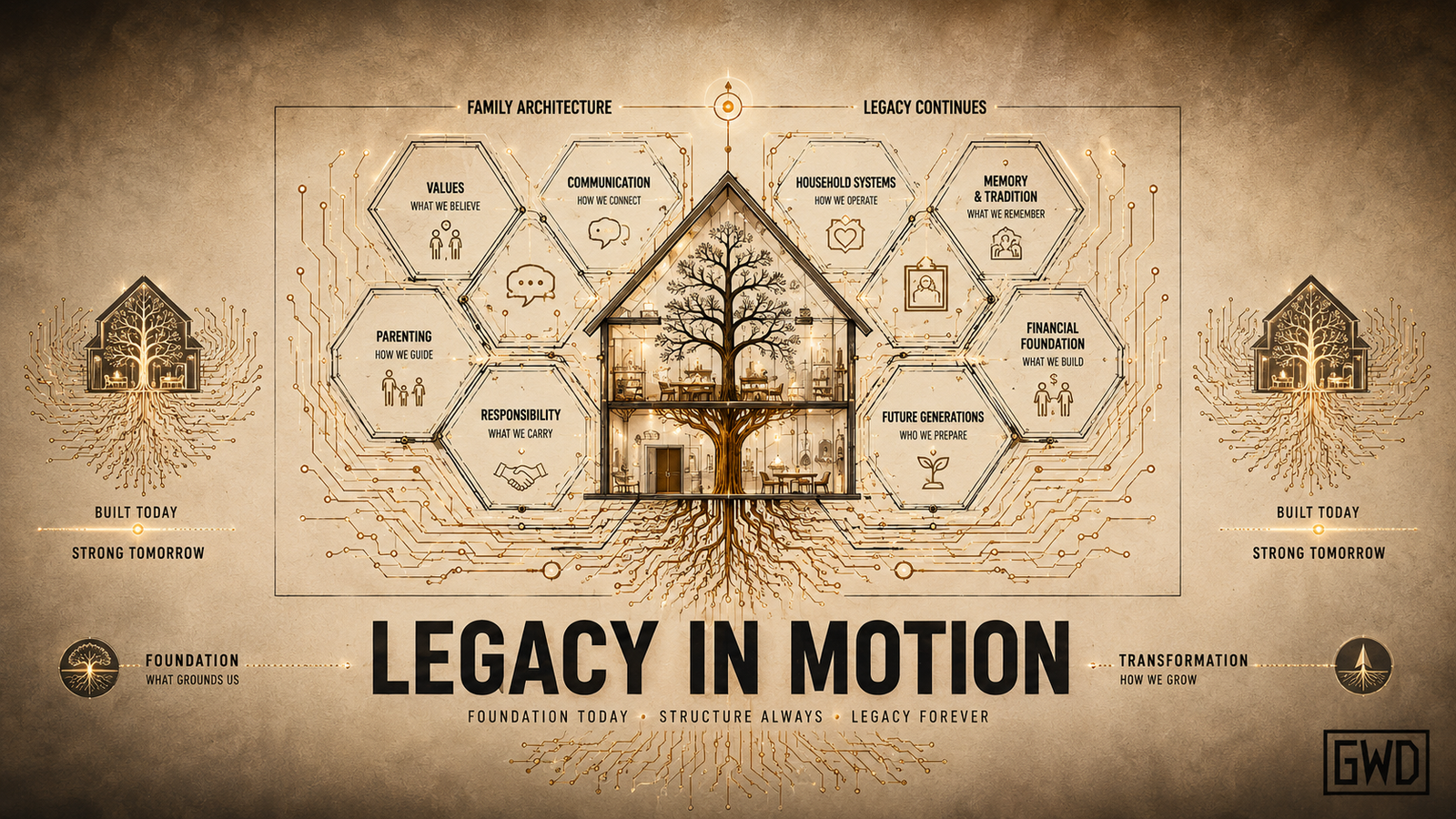
Move back to healthy space, continue into perspective, or return to the complete Legacy In Motion collection.

Marcus Vaughn
Economy, Ownership & Generational Structure
Marcus Vaughn writes about ownership, financial discipline, family structure, and generational continuity. Through Money Monday and Legacy In Motion, he examines the systems that turn income into stability, responsibility into structure, and today’s decisions into tomorrow’s inheritance.