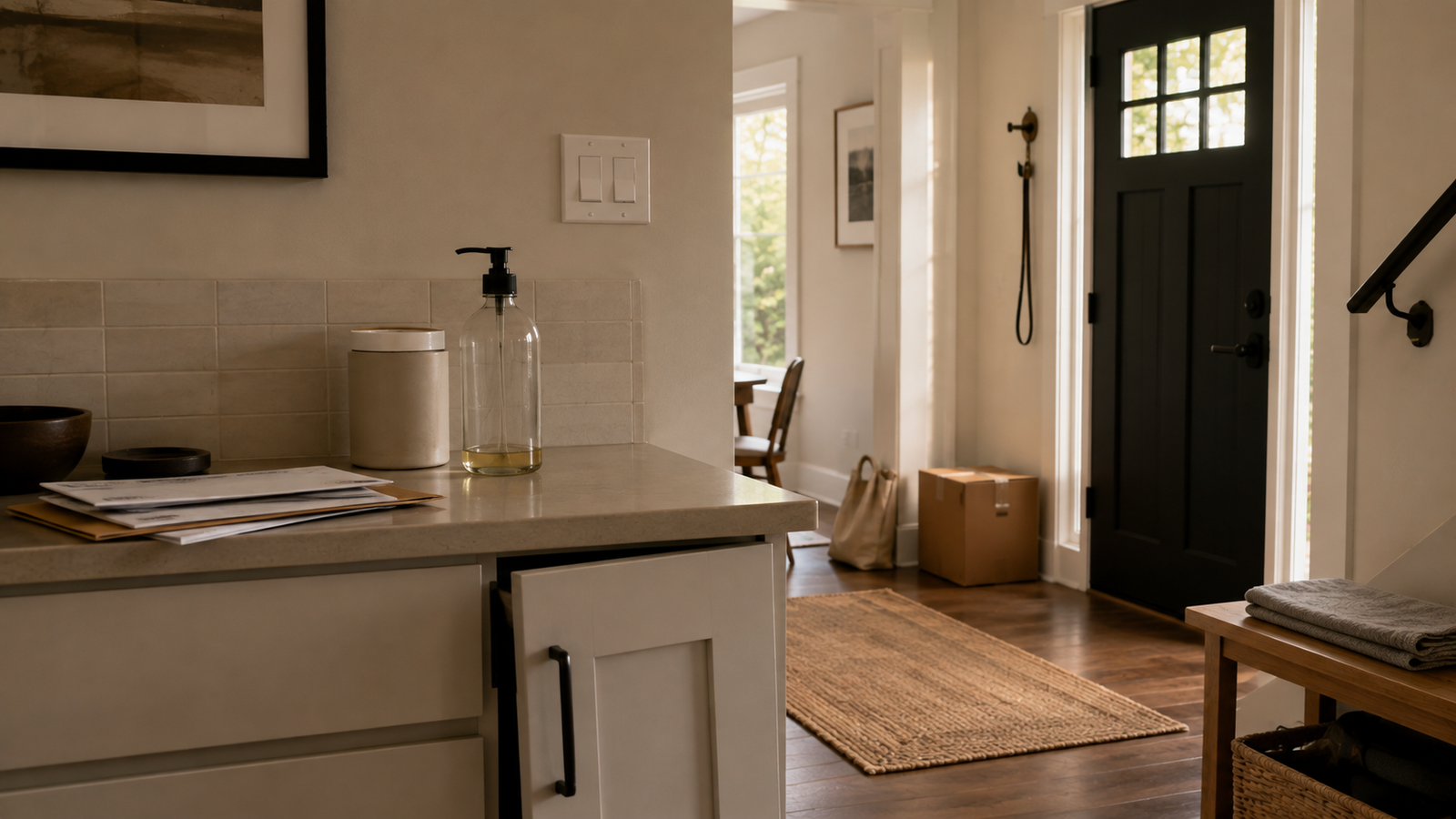
Household maintenance keeps an ordinary home easy to operate by closing small gaps before they accumulate. A cabinet handle gets tightened before it comes loose. The empty detergent bottle leaves the shelf when its replacement arrives. Clean laundry completes the trip back to the drawer instead of settling into a chair for three days.
Most of these actions take only a few minutes. Yet when they remain unfinished, they begin stacking on top of one another. The kitchen may still function. The entryway may still look respectable. Nothing dramatic has failed. Even so, more objects wait for decisions, more surfaces become temporary holding zones, and ordinary movement requires extra steps.
The house still works.
It simply works harder.
The Household Maintenance Gap
The maintenance gap forms between noticing a small problem and fully resolving it. Someone sees the package by the door but plans to move it later. A loose cabinet pull still works, so tightening it can wait. Mail gets opened, although the papers never reach the file, recycling bin, or next action.
Each delay seems reasonable in isolation. That is why the pattern survives.
Eventually, the household begins carrying a backlog of small unfinished actions. None is large enough to justify a major project. Together, they make the house more complicated to run.
A countertop built for meal preparation starts holding paperwork. An entry bench meant for sitting becomes storage for bags waiting to be emptied. Missing batteries get remembered only when the device is needed again. Supplies disappear without entering a replacement sequence.
This is household drift in plain view.
The problem is accumulation.
Household Maintenance Is Different From Cleaning
Cleaning restores visible condition. Maintenance preserves function.
A kitchen can be wiped down every night while one drawer remains difficult to close. A bathroom may look spotless even though a slow leak continues beneath the sink. An entryway can be swept regularly while packages, shoes, and return items interfere with movement near the door.
Those differences matter because a clean home can still carry operational friction.
The distinction becomes clearer when the household asks a different question. Beyond what needs cleaning, what is becoming harder to use?
A sticking door is giving information. So is a drawer that has become too full, a pantry shelf holding expired duplicates, or a laundry basket permanently occupying the same hallway corner.
Maintenance listens to function.
The Hidden Cost of Unfinished Household Work
Unfinished work does not disappear when attention moves somewhere else. It remains in the environment.
The package by the door must still be opened, returned, stored, or discarded. Mail needs a destination. A nearly empty soap dispenser requires replacement. The clean towel resting on a chair still has to reach the linen cabinet.
Each item quietly occupies physical capacity.
As unfinished actions accumulate, useful surfaces begin losing their original purpose. This is why household friction often appears before obvious clutter. A table can hold only four or five unresolved items and still become less useful as a table.
When a Surface Changes Jobs
The effect spreads quickly. Once one surface becomes a holding zone, the next object tends to join it. A receipt lands beside unopened mail. Sunglasses arrive beside the receipt. Later, keys, a charger, and something meant for another room settle into the same space.
No one formally reassigned the table.
Yet its job changed anyway.
That is how drift becomes visible. The household starts sacrificing useful capacity to unfinished decisions.
Small Maintenance Failures Multiply
A missing household item rarely creates only one inconvenience. More often, it creates a sequence.
Consider a roll of trash bags that runs out without replacement. The next bag change stops midway. Someone searches another cabinet, finds a substitute size, and uses it temporarily. The empty box remains on the shelf.
Another person sees the box later and assumes bags are still available.
One missing replacement has now generated several extra actions.
The same pattern appears with batteries, filters, cleaning supplies, light bulbs, toiletries, pantry basics, and other ordinary items. The cost rarely comes from the item itself. It comes from the interruption created when a predictable need has no prepared next step.
Strong household maintenance catches these gaps early. Replacement becomes part of use rather than a separate emergency later.
When Temporary Holding Zones Become Permanent
Every functioning home needs temporary space. Groceries arrive before they are put away. Packages enter before they are opened. Laundry waits briefly between cycles.
The problem begins when temporary stops having an expiration point.
A reusable bag remains beside the doorway because it will be needed again soon. One folded sweater stays on a bench because it belongs upstairs. Papers remain on the counter because each sheet requires a different decision.
After several days, the household stops seeing those objects as unfinished work. They become part of the room.
That change matters.
Once an unresolved item becomes visually normal, the system loses the signal that something remains incomplete. Unfinished tasks begin blending into the permanent arrangement.
A stronger maintenance rhythm prevents that conversion. Temporary items need either a destination or a deadline.
The Replacement Gap
Many homes handle consumption better than replacement.
People know how to use the last paper towel, finish the dish soap, empty the coffee container, or take the final trash bag. The sequence becomes weaker at the moment the empty package should trigger the next action.
That is the replacement gap.
A stable household closes the sequence. When the last item gets used, the replacement enters the shopping list or comes forward from back stock. Once the new supply arrives, the empty container leaves. If the backup becomes the active supply, another backup can enter the next purchasing cycle when appropriate.
The sequence sounds ordinary because it is.
Ordinary systems carry homes.
Without that sequence, the household repeatedly discovers predictable shortages as though they were surprises. Extra trips follow. Substitutions appear. A basic need becomes a small disruption.
Repair Drift Makes the Home Harder to Operate
Minor repairs deserve the same attention. A loose hinge, slow drain, sticking latch, weak light bulb, or small leak can remain tolerable for weeks because the home still functions around it.
That tolerance creates more work than it appears to.
The U.S. Environmental Protection Agency identifies moisture control as central to preventing mold problems in homes, and its homeowner guidance stresses correcting water and moisture problems rather than allowing them to remain unresolved. The Centers for Disease Control and Prevention treats prompt moisture correction the same way, as a basic home-health practice, not an optional one.
The larger household lesson is straightforward: small defects deserve action while they are still small.
Not Every Repair Has to Happen Today
Some repairs require a landlord, technician, contractor, replacement part, or larger budget. A delay does not have to become drift.
The household can still move the issue into a defined sequence: identify the problem, document it, assign the next action, and track it until the matter closes.
A problem waiting inside a system is different from a problem merely waiting.
One has direction.
The other has residue.
Household Maintenance Closes the Whole Cycle
Many household tasks fail at the final ten percent.
Laundry provides the clearest example. Washing is one stage. Drying is another. Folding may happen soon after. Even then, the cycle remains open until clothing returns to the drawer, shelf, or closet.
Dishes work the same way. Washing does not fully close the cycle if dry dishes occupy the rack indefinitely and reduce space for the next round.
Completion Restores Capacity
Shopping also has a final stage. Bringing groceries through the door is only the beginning of the closeout. Cold items need storage. Packaging needs disposal. Reusable bags require a destination. Newly purchased supplies must replace whatever ran out.
The maintenance mindset notices the entire sequence.
Completion protects capacity.
When cycles close consistently, surfaces return to service and rooms remain available for their intended purpose. Yesterday’s unfinished work no longer competes with today’s movement.
Build a Household Maintenance Rhythm
Household maintenance works best when small corrections happen before they require a full reset.
A complicated checklist covering every room is unnecessary. A stronger structure begins with recurring inspection points.
A daily pass can catch obvious unfinished cycles: items waiting by the door, dishes that need to return to cabinets, laundry that stopped at the folding stage, or supplies that ran out during the day.
Use Different Review Speeds
A weekly review can catch slower drift. Check the entryway, kitchen, bathroom, utility areas, and surfaces that tend to collect unfinished decisions. Anything that has stayed in the same temporary position for several days deserves another look.
A quarterly review can go deeper. Filters, batteries, seasonal equipment, storage, minor repairs, household inventories, and changing room use deserve attention before the next season adds new demands.
The intervals differ because the problems move at different speeds.
That is good design.
Let Friction Show What Needs Attention
The home already produces useful maintenance information. Friction is one of the clearest signals.
If something has to be moved before another task can begin, notice the pattern. When the same object requires another search, record where the breakdown occurred. A door, drawer, cabinet, basket, or surface that requires a daily workaround is also providing useful evidence.
Repeated workarounds are evidence.
They show where the household has accepted extra effort as normal.
A practical maintenance review can therefore begin with three observations: what keeps getting moved, what keeps getting searched for, and what keeps getting postponed.
Those answers usually reveal the strongest opportunities for correction.
What a Stable Home Actually Does
A stable home does not remain permanently finished. People live there. Food gets prepared. Clothing gets worn. Packages arrive. Supplies get consumed. Rooms change throughout the day.
Stability comes from the home’s ability to return.
Objects return to useful positions. Supplies arrive before shortages interrupt the day. Small repairs enter a clear path toward resolution. Temporary holding zones empty before they become permanent storage.
The system keeps recovering its capacity.
Keep Small Work Small
That is the real value of household maintenance. It prevents ordinary life from leaving behind more residue than the next day can comfortably carry.
A well-maintained home does not eliminate work. It keeps small work small.
That difference compounds.
The Ritual Audit: Five Questions Every Household Should Ask
Weekly Reset Protocol: Rebuild the System Before It Breaks
The Cost of Living Without Ritual
Centers for Disease Control and Prevention — About Mold
Maintenance rarely earns attention when it works. The hinge stays tight. A replacement is already available. The table remains usable. Packages leave the entryway before becoming part of the furniture.
Nothing dramatic happens.
That is the outcome.
A home becomes easier to run when small failures do not mature into recurring friction. Household maintenance protects that ease through ordinary corrections made early enough to remain ordinary.
The work stays quiet.
What remains is visible stability.
Build Better. Every Day.
Receive practical essays and grounded frameworks for building stronger household systems, steadier routines, and environments that require less recovery.
Subscribe to Groundwork DailyOne email. No noise. Unsubscribe anytime.