

Leadership in a relationship is not established by claiming authority. It becomes credible when judgment, responsibility, accountability, boundaries, and earned trust begin reinforcing one another.
Relationship conversations often get trapped in the wrong debate.
People argue over who should lead, who should follow, who gets the final decision, and what respect is supposed to look like. Meanwhile, a harder question sits underneath all of it.
What would make another capable adult rationally trust your leadership?
A title cannot answer that question. Tradition cannot answer it either. Neither can masculinity, femininity, income, personality, confidence, or the ability to win an argument.
When one person carries greater responsibility for direction, planning, protection, decision-making, or long-term household stability, the standard on that person should rise.
More authority should mean more accountability.
Without that exchange, leadership becomes little more than a polished word for concentrated power.

The Mechanism
Responsibility → Judgment → Accountability → Consistency → Earned TrustLeadership becomes credible when the person carrying authority repeatedly demonstrates the capacity to carry its consequences.
Groundwork Guide
Credibility Before Compliance
Trust in Relationship Leadership Is Built From Evidence
Consider what is actually being requested when one partner says, “I need you to trust my decisions.”
The request is not small.
Depending on the decision, trust may involve money, housing, children, career moves, family obligations, safety, or years of shared life.
Inspect the Record
Before deciding whether trust is reasonable, look at the operating history.
- Does this person prepare before important decisions?
- Can uncertainty be acknowledged without embarrassment?
- Does contrary information receive serious consideration?
- Are commitments generally kept?
- Can confidence be separated from certainty?
- Does correction lead to adjustment or defensiveness?
- When judgment fails, who owns the outcome?
That record carries more weight than any title.
Trust grows when repeated experience gives another person reason to believe that something important can be placed in your hands without being treated casually.
Credibility Accumulates
Money reveals it. Parenting reveals it. Conflict exposes it. Household responsibilities make it visible. Long-term planning eventually puts it under pressure.
Good intentions help, but they are not enough.
Patterns build credibility.
The uncomfortable part is that evidence works in both directions. Reliability accumulates. So do missed commitments, unowned mistakes, impulsive decisions, and repeated excuses.
No title can indefinitely outrun the record beneath it.
The Other Side of Trust
Independence Can Become Its Own Kind of Infrastructure
Any serious conversation about leadership also has to examine the person being asked to trust.
Some adults learned early that depending on other people carried risk. Perhaps promises were inconsistent. Maybe one parent handled nearly everything. In other homes, asking for help regularly produced disappointment.
Over time, a survival rule can form:
That rule can produce extraordinary capability.
It can also complicate partnership.
Capability Is Not the Same as Partnership
Survival skills do not automatically become relationship skills. Someone who has spent years carrying everything may struggle when a healthy partnership eventually requires a different sentence:
The challenge is bigger than gender or submission. Depending on someone creates vulnerability because that person now has the ability to disappoint you.
That is real exposure.
Delegating Labor While Retaining Control Is Not Trust
Highly independent partners have their own accountability test.
If every responsibility still needs approval, supervision, correction, or redoing, ownership never actually transferred.
Someone delegated the labor while keeping control centralized.
Eventually, both people pay for that arrangement. One becomes exhausted from carrying too much oversight. The other begins to feel unnecessary because responsibility arrives without genuine room to exercise judgment.
Partnership cannot mature when one person must remain indispensable.
Groundwork Daily’s work on commitment as infrastructure starts from the same reality: shared life requires more than intention. Roles, expectations, maintenance, and correction have to become visible enough for both people to rely on them.
Healthy Dissent
Leadership Cannot Require Silence
Trust does not eliminate disagreement.
In fact, a strong decision structure should make disagreement safer and more useful.
This is where poorly defined ideas about “final say” tend to fail. They explain who ends the discussion but often say nothing about how the discussion should work.
A Healthy System Makes Room for Dissent
A partner should be able to raise a concern without the other person automatically calling it disrespect.
- “I think something is being missed.”
- “I disagree with that approach.”
- “Here is the risk I see.”
- “Have we considered another option?”
- “That decision affects me differently than it affects you.”
Those statements may be uncomfortable. They may also be essential.
Responsible partnership requires access to information, especially information that challenges the preferred answer.
Compliance Is Not Alignment
Someone who wants leadership but cannot tolerate meaningful disagreement is not really asking for counsel.
What that person wants is compliance.
Compliance may make a room quieter, but quiet is not the same as alignment.
Strong leadership should welcome whatever improves the decision.
The objective is to protect what the room is responsible for.
Governance Test
Responsibility Has to Travel With Authority
A practical relationship-governance rule is simple:
Whenever authority moves in one direction, responsibility should move with it.
Requires understanding the numbers, communicating risk, protecting shared priorities, and owning the consequences.
Requires ownership of schedules, follow-up, maintenance, preparation, and the details that keep the function operating.
Requires consistency, judgment, presence, correction, communication, and responsibility for long-term formation.
Requires research, preparation, scenario thinking, communication, and willingness to adjust as circumstances change.
The Worst Design Gives Power to One Person and Work to the Other
A household becomes unstable when decision-making authority sits with one person while somebody else absorbs most of the operational burden.
That is not defined leadership.
It is poor system design.
The reverse arrangement also fails. Responsibility cannot work when a person has too little authority to fulfill what the household expects them to carry.
If your partner owns a function but every meaningful decision still requires approval, responsibility exists without control.
Align the Three
Durable households keep those three elements close together.
When they separate, resentment usually finds the gap.
That is the deeper function of accountability in relationships . Accountability is not simply apologizing after something goes wrong. It compares what was promised, what was owned, what actually happened, and what must change next.
Beyond 50/50
Defined Roles Can Help. Undefined Assumptions Cannot.
There is nothing inherently enlightened about 50/50.
Traditional roles are not automatically wise either.
Both models can work. Both can also become deeply unfair.
The Arithmetic Is Not the System
Two people can divide every bill exactly in half while one partner performs most of the domestic labor, planning, caregiving, emotional coordination, family communication, and household administration.
On paper, the split is equal.
Operationally, it may be nowhere close.
Another couple might divide responsibilities very differently and still experience the arrangement as fair because both people can see expectations clearly, respect each other’s contribution, and feel that the structure reflects actual capacity.
Does every responsibility have an identical split?
Does our arrangement distribute responsibility in a way both people understand, consent to, and can sustain?
Put the Household on the Table
Relationship conflict often sounds emotional because nobody ever made the underlying workload visible.
Make it visible.
- Bills and budgeting
- Meals and groceries
- Cleaning and household care
- Appointments
- Children and school logistics
- Extended-family obligations
- Repairs and maintenance
- Transportation
- Planning and scheduling
- Money management
- Social commitments
- Emergency preparation
Then determine who owns each responsibility.
Ownership is different from occasionally helping. It means remembering, planning, executing, following up, and communicating when circumstances change.
Long-term stability depends on defined expectations, shared direction, correction mechanisms, and repeated maintenance.
Words Follow Structure
Respect Has to Be Reciprocal, but It Does Not Have to Look Identical
Most people want to feel respected by the person they love.
The problem begins when people reduce respect to a handful of approved phrases.
“I trust your decision” can be meaningful. So can “thank you for how you handled that” or “I feel safe when you take the lead.”
Those words matter when they describe something real.
Affirmation Cannot Cover Structural Failure
Declarations of trust cannot repair repeatedly reckless decisions.
Demanding more gratitude cannot solve chronic avoidance of responsibility.
If safety is absent, performing the language of safety will not create it.
Affirmation should recognize a pattern.
It should not substitute for one.
Respect Moves in Both Directions
- The partner being asked to trust deserves honesty.
- Whoever carries responsibility deserves appreciation.
- Leadership deserves room to exercise judgment.
- Anyone affected by a decision deserves a voice.
- Both people deserve correction without humiliation.
Reciprocal respect does not make the structure weaker.
It is one of the mechanisms that keeps the structure aligned.
Commitment With Boundaries
Stop Using Divorce as a Weapon. Do Not Use Commitment as a Cage.
Refusing to weaponize the end of a relationship during ordinary conflict is a reasonable standard.
Repeatedly threatening divorce or separation whenever disagreement becomes uncomfortable makes stability difficult to trust.
People cannot build securely when someone constantly uses the foundation as leverage.
Permanence and Captivity Are Not the Same Thing
“We do not threaten this relationship casually” is a relationship standard.
“You can never leave regardless of what happens here” is something fundamentally different.
No commitment standard can make abuse, coercion, violence, serious financial exploitation, or other dangerous behavior healthy.
Durable relationships need commitment.
They also need boundaries strong enough to distinguish commitment from captivity.
Reciprocal Standards
Relationship Boundaries Have to Govern Both People
The same structural principle applies to outside friendships, former partners, social-media interactions, privacy, secrecy, and emotional intimacy with other people.
Couples may decide that certain behaviors introduce unnecessary risk.
That can be a legitimate choice.
A Boundary Should Protect the Relationship, Not One Person’s Power
If a couple considers private emotional intimacy with an ex inappropriate for one partner, the standard should not disappear when the other partner wants an exception.
When flirtation violates the relationship, the rule should apply regardless of who is doing it.
Likewise, a standard around secrecy cannot govern only one phone.
Boundaries become credible when both people can explain what the boundary protects and why the rule applies to them.
A rule that consistently restrains only the person with less power is not much of a shared boundary.
It is leverage wearing the language of structure.
Measure the Outcome
Good Leadership Should Reduce Chaos, Not Manufacture Dependence
One of the clearest ways to evaluate leadership in a relationship is to examine what it produces over time.
Look for the Output
Does the relationship have more clarity?
Are decisions becoming more thoughtful?
Does the household feel more prepared?
Can both people trust that each partner will actually carry the responsibilities assigned to them?
Is conflict easier to repair because expectations are clearer?
Those are meaningful outputs.
Leadership Should Not Require a Smaller Partner
Trouble begins when one person’s sense of leadership requires the other person to become less capable, less informed, less vocal, or less independent.
Good leadership does not need incompetence beneath it.
A capable partner should not have to become incapable to make somebody else’s role feel important.
The better outcome is enough reliability that two competent adults no longer have to fight for control over every square inch of shared life.
Expertise may determine who leads a particular decision. In another area, the balance can reverse. Some choices require consensus because the consequences are too large for unilateral authority.
Mature relationships do not pretend every decision is identical.
They build a structure for knowing the difference.
What Gets Carried Forward
The Household Is Teaching Leadership Even When Nobody Calls It a Lesson
Relationship structure does not remain between two adults.
Children watch how authority behaves.
They notice who gets heard when people disagree. They see whether responsibility follows power, whether apologies mean anything, whether one person’s exhaustion matters more than another’s, and whether a mistake leads to correction or blame.
Those observations become part of a family’s inheritance.
A child can grow up hearing that leadership means responsibility while repeatedly watching leadership operate as entitlement.
The lesson they carry forward will come from the pattern, not the slogan.
What Adults Normalize Becomes a Model
If leadership means one person speaks and everybody else adjusts, that structure teaches something.
If independence means never needing anyone, that teaches something too.
So does a household where adults can disagree without humiliation, divide responsibilities without keeping score, admit when judgment failed, and repair what their decisions damaged.
None of those lessons requires a formal family meeting.
The household is already transmitting them.
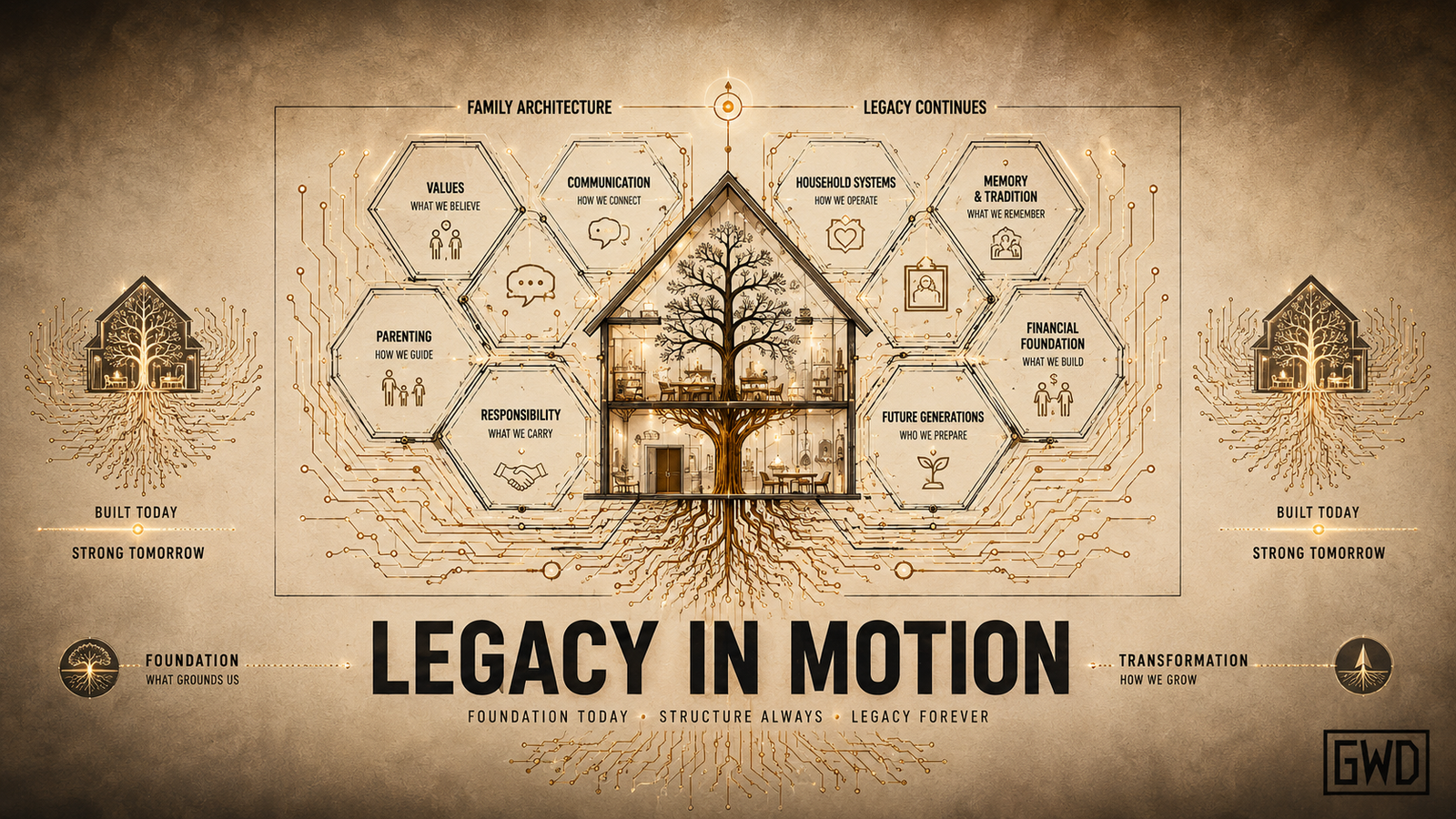
That is where relationship leadership becomes a Legacy In Motion question.
The issue is no longer only whether one partner trusts the other today.
The deeper question is what definition of leadership, responsibility, partnership, and accountability the household is quietly teaching the people who will carry those ideas into relationships of their own.
What a family repeats eventually becomes part of what a family passes forward.
Pressure Test
The Relationship Leadership Test
Before asking whether a partner respects your leadership, inspect what you are actually asking that person to trust.
- Can you carry responsibility without needing applause?
- Will you hear disagreement without treating it as insubordination?
- Can you make a decision without pretending uncertainty does not exist?
- Will you admit when your partner has better information?
- Can you apologize without believing you have lost authority?
- Are you willing to change course?
- Can the household’s interests outrank your ego?
- Will you stay accountable for the consequences of your judgment?
The Title Comes With a Cost
Leadership is expensive.
Ego is part of the price. Convenience is another. So is the freedom to blame everybody else when your call goes wrong.
Serious leadership accepts those costs because responsibility belongs to the role.
That is precisely what can make leadership worthy of trust.
Applied Groundwork
Build the Decision System Before the Next Big Decision
Couples often try to invent the rules while already inside the conflict.
That is a poor operating model.
Structure works better when couples build it before pressure arrives.
Eight Questions Worth Answering Together
- What decisions require consensus?
- Where does one partner have clear operating authority?
- Where should expertise override habit or tradition?
- Which responsibilities clearly belong to each person?
- What information do both partners need before a major decision?
- How can either partner challenge a weak decision without turning disagreement into disrespect?
- Who owns the consequences if a decision goes badly?
- How will responsibilities change when capacity changes?
None of this requires turning a relationship into a board meeting.
The purpose is simpler.
Remove ambiguity before pressure learns how to exploit it.
The Groundwork
Do Not Begin With “Who Is in Charge?”
Begin with the questions that expose the actual structure.
Who is responsible for what?
Which decisions require consensus?
Where does one partner have clear operating authority?
What happens when the two of you disagree?
How can either person challenge weak judgment?
Who owns the consequences when a decision fails?
Which boundaries apply equally to both people?
What evidence has each person given the other that makes trust reasonable?
Then put something physical on the table.
Use a calendar. Write down the responsibilities. Identify the decisions that require both people. Mark the areas where one person clearly owns the work. Agree on what happens when judgment fails.
A relationship does not become structured because somebody receives a title.
It becomes structured when authority, responsibility, accountability, boundaries, communication, and trust support one another strongly enough to survive pressure.
You cannot demand trust in your leadership. Build a life that makes trusting you a rational decision.
Continue Building
Follow the Relationship Structure
Leadership becomes easier to evaluate once it is placed beside the larger systems that govern accountability, commitment, and shared life.
Groundwork Architecture
The Principle and Condition Beneath This Work
This article applies one governing Core Principle and one structural Condition from the Groundwork Daily architecture to the relationship between authority, responsibility, correction, and earned trust.
Primary Core Principle
Accountability Is a Form of Strength
Legitimate leadership becomes stronger when authority remains answerable to evidence, consequence, correction, and the people affected by its decisions. Accountability protects the standard instead of diminishing the person carrying responsibility.
Primary Condition · Corrects
Accountability
Accountability identifies the gap between what was promised, what was carried, and what actually happened. It assigns responsibility for correction and gives trust a record sturdy enough to survive more than good intentions.
See the full Groundwork Daily Core Principles and Conditions architecture .