
Small daily wins rarely feel important while they are happening. You put yesterday’s clothes away, clear the mail from the counter, tighten the loose hinge, return one tool to its place, or finally delete the files you no longer need. None of it looks like transformation, and most of it will never be noticed by anyone else.
That is part of why these actions are easy to dismiss. Much of everyday stability is built through maintenance that prevents a small problem from becoming a larger one. The drawer closes because someone fixed it before the broken track became normal. The counter stays usable because yesterday’s objects did not become next week’s pile. A familiar routine remains easy to return to because one person took a few minutes to leave it ready.
The Daily Build is interested in that kind of work. Not dramatic reinvention. Not a perfectly controlled home. Not the performance of being disciplined. The work is quieter: notice what is beginning to drift, make one useful correction, and leave one part of life a little easier to come back to.
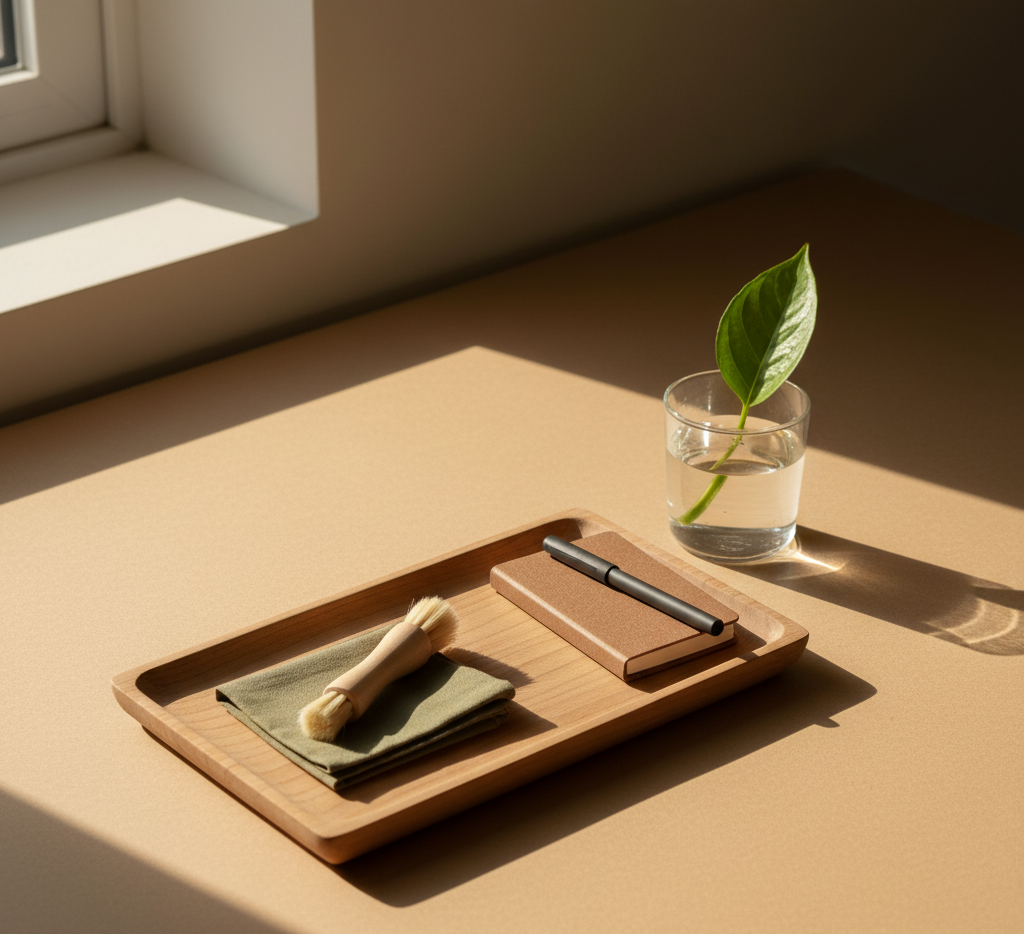
Most disorder does not announce itself as a crisis. It gathers quietly. One object stays on the table because you will deal with it later. A small repair waits because it still mostly works. A bill gets pushed aside. A cabinet becomes difficult to use, so you stop putting things back properly.
None of those moments is especially serious on its own. Over time, though, ordinary friction starts to accumulate. The room becomes harder to use. The task becomes easier to avoid. What once took two minutes now feels like a project.
This is where small actions earn their value. They interrupt accumulation early. Instead of waiting until the room, schedule, or routine requires a major reset, you make a modest correction while the problem is still modest.
Small Daily Wins Keep Small Problems Small
There is a temptation to judge an action by how much visible progress it creates. Clearing one corner can feel insignificant because the rest of the room still exists. Paying one bill does not resolve every financial question. Putting away one basket of laundry does not produce a perfectly ordered house.
But visible transformation is the wrong test for maintenance. A small action can be valuable because it prevents more friction from accumulating. If the counter is usable tomorrow because you cleared it today, the action worked. If the repair takes five minutes now instead of an hour next month, the action worked.
The win is not that everything changed. The win is that one useful part of life stayed usable.
Small Daily Wins Often Disappear After You Do Them
A great deal of useful work becomes invisible almost immediately. The trash goes out. The sink clears. The charger returns to the place where you will need it. The loose screw gets tightened, and nobody thinks about it again.
That invisibility is not a weakness. Often, it is evidence that the maintenance restored function without demanding more attention. The best small win may be the one you no longer have to think about tomorrow.
Use Small Daily Wins as Maintenance, Not Transformation
The language around habits often pushes people toward dramatic change: new routines, new systems, new identities, new standards. Yet much of adult life does not need another reinvention. It needs maintenance.
Maintenance asks a more modest question: what would keep this useful thing from getting harder?
Touch the Problem Before It Becomes a Project
A loose handle is easier to address before it breaks. Ten pieces of mail are easier to sort than a month’s accumulation. Five unnecessary files are easier to remove than a desktop nobody wants to look at anymore.
This is not an argument for spending the entire day scanning life for imperfections. That would turn maintenance into another form of anxiety. Instead, notice when a small correction can cheaply preserve function, make that correction, and move on.
Leave Something Better, Not Perfect
There is a meaningful difference between improving one thing and trying to finish everything. The first can create relief. The second can quietly erase the evening.
You do not need to clear the entire kitchen because one counter needs attention. You do not need to reorganize the garage because one tool has lost its place. You do not need a new household system because one small corner has begun to drift.
Sometimes the most disciplined choice is to make one useful correction and leave the rest for another day.
Do Not Turn Every Small Win Into Another Standard
The phrase daily can become dangerous when it turns into a demand for a perfect streak. Some days the useful move will be obvious. Other days the responsible choice may be rest, a smaller routine, or leaving something alone until tomorrow.
The Daily Build eventually returns to this lesson repeatedly: the system should support the person, not create another reason for the person to feel behind.
Small Daily Wins Work Best When They Are Easy to Repeat
A small action becomes more useful when the surrounding environment makes repetition straightforward. If every reset requires gathering supplies, remembering a complicated sequence, or deciding from scratch what should happen next, the supposedly simple action has acquired a large operating cost.
Keep the useful part close to the place where it happens. Store the basic tool where the repair usually begins. Give everyday objects obvious homes. When possible, let the end of one action make the next use easier.
Familiar Context Helps Behavior Become Familiar Too
Habit research gives this idea a useful foundation. Repetition in recurring contexts can strengthen the association between a situation and a practiced response. The takeaway is not that behavior becomes magical or effortless. Rather, familiar cues and repeated actions can reduce how much fresh deliberation is required each time.
That makes the design question practical: can tomorrow’s useful action be easier to recognize because of what you do today?
A Useful Win Should Lower Tomorrow’s Friction
This is a better test than whether the action feels productive. Returning the scissors to one obvious drawer may matter more than reorganizing the entire utility shelf. Setting out the thing you will actually use tomorrow may matter more than planning a perfect morning.
The best small daily wins often have a quiet aftereffect: the next beginning asks a little less from you.
Small Daily Wins Matter Because Drift Compounds Too
One neglected item rarely causes chaos. The problem is repetition in the other direction. One thing stays out, then another. One delayed repair becomes something you learn to work around. One recurring decision remains unresolved and gets made badly at the end of every long day.
Eventually, friction becomes part of the environment. You stop noticing how much effort the workaround takes because you have been living with it for months.
Notice the First Signs of Accumulation
You do not need to hunt for problems. Look for the places where ordinary use is becoming slightly more difficult: the chair where everything lands, the drawer that now requires two hands, the work surface that has lost its working space, or the repeated task you postpone because beginning it has become annoying.
Those are often better Daily Build targets than the most dramatic project in the room. A small intervention near the beginning of drift can prevent the need for a much larger intervention later.
Do Not Wait Until Friction Feels Normal
Human beings are remarkably good at adapting to inconvenience. We push the drawer harder. We step around the pile. We search for the charger again. We work from half a table because the other half slowly disappeared under things that never found a home.
Sometimes the useful work begins with noticing that the workaround has become familiar. Small daily wins can interrupt that pattern before inconvenience turns into the permanent shape of the room.
The Daily Build Eventually Asked a Harder Question
This early Daily Build idea became more precise as the series developed. Small wins matter, but not because every small action deserves to become another habit. Structure earns its place when it reduces the operating burden of ordinary life.
That is why later builds such as Stop Organizing What You Should Eliminate challenge unnecessary complexity instead of asking readers to maintain it more carefully. Protect What Already Works makes the complementary case that a functioning system does not need constant redesign.
Maintenance Should Not Become a Second Job
Make the System Easier to Maintain pushes the same idea further by asking what the system itself costs to keep alive. A useful routine can still be poorly designed if it requires constant tracking, sorting, resetting, or attention.
The mature version of the small-win idea is simple: maintenance should preserve function without becoming another project.
There Is Relief in Leaving One Thing Better
Not every day gives you room to solve a large problem. Sometimes the day has already taken enough. Work ran long. Dinner was late. Someone needed you. Your own energy has started disappearing at the edges.
A humane standard still leaves room for one modest act of care. Maybe you put the tools away so tomorrow does not begin by searching for them. Maybe you clear enough of the table to eat breakfast there. Perhaps you fix the thing that has annoyed you for a week and discover that it only needed three minutes.
The value is not that you won the day. You simply left one part of tomorrow easier to enter.
Enough Can Be a Complete Sentence
There is dignity in finishing one useful thing and stopping. You do not have to convert a burst of energy into an evening of catch-up. You do not have to turn one repaired hinge into a full household reset.
Some nights, one small win really is enough. The structure is a little stronger, the next beginning is a little easier, and the rest of you still gets to have an evening.
Choose One Small Daily Win, Not Ten
The easiest way to ruin this idea is to turn it into another long list. Do not identify fifteen small wins for tonight. Choose one point of friction that has started accumulating and make one correction that restores useful function.
Use the Small-Win Test
Ask four questions:
- Drift: What small part of ordinary life is becoming slightly harder to use?
- Action: What can realistically be corrected in a few minutes?
- Function: Will the action make tomorrow easier, clearer, or more usable?
- Stop: Can you finish that correction without turning it into a larger project?
If the answer is yes, do that one thing and let it be enough.
Small Daily Wins Protect What You Will Need Again
Small actions do not matter because small is automatically virtuous. They matter when they preserve something useful before neglect makes the work heavier.
Put the object back. Clear the working space. Make the small repair. Resolve the recurring annoyance. Leave the next beginning a little easier than the last one.
That is enough for a Daily Build. Over time, small daily wins can become something less visible and more valuable than a dramatic transformation: a life with fewer neglected corners asking to be rescued all at once.
Build What Holds
Useful structure does not always need another improvement. Sometimes it needs modest maintenance before ordinary drift becomes expensive. Protect what will be used again, restore enough function for the next cycle, and stop before maintenance becomes another system to manage.
Correct One Small Point of Drift
Find one thing that has become slightly harder to use, find, maintain, or begin. Spend a few minutes restoring function, then stop. Tomorrow, notice whether that small correction made the next use easier.
American Psychological Association — Habit Psychology
Further reading on repeated behavior, cues, and the psychology of habit formation.
National Center for Biotechnology Information — Behavioral Routines
Additional research context on repeated behavior and routine.
Further Groundwork
Stop Organizing What You Should Eliminate
Remove unnecessary complexity before building a more elaborate system to manage it.
Protect What Already Works
Preserve useful structure rather than constantly redesigning a routine that is already carrying its load.
Make the System Easier to Maintain
Reduce the service work around useful routines so maintenance does not become another job.
The Daily Build
Keep Building the System
This article is part of The Daily Build, Groundwork Daily’s series about practical routines, recovery, adaptation, maintenance, rhythm, and structures designed to survive ordinary life.
Explore The Daily Build →Explore Education & Skills
The Daily Build is the daily-practice layer of Groundwork Daily’s Education & Skills system. It turns larger ideas about habits, structure, maintenance, recovery, and durability into actions that can be tested in ordinary life.
Build Better. Every Day.
Groundwork Daily looks beneath visible results for the structures carrying the weight. Follow The Daily Build for practical systems that make ordinary work easier to begin, recover, maintain, and keep.
Small structures. Useful corrections. A life that becomes easier to carry.