
The work refines the worker.
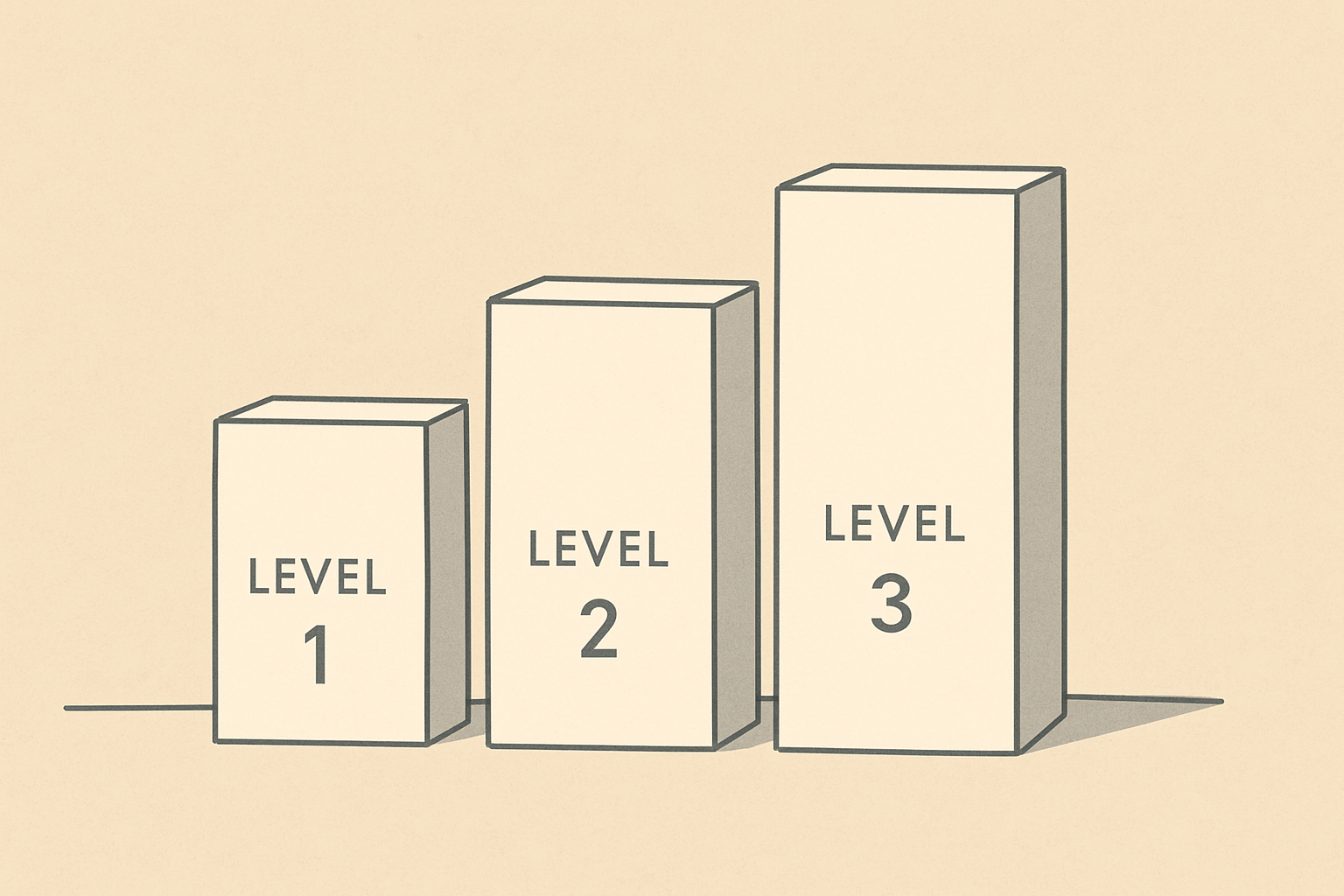
The three levels of capability are a Groundwork Daily framework for understanding how effort can develop into reliable performance. The model moves through three practical stages: completing the task, building a repeatable system, and adapting that system when conditions change.
This is not presented as a universal academic taxonomy. It is a working framework for diagnosing where performance depends on pressure, where structure has begun to carry the load, and where judgment has become strong enough to travel across situations.
At first, capability often looks like effort. With practice and structure, effort can become more repeatable. With enough understanding, that structure can become more adaptable.
What Are the Three Levels of Capability?
The three levels of capability in this framework are task capability, system capability, and adaptive capability.
Task capability is the ability to complete defined work. System capability is the ability to organize repeated work so useful outcomes become easier to reproduce. Adaptive capability is the ability to adjust knowledge, behavior, and systems when the environment changes.
The levels are not personality types. A person can operate at different levels in different areas of life. Someone may have adaptive capability at work while still depending on reminders and urgency at home.
That is why the framework is useful as a diagnostic tool. It asks a better question than, “Am I capable?” It asks, “What is currently carrying the result?”
What Capability Really Means
Capability is more useful when it is measured by performance than by potential. Potential describes possibility. Capability shows up in what can actually be executed, repeated, reviewed, and improved.
Expertise research has also cautioned against assuming that experience alone guarantees superior performance. Observed performance and accumulated experience are not always the same thing. Improvement depends on what is practiced, how performance is evaluated, and whether feedback produces correction.
That distinction matters in work, money, health, leadership, family life, and personal discipline. Repetition can build familiarity. Deliberate review can build something stronger.
Level One: Task Capability
Most capability begins with task capability. At this level, a person can complete a clear assignment when the required outcome is visible.
The instruction is known. The deadline is identifiable. The next action can be understood.
Sometimes the pressure comes from outside. A supervisor follows up. A bill becomes due. A client calls. A school assignment reaches its deadline. The external signal creates movement.
There is nothing trivial about this level. Task capability proves that a person can convert instruction into execution.
The limitation appears when the same responsibility must be managed repeatedly without someone else creating the trigger.
The Risk of Staying at Task Capability
Task capability becomes fragile when urgency is the primary management system.
A person may work extremely hard while remaining reactive. The work gets completed, but the structure needed to make completion predictable never gets built.
Bills trigger financial attention. Deadlines trigger professional attention. Conflict triggers relationship attention. A health scare suddenly creates attention to the body.
In each case, pressure is doing work that a system could have started earlier.
The answer is not to shame reactive behavior. The useful move is to ask what recurring responsibility is ready to become a repeatable process.
Signs You May Be Operating at Task Capability
Task capability can hide behind busyness because activity is visible while missing structure is not.
- You regularly wait until pressure becomes difficult to ignore.
- You need repeated reminders for recurring responsibilities.
- You restart the same process more often than you maintain it.
- You perform well in emergencies but struggle with ordinary consistency.
- You complete individual tasks while the underlying problem keeps returning.
These patterns do not prove that someone lacks ability. They suggest that ability is still being carried primarily through individual task execution.
Level Two: System Capability
The second level is system capability. Here, the question changes from whether the task can be completed to how the work can be made more repeatable.
Calendars, checklists, templates, routines, reviews, and standard procedures begin carrying part of the cognitive and operational load.
A weekly budget review is system capability. A recurring planning block is system capability. A standard project checklist is system capability. A household maintenance rhythm is system capability.
None of these tools guarantees a good outcome. Their value is more practical: repeated work no longer has to be invented from scratch every time.
Why Systems Matter
Repeated decisions consume attention. A useful system can reduce the number of routine choices that need to be reconstructed each time the same responsibility appears.
That does not eliminate judgment. It preserves judgment for the places where judgment is actually needed.
Without structure, every recurring responsibility can become a fresh negotiation. With structure, the starting point is already established.
This is the practical connection between capability and systems thinking. The goal is not to automate life. The goal is to stop asking individual effort to carry work that a repeatable process can support.
Signs You Are Building System Capability
- You schedule recurring work before it becomes urgent.
- You use checklists for tasks that have predictable steps.
- You review progress before problems become expensive.
- You reuse useful templates instead of repeatedly starting from zero.
- You improve the process when the same failure keeps returning.
At this level, discipline begins to leave evidence behind. The calendar, checklist, procedure, template, or review process becomes part of the capability itself.
Level Three: Adaptive Capability
The third level is adaptive capability. At this stage, the person is not simply following a task or protecting a routine. The person can adjust behavior and systems when circumstances change.
Research on adaptive performance uses similar language. Adaptive performance concerns the capacity to modify behavior in response to changing conditions, new information, or unfamiliar situations.
That makes adaptability different from inconsistency. The objective does not change every time the environment changes. The method changes when the existing method no longer fits the conditions.
This is where capability becomes more strategic.
What Adaptive Capability Looks Like
Adaptive capability becomes visible when useful principles travel.
A budget review can teach someone how to conduct a time review. A project postmortem can improve household planning. A training log can reveal the value of measurement in professional development. A conflict repair process can inform leadership practice.
The surface problem changes, but parts of the underlying reasoning remain useful.
Adaptive capability therefore does not mean having a ready-made answer for every environment. It means having enough understanding to recognize what should remain stable and what should change.
Signs You Are Developing Adaptive Capability
- You recognize useful patterns across different areas of work or life.
- You modify a system without abandoning its purpose.
- You can respond to unfamiliar conditions without immediately losing structure.
- You apply lessons from one domain to another when the underlying principle fits.
- You use feedback to change execution rather than merely defend the original approach.
This is disciplined adjustment. The system remains useful because it can learn.
Why the Three Levels Matter
The three levels of capability help locate the actual constraint.
Some performance problems do not require more motivation. The person can already do the task. What is missing is a system that makes the task repeatable.
Other problems appear after a strong system has already been built. The process works under familiar conditions but breaks whenever the environment changes. In that case, more routine is not necessarily the answer. Adaptation is.
This distinction keeps improvement from becoming generic advice. The intervention depends on the level of the problem.
Capability and Discipline Are Not the Same
Discipline and capability reinforce each other, but they are not interchangeable.
Discipline helps someone continue the work. Capability includes the knowledge, processes, feedback, and judgment that help the work improve.
Research on deliberate practice makes a related distinction. Repetition by itself is not the same as purposeful practice. Practice becomes more developmental when it includes focused goals, feedback, correction, and continued adjustment.
That matters because “try harder” is often an incomplete diagnosis. Sometimes effort is weak. Other times the process is weak. Mature capability can tell the difference.
How to Identify Your Current Level
Choose one domain rather than auditing your entire life at once. Use money, health, work, home, communication, study, or planning.
Then identify what is currently carrying performance.
Task capability
The result depends mainly on remembering, responding, or being prompted.
System capability
The result is supported by routines, calendars, checklists, templates, procedures, or regular reviews.
Adaptive capability
The structure can be modified intelligently when conditions, information, or demands change.
The purpose is diagnosis, not ranking. Moving everything to level three is unnecessary. Some work only needs a reliable checklist. Other work requires judgment precisely because conditions cannot be standardized.
How to Build Capability
Start with one repeated responsibility that creates unnecessary friction.
If the task itself is unfamiliar, improve task capability first. Learn the steps. Practice the skill. Get feedback. Correct errors.
Once the task is understood, identify what can become repeatable. Create one calendar block. Write one checklist. Save one template. Establish one review.
Then use the system long enough to observe where it fails.
The next level begins when the system encounters conditions it was not designed for. Do not immediately throw it away. Determine what principle still works, what assumption failed, and what needs to change.
That sequence is the practical ladder: learn the work, structure the work, then learn how to adjust the structure.
A Simple Capability Audit
Use this five-step audit when a repeated problem keeps returning.
- Name the result. What outcome needs to become more reliable?
- Identify what currently triggers action. Is the work initiated by intention, routine, reminder, deadline, or crisis?
- Locate the level. Is the problem primarily task execution, system design, or adaptation?
- Build the smallest useful support. Add the training, checklist, calendar block, template, review, or feedback loop that addresses the actual constraint.
- Review what happens under pressure. Keep what holds. Correct what breaks. Transfer the lesson only where it genuinely fits.
The Groundwork Principle
Capability grows when effort becomes more reliable.
Task capability proves that the work can be done. System capability helps make the work repeatable. Adaptive capability helps keep the work useful when conditions change.
The goal is not to make every part of life more complicated. It is the opposite.
Build enough skill to do the work. Build enough structure to stop recreating the work. Build enough judgment to know when the structure needs to change.
That is how capability compounds.
Further Groundwork
- How to Use Systems Thinking in Real Life for recognizing patterns, feedback, and the structure underneath repeated outcomes.
- Discipline Before Dollars for the role discipline plays before systems can become dependable.
- How to Build a Two-Year Direction for putting capability inside a longer operating horizon.
Receipts
- Deliberate Practice and Acquisition of Expert Performance examines why observed performance, purposeful practice, and feedback matter more than simply accumulating experience.
- Positive Psychology and Employee Adaptive Performance reviews adaptive performance as the capacity to modify behavior in response to changing circumstances or information.
