

What does the Bible say when you don’t know what to do? Sometimes uncertainty arrives because the choices are complicated. Other times, the problem is simpler and harder: you genuinely cannot see the next step.
You have prayed. You have thought about it. Perhaps you have asked people you trust. Still, nothing feels clear enough to call an answer.
That kind of uncertainty can create its own pressure. We begin to believe that faithful people should always know what comes next. Then, because clarity has not arrived, we start manufacturing certainty.
Scripture gives us another option.
In 2 Chronicles 20, King Jehoshaphat faces a threat he does not know how to solve. Rather than pretending otherwise, he says something remarkably honest:
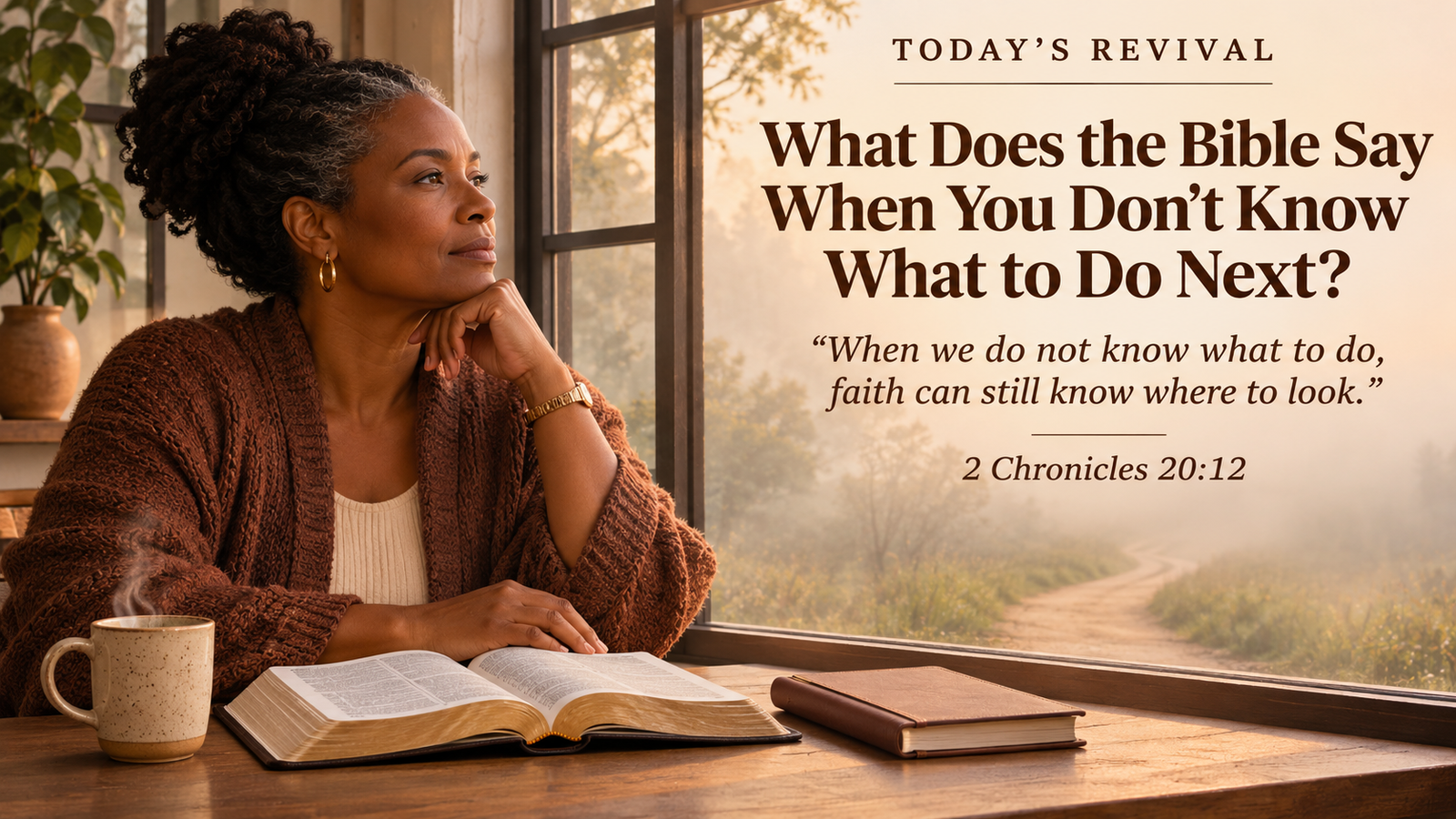
“We do not know what to do, but our eyes are on you.”
That sentence makes room for a kind of faith we do not talk about enough: faith that remains steady before the answer becomes visible.
Primary Scripture
“We do not know what to do, but our eyes are on you.”
“Faith does not always give you the next answer immediately. Sometimes it gives you a way to stand while the answer is still forming.”
N. Grace James
What Jehoshaphat Does When He Does Not Know What to Do
The situation in 2 Chronicles 20 is not minor. Jehoshaphat receives word that a large force is coming against Judah.
His first response is fear.
Scripture does not hide that reaction. However, fear is not allowed to become the entire response.
Jehoshaphat turns his attention toward God. He gathers the people, prays publicly, remembers God’s past faithfulness, names the present threat, and finally admits the truth: Judah does not have enough power to solve the problem on its own.
He Admits His Limits Without Giving Up
This is the part worth noticing.
Jehoshaphat does not confuse admitting uncertainty with surrendering responsibility. He does not say, “I do not know, so nothing matters.”
Instead, he tells the truth about the limits of his knowledge while remaining spiritually attentive.
That is a mature posture.
What Does the Bible Say When You Don’t Know What to Do?
It does not say that uncertainty itself is evidence of weak faith.
Scripture repeatedly shows faithful people living through situations they cannot fully interpret. They pray, ask, wait, decide, reconsider, seek wisdom, and sometimes move forward without possessing the whole picture.
Therefore, the goal is not to eliminate every unanswered question before you act.
A Groundwork Distinction
Not knowing what comes next is a knowledge problem. Panic turns it into an authority problem by letting uncertainty govern everything else.
You may not know what the outcome will be. Still, you can know what should not lead you: panic, desperation, pressure, or the need to manufacture a sign.
“Our Eyes Are on You” Is a Decision About Attention
Jehoshaphat’s prayer does not end with an answer. It ends with attention.
“Our eyes are on you.”
That matters because uncertainty tends to scatter attention. We revisit the same possibilities. We imagine outcomes. We look for hidden meaning in every conversation. Eventually, the mind can become so crowded with possibilities that nothing receives proper weight.
Jehoshaphat does something different.
He returns attention to the One he trusts before he knows how the situation will resolve.
Stillness Does Not Mean Doing Nothing
This is where Stillness Is Strategy becomes useful.
Stillness creates a pause between pressure and reaction. That pause does not guarantee instant clarity. However, it can keep urgency from deciding before wisdom has had room to speak.
When You Don’t Know What to Do, Discern What You Already Know
Uncertainty can make everything feel uncertain.
Usually, that is not true.
You may not know which job will open, whether a relationship will recover, when circumstances will change, or exactly how a difficult decision will turn out. Yet some things may already be clear.
You may know what Scripture forbids. You may know which responsibility belongs to you today. Perhaps you already know which choice would require dishonesty or which boundary needs to remain intact.
That is why Discernment matters.
Discernment does not require pretending to know what God has not revealed. Instead, it gives Scripture, evidence, values, constraints, counsel, and consequences the weight they deserve.
Ask God for Wisdom Without Demanding a Secret Map
James gives believers a simple instruction when wisdom is lacking:
“If any of you lacks wisdom, let him ask God.”
Wisdom is not the same as receiving a private preview of the future.
Sometimes wisdom clarifies the next decision. At other times, it helps us carry uncertainty without abandoning good judgment.
Do Not Turn Uncertainty Into a Search for Signs
When we desperately want direction, almost anything can begin to feel meaningful.
A repeated number, a song, a coincidence, a dream, or a sentence overheard at the right moment may catch our attention. Those experiences can prompt reflection. However, they should not automatically become proof that God has issued a private instruction.
Today’s Revival explored that question more directly in How Can I Know God Is Speaking? .
The same discipline belongs here: do not manufacture certainty simply because uncertainty is uncomfortable.
Trust Does Not Require Complete Understanding
Not knowing what to do can also expose how much we depend on explanation before obedience feels safe.
Yet trust and understanding are not identical.
In How Do I Trust God When I Don’t Understand? , the emphasis is learning to trust when circumstances themselves do not make sense.
Here, the problem is narrower: the next decision is unclear.
Even then, faith can remain active before certainty arrives.
What to Do When You Don’t Know What to Do Next
You may not be able to force clarity, but you can create better conditions for discernment.
In Practice
1. Admit what you do not know.
Stop treating uncertainty like a spiritual embarrassment. Honest limits are easier to work with than invented certainty.
2. Name what is already clear.
Separate the unanswered question from the responsibilities, values, boundaries, and biblical guidance you already understand.
3. Slow the pressure where possible.
If a decision does not require an immediate answer, give prayer, evidence, counsel, and reflection enough time to do their work.
4. Ask for wisdom rather than a guarantee.
Wisdom can guide a faithful decision even when the future remains uncertain.
5. Take the next responsibility you can actually see.
You may not have the whole map. Still, there is often one honest, faithful action available today.
You May Only Need Enough Light for the Next Step
We often ask God for the entire road because the whole road feels safer.
Yet life rarely works that way.
Many decisions become clear only after earlier responsibilities have been carried. One conversation changes what you know. One boundary reveals something important. One act of obedience creates information that was unavailable while you stood still.
Therefore, the next faithful step does not have to explain the next five years.
It only has to be faithful enough for today.
What Does the Bible Say When You Don’t Know What to Do? Keep Your Eyes Where Faith Can Stand
So, what does the Bible say when you don’t know what to do?
Jehoshaphat gives us language for the moment before clarity.
Admit the limits. Name the threat. Remember what is true. Ask for wisdom. Refuse to let panic become authority.
Then return your attention to God.
“We do not know what to do, but our eyes are on you.”
That is not passivity. It is a refusal to manufacture an answer merely to escape the discomfort of not having one.
Sometimes faith knows the next step.
At other times, faith first learns how to stand.
A Prayer When You Don’t Know What to Do
Father, I do not have every answer, and I do not want fear to invent one for me. Give me wisdom for what belongs to today. Help me recognize what is already clear, remain patient with what is not, and keep my attention anchored in You. Guard me from panic, false certainty, and the need to control what I cannot yet see. When the next faithful step becomes clear, give me courage to take it. Until then, teach me how to stand with my eyes on You. Amen.
When You Don’t Know What to Do FAQ
What does the Bible say when you don’t know what to do?
In 2 Chronicles 20:12, Jehoshaphat admits that Judah does not know what to do and turns his attention toward God. The passage shows that uncertainty can be acknowledged honestly without abandoning faith.
Is it wrong for a Christian not to know what to do next?
No. Scripture includes faithful people who faced uncertainty. Not knowing an answer is different from refusing wisdom, responsibility, or clear biblical guidance.
How should I pray when I don’t know what decision to make?
Pray honestly about what you do not know, ask God for wisdom, return to what Scripture already makes clear, and seek wise counsel without demanding instant certainty.
Should I wait until I feel completely certain before making a decision?
Not every faithful decision comes with complete certainty. When enough is clear, wisdom may require acting without knowing every future outcome.
Further Groundwork
Continue through related reflections on discernment, trust, and spiritual uncertainty.
→ How Can I Know God Is Speaking?
→ How Do I Trust God When I Don’t Understand?
Groundwork Daily
Build a quieter foundation for a louder world.
Join the Groundwork List for Scripture-centered reflections, practical wisdom, and ideas built to help faith become something lived in ordinary life.
Meet the Builder
N. Grace James
N. Grace James builds in the space between what a person feels, what a person believes, and what a person allows to lead. Her work for Groundwork Daily explores faith, Scripture, prayer, discernment, stillness, emotional discipline, and the quiet choices that shape ordinary life.
Through Today’s Revival, she writes Scripture-centered reflections for honest spiritual formation. She also builds Wisdom Wednesday, a practical lane for clearer judgment and self-governance.