

We say we want culturally rooted businesses to survive. Then a restaurant charges enough to pay people, replace equipment, build management and survive the next generation—and suddenly we wonder whether it is still authentic.
Authentic Food and Pricing: The Price of “Real”
Authentic food and pricing have developed a strange relationship. We praise a restaurant for being real, rooted and untouched by outside expectations. Yet when the same restaurant begins charging more, some of us start wondering whether the culture changed with the price.
You know the kind of recommendation. The place is not fancy. The menu may be laminated. The room is crowded. The portions are generous. Meanwhile, the owner might still be somewhere near the register. Somebody tells you not to judge the building. Another person says the service can be a little rough, but that is part of the experience.
Finally, the phrase arrives that settles the argument: This is the real stuff.
There is affection inside that language. Sometimes there is real cultural knowledge too. People recognize places that fed families, survived neighborhood change and kept cooking something long before outsiders learned the name for it.
However, another possibility hides inside the compliment. We may have learned to recognize certain cultures not only by their food, but also by the economic conditions surrounding the food.
Consider the signals. The small room. The family labor. The enormous plate. The owner who never seems to leave. Then there is the price, which can feel almost too low for the amount of work involved.
After enough repetition, those conditions can stop looking economic. Instead, they start looking cultural.
That is where the ledger gets interesting.
If low prices become part of what customers use to recognize authenticity, a culturally rooted business can face a peculiar penalty for becoming more durable. Paying workers more, hiring management, replacing old equipment, improving the room or building enough margin to survive can make the business look less like the thing people originally loved.
Therefore, the question is not whether a $14 plate should become a $22 plate. Some price increases are justified; others are not. Some restaurants genuinely abandon the communities that built them. Conversely, others simply discover that nostalgia does not pay payroll.
The better question is harder: when did struggle become one of the signals we use to recognize authenticity?
How Authentic Food and Pricing Get Read
Authenticity sounds as if it should live entirely in the food. In practice, diners read the entire environment.
A recipe matters. Technique matters. Ingredients matter. History matters. Likewise, the knowledge of the person preparing the food matters. Customers, however, do not walk into a restaurant carrying a laboratory. Instead, they make judgments from signals.
The menu becomes a signal. The room does too. Language, neighborhood, employees and the story surrounding the meal can all influence how a customer reads the experience.
Research on ethnic restaurants supports that narrower point. A 2017 experimental study in Cornell Hospitality Quarterly found that menu and employee cues affected perceived authenticity. In that study, ethnic menu names and employees perceived as being of the cuisine’s referent ethnicity were especially influential cues.
Restaurant authenticity is not evaluated through food alone. Extrinsic cues—including menu presentation and employee cues—can affect how customers perceive authenticity.
Source: Kim & Baker, Cornell Hospitality Quarterly, 2017.
Of course, that does not mean every customer thinks the same way. Nor does it mean an unpolished room automatically produces an authenticity premium. Rather, the research tells us something more useful: authenticity is partly interpreted.
Once interpretation enters the picture, expectations enter with it. Consequently, the relationship between authentic food and pricing is shaped by more than the recipe.
Expectations can also become sticky. A community may know what its food tastes like, while a wider market learns what it thinks the culture is supposed to look like.
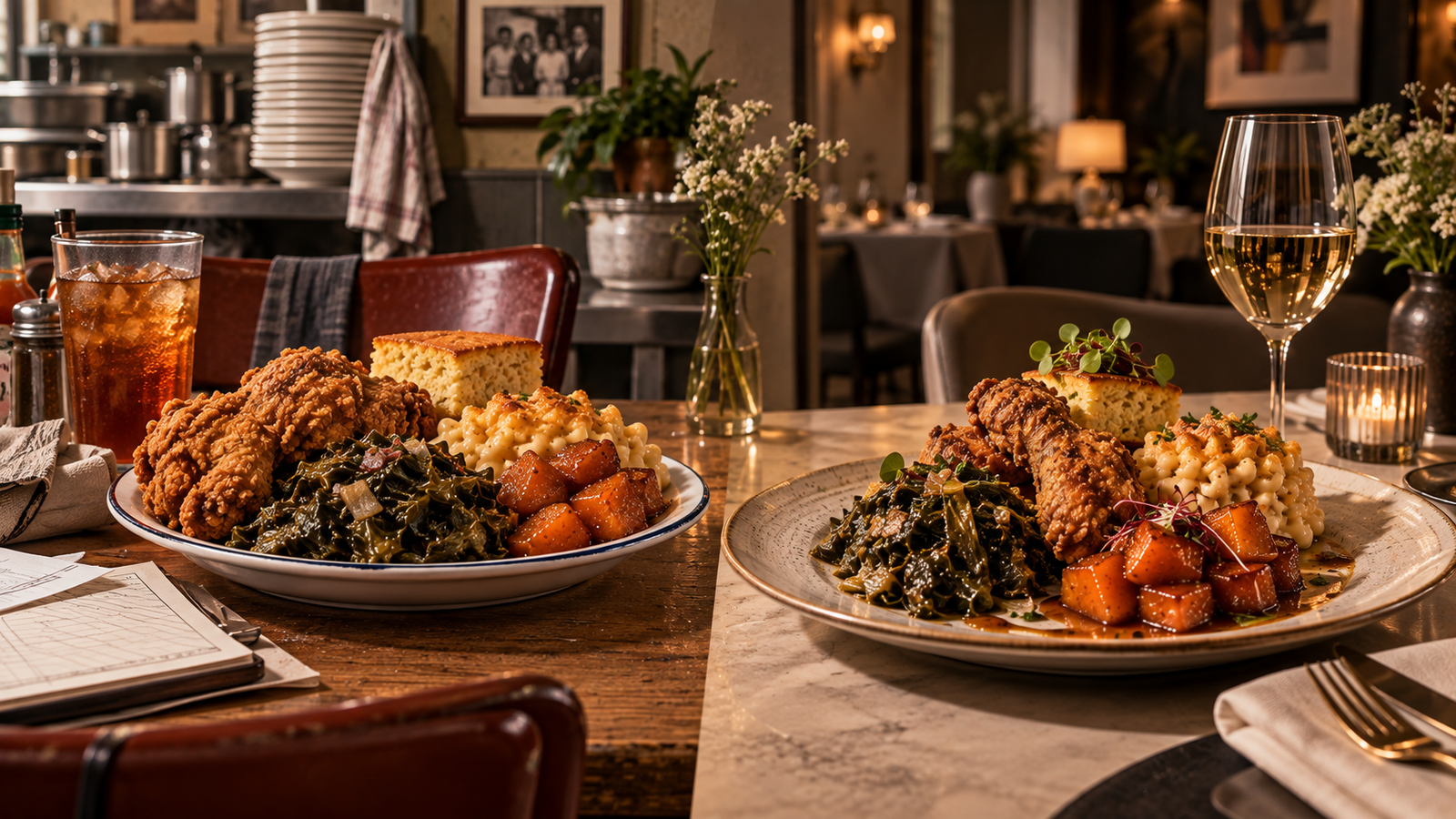
Authentic Food Does Not Require Cheap Pricing
There is nothing inherently authentic about a business operating on a thin margin.
An owner working twelve-hour days because another manager would cost too much is not a cultural tradition. Neither is inadequate retirement savings. Likewise, deferred maintenance is not ancestral. A broken refrigerator threatening the month’s cash flow is not evidence that a restaurant stayed true to its roots.
Those are economic conditions.
Nevertheless, economic conditions can become visually familiar. If enough culturally rooted businesses operate under the same constraints for long enough, the constraint itself can begin to look like part of the culture.
For example, the owner behind the counter can feel authentic. Family members working every shift can feel authentic. A modest room, a giant portion and a low price can all become part of the same picture.
Eventually, several different things get compressed into one word: real.
Those are not automatically the same thing. The first may carry memory. The second may simply carry an old price expectation forward.
This is not an argument for making everything expensive. Instead, it is an argument for separating the cultural standard from the economic circumstance.
Otherwise, we may accidentally demand that businesses preserve hardship in order to preserve recognition.
Authentic Food and Pricing: What the $14 Plate Hides
Suppose a restaurant serves a generous plate for $14. Naturally, the customer sees value.
What the customer cannot see from the menu is how the restaurant made $14 possible.
Perhaps the economics are excellent. The restaurant may own the building, buy exceptionally well, run enormous volume or have spent decades making the operation efficient. In those circumstances, a low price can absolutely be the product of a strong business model.
Sometimes, though, the missing dollars are being absorbed somewhere else.
The owner works the extra shift. A spouse handles the books at night. Family members fill labor gaps. Meanwhile, equipment replacement waits another year.
The dining room may stay mostly unchanged. Management can remain concentrated in one person because another salary would erase the margin.
As a result, the customer experiences affordability while the business experiences the structure required to produce it.
The Next Generation Changes the Pricing Equation
Now imagine the founder’s daughter takes over.
She keeps the recipes and the restaurant in the neighborhood. Moreover, she continues buying from the same suppliers where it makes sense. Regulars can still order what they have ordered for years.
At the same time, she pays the cooks more. She replaces equipment before it fails and hires a professional accountant.
Next, she improves the website and upgrades packaging. She creates a management position so every decision no longer ends at one exhausted owner.
Perhaps she adds benefits. Maybe she closes one day a week because seven-day operations were slowly consuming the family. In addition, she finally prices in the maintenance that previous generations kept postponing.
The $14 plate becomes $22.
Did the Culture Change, or Did the Cost Become Visible?
That question is more useful than assuming the higher price explains the entire story.
The restaurant got expensive. It became polished. It changed. Perhaps it is no longer “for us.”
The full cost of operating is finally visible in the price instead of being hidden inside family sacrifice, deferred investment and concentrated labor.
Either interpretation can be wrong. A new owner really can chase a wealthier customer and leave the original community behind. Quality can fall while prices rise. Investors can extract value from a beloved institution. Similarly, “premium” can become a costume.
Therefore, the point is not to defend every price increase. The point is to use a better standard.
A higher price is not proof of betrayal any more than a low price is proof of authenticity.
Sometimes the next generation is not abandoning the culture. Instead, it is refusing to inherit the operating sacrifice that came with it.
Authentic Food, Pricing and Accessibility Are Different Questions
None of this works if affordability becomes the villain.
Affordable restaurants matter. The neighborhood carryout matters. Likewise, the lunch counter matters. The place where a family can eat without turning dinner into a financial event matters.
Restaurants are not merely units in a luxury market. They can function as gathering places, employment networks, informal institutions and repositories of memory. Therefore, a cultural economy composed only of premium experiences would lose something essential.
Still, accessibility and authenticity solve different problems.
Accessibility asks whether people can participate. Authenticity asks whether the cultural expression is recognizable, grounded and credible. Meanwhile, business durability asks whether the institution carrying that expression can keep operating.
Those goals can support one another. However, they can also create tension.
That distinction gives communities room to defend affordability without demanding fragility.
Authentic Food and Pricing Need Economic Range
Americans already understand economic range when we are accustomed to seeing it.
Pizza can be a quick slice or part of an expensive restaurant experience. Likewise, a burger can come through a drive-through window or arrive in a luxury hotel. Japanese food can appear in a supermarket case, a neighborhood restaurant or an intimate omakase.
Those price points do not have to invalidate one another.
Instead, they serve different customers, occasions, operating models and forms of value.
Range Creates More Than One Path for Cultural Institutions
Some restaurants should optimize for affordability. Others should optimize for craftsmanship. Some should scale, while others should stay small.
Similarly, one institution may preserve a form almost exactly while another reinterprets it. A mature cultural marketplace can hold all of those possibilities.
The warning sign appears when a culture is permitted to have tradition but not range. In that market, people may enjoy the food yet become suspicious the moment those carrying it seek more margin, more ownership or a different kind of institution.
Authentic Food Can Support Higher Pricing
There is another reason to be careful about treating authenticity and low prices as natural partners: research does not require that conclusion.
A study of Thai Select restaurants in Taipei found that perceived ethnic authenticity and the physical environment were positively associated with customers’ willingness to pay.
Separately, a 2023 study examining ethnic restaurant choice found that authenticity interacted with the importance customers placed on several dining attributes. Among the reported patterns, customers with stronger interest in authenticity did not simply behave as though the lowest price were the overriding criterion.
These studies do not prove that culturally rooted restaurants can raise prices without consequence. However, they do show that authenticity and willingness to pay are not inherently opposed.
Sources: Lin & Jiang, 2021/2022; Premordia & Gál, 2023.
Authenticity Can Change Perceived Value
In August 2026, researchers published an experiment in the Journal of Sensory Studies that made the signaling problem even more visible.
Participants were presented with the same dish under different naming conditions. Compared with a “traditional” label, an “ancestral” label increased expectations, perceived authenticity and willingness to pay.
In other words, the dish stayed the same while the frame changed. Perceived value changed with it.
The lesson is not that one word can magically turn ordinary food into a premium product. Rather, the useful lesson is that cultural meaning can affect economic perception.
The deeper question is which forms of authenticity a market has learned to recognize as premium—and which forms it has learned to recognize as cheap.
When Authentic Food Becomes Premium
This is where the story becomes uncomfortable.
Sometimes culturally rooted food becomes easier for the market to price as premium after the presentation changes.
The room gets quieter. Meanwhile, the menu gets shorter. The plate gets larger while the portion gets smaller. Ingredients acquire provenance, and the chef biography becomes part of the experience.
Then a server explains the history before the first bite arrives. Suddenly, the story becomes legible to a customer who has been trained to pay for story.
None of those changes is automatically cynical. Good hospitality matters. Craft matters. Design and service matter as well. In fact, interpretation can deepen an experience.
The Culture Was Already There
Notice what did not happen: the food did not suddenly acquire culture when the lighting changed.
The culture was already there.
What changed was the market’s ability—or willingness—to read that culture as premium.
Language can do similar work. “Peasant food” and “rustic cuisine” can point toward overlapping histories while carrying different status. Likewise, “Grandmother’s recipe” can sound inexpensive and comforting in one room, then rare and artisanal in another.
The history may be similar. The market, however, is reading the history differently.
Who Captures the Value Created by Authentic Food?
Once culture can create premium value, the next question is not merely what the meal costs.
It is who captures the difference.
Does the original family build the premium institution? Can a chef raised inside the tradition gain the capital to reinterpret it? Furthermore, does a neighborhood entrepreneur own the building? Do employees participate in the upside?
Or does somebody else recognize the opportunity, package the culture for a new audience and capture the premium while the original producer keeps the compliment?
That is a Culture Ledger question because cultural recognition and economic capture are not the same thing.
One party carries the cultural credibility. Another may own the location, capital, distribution, brand architecture or customer relationship that turns credibility into durable value.
There is nothing inherently wrong with culturally rooted food becoming premium. Instead, the ownership question is whether the people who created, preserved and carried the tradition have viable pathways to participate in the value accumulating around it.
Authentic Food and Pricing Create a Two-Sided Trap
Culturally rooted businesses can get caught between two expectations.
Keep the price, room, portions and operating style close to what customers already recognize. Familiarity protects cultural recognition but may also preserve an economically narrow model.
Add margin, design, management and a different service model. The business may become more durable, yet the changes can trigger suspicion that it has become too polished or too distant from its roots.
Change too little and the business may remain trapped inside the economics people associate with it. On the other hand, change too much and customers may stop recognizing what they loved.
That is a narrow corridor.
Durability Is Not Cultural Betrayal
There is no universal answer. Not every restaurant should expand, and not every restaurant needs investors. Likewise, not every cuisine needs a tasting menu.
A beloved neighborhood institution may have excellent reasons to remain exactly what it is. Nevertheless, financial durability should not, by itself, disqualify a business from cultural legitimacy.
A Better Standard for Authentic Food and Pricing
Communities have a legitimate interest in what happens to institutions they helped sustain.
People notice when a restaurant stops serving them. They also notice when familiar food becomes inaccessible. Most of all, they notice when a neighborhood institution begins treating longtime customers as an inconvenience while courting a more profitable audience.
Those concerns should not be dismissed as resistance to change.
At the same time, communities can ask more precise questions than whether the price went up.
Ask What the New Economics Are Building
Did the quality improve or decline? Are workers being treated better? Did the restaurant preserve what it claims to preserve? Moreover, is the business building enough margin to maintain itself?
Ownership matters too. Is it staying close to the people who created the value? Can longtime customers still participate in some meaningful way?
Most importantly, is the business becoming stronger—or simply more expensive?
That standard protects more than nostalgia. Ultimately, it protects the possibility that culture can remain accessible at one price point, ambitious at another and durable across both.
Authentic Food and Pricing Should Not Preserve Sacrifice
A culture should not have to remain economically constrained in order to remain recognizable.
The grandmother who cooked without measuring can be authentic. So can the granddaughter who documents the recipe, builds a commercial kitchen, pays her staff well and creates management systems.
Crucially, the granddaughter can also charge enough to keep the institution alive.
The neighborhood carryout can be authentic. Likewise, the white-tablecloth restaurant can be authentic. An inexpensive plate can be authentic, and an expensive one can be authentic too.
Price does not settle the question.
What Actually Has to Hold?
The better test is whether the culture is being carried with integrity, whether the people creating the value are positioned to participate in it and whether the economic structure underneath the institution can actually hold.
Sometimes what looks like tradition is accumulated sacrifice that has been repeated so long nobody remembers to call it sacrifice.
Eventually, a new generation arrives and changes the math.
It hires the manager. It replaces the equipment. It pays for the accountant. Then it takes a day off, builds a reserve and charges the price required to stop using exhaustion as working capital.
That generation may make mistakes. It may overreach. Therefore, it may also have to correct course.
But refusing to inherit every hardship is not the same as refusing to inherit the culture.
Sometimes it is the first serious attempt to build an institution strong enough to carry the culture forward.
Authenticity should preserve what is culturally meaningful. It should not require preserving the hardship that once surrounded it.

Groundwork Architecture
Build What Holds asks whether the institution carrying cultural value can survive labor costs, maintenance, succession and changing markets without depending indefinitely on hidden sacrifice. Meanwhile, Standards clarifies what should actually be protected: cultural integrity and credible practice rather than an inherited expectation that authenticity must remain economically constrained.
Receipts
Kim, Kawon & Melissa A. Baker · Cornell Hospitality Quarterly
Experimental research examining how menu presentation and employee
cues influence perceived authenticity, revisit intentions and
willingness to pay more in ethnic restaurants.
→
The Impacts of Service Provider Name, Ethnicity, and Menu Information on Perceived Authenticity and Behaviors
Lin, Shinyi & Sian-Long Jiang · Journal of Foodservice Business Research
Survey research involving Thai Select restaurants in Taipei reporting
positive relationships between physical environment, perceived ethnic
authenticity and willingness to pay.
→
Relationships Between Physical Environment, Ethnic Authenticity, and Willingness to Pay in Thai Select Restaurants
Premordia, Inda & Timea Gál · PLOS ONE
Research examining food neophilia, demand for authenticity and the
relative importance of food quality, service, atmosphere and price in
ethnic restaurant choice.
→
Food Neophilics’ Choice of an Ethnic Restaurant: The Moderating Role of Authenticity
Valdés-Alarcón et al. · Journal of Sensory Studies · 2026
A randomized naming experiment involving the same dish under different
labels. The “ancestral” condition increased expectations, liking,
perceived authenticity and willingness to pay relative to the
traditional condition.
→
What’s in a Name? Experimental Evidence That “Ancestral” Menu Labels Increase Expectations, Liking, Perceived Authenticity, and Willingness to Pay
Groundwork Daily · Build What Holds
Governing Core Principle for this article. The principle tests whether
a structure can carry its real load, survive pressure, receive
maintenance, transfer capability and preserve value as conditions
change.
→
Build What Holds
Groundwork Daily · Standards
Primary Condition for this article. Standards define the threshold a
system intends to protect and distinguish that threshold from
preference, familiarity and whatever the system has simply learned to
tolerate.
→
Standards: The Threshold Strong Systems Must Hold