
System Updates
Langston Reed examines the systems beneath familiar outcomes: the infrastructure, institutions, incentives, capacity, and constraints that determine what people ultimately experience.
Why food shortages happen becomes easier to understand once an empty grocery shelf stops being treated as proof that the country has run out of food. Sometimes production really does fall. In other cases, however, food exists somewhere in the system but cannot be processed, stored, transported, distributed, or replenished quickly enough to meet demand where people actually need it.
That distinction matters because food availability depends on more than farms. Harvested crops may still require sorting, processing, packaging, refrigeration, warehousing, trucking, distribution centers, and store-level inventory before a household can buy them. A failure anywhere along that path can reduce local availability even when agricultural production remains substantial.
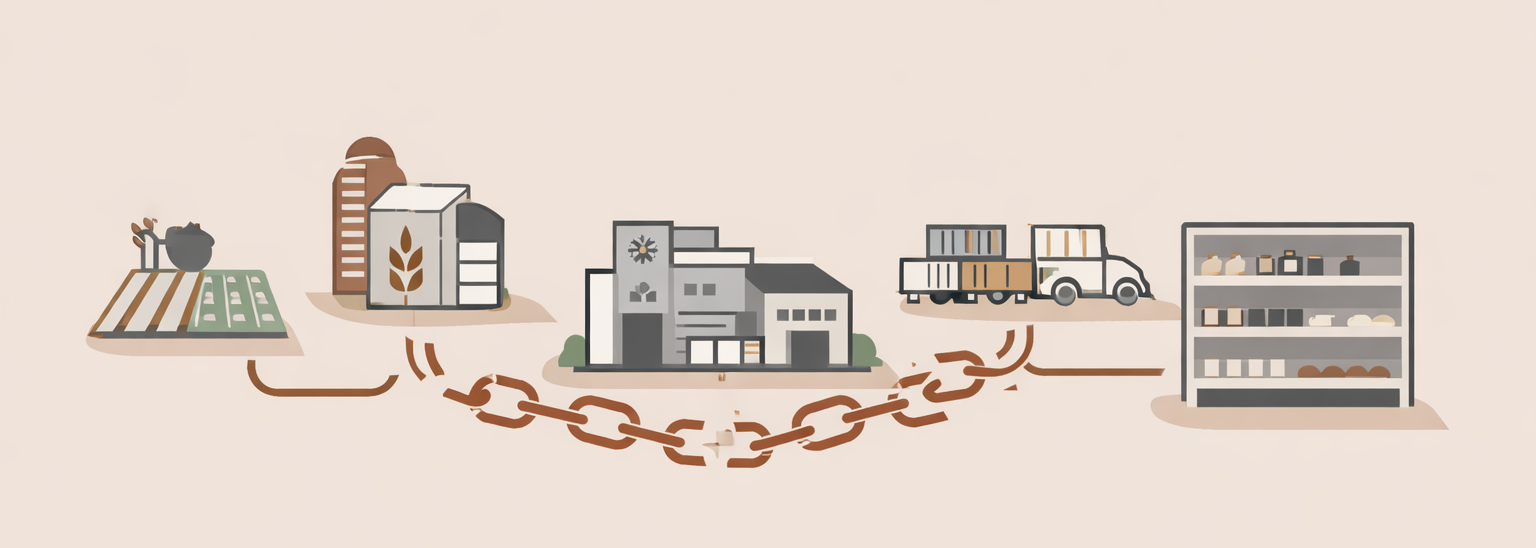
Modern food systems are therefore coordination systems. Farms create supply, but infrastructure turns supply into access. When processing, transportation, refrigeration, labor, inventory, and distribution remain aligned, food moves so quietly that most people never notice the machinery. When one or more of those systems fail, the grocery shelf makes the failure public.
Short Answer
Why food shortages happen depends on where the system loses capacity. Production may fall because of weather, disease, or other agricultural shocks. Yet shortages can also emerge when processors shut down, warehouses back up, refrigerated storage fails, transportation is delayed, workers are unavailable, demand rises unexpectedly, or retailers cannot replenish inventory fast enough.
Why Food Shortages Happen Even When Farms Produce Enough
Production and access are not the same thing. A farm can successfully grow a crop, but that crop still has to survive the rest of the system. Depending on the food, it may need to be washed, sorted, processed, packaged, refrigerated, stored, transported, distributed, stocked, and sold before it reaches a household.
Every additional stage introduces another capacity requirement. Processing plants need labor and energy. Warehouses need space and inventory management. Refrigerated products need temperature control. Transportation networks need equipment, drivers, fuel, scheduling, and usable routes.
Consequently, strong agricultural production does not guarantee that every region will have the right food, in the right place, at the right time. The modern food system must coordinate production and movement.
Food Can Exist and Still Be Unavailable
This is one of the most important distinctions in food security. A product may exist nationally while being temporarily unavailable locally. Inventory may sit hundreds of miles away, remain inside a warehouse, wait for processing, or move through another part of the distribution system.
From the household’s perspective, however, unavailable food is still a real shortage. A family cannot purchase inventory that exists somewhere else in the network but never reaches the stores it can realistically access.
Why Food Shortages Happen for Different Reasons
The phrase “food shortage” can hide several different failures. Treating every empty shelf as the same problem makes the system harder to understand and the response less effective.
Production Shortage
Sometimes the underlying food supply really does decline. Drought, flooding, extreme temperatures, crop disease, animal disease, poor harvests, or other production shocks can reduce the amount available to the market.
Processing Shortage
Raw agricultural supply may exist while processing capacity becomes constrained. Livestock still needs processing. Grain may require milling. Milk moves through dairy plants. Many foods cannot simply move directly from a farm to a supermarket.
Distribution Shortage
Food may be produced and processed but fail to reach a particular market at the necessary speed. Transportation delays, warehouse problems, routing failures, or local delivery constraints can all reduce availability.
Demand Shock
Supply can also become temporarily inadequate because demand rises faster than the replenishment system can respond. A storm warning, emergency, holiday, recall of a competing product, or sudden change in consumer behavior can empty shelves before replacement inventory arrives.
Agricultural Production
↓
Processing and Packaging
↓
Storage and Refrigeration
↓
Transportation
↓
Distribution
↓
Retail Inventory
↓
Household Access
Processing Bottlenecks Can Create Food Shortages
Farming receives much of the attention because it is where food originates. However, the raw commodity often cannot be sold directly in the form consumers expect. Processing turns agricultural production into market-ready food.
When a major processing facility loses capacity, the disruption can move in both directions. Farms may have fewer places to send output, while retailers receive less finished product. The physical food exists, but the system that converts it into something marketable has become constrained.
Processing Capacity Is Not Always Easy to Replace
A processor cannot necessarily redirect large volumes to another plant overnight. Facilities have equipment limits, staffing requirements, regulatory obligations, contracts, transportation schedules, and product-specific capabilities.
Therefore, a bottleneck at one important plant can have consequences well beyond the facility itself. The more concentrated the processing network is, the fewer immediate alternatives may exist.
Storage Helps Explain Why Food Shortages Happen
Food cannot always move directly from production to consumption. Warehouses and storage systems give the network time to match supply with demand. They also allow processors, distributors, and retailers to manage inventory across locations.
Yet storage has limits. Facilities can become full, delayed, understaffed, or poorly synchronized with incoming and outgoing transportation. When that happens, food can remain stuck at one stage while another part of the system runs short.
Perishable Food Has a Clock
Meat, dairy, seafood, frozen goods, and many fruits and vegetables require controlled temperatures. This network of refrigerated storage and transportation is commonly called the cold chain.
Temperature failures or long delays can shorten useful shelf life and create loss before the food reaches consumers. FAO identifies storage, transportation, and handling as important stages where food can be lost between production and retail.
More Production Cannot Always Solve a Storage Problem
If the bottleneck is warehouse capacity, refrigeration, or transportation, producing more food may add pressure instead of solving it. The additional supply still has to move through the constrained part of the system.
That is a fundamental systems lesson. Capacity has to exist at the bottleneck, not merely somewhere else in the chain.
Transportation and Distribution Shape Food Availability
Food moves through trucks, rail networks, ports, ships, distribution centers, and local delivery routes. Each mode solves a different part of the movement problem, and many products use several of them before reaching consumers.
Transportation disruptions can therefore affect availability without changing farm output. Congestion, equipment shortages, severe weather, damaged infrastructure, driver constraints, port disruptions, or scheduling failures can all slow the system.
The Last Miles Matter Too
National supply can look healthy while particular communities still experience difficulty. Food has to make the final trip from a regional distribution network to an individual retailer.
A large supermarket with several suppliers may have more options when one distributor fails. A small or remote retailer may depend on fewer routes and fewer wholesalers. The same disruption can therefore create very different local outcomes.
Transportation Is Part of the Food System, Not an Add-On
USDA’s Agricultural Marketing Service tracks truck, rail, barge, and ocean transportation because moving agricultural goods is inseparable from agricultural markets. Producing food and moving food are different functions, but both are required before production becomes access.
Inventory Decisions Can Make Shortages Appear Faster
Grocery stores do not keep unlimited inventory in the back room. Holding extra stock requires space, refrigeration, working capital, labor, and an acceptance of spoilage risk. Retailers therefore balance the cost of carrying inventory against the risk of running short.
Under normal conditions, frequent replenishment can make that system efficient. Under unusual conditions, however, low inventory buffers can leave less time to absorb disruption.
A Demand Spike Can Empty a Healthy Supply Chain
Imagine a store normally sells 100 units of a product before its next shipment. If consumers suddenly buy 250, the shelf may empty even though farms, factories, and warehouses are still operating normally.
The shortage is real at the retail level, but its cause is different from a crop failure. Replenishment simply cannot move as quickly as the temporary increase in purchasing.
Consumer Behavior Can Reinforce the Shortage
Empty shelves can also change behavior. Shoppers who expect a shortage may buy more than usual when they find the product. That extra purchasing can keep shelves empty longer and make the original disruption appear larger.
This does not mean consumers cause every shortage. It means demand behavior can become another feedback loop once supply is already tight.
Concentrated Systems Can Turn One Failure Into a Larger Shortage
Efficiency often rewards consolidation. Large processing plants, warehouses, and distribution centers can move enormous volumes at lower average cost. That scale can make the system cheaper and more productive under normal conditions.
Yet concentration can create another trade-off. If too much capacity depends on one facility, supplier, warehouse, transportation corridor, or geographic region, a problem at that node can affect a much larger share of the market.
Efficiency and Resilience Are Not the Same Goal
An efficient system minimizes unnecessary cost and duplication. A resilient system also preserves alternatives when something fails. Those goals overlap, but they are not identical.
Backup suppliers, additional storage, alternate routes, regional processing, and excess capacity can look inefficient when everything works perfectly. Their value becomes visible when the primary system stops working.
Why Food Shortages Happen Unevenly Across Communities
A national supply problem does not create the same consequence everywhere. Communities differ in transportation access, retailer competition, warehouse proximity, household income, vehicle access, local storage, and the number of suppliers serving the area.
Those differences matter when the system tightens. A household with several grocery stores nearby may find a substitute quickly. Someone dependent on one retailer, one bus route, or one local market has fewer options when inventory disappears.
Availability and Affordability Interact
A shortage can also raise costs. Retailers may have to use alternate suppliers, smaller deliveries, longer routes, or more expensive transportation. Even when a substitute exists, it may cost more than the item households normally buy.
Food security therefore involves both physical access and economic access. Food has to exist, reach the community, and remain affordable enough for households to use it.
What Makes a Food System More Resilient
Resilience does not mean preventing every disruption. Weather will change, equipment will fail, demand will move, transportation will be interrupted, and production shocks will still occur. The question is whether the system has enough alternatives and capacity to recover before a disruption becomes a prolonged household problem.
Supplier Diversity
Multiple suppliers reduce dependence on one source. When one producer or processor loses capacity, another may be able to increase output or serve a different route.
Transportation Alternatives
Redundant routes and transportation modes create options when one corridor becomes constrained. The more ways food can move, the less one disruption can control the entire outcome.
Storage and Inventory Buffers
Appropriate reserves can give the system time to respond. Too little inventory makes disruption visible quickly, while excessive inventory can increase cost and waste. Resilience requires balancing both risks.
Processing Capacity
Agricultural abundance has limited value if too little capacity exists to convert that production into food consumers can use. Processing is therefore part of food security infrastructure.
Local and Regional Capacity
Regional suppliers, processors, food hubs, and distribution networks cannot replace national systems in every category. Still, they can provide another layer of flexibility when larger networks strain.
Recognition Skill: Diagnose Why a Food Shortage Is Happening
When shelves begin to empty, do not immediately assume the country has run out of food. First identify where the constraint appears to be. A production shortage requires a different response from a warehouse problem, demand spike, processing outage, or transportation delay.
This is the practical value of understanding why food shortages happen. Once the mechanism is visible, headlines become easier to evaluate and short-term disruption becomes easier to distinguish from a deeper supply problem.
Six questions to carry forward
- Did agricultural production actually decline?
- Is processing capacity constrained?
- Are transportation or warehouse delays preventing replenishment?
- Did demand rise unusually quickly?
- Is the shortage national, regional, or limited to particular retailers?
- Which part of the system has the fewest alternatives?
Receipts
These sources document the role of transportation, storage, distribution, and supply-chain capacity in moving food from production to consumers.
Transportation and Agricultural Markets
- USDA Agricultural Marketing Service — Transportation Research and Analysis — tracks truck, rail, barge, and ocean transportation used to move agricultural products from farms toward markets.
Real-World Distribution Disruption
- USDA — Food Distribution Supply Chain Disruptions — documents warehouse and delivery delays that reduced inventory availability for federal nutrition-program locations.
Food Loss Across the Supply Chain
- FAO — The Losses Along the Way — explains how transportation, handling, packaging, temperature, and infrastructure can contribute to food loss before retail.
- FAO — The State of Food and Agriculture: Food Loss and Waste — examines losses during storage, transportation, processing, retail, and other stages of the food system.
The Groundwork
Why food shortages happen cannot be answered by looking at farms alone. Food security is the result of a chain: production, processing, storage, transportation, distribution, retail, and household access. A failure at any major stage can change what people find when they walk into a store.
That is why an empty shelf should be read as a signal rather than a complete explanation. The food may genuinely be scarce. It may also be sitting in the wrong place, waiting on processing, delayed in transportation, trapped behind a storage problem, or disappearing faster than the replenishment system can replace it.
Strong systems do more than produce enough under ideal conditions. They preserve enough capacity, alternatives, and coordination to keep food moving when conditions stop being ideal.
The System: Updated.
What looked like the problem: The grocery store ran out of food.
What the system reveals: an empty shelf can begin with production, processing, storage, transportation, distribution, inventory, or demand. The updated model is food supply → system capacity → movement and replenishment → local availability → household access.
Put the Principle to Work
Structure Builds Freedom
Households cannot repair national logistics networks, but they can reduce some exposure to short disruptions. Maintain practical substitutes for essential foods, avoid depending on only one retailer where alternatives exist, keep a reasonable household buffer for frequently used staples, and distinguish preparation from panic buying.
Join the Groundwork List
Get systems analysis, institutional literacy, and practical frameworks built to remain useful after the headline moves on.
Continue Building
Continue through the food-system cluster based on the mechanism you want to understand next.
Price Transmission —
Why Grocery Prices Rise: The Logistics Most People Never See
Follow how fuel, processing, storage, transportation, and retail costs move toward
the household.
Upstream Inputs —
The Fertilizer Factor: Why Agriculture Depends on Energy
See how energy and fertilizer pressures can reach food production before the
supply chain even begins moving the harvest.
Product Response —
Food Quality Decline Under Cost Pressure
Examine how cost and supply pressure can influence sourcing, formulation, package
size, and product design.
Household Structure —
Discipline Before Dollars
Build stronger household resource systems around disruptions you cannot completely
control.
Meet the Builder

Langston Reed
Builder, Civic Power & Policy
Langston Reed helps readers understand how institutions, governance, public policy, markets, and infrastructure shape everyday life. His work develops institutional literacy by translating complex systems into practical frameworks that remain useful after the immediate news cycle has moved on.
Continue through System Updates, Building Institutional Literacy, or The Sovereign Ledger.