

Signal Check · Updated September 2026
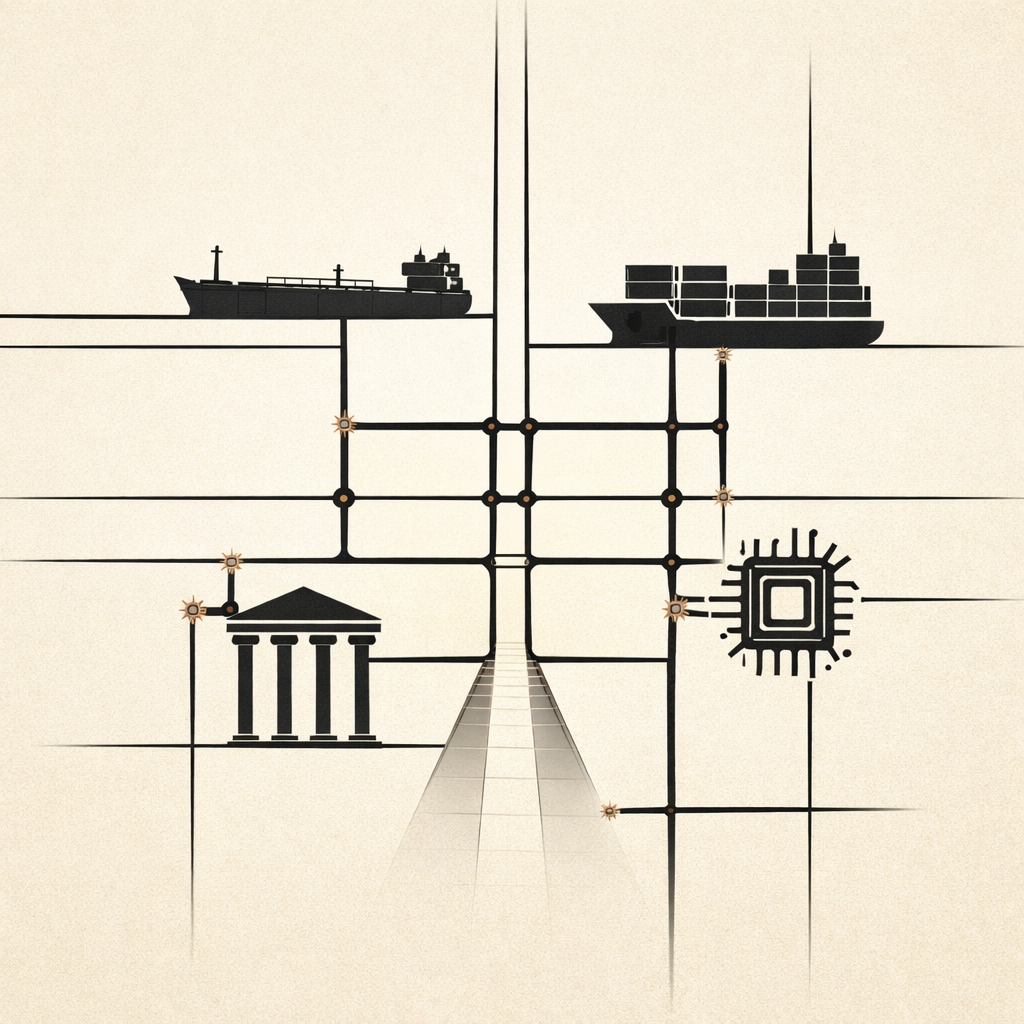
Energy shocks, trade friction, restrictive financing, artificial intelligence, and cybersecurity are still moving through the same global system. The important change is not simply that pressure exists. It is that maintaining reliable systems increasingly requires more redundancy, security, capital, and institutional capacity.
Global economic trends 2026 are sending a more complicated signal than either collapse or recovery. The world economy is still trading. Companies are still investing. Artificial-intelligence infrastructure is expanding. Financial systems are functioning. Supply chains continue to move enormous quantities of goods across borders.
Yet keeping those systems reliable is becoming harder.
Energy disruptions can move into transportation costs and inflation. Trade policy can alter sourcing decisions even when overall trade volumes remain resilient. Interest rates change the price of carrying inventory, financing infrastructure, buying homes, expanding businesses, and building redundancy. Artificial intelligence can improve productivity while creating new questions about identity, permissions, data access, auditing, and security.
These are not separate stories. They are different pressures moving through connected infrastructure.
The September Read
The signal is not that the global system is collapsing. The signal is that resilience is becoming more expensive.
Reliable systems increasingly need alternate suppliers, spare capacity, stronger digital controls, financing flexibility, inventory buffers, secure energy access, and institutions capable of adapting when the first plan stops working.
What Changed Since the First 2026 Signal Check
The original version of this analysis focused heavily on tightening conditions. That diagnosis needs refinement.
Global trade has proved more resilient than a simple disruption narrative would suggest. In September, the World Trade Organization’s Goods Trade Barometer stood at 102.0. A reading above 100 indicates above-trend merchandise trade. Electronic components were particularly strong, reflecting demand associated with investment in artificial intelligence.
That matters because disruption and resilience can exist at the same time.
A supply chain may keep functioning because companies change suppliers, carry more inventory, use alternate transportation, accept higher insurance or compliance costs, or build redundancy. The successful delivery of the product does not mean the underlying system became cheaper or simpler.
The better question is therefore not only whether the system is still operating.
What is the system having to spend, duplicate, secure, reroute, or protect in order to keep operating?
Shock → Adaptation → Added Cost → Preserved Function
Energy Risk Still Travels Far Beyond the Energy Market
Energy remains one of the clearest transmission systems in the global economy. Oil and gas do not remain inside an energy-market box. They move into transportation, electricity, manufacturing, chemicals, fertilizer, food production, household bills, inflation expectations, and monetary policy.
The Middle East conflict has made that connection especially visible in 2026. The Bank of England has explicitly identified disruption to energy transportation and supply as a source of higher fuel and utility costs. The European Central Bank has also tied continuing inflation pressure to the conflict.
This does not mean every increase in consumer prices can be traced directly to energy. Businesses can absorb costs, inventories can soften short-term shocks, contracts can delay price changes, and demand can weaken.
But energy remains an upstream variable. When it becomes more volatile, other systems must decide how much of that volatility they can absorb.
Groundwork Daily’s analysis of why agriculture depends on energy shows the same mechanism at a narrower scale: energy conditions can enter fertilizer production before eventually reaching farms and food systems.
Trade Is Resilient. Trade Is Also Becoming More Strategic.
The strongest correction to the earlier version of this article belongs here.
Global trade has not simply retreated under geopolitical pressure. WTO data released in September show merchandise trade above its recent trend and continuing to gain momentum. Around 72 percent of global merchandise trade also continues to move under the WTO’s core most-favoured-nation tariff terms.
That is a significant stabilizing fact.
At the same time, the structure surrounding trade is changing. Governments are paying greater attention to strategic dependence, critical minerals, semiconductor capacity, national security, export controls, industrial policy, and supply-chain concentration.
Companies therefore face two realities at once.
They still benefit from a highly integrated global trading system. Yet they increasingly have to ask whether a low-cost supplier, transportation route, technology platform, mineral source, or manufacturing concentration creates unacceptable exposure.
The result is not deglobalization in any simple sense. It is a more selective form of interdependence.
Groundwork Daily examines that deeper strategic layer in Technology Supply Chains in Geopolitics, where semiconductors, minerals, infrastructure, manufacturing equipment, and trade restrictions become questions of national capacity rather than ordinary procurement.
Interest Rates Are Now Part of the Resilience Equation
A resilient system needs options. Options usually require capital.
A company may want a second supplier, additional inventory, a new factory, stronger cybersecurity, backup power, more warehouse capacity, or a different transportation network. A household may want emergency savings, manageable debt, or enough financial margin to absorb a higher utility bill.
All of those choices become harder when financing is expensive.
Monetary conditions also differ across economies. On September 10, the European Central Bank raised its three key policy rates by 25 basis points as it responded to inflation pressure. In the United Kingdom, Bank Rate remained 3.75 percent ahead of the Bank of England’s September 17 meeting. In the United States, the effective federal funds rate stood at 3.63 percent on September 14.
Those figures are not interchangeable policy measures. They do, however, illustrate the wider point: the era of assuming cheap capital will automatically finance every adaptation is over.
When resilience requires investment, the price of money becomes part of the price of resilience.
AI Is Moving From Assistance Into Authority
Artificial intelligence is another reason the 2026 system looks different from the one that entered the year.
The important transition is not simply that people are using more generative AI. The institutional question is what happens when software agents receive permission to act.
An AI system that summarizes a document creates one kind of risk. An agent that can access internal data, use tools, interact with applications, make purchases, manage calendars, change software, or initiate workflows creates another.
The National Institute of Standards and Technology has increasingly focused on this distinction. Its 2026 work on software-agent identity and authorization emphasizes identification, permissions, auditing, non-repudiation, and controls against attacks such as prompt injection.
That changes the enterprise AI question.
The question is no longer only, What can the model produce?
It is also, What is this system allowed to do, which resources can it reach, and how will the institution know what happened afterward?
Cybersecurity Becomes More Important as Systems Become More Autonomous
Automation can reduce friction. It can also increase the number of pathways through which a mistake, compromised credential, malicious instruction, or poorly designed permission can travel.
NIST’s 2026 analysis of public responses on AI-agent security found broad agreement that agents introduce novel security threats and that established cybersecurity practices will need adaptation.
This does not mean autonomous systems are inherently unsafe. It means capability and control have to mature together.
Identity becomes infrastructure. Authorization becomes infrastructure. Audit trails become infrastructure. Human escalation paths become infrastructure.
The more work software can perform independently, the more important it becomes to define where that independence stops.
The 2026 Signal Board
Signal Check works best when it separates observed movement from interpretation. The table below does not assign arbitrary risk scores. It identifies what is moving, how the pressure travels, and what would change the read.
| System | Current Signal | Transmission Path | What Could Change the Read |
|---|---|---|---|
| Energy | Geopolitical disruption continues to create price and inflation pressure. | Fuel → transport → production → household and business costs. | Durable stabilization of supply, transportation, and energy prices. |
| Trade | Goods trade remains resilient even as geopolitical and policy uncertainty persists. | Tariffs, compliance, sourcing, strategic concentration, logistics. | A sustained fall in trade volumes or a durable reduction in policy friction. |
| Finance | Borrowing conditions remain restrictive and policy paths differ across economies. | Credit → investment → housing → inventories → expansion. | Persistent disinflation that allows materially easier financing conditions. |
| AI | Agents are moving from content generation toward tool use and autonomous action. | Automation → permissions → data access → operational authority. | Slower deployment, stronger standardization, or clearer institutional controls. |
| Security | Agentic systems create new identity, authorization, and auditing requirements. | Access → action → attack surface → institutional exposure. | Mature identity and security standards becoming routine deployment infrastructure. |
What Did Not Change
Good signal analysis also identifies what the evidence does not show.
The global trading system has not stopped functioning. Current WTO indicators do not support a broad claim that world merchandise trade is collapsing. Artificial intelligence has not eliminated the need for institutional controls. Higher energy costs do not automatically produce the same inflation outcome in every country. And one central bank’s rate decision does not describe global monetary policy as a whole.
Those distinctions matter because spectacle encourages binary thinking.
A system is either declared strong or broken. Globalization is either alive or dead. AI is either revolutionary or useless. Interest rates are either high or low.
Real systems rarely move that cleanly.
They absorb pressure. They redirect flows. They create workarounds. They transfer costs. They preserve some functions while weakening others.
Discernment means separating those movements instead of forcing them into a single dramatic conclusion.
Five Signals to Watch Next
The next phase of the story will be easier to understand if readers watch mechanisms rather than headlines.
What This Means Outside the Headlines
Most people cannot control energy markets, central-bank policy, global trade rules, or the pace of artificial-intelligence deployment.
They can still understand the transmission paths.
For households, the practical lesson is to recognize that energy, credit, employment, cybersecurity, and consumer prices can be connected even when they arrive as separate bills or decisions.
For businesses, the lesson is to map concentration. Which supplier, lender, technology platform, credential, transportation route, data system, or employee carries more operational importance than the organization realizes?
For institutions, the lesson is broader. Efficiency cannot be the only design objective. A system optimized entirely for the cheapest normal day may perform poorly when the normal day disappears.
That is where Structure Builds Freedom becomes practical rather than philosophical. Options exist because someone built the structure that makes another route possible.
The Groundwork
Stability Has a Cost
The most important global economic trend of 2026 may not be a single price, tariff, interest rate, conflict, or technology.
It may be the rising cost of keeping complex systems dependable.
A company survives a supply disruption because it has another supplier. A country absorbs an energy shock because it has alternative sources, reserves, infrastructure, or fiscal capacity. A digital system survives compromise because access was segmented and recovery was planned. An institution deploys AI safely because permissions, identity, auditing, and accountability were built before autonomy expanded.
None of that redundancy looks maximally efficient on an ordinary day.
Under pressure, it becomes the reason the system still works.
A system can look stable because somebody is paying for the structure that keeps it stable. In 2026, that bill is becoming easier to see.
Continue Building
Follow the Systems Behind the Signal
Follow semiconductors, critical minerals, infrastructure, export controls, and strategic dependence into the architecture of national power.
See how an upstream energy dependency can travel through fertilizer, farming, food production, and consumer systems.
Separate meaningful institutional and structural movement from noise, spectacle, and temporary attention.
Groundwork Architecture
The Principle and Condition Beneath This Signal Check
Structure Builds Freedom
Useful structure creates options before pressure arrives. Redundancy, clear authority, alternate pathways, reserves, and recovery systems make adaptation possible when the first route fails.
Discernment
Discernment gives evidence, context, constraints, and consequences the weight they deserve. It separates structural movement from dramatic interpretation without pretending uncertainty has disappeared.
Meet the Builder

Langston Reed
Builder · Civic Power & Policy
Langston Reed helps readers understand how institutions, governance, public policy, and civic systems shape everyday outcomes. His work looks beneath visible events to examine the structures that made them possible, the incentives moving through them, and the institutional patterns that remain after public attention shifts.
“Headlines describe movement. Systems explain movement.”
Reader Promise: Move past the visible event and understand the system underneath it.
Evidence Ledger
Receipts
Reports a 102.0 barometer reading, indicating above-trend merchandise trade, with particularly strong electronic-component demand associated with AI investment.
Provides current context on trade resilience, geopolitical fragmentation, strategic interdependence, global value chains, and the continuing role of WTO trade rules.
Documents the ECB’s 25-basis-point increase in its three key interest rates and its assessment of continuing inflation pressure associated with the Middle East conflict.
Provides the current Bank Rate and inflation reading and identifies September 17, 2026 as the next scheduled monetary-policy decision.
Provides current U.S. market interest-rate data, including the effective federal funds rate.
Establishes identity, authorization, auditing, non-repudiation, and access controls as important governance questions for AI agents.
Summarizes stakeholder findings that AI agents create novel security challenges and that existing cybersecurity practices require adaptation for agentic systems.
External links were live and accessible when this article was published or last substantively updated. Third-party pages may change, move, or be removed over time.