
Street trees are often treated as decoration. That is the first mistake.
A mature street tree is not simply a nice thing beside the curb. It is public infrastructure. It cools pavement, shades sidewalks, slows heat, absorbs stormwater, improves walkability, and helps neighborhoods feel cared for.
As part of Urban Logic, this article studies street trees as one of the systems people use every day but rarely examine. They stand quietly along sidewalks, parks, bus stops, storefronts, schools, and civic buildings. Yet their work shapes public health, local commerce, transportation, comfort, and neighborhood trust.
When a city loses tree cover, the cost does not stay inside the landscape budget. Instead, it moves into energy bills, heat stress, stormwater systems, public health, street maintenance, and quality of life.
That is the point.
Street trees are not extras. They are living infrastructure.
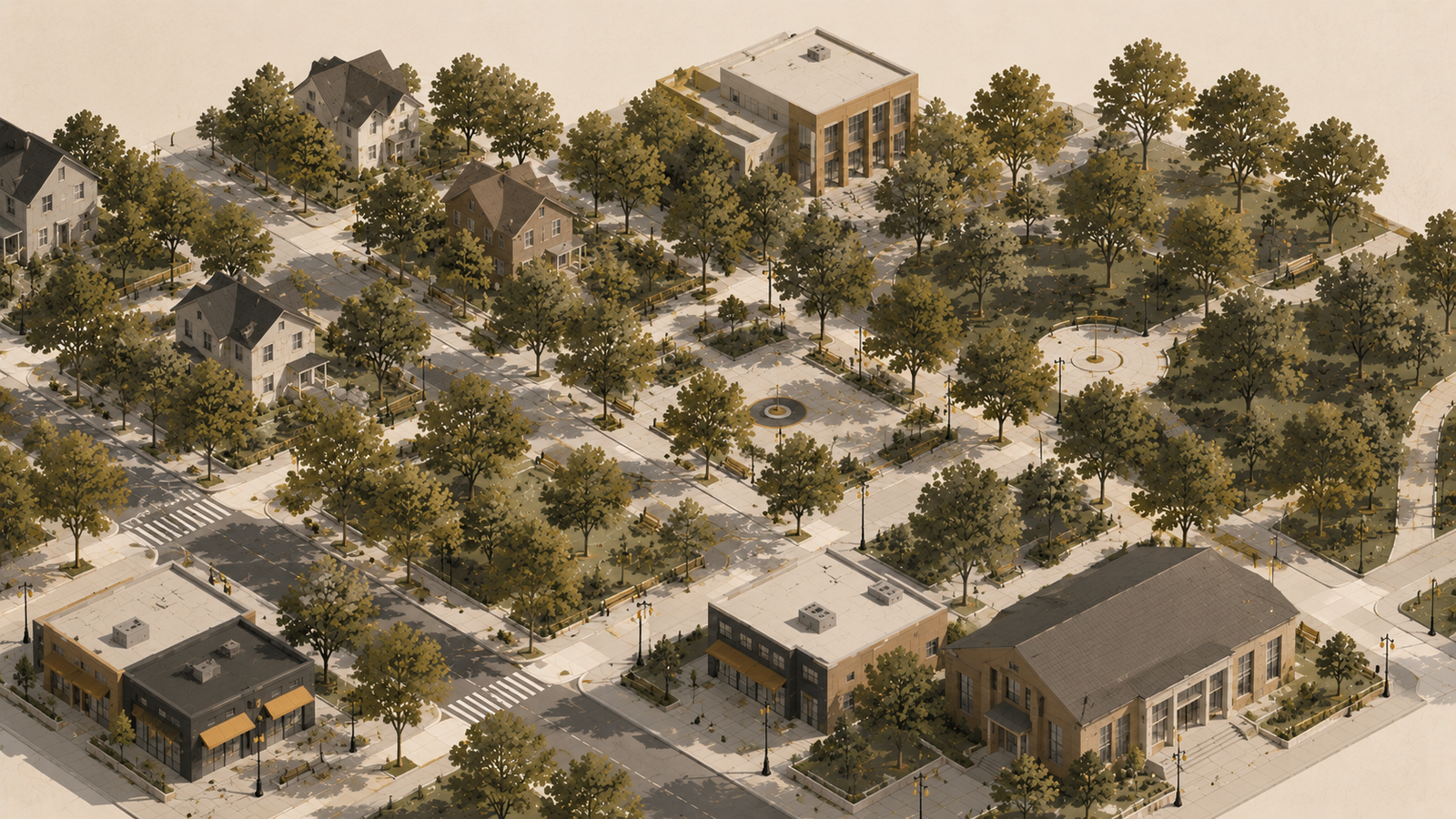
Street Trees Work Every Day
Street trees work without announcement.
They do not hold press conferences. They do not ask residents to notice them. Still, they perform every hour. They shade sidewalks in the morning. They lower surface heat in the afternoon. They soften wind. They collect rainfall. They filter air. They make streets feel less exposed.
Because the work is quiet, it is easy to undervalue.
That is how weak planning begins. A city looks at a tree and sees maintenance. It sees pruning, leaves, roots, irrigation, liability, and cleanup. Then the city forgets to count the benefits.
Shade has value. Stormwater absorption has value. Lower heat has value. Public comfort has value. Longer pedestrian activity has value.
In other words, the tree is doing work the budget often fails to name.
This is why the language matters. If street trees are called landscaping, they become vulnerable during cuts. If they are understood as public infrastructure, the conversation changes. Maintenance becomes stewardship. Planting becomes investment. Protection becomes risk management.
A city that understands infrastructure should understand trees.
Walk one block with trees and one block without trees. Notice the temperature, noise, shade, speed, and comfort. The difference is not mood. It is infrastructure.
The Urban Tree Canopy Cools Cities
The urban tree canopy is one of the most practical defenses against heat.
Cities hold heat because pavement, rooftops, brick, concrete, and asphalt absorb sunlight and release warmth slowly. As a result, dense neighborhoods can remain hotter than surrounding areas, even after the sun starts to fall.
Street trees interrupt that pattern.
Shade lowers the heat absorbed by sidewalks, roads, walls, benches, bus stops, storefronts, and plazas. Leaves also cool the surrounding air through evapotranspiration. That word sounds technical, but the effect is simple. Trees release moisture and help reduce heat around them.
For pedestrians, this is not abstract.
A shaded block feels different from an exposed block. People walk farther when the route is comfortable. They wait longer at transit stops when they are not standing under direct sun. They are also more likely to use parks, sidewalks, plazas, and outdoor seating when shade exists.
Heat changes behavior. Therefore, shade changes behavior too.
The mistake is treating heat only as weather. In cities, heat is also design. A block with no canopy is not just hot by chance. It is hot because shade was not protected, planted, or maintained.
That is why sidewalks and street trees belong in the same conversation. A sidewalk can be connected and still fail if it becomes unbearable during heat. Concrete alone does not create walkability. Comfort does.
Street trees make heat visible as a planning issue.
Street Trees Improve Walkability
Walkability is not only about sidewalks.
A sidewalk can be wide, connected, and technically usable while still being unpleasant. If the route is exposed, noisy, hot, and visually harsh, people may avoid it. They may drive short distances. They may rush through public space instead of using it.
Street trees improve that experience.
They create a softer edge between pedestrians and traffic. They make sidewalks feel more protected. They frame the route. They give walkers rhythm, shade, and visual relief. As a result, the street becomes easier to occupy.
This matters because walkable communities depend on comfort as much as connection. People do not only ask whether they can walk. They ask whether the walk feels reasonable.
That question becomes even sharper for children, older adults, disabled residents, delivery workers, transit riders, and anyone carrying bags or pushing a stroller. Shade and comfort are not cosmetic for them. They shape whether the route is usable.
Strong pedestrian infrastructure needs more than concrete. It needs trees, lighting, safe crossings, benches, clear sightlines, and reliable maintenance. Each part supports the others.
For example, crosswalks help organize movement at intersections. Street lighting extends public space after sunset. Public benches give people places to rest. Street trees help connect those systems by making the route more comfortable during the day.
Together, they turn a path into a place.
Street Trees Support Local Business
Street trees help local businesses by making streets worth staying on.
That may sound simple, but it matters. A commercial corridor is not only a collection of storefronts. It is an environment. People decide whether to browse, linger, cross the street, sit outside, or return later based partly on how the street feels.
Shade supports that feeling.
A tree-lined block is easier to walk. Outdoor tables become more usable. Window shopping becomes more natural. People slow down enough to notice signs, entrances, and displays. Small purchases become more likely because the route invites attention.
By contrast, a harsh corridor pushes people through quickly. Heat, glare, wide roads, limited shade, and poor pedestrian comfort turn local commerce into a chore. The businesses may be present, but the street does not help them.
That is bad design.
Economic development often focuses on grants, rents, branding, and business attraction. Those things matter. However, the street outside the storefront also matters. If the sidewalk is uncomfortable, the district loses part of its economic engine.
Street trees are not a substitute for business support. Still, they are part of the operating environment that allows local business to perform.
This is why third places often depend on the street around them. A coffee shop, library, barbershop, plaza, or community center becomes stronger when the route to it feels shaded, visible, and humane.
Commerce lives at ground level. Trees improve the ground.
Trees Protect Infrastructure
Street trees protect public infrastructure by reducing stress on other systems.
They shade pavement, which can reduce heat exposure and slow surface wear. They intercept rainfall before it reaches storm drains. They help manage runoff. They reduce the amount of heat radiating from hard surfaces. They also improve the experience of using sidewalks, transit stops, plazas, and parks.
That means trees are not separate from infrastructure. They interact with it.
Of course, poor tree management can create problems. Roots can damage sidewalks. Branches can interfere with wires. Invasive species can become costly. Bad planting locations can create conflicts. Therefore, tree infrastructure requires planning, species selection, soil space, maintenance, and long-term care.
That is not an argument against trees. It is an argument for better governance.
Weak systems plant trees without giving them room to mature. Strong systems design for the full life of the tree. They consider roots, canopy spread, water access, pruning cycles, utility conflicts, and sidewalk repair. They understand that living infrastructure needs stewardship.
The goal is not to drop trees into leftover spaces. The goal is to build streets where trees can perform safely and consistently.
Infrastructure fails when maintenance is ignored. Trees are no different.
Public Health Begins Under Shade
Public health does not begin only in clinics.
It begins on the block. It begins at the bus stop. It begins on the walk to school. It begins in the park, the plaza, the shopping corridor, and the sidewalk outside a home.
Street trees affect public health because they shape exposure.
They reduce heat stress. They encourage walking. They improve outdoor comfort. They support time outside. They can help soften the psychological load of hard urban environments. They also make public space more usable during hot months.
That matters because not every resident has equal access to private cooling, private outdoor space, or flexible schedules. Some people must walk. Some must wait outside. Some work outdoors. Some live in neighborhoods where shade is scarce and heat is heavy.
When shade is uneven, comfort becomes unequal.
This is where the urban tree canopy becomes a justice issue without needing slogans. The question is practical. Which neighborhoods have shade? Which blocks are exposed? Which residents face higher heat because trees were never planted or were not maintained?
A city that studies those questions can make better decisions.
That also matters for transit. As discussed in Bus Stops Are Public Infrastructure, waiting is part of the transportation experience. A bus stop without shade asks riders to absorb heat as part of the cost of access.
Public health is not only treatment.
It is prevention built into place.
Street Trees Increase Neighborhood Value
Street trees increase value in more than one way.
Yes, they can support property value and commercial appeal. However, that is not the whole story. They also increase the value of daily life.
A shaded street feels more settled. A tree-lined block often signals care. A park connected by shaded sidewalks feels more reachable. A library or civic building framed by mature trees feels more welcoming. These details shape how residents experience their own neighborhood.
That experience matters.
People build attachment through repeated contact with place. They remember certain blocks. They know which route feels calm. They notice when a tree is cut down. They know where shade gathers in the afternoon. Over time, the canopy becomes part of neighborhood memory.
This is not sentimentality. It is civic identity.
Places become meaningful through consistent features that people share. Street trees help create that continuity. They make streets recognizable. They mark seasons. They offer shade to strangers who may never speak but still share the same public environment.
Value is not only resale price. It is also belonging, comfort, memory, and trust.
A strong city protects those forms of value too.
The Cost of Removing Trees
Removing a street tree may look like a small decision.
Sometimes removal is necessary. A tree may be diseased, unstable, invasive, badly placed, or dangerous. Serious maintenance requires judgment. However, careless removal creates a larger cost than many cities admit.
One mature tree can take decades to replace.
A young replacement may be necessary, but it does not immediately provide the same canopy, shade, cooling, stormwater benefits, habitat, or visual presence. The neighborhood loses performance in the meantime.
That gap matters.
When trees are removed without a serious replacement strategy, heat rises. Shade disappears. The sidewalk becomes harsher. Public space feels thinner. Businesses lose comfort at the curb. Residents lose part of the block’s identity.
Loss compounds.
This is why tree removal should be treated as infrastructure loss, not simple cleanup. The decision should ask what service the tree was providing, what risk required removal, and how the city will replace the lost performance.
A serious infrastructure culture does not remove assets casually.
It repairs when possible. It replaces when necessary. It plans for continuity.
Unequal Canopy Creates Unequal Cities
Tree canopy is rarely distributed evenly.
Some neighborhoods have mature shade, generous planting strips, and well-maintained parks. Other neighborhoods have wide asphalt, exposed bus stops, few trees, and limited maintenance. The difference can be felt immediately on a hot day.
That difference is not just visual. It shapes daily life.
Residents in low-canopy areas may face more heat exposure, less comfortable walking conditions, higher cooling burdens, and weaker public space use. Children may have harsher routes to school. Older adults may leave home less often during heat. Small businesses may operate on streets that do not invite people to linger.
Therefore, tree planting cannot be only beautification. It must be infrastructure planning.
A city should know where canopy is missing. It should know where heat is most intense. It should know where pedestrian routes need shade most urgently. It should also know which communities have been waiting the longest for basic environmental infrastructure.
Good planning does not spread resources evenly without thought. It directs them where performance gaps are largest.
That is how public infrastructure should work.
Street Trees Need Long-Term Stewardship
Planting a tree is only the beginning.
A city that plants trees but does not maintain them is performing care without completing it. Young trees need watering. Mature trees need pruning. Soil needs room. Roots need protection. Species must be selected for local conditions. Sidewalk conflicts must be managed early.
Otherwise, the system fails.
This is where public infrastructure thinking becomes useful. Nobody expects a bridge to maintain itself. Nobody expects a road to last forever without repair. Nobody expects a transit system to function without scheduled service and upkeep.
Street trees deserve the same seriousness.
They are living assets. Because they are living assets, their performance changes over time. A young tree may start small, then become more valuable as it matures. That makes patience part of the investment.
Short political cycles struggle with this. A tree planted today may deliver its greatest value years later. Still, cities that understand continuity invest anyway.
That is the discipline.
Planting is the promise. Maintenance is the proof.
Read Your City
Choose a hot day and compare two routes. Which one has shade? Which one has benches? Which one connects to transit, stores, or public space? The better route is not accidental. It is the result of public choices.
Street trees become easier to understand once you read them as infrastructure.
Do not only ask whether a street looks pretty. Ask what the trees are doing. Are they shading the sidewalk? Are they protecting a bus stop? Are they making a business corridor more walkable? Are they helping people remain outside longer? Are they supporting a route to school, a park, or a library?
Then ask where trees are missing.
Which blocks feel exposed? Which sidewalks feel abandoned? Which bus stops leave riders under direct sun? Which storefronts sit behind heat and glare? Which neighborhoods must absorb summer conditions with little public shade?
These questions reveal the deeper system.
Street trees are not only about nature. They are about access, maintenance, care, and public value.
The Groundwork Principle
Street trees are public infrastructure because they perform essential work in public space.
They cool neighborhoods. They support walkability. They protect sidewalks and public areas. They help manage stormwater. They strengthen local business corridors. They improve public health. They make streets more human.
Most importantly, they remind us that infrastructure is not always steel, concrete, wires, rails, and pipes. Sometimes infrastructure has roots.
Urban Logic asks readers to look again at what the city has trained them to overlook. Street trees are easy to miss because they do not announce themselves as systems. Yet their absence is immediate. The block feels hotter. The walk feels longer. The public space feels harsher.
That is how infrastructure often works. When it functions, it disappears into daily life. When it fails, everyone feels the cost.
A city that removes shade removes capacity. A city that plants and maintains street trees builds comfort, resilience, and public value at the same time.
The lesson is clear.
Street trees are not decoration. They are the living architecture of public infrastructure.
Keep Seeing the Systems Around You
Most people move through cities without noticing the systems shaping their choices. Urban Logic helps you read the built environment differently, from street trees and sidewalks to bus stops, public benches, lighting, parking, and third places.
Subscribe to the Groundwork Daily newsletter for weekly essays that reveal the hidden systems behind modern life and help you navigate them with greater clarity, capability, and intention.
→ Urban Logic: Understanding the Hidden Systems That Shape Cities
→ Sidewalks Are Economic Infrastructure
→ Bus Stops Are Public Infrastructure
→ Street Lighting Is Public Infrastructure
→ Public Benches Matter More Than You Think
→ Why Third Places Matter More Than Ever
Receipts:
→ U.S. Forest Service Urban & Community Forestry
→ EPA Heat Island Resources
→ Arbor Day Foundation
→ American Planning Association