
Crosswalks are usually treated as paint. That is the weak reading.
A crosswalk is not just a marking on the street. It is a civic signal. It tells people where they are allowed to move, where drivers are expected to yield, and whether a city has designed public space for human life or vehicle speed alone.
As part of Urban Logic, this article studies crosswalks as one of the everyday systems people use without always noticing. Crosswalks sit at the exact point where design, safety, law, habit, and public trust meet.
Every crossing asks the same question.
Who gets priority here?
That question is answered in paint, timing, curb ramps, lighting, traffic speed, signal length, visibility, enforcement, maintenance, and wayfinding. A strong crosswalk says that people on foot belong in the city. A weak one says they are tolerated only after traffic has been served.
That difference matters. Crosswalks shape pedestrian safety, school routes, transit access, public health, neighborhood confidence, and local commerce. They also decide whether sidewalks, parks, libraries, stores, bus stops, and third places actually connect.
Without safe crossings, a walkable community is only half-built.
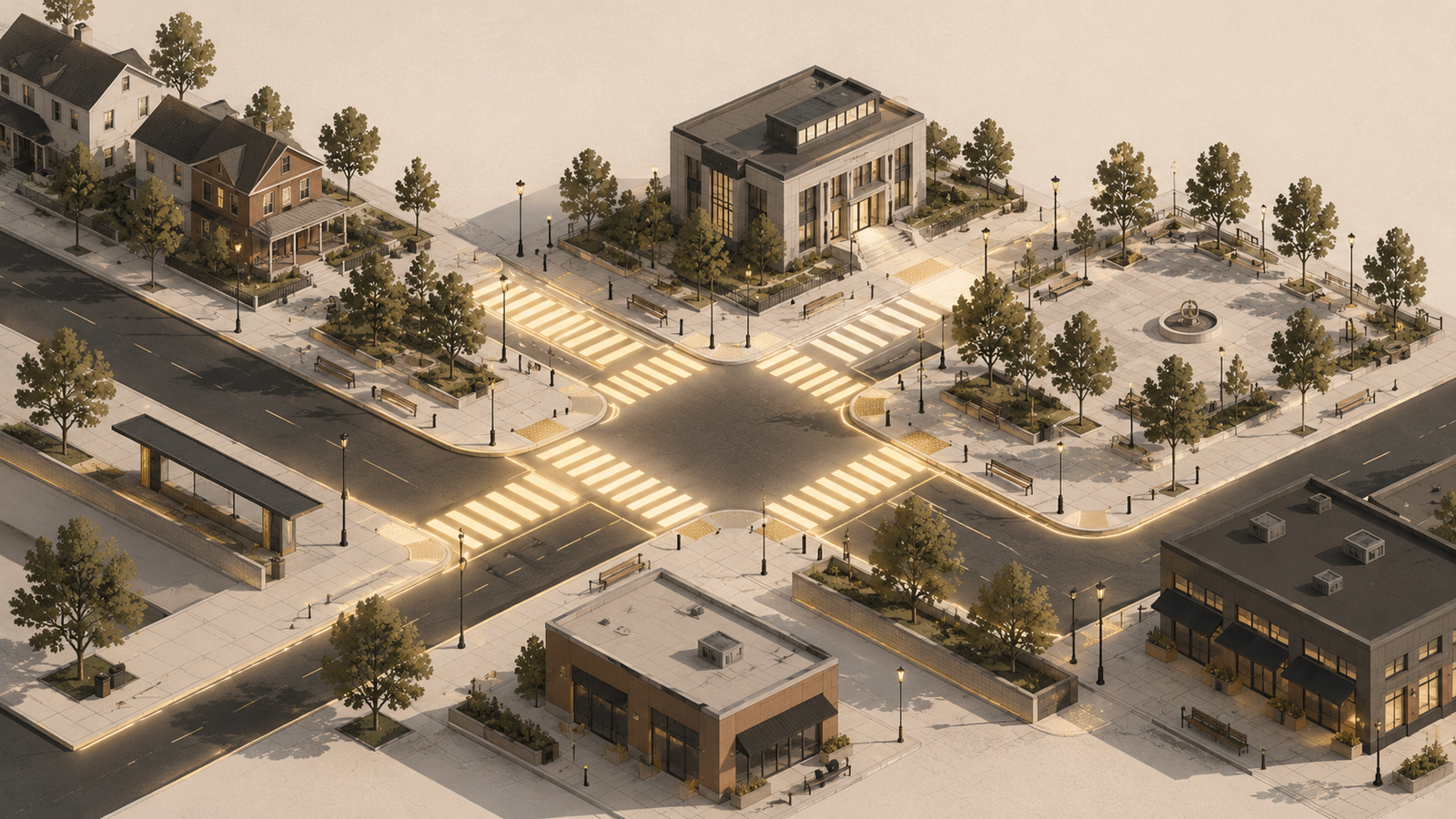
Crosswalks Are More Than Paint
A crosswalk begins with paint, but it cannot end there.
Paint alone does not slow a speeding driver. It does not protect a child. It does not help a person with low vision know when it is safe to cross. It does not give an older adult enough time to reach the other side.
Good crosswalks are systems. They include visibility, timing, curb design, pavement markings, lighting, signage, traffic behavior, and street geometry. When those pieces work together, the crossing becomes clear. When they do not, pedestrians inherit the risk.
This is where many cities fail. They install markings and call the job complete. Then they act surprised when people still feel unsafe. That is not serious infrastructure thinking. It is compliance dressed as design.
A true crosswalk changes how the street behaves. It interrupts speed. It clarifies expectations. It organizes movement. It makes the pedestrian visible before conflict begins.
Clear navigation also matters. As explored in Wayfinding Is Public Infrastructure, people need to understand where they are, where they can go next, and how the public system expects them to move. A crosswalk that is hard to find, poorly marked, or disconnected from the route is not doing enough civic work.
That is why crosswalks are civic infrastructure. They are not decorative lines. They are public agreements made visible.
Stand at a familiar corner. Notice whether the crossing tells people what to do clearly. Then notice whether drivers behave as if people on foot belong there. The gap between those two answers is the real condition of the street.
Pedestrian Safety Is Designed
Pedestrian safety is not created by telling people to be careful.
That advice is too thin. It puts the burden on the most vulnerable person in the street. The pedestrian is slower than the car. The child is smaller than the truck. The older adult needs more time than the signal may allow. The wheelchair user cannot improvise around a missing curb ramp without risk.
So the question should not be, “Why did the pedestrian cross there?”
The sharper question is, “Why did the street make the safe choice difficult?”
People rarely cross dangerously because they enjoy danger. They cross where the bus stop is. They cross where the store is. They cross where the school is. They cross where the sidewalk continues. In other words, they cross where daily life requires movement.
If the nearest safe crossing is too far away, people will create a desire line. If the signal is too short, people will hurry. If the intersection is confusing, people will guess. If drivers do not yield, people will wait too long or take a risk.
Design creates behavior. Then behavior gets blamed.
A serious city does not treat pedestrian safety as a lecture. It treats safety as an operating condition. It studies where people actually walk. It shortens crossings where possible. It improves visibility. It slows turning vehicles. It gives people enough time. It makes the lawful path the practical path.
That is how safety becomes structural.
Crosswalks Organize Movement
A crosswalk organizes a negotiation that could otherwise become chaos.
At every intersection, multiple forces meet. Cars turn. Buses stop. Bikes pass. People walk. Delivery workers unload. Children move in groups. Parents push strollers. Older adults pause. Someone checks the signal. Someone rushes toward transit.
Without clear design, the intersection becomes a contest.
Crosswalks reduce that contest. They tell people where to cross. They tell drivers where to expect pedestrians. They establish a visible zone of responsibility. Most importantly, they make movement legible.
Legibility matters in dense environments. Cities are full of competing motion. When the street is easy to read, people make better decisions. When the street is unclear, everyone improvises.
Improvisation at walking speed is inconvenient. Improvisation at vehicle speed can be deadly.
This is why a crosswalk is not a minor detail. It is a control point. It shapes who waits, who yields, who moves first, and who feels protected.
In that sense, crosswalks communicate belonging. They tell pedestrians whether they are part of the design or merely an obstacle inside it.
A city that values public life cannot leave that message vague.
Crosswalks Connect Every Other System
Crosswalks are small, but they connect large systems.
A sidewalk network depends on crossings. A transit system depends on crossings. A school route depends on crossings. Parks, libraries, clinics, grocery stores, public squares, and local businesses all depend on the ability to cross streets safely.
That is the hidden leverage.
A neighborhood may have strong sidewalks, but if major intersections are hostile, the walking system breaks. A city may invest in transit, but if the stop is difficult to reach, riders pay the price. A commercial corridor may have good businesses, but if crossings are dangerous, foot traffic suffers.
Crosswalks are the joints of the pedestrian city.
When those joints work, movement feels natural. People walk to the library. They cross to the park. They reach the bus stop. They enter the store. They walk children to school. They connect one side of the neighborhood to the other.
When those joints fail, distance expands. A store across the street feels far away. A park on the next block feels less accessible. A bus stop becomes a risk point. The neighborhood may be close on a map but divided in real life.
That is why bus stops, crosswalks, and sidewalks belong in the same transportation conversation. Transit does not begin when the vehicle arrives. It begins with whether people can safely reach the stop.
Wayfinding belongs in this same chain. A rider needs to know where to cross, where the stop sits, which side of the street serves the correct direction, and how to continue after exiting. If the crossing is not legible, the whole trip becomes harder than the map admits.
Urban Logic pays attention to this because maps lie when they ignore friction.
Accessible Crosswalks Matter
Accessible crosswalks are not special features. They are basic infrastructure.
A crossing that works only for fast, able-bodied adults is not a good crossing. It is a narrow design pretending to serve the public.
Real accessibility requires curb ramps, detectable warning surfaces, audible or tactile signals where appropriate, enough crossing time, smooth surfaces, clear sightlines, and protection from turning vehicles. It also requires maintenance. A curb ramp blocked by snow, trash, construction, or parked vehicles is not accessible in practice.
Accessibility widens participation.
Wheelchair users need curb ramps. People with low vision need clear cues. Older adults may need longer signals. Parents with strollers need smooth transitions. Children need crossings that drivers can see and understand. People carrying bags, using canes, recovering from injury, or moving slowly all benefit from better design.
This is the practical truth. When cities design for people with the least margin, the street works better for everyone.
Wayfinding is also part of accessibility. Clear signs, signals, route cues, and visible crossings help people understand the public realm without unnecessary guesswork. A crossing that is technically accessible but difficult to locate still creates friction.
Weak crosswalks create hidden costs. They add stress. They add time. They add dependence. They make simple trips harder. They tell some residents that public space was not built with them in mind.
That message is unacceptable.
Civic infrastructure should not require heroic effort from the people it claims to serve.
Streets Reveal Civic Priorities
Every street reveals a value system.
Look at the crossing. How wide is the road? How fast are vehicles moving? How long is the pedestrian signal? Are the markings visible? Are curb ramps aligned? Is there lighting? Are drivers expected to slow down, or are pedestrians expected to hurry?
The answers tell the truth.
Cities often speak warmly about safety, access, community, and public life. However, the street shows whether those values made it into the design. A dangerous intersection does not care about a mission statement. It only reflects the priorities that were built.
This is where leadership becomes concrete.
A city can choose shorter crossing distances. It can install raised crosswalks. It can add curb extensions. It can improve signal timing. It can daylight intersections by keeping parked cars away from corners. It can lower speeds. It can improve lighting. It can maintain paint so crossings remain visible.
It can also improve wayfinding so people can understand the safest route before conflict begins.
Or it can delay.
Delay is also a decision.
When dangerous intersections remain unchanged, residents learn something. They learn that the system can see the risk and still tolerate it. Over time, that weakens trust.
Public trust is not only built in hearings, speeches, or plans. It is built at the corner where a person tries to cross safely.
Designing Streets for Humans
Designing for pedestrians does not mean pretending cars do not matter.
That is a lazy argument. Cars matter. Deliveries matter. Emergency access matters. Transit vehicles matter. Workers, families, businesses, and services all depend on movement through the city.
But people matter first.
Every driver becomes a pedestrian at some point. Every transit rider starts and ends on foot. Every business needs people to reach the door. Every neighborhood depends on public movement beyond vehicles.
So the issue is not cars versus people. The issue is whether the street understands that cars are tools while people are the purpose.
A human-centered street does not remove all friction. It manages friction intelligently. It slows vehicles where people cross. It makes pedestrian zones obvious. It reduces conflict between turning vehicles and walkers. It gives children and older adults more protection. It designs for attention, not fantasy.
Because attention is limited.
Drivers get distracted. Pedestrians get tired. Children misjudge speed. People rush. Weather changes visibility. Signals fail. Paint fades. Therefore, design must account for real human behavior, not ideal behavior.
That is what serious infrastructure does. It assumes people will be human and builds safeguards accordingly.
Crosswalks Shape Neighborhood Confidence
Confidence is an underrated part of urban life.
People move differently when they trust the environment. They walk farther. They allow children more independence. They visit local businesses more often. They use parks and libraries with less hesitation. They rely on transit with more confidence.
Crosswalks help create that confidence.
A well-marked crossing with clear sightlines and reasonable signal timing tells residents that movement has been considered. It reduces the feeling that every intersection is a personal gamble.
That matters for everyone. Still, it matters most for people with less margin.
A parent walking with children cannot treat every crossing as an experiment. An older adult cannot sprint through a short signal. A person using a mobility device cannot step around a bad curb. A transit rider cannot miss the bus because the crossing is hostile.
When crosswalks fail, the neighborhood shrinks.
People may still live there, but they use less of it. They avoid certain corners. They skip certain trips. They drive when they could walk. As a result, they become less visible to one another.
That is not only a mobility issue. It is a community issue.
This is also why third places need safe crossings. A library, park, café, barbershop, public square, or community center becomes weaker when people cannot reach it comfortably.
Bad Crossings Create Hidden Costs
Bad crossings are expensive, even when the budget does not show it clearly.
The costs appear in injuries, near misses, stress, delayed transit trips, weaker foot traffic, reduced independence, and lower use of public space. They appear when parents decide a child cannot walk to school. They appear when older adults avoid crossing a major street. They appear when a business loses casual customers because the corridor feels hostile.
These costs scatter across households, agencies, health systems, and local economies.
That makes them easy to ignore.
A city may delay a crossing improvement because the project has a visible price. But the existing danger also has a price. It is just distributed across people who did not design the street.
This is the same failure pattern that shows up across weak infrastructure. Neglect looks cheaper until the cost moves somewhere else.
Crosswalks make that tradeoff visible. Pay for better design now, or force residents to pay through risk, delay, and reduced mobility later.
That is not a neutral choice.
Street Design Works as a System
No crosswalk works alone.
Crossings need sidewalks that lead to them. They need lighting so people remain visible after dark. They need trees and shade so walking remains usable in heat. They need curb space that does not block sightlines. They need bus stops, benches, schools, libraries, and stores arranged so people can reach them without constant danger.
In other words, crosswalks are part of a larger civic network.
As discussed in Street Lighting Is Public Infrastructure, lighting extends the useful life of public space after sunset. Meanwhile, street trees make walking more comfortable during the day. Each system strengthens the others when planning is coherent.
Wayfinding strengthens that network by helping people understand where the safe crossing is, where the route continues, and how public destinations connect. A city can build a crossing, but if people cannot read it, find it, or trust it, the crossing underperforms.
By contrast, isolated improvements can leave people exposed. A painted crossing without lighting may fail at night. A sidewalk without a safe crossing may stop at the curb. A bus stop without a nearby crossing may force riders into risk.
That is why Urban Logic treats the city as an operating system.
The crossing is small. The system around it is not.
Read Your City
Choose one intersection you use often. Watch one full signal cycle. Count who gets time, who has to hurry, who seems protected, and who seems exposed. The timer will tell you what the street values.
The quality of a crosswalk should be judged from the ground.
Not from a planning diagram. Not from a traffic model alone. Not from a driver’s windshield at speed. Judge it from the position of a person standing at the curb, trying to decide whether the street will protect them.
Can they see clearly?
Can drivers see them?
Is the crossing marked?
Is the signal long enough?
Is the curb ramp usable?
Is the route obvious?
Can someone unfamiliar with the area understand where to cross?
Does the design reduce conflict, or does it push conflict onto the pedestrian?
Those are not soft questions. They are operational questions.
The ground-level test exposes whether the crossing works for real people. It also exposes whether the city has confused technical compliance with actual usability.
A crosswalk that looks acceptable on paper but feels dangerous in practice is not a success. It is a warning sign.
The Groundwork Principle
Crosswalks are civic infrastructure because they turn public values into street-level behavior.
They show whether a city values pedestrian safety. They show whether accessibility is real. They show whether public space connects or fragments. They show whether the built environment expects people to move with dignity or hurry through danger.
Most people pass crosswalks without thinking about them. That is understandable. Strong infrastructure often disappears into routine. But when crosswalks fail, the cost becomes immediate. The walk becomes tense. The route becomes unclear. The corner becomes a risk.
Urban Logic asks readers to look again at ordinary systems. Crosswalks are not ordinary because they are minor. They are ordinary because they are everywhere.
That makes them powerful.
A city can reveal its civic priorities at the scale of a major project. It can also reveal them at the scale of a painted line, a curb ramp, a signal timer, a wayfinding sign, and a corner where someone waits to cross.
The lesson is simple.
Infrastructure communicates values.
Crosswalks communicate whether a city believes people deserve safe passage.
Keep Seeing the Systems Around You
Most people move through cities without noticing the systems shaping their choices. Urban Logic helps you read the built environment differently, from crosswalks and sidewalks to bus stops, public space, street trees, lighting, wayfinding, and neighborhood design.
Subscribe to the Groundwork Daily newsletter for weekly essays that reveal the hidden systems behind modern life and help you navigate them with greater clarity, capability, and intention.
→ Urban Logic: Understanding the Hidden Systems That Shape Cities
→ Wayfinding Is Public Infrastructure
→ Sidewalks Are Economic Infrastructure
→ Bus Stops Are Public Infrastructure
→ Street Lighting Is Public Infrastructure
→ Street Trees Are Public Infrastructure
→ Why Third Places Matter More Than Ever
Receipts:
→ Federal Highway Administration Pedestrian and Bicyclist Safety
→ National Association of City Transportation Officials
→ Vision Zero Network
→ National Complete Streets Coalition