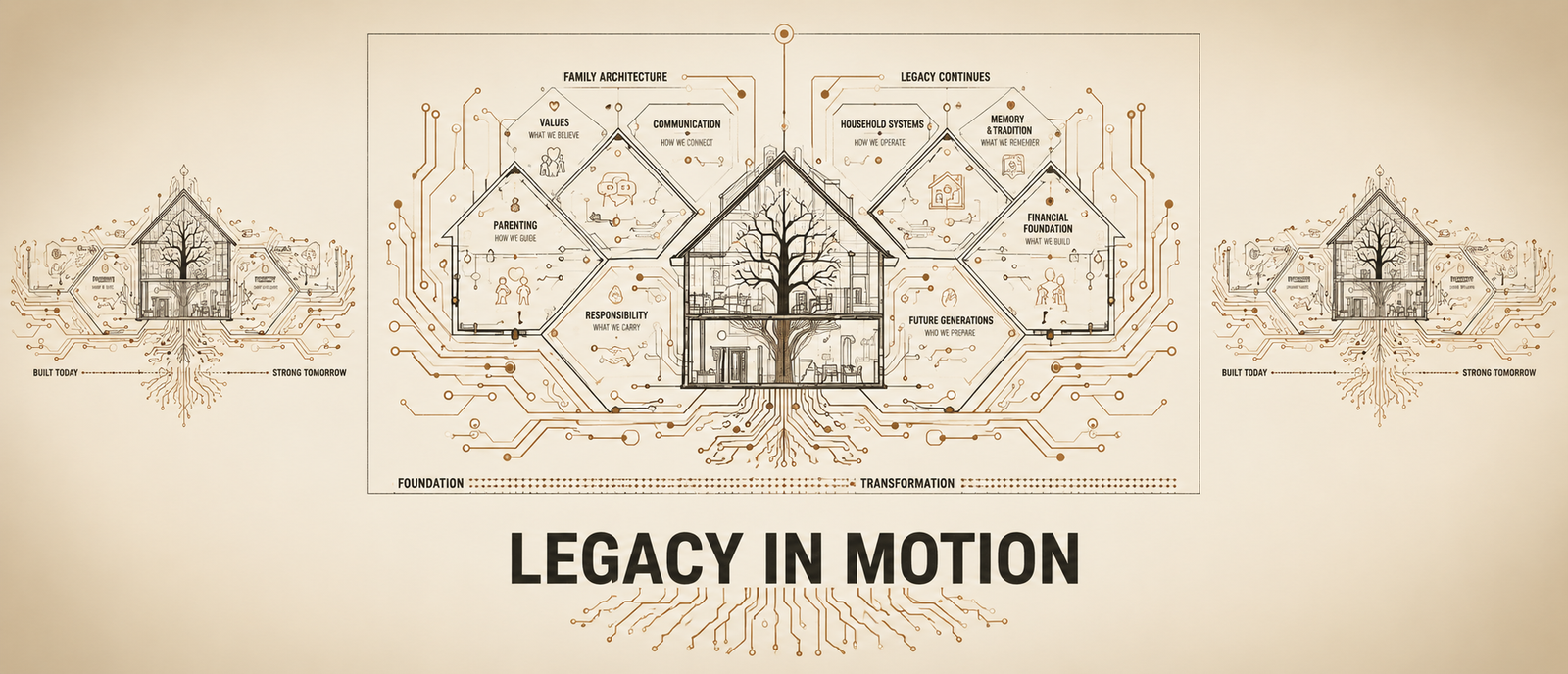
Series: Legacy in Motion | Family Architecture
Relationship maintenance is the work people postpone precisely because the relationship still appears to be working. The bills get paid. The household moves. Conversations still happen. Responsibilities are handled. From the outside, nothing looks broken.
That is what makes the maintenance gap dangerous.
Most relationships do not move from healthy to broken in one dramatic event. More often, small changes accumulate without inspection. Attention gets thinner. Responsibilities shift. Intimacy becomes less intentional. Financial pressure changes the household. Two people who once talked about where they were going become consumed with getting through the week.
Nothing necessarily fails at first.
The structure simply begins carrying conditions it was never designed to carry indefinitely.
Love has maintenance costs. Ignoring them does not eliminate the bill. It converts maintenance into repair.
What Is the Relationship Maintenance Gap?
The relationship maintenance gap is the distance between what a relationship currently requires to remain healthy and what the people inside it are consistently doing to maintain it.
That gap can remain small for years. However, life rarely stays still.
A new job changes time. A child changes responsibility. A parent needs care. Income rises or falls. Health changes. Sex changes. Ambition changes. Household labor changes. The people inside the relationship change.
Yet many couples continue operating from agreements that belonged to an earlier version of their lives.
That is the problem.
A structure can be sound and still require adjustment when the load changes.
Why Good Relationships Drift
Bad relationships are not the only relationships that deteriorate. Functional relationships can drift because functionality creates its own blind spot.
When something keeps working, people inspect it less.
The reliable partner keeps handling things. The household routine keeps moving. Conflict stays manageable. Money remains sufficient. Affection has not disappeared. Therefore, nobody feels urgency.
But absence of crisis is not proof of alignment.
Familiarity can quietly turn attention into assumption. What once received deliberate care begins running on habit.
That is how relationship maintenance gets deferred.
Maintenance Is Different From Crisis Management
Many couples become highly attentive once something hurts badly enough.
They finally discuss money after debt creates pressure. They examine responsibility after resentment forms. They talk about intimacy after distance becomes obvious. They reconsider communication after arguments become repetitive.
That is repair.
Repair matters. Every durable relationship will need it.
However, relationship maintenance asks a better question: what can we notice while the problem is still small?
There is a meaningful difference between tightening a connection and rebuilding the joint after it fails.
The same principle applies to partnership.
The Maintenance Principle
Strong relationships are not relationships without wear. They are relationships where changing conditions are noticed early enough for two people to adjust before strain becomes identity.
The Five Systems That Need Maintenance
Relationship maintenance becomes easier when couples stop treating the relationship as one giant emotional category. A household is made of interconnected systems. Each system can strengthen, drift, or become overloaded independently.
Five deserve regular attention.
1. Connection
Connection is not simply being in the same room.
Two people can share a home, calendar, bed, children, and responsibilities while gradually losing meaningful access to each other.
Ask whether attention still moves between you. Are you curious about each other’s thinking? Do conversations extend beyond logistics? Does either person feel known only by function?
Connection rarely disappears overnight. Usually, it gets crowded out.
2. Responsibility and Load
Every household develops a division of labor. The problem is that temporary arrangements have a habit of becoming permanent.
Someone handles a task during a busy month. Then that person keeps handling it. One partner becomes better at solving a particular problem, so every version of that problem eventually lands there.
Reliability becomes expectation.
Expectation becomes invisible load.
That is why responsibility must be reviewed rather than assumed. As explored in When Responsibility Becomes Resentment, capable people often accumulate responsibility precisely because they keep proving they can carry it.
3. Money and Household Systems
Money changes relationships even when couples avoid talking about it.
Income changes. Expenses change. Goals change. Risk tolerance changes. What felt fair at one salary may not feel fair after a promotion, layoff, mortgage, caregiving responsibility, or new child.
Financial maintenance means reviewing the system before money becomes an argument about character.
Who pays is only one question. Couples also need to understand who plans, who tracks, who absorbs uncertainty, what they are building toward, and whether both people understand the household’s financial position.
4. Intimacy and Emotional Access
Intimacy needs maintenance because familiarity does not automatically create closeness.
Affection can become routine. Desire can change. Emotional availability can narrow under pressure. Neither person has to be doing anything wrong for distance to develop.
The mistake is assuming that because intimacy was once strong, it will maintain itself.
It will not.
Attention, affection, honesty, privacy, desire, and emotional access all respond to conditions. When the conditions change, the conversation must change with them.
5. Shared Direction
A relationship can function efficiently while two people slowly begin building toward different futures.
That is a serious maintenance problem because direction determines which sacrifices still make sense.
Where are we going?
What are we trying to own?
What kind of household are we building?
What are we willing to sacrifice for?
What no longer fits?
Those questions should not be reserved for engagement, marriage, retirement, or crisis. Shared direction needs inspection because people grow, and growth changes priorities.
The Most Dangerous Sentence Is “We’re Fine”
There is nothing wrong with being fine.
The problem is using “fine” as the end of inspection.
A relationship does not have to feel terrible before something deserves attention. In fact, waiting for pain to become unmistakable is one of the most expensive ways to manage any important system.
Think about what happens when a small concern gets dismissed repeatedly.
A missed conversation becomes a pattern. A temporary imbalance becomes the normal division of labor. Reduced affection becomes the new baseline. A financial disagreement becomes something neither person wants to raise.
Eventually, the couple is no longer discussing one problem. They are confronting accumulated deferred maintenance.
Relationship Maintenance Requires a Rhythm
Good intentions are weak infrastructure.
If something matters repeatedly, give it a rhythm.
This does not mean turning a relationship into a board meeting. It means refusing to rely entirely on memory, mood, or crisis to determine when important conversations happen.
Weekly: Check the Operations
Keep this simple.
What does the coming week require? Where is pressure building? Who needs help? What has changed?
A ten-minute conversation can prevent one person from silently absorbing a new responsibility for the next six months.
Monthly: Check the Relationship
Move beyond logistics.
Ask what has felt good, what has felt distant, what each person needs more of, and whether anything small has begun creating friction.
The goal is not to manufacture problems. The goal is to make honesty inexpensive.
Quarterly: Check the Structure
Look at responsibility, money, schedules, intimacy, family obligations, and household systems together.
What started as temporary?
What no longer feels balanced?
Where has one person become the default?
What needs redistribution?
This is where the principles in Fairness vs Equality in Relationships become practical. Fairness is not a permanent assignment. It must respond to changing capacity and conditions.
Annually: Check the Direction
Once a year, zoom out.
Talk about money, work, home, family, health, intimacy, ownership, travel, caregiving, retirement, children, and whatever else defines the life you are actually building.
Do not assume last year’s priorities remain this year’s priorities.
Alignment should be confirmed, not presumed.
Some Changes Should Trigger an Immediate Review
Calendar rhythms help, but some changes are too significant to wait for the next scheduled conversation.
A new job, job loss, major promotion, birth, death, illness, move, financial shock, caregiving responsibility, or major change in work hours can alter the relationship’s load almost immediately.
When the conditions change, review the structure.
Do not force an old agreement to carry a new reality.
Maintenance Is Not Scorekeeping
This distinction matters.
Relationship maintenance is not an invitation to audit every contribution or turn affection into a performance metric.
The objective is not perfect equality.
The objective is visibility.
Both people should understand what the relationship requires, what each person is carrying, where conditions have changed, and whether the current arrangement still feels legitimate.
That is why reciprocity in relationships matters. Healthy reciprocity does not demand identical contribution. It requires mutual responsiveness.
Maintenance Protects Voluntary Commitment
There is another reason maintenance matters.
People are more likely to keep investing in structures that respond when conditions change.
A relationship becomes fragile when one person believes nothing can be renegotiated without a fight. It becomes fragile when concerns must become crises before they are taken seriously. It becomes fragile when history is used as an excuse to stop adapting.
Durable commitment works differently.
Two people keep choosing the relationship while continuing to improve the conditions under which that choice is made.
That is not weakness.
That is stewardship.
The Relationship Maintenance Audit
You do not need a crisis to ask better questions.
- Connection: Are we still meaningfully connected, or mostly coordinating?
- Responsibility: Has anything temporary quietly become one person’s permanent job?
- Money: Does our current financial structure still reflect our actual circumstances?
- Intimacy: Are affection, desire, and emotional access receiving deliberate attention?
- Direction: Are we still building toward a future both people recognize?
- Repair: Is there anything small we keep postponing because it does not hurt enough yet?
The last question may be the most important.
Deferred maintenance is attractive because postponement feels free.
It is not.
Maintain What You Want to Keep
Relationships are living structures. They carry changing loads through changing seasons.
Therefore, durability cannot mean keeping everything exactly as it was.
Durability requires inspection. Adjustment. Reinforcement. Redistribution. Repair.
Sometimes the strongest thing two people can say is not “nothing is wrong.”
It is:
Nothing is broken. But something has changed, and we should tend to it now.
That is the discipline of relationship maintenance.
A strong relationship is not one that never needs repair. It is one that notices enough early that repair does not have to become reconstruction.
Further Groundwork
When Responsibility Becomes Resentment
How reliability can quietly become expectation, invisible load, and resentment.
Fairness vs Equality in Relationships
Why durable partnerships require proportional responsibility rather than rigid 50/50 accounting.
Reciprocity Is the Missing Relationship Skill
Why mutual responsiveness matters more than identical contribution.
Appreciating Interdependence
How two capable people can preserve individual strength while building shared stability.