

The cultural value of food can shape its price before a customer takes the first bite.
A waffle costs what?
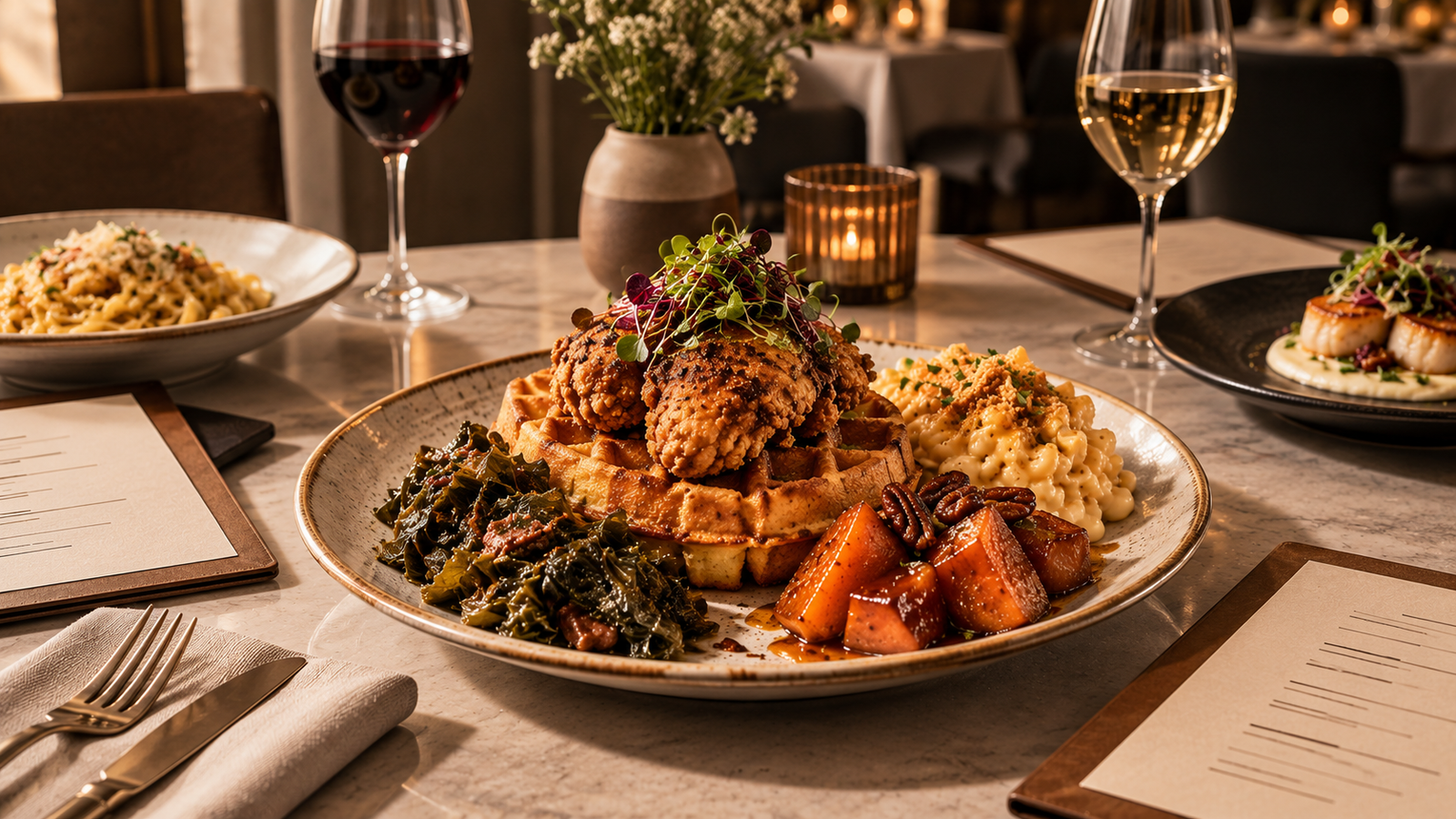
That was the reaction when rapper DaBaby opened No Knife Chicken & Waffles in Charlotte, North Carolina. One menu item quickly became the center of attention: a $45 Soulfood Cornbread Waffle.
Forty-five dollars. For a waffle.
The number did most of the work. Once those two pieces of information appeared beside each other, much of the internet seemed ready to render a verdict.
Yet something is hidden inside that reaction.
Before tasting a meal, examining its ingredients, considering the labor required to prepare it, or deciding whether the restaurant has delivered an experience worthy of its price, a customer arrives carrying an internal price list.
People already have ideas about what a taco should cost, what pasta should cost and what fried chicken should cost. Similar expectations exist for sushi, barbecue and a French entrée.
Apparently, we also have an idea about what a waffle should cost.
Years of repetition make those expectations feel natural. They are not necessarily natural. We learn them.
The Cultural Value of Food Comes Before the Price
A restaurant menu contains numbers, but customers rarely encounter those numbers without context.
Instead, cuisine, neighborhood, décor, reputation, service, presentation, language, scarcity, memory and prestige surround the number. Somewhere inside all of that sits an assumption about what kind of food deserves what kind of price.
What Happens When Only the Cuisine Changes?
A revealing experiment published in Appetite in 2025 tested precisely this problem. Researchers conducted four preregistered randomized experiments involving 1,083 participants. They compared how people valued analogous dishes associated with French or Thai cuisine.
Across the first three studies, participants estimated that dishes labeled French would cost an average of $4.47 more than dishes labeled Thai.
In the fourth experiment, participants said they would pay an average of $3.83 more for the French-labeled dish.
Production costs had not suddenly increased. Instead, researchers changed the cuisine label, and participants changed the price they associated with the food.
Those findings do not prove that every expensive French restaurant is culturally overvalued. Nor do they establish that every Thai restaurant is undervalued or that cultural hierarchy explains every price difference between cuisines.
The experiment demonstrates something more useful: cuisine itself can function as a pricing signal.
Once that mechanism becomes visible, the $45 waffle becomes more interesting.
Every Cuisine Has a Price Ceiling Until Someone Breaks It
American consumers have learned to understand some cuisines across enormous price ranges.
For example, Italian food can mean a slice of pizza eaten standing at a counter or a tasting menu served on white linen. Japanese food can mean an inexpensive takeout roll or an omakase experience costing hundreds of dollars.
French cuisine, meanwhile, enters the American imagination carrying associations with technique, culinary training, refinement and fine dining.
Not Every Cuisine Inherits the Same Range
Other cuisines have historically occupied a more complicated economic position.
Chinese food became deeply embedded in American life, yet much of the industry developed around expectations of accessibility, speed, volume and low prices.
Mexican food has faced a similar tension. Consumers may enthusiastically consume the cuisine while resisting prices that would appear ordinary in restaurants carrying different cultural associations.
Black American food has its own version of the problem.
Those qualities can make a cuisine culturally beloved while also making premium pricing feel like a violation of what customers believe the food is supposed to be.
Customers may expect fried chicken to be plentiful and macaroni and cheese to be generous. Collard greens should arrive in abundance, while cornbread should not cost much.
Above all, the meal should feel like somebody’s grandmother could have made it.
Hidden inside that last compliment, however, can be an economic trap.
When people code food as home cooking, comfort food or community food, a restaurant may face resistance when it tries to convert that cultural value into premium economic value.
As a result, customers can treasure the culture while questioning the price.
Authenticity Changes the Cultural Value of Food
There is another contradiction worth examining. Consumers often say they want authenticity, but authenticity can carry an expectation of affordability.
A small neighborhood restaurant may earn praise precisely because it appears untouched by corporate polish. Customers can read the plastic tablecloth, handwritten menu, crowded dining room or enormous portion as evidence that the experience is somehow more real.
Then something peculiar can happen.
If the owner improves the room, reduces the portion, refines the presentation and raises the price, some customers may accuse the restaurant of abandoning what made it authentic.
Consequently, customers can ask the business to preserve the cultural experience while also remaining inside the economic conditions associated with that experience.
That dynamic does not always amount to exploitation. Customers have legitimate concerns about price, accessibility and commercialization. Nevertheless, the tension is real.
Authenticity Does Not Operate Equally Across Cuisines
Research on how ethnic cuisines enter the American mainstream reinforces the importance of these cultural signals.
Researchers examined 761,444 Yelp reviews of Mexican, Italian, Chinese and American restaurants across the United States. Reviewers invoked ethnicity and authenticity more frequently when discussing Mexican restaurants than Italian and American restaurants, but less frequently than when discussing Chinese restaurants.
The researchers interpreted the pattern as evidence that cuisines reach different degrees of cultural mainstreaming.
That distinction matters because familiarity and pricing power are not the same thing.
Then Comes the $45 Waffle
This is where DaBaby’s restaurant becomes useful again.
No Knife Chicken & Waffles opened in Charlotte in 2026. Reporting around the restaurant showed a $15 plain waffle, $25 specialty waffles and the now-famous $45 Soulfood Cornbread Waffle.
Published menu reporting described the $45 offering as topped with collard greens, candied yams and macaroni and cheese, with chicken available separately.
DaBaby later offered a different description while publicly defending the price. He emphasized homemade cornbread, collard greens with turkey leg meat, macaroni and cheese, sweet potato soufflé with pecans and four pieces of fried chicken.
His argument was straightforward: preparing the dish required substantially more work than preparing a conventional waffle.
Those descriptions do not line up perfectly. That matters. Cultural undervaluation cannot become an all-purpose defense against ordinary consumer scrutiny.
A Higher Price Creates a Higher Standard
A restaurant seeking premium pricing still has to deliver premium value. Food quality, service, consistency, wait time, environment and execution all matter.
Moreover, the restaurant must clearly explain what the customer is purchasing.
A cultural argument cannot turn a mediocre $45 plate into an excellent one. Likewise, expensive French, Italian or Japanese restaurants do not prove that every soul food restaurant can justify equivalent prices.
Making that leap would replace one lazy pricing assumption with another.
The stronger standard demands more.
Cultural Value of Food Is Not the Same as Price
This is also where the argument circulating around the controversy can go too far.
We cannot simply translate the amount someone will pay for a cuisine into the amount of respect that person has for the people who created it. Markets are messier than that.
Income, location, portion size, service, convenience, ingredients, competition, brand recognition, atmosphere and dozens of other variables can shape a customer’s willingness to pay.
A customer can reject a $45 waffle without rejecting the cultural value of food associated with Black American culinary traditions.
However, culture does not disappear from the pricing decision.
Research suggests that cuisine labels, naming conventions and inherited expectations can influence what consumers expect food to cost and what they will pay.
Therefore, the important question is not whether culture determines price. It is how culture participates in the construction of price.
That question is harder, but it is also more useful.
The Two Prices on Every Menu
Every restaurant menu effectively carries two prices.
Ingredients, labor, rent, utilities, insurance, equipment, waste, marketing, debt, taxes and profit.
The price range customers have learned to regard as plausible for this kind of food before judging the particular restaurant.
Eventually, every restaurant has to solve the first equation. Businesses also have to solve the second.
Higher ingredient spending will not guarantee success if customers believe the cuisine belongs in a lower price category.
Similarly, a business can invest in labor and technique without receiving credit for either.
When that restaurant tries to move upmarket, it may discover that customer expectations grew around prices that left less room to absorb higher labor, ingredient, occupancy and operating costs.
At that point, the conversation becomes larger than restaurants.
When Cultural Value of Food Becomes Economic Value
Communities frequently talk about preserving cultural traditions. The harder question is whether the people maintaining those traditions can build durable economic systems around them.
A cuisine cannot survive entirely on nostalgia.
Restaurants need margins. Chefs need careers. Workers need wages. Owners have to pay rent, purchase ingredients and secure capital.
Businesses also need enough surplus to survive a month when the dining room is not full.
Where Does the Value Stay?
The economic question is not whether every cultural tradition should command the highest possible price.
Instead, ask whether the people and institutions carrying that tradition have enough room inside the market to pay labor, maintain quality, invest in capacity, survive volatility and retain some of the value they create.
The culture may receive celebration while the businesses carrying it remain fragile.
That is not preservation. It is consumption.
Access and Premium Pricing Can Exist Together
None of this requires everything to become luxury. In fact, healthy cultural economies need multiple levels of access.
There should be the $12 plate and the $25 plate. A healthy market can also make room for the $45 plate and, where demand and execution support it, the $125 tasting menu.
The objective is not to replace affordable food with expensive food.
Rather, the objective is to remove the assumption that a cuisine loses legitimacy when it enters a higher economic tier.
The Durable Standard
Soul food has the right to compete at every price point. At the same time, customers retain the right to decide whether a particular restaurant has earned that price.
Those positions do not contradict each other. Together, they create the standard a durable market actually needs.
The Better Question About Cultural Value and Price
Maybe DaBaby’s waffle is worth $45. Perhaps it is not.
Customers will settle that question more effectively than social media will.
Still, the controversy exposed something more durable than the price of one restaurant’s menu item.
Price Expectations Become Market Conditions
We carry cultural assumptions into economic transactions. Over time, people learn which foods signify luxury, which suggest sophistication, which offer comfort and which represent authenticity.
Along the way, consumers also learn which foods are simply supposed to be cheap.
Those categories influence markets because people act on them. In response, businesses adapt to customer expectations.
Repeated often enough, the expectation begins to resemble economic reality.
That is why the useful question was never simply:
Is a waffle worth $45?
The better question is:

Cultural Value of Food Requires a Durable Standard
Cultural pride cannot substitute for a sound business model. Neither should inherited assumptions about a cuisine determine its economic ceiling.
Black American food does not need permission to enter premium markets. Remaining authentic does not require remaining inexpensive. Building a business capable of retaining more economic value from the craft does not make the food less communal.
Premium positioning, however, creates a corresponding obligation.
If the price rises, the standard must rise with it.
The food has to hold. Service must hold too. The same standard applies to the experience and the business behind it.
The objective is not to convince customers that every $45 waffle deserves their money. Instead, the goal is to build a market in which customers judge a $45 soul food dish by what the restaurant delivers rather than dismissing it because people decided long ago what soul food was supposed to cost.
Price the work. Prove the price. Build what holds.
Groundwork Architecture
Explore the full Core Principles and Conditions that govern the Groundwork Daily framework.

Samuel Drayton
Economic Power, Ownership & Leverage
Samuel Drayton examines the structure beneath economic activity: who owns the asset, who controls access, who sets the terms, who absorbs the cost, and where value remains after money moves. Through Power & Price, he follows pricing, leverage, markets, institutions, supply systems, ownership, and capital retention to reveal the difference between economic activity and durable economic position.
Follow the money past the transaction. The structure tells you who controls the terms, who carries the cost, and where the value settles.
Expect practical Groundwork on economic power, ownership, pricing, leverage, market structure, cost transfer, institutions, supply systems, trust, community wealth, and capital retention. Samuel gives readers a clearer way to see who controls the system, where pressure travels, and what remains after the transaction is over.
Receipts
→ Appetite: Why do people in the U.S. pay more for bouillabaisse than kaeng som?
→ Stanford Sociology: Mainstream Flavor: Ethnic Cuisine and Assimilation in the United States
→ Axios Charlotte: No Knife Chicken & Waffles
→ Complex: DaBaby’s No Knife Chicken & Waffles Opening and Menu Pricing
→ CharlotteVibes: No Knife Chicken & Waffles Menu
→ XXL: DaBaby Responds to No Knife Chicken & Waffles Pricing Criticism