
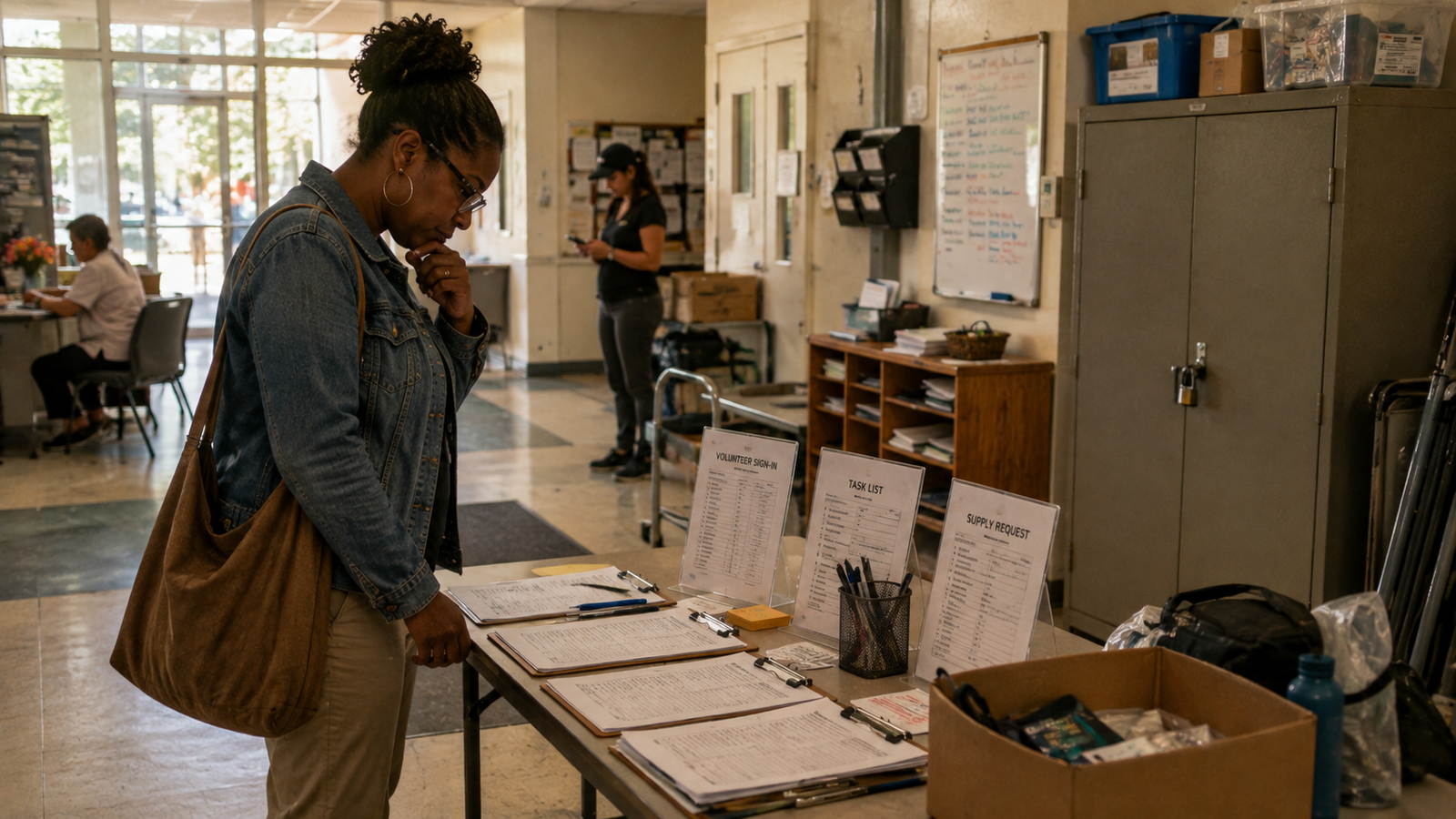
Participation barriers do not always look like locked doors. Sometimes they look like a clipboard, a meeting that lasts too long, unclear instructions, three people who give three different answers, or a simple favor that quietly becomes a permanent responsibility.
Someone may be ready to help and still decide the process is not worth entering.
That distinction matters.
Communities often interpret low participation as low interest. They ask why people will not volunteer, why residents do not attend, why parents stop showing up, or why the same names keep appearing on every sign-up sheet.
Sometimes people really are uninterested.
But willingness is only one part of the system.
The other part is friction.
How difficult is it to understand what is needed? How much time does a small task actually consume? Does helping once create another obligation? Does somebody know when the work ends? Can a new person enter without first learning the history, personalities, routines, and unwritten rules of the entire group?
When those costs rise, the system starts filtering out people who may have been perfectly willing to contribute.
Then leaders see withdrawal and call it apathy.
The better question is simpler:
What does somebody have to endure in order to help?
Caring Is Not the Same as Participating
A person can care deeply about a place and still stay outside its participation system.
A parent may care about the school but work during every committee meeting. A tenant may care about the building but have no idea who is responsible for the recurring maintenance problem. A neighbor may want to contribute but hesitate because every person who helps eventually seems to become responsible for everything.
None of those people are necessarily disengaged from the community itself.
They may be disengaged from the way contribution has been designed.
This is where participation gets misread.
Organizations tend to measure visible behavior. Who came? Who signed up? Who responded? Who volunteered?
Those measures matter, but they do not tell us why somebody stayed out.
A participation system should therefore be judged by more than the number of willing people it attracts. It should also be judged by how difficult it makes willingness to become useful action.
Every Contribution Has an Entry Cost
No act of participation is free.
Even a small contribution requires something from the person making it.
There may be travel. Childcare. Scheduling. Forms. Parking. Preparation. A meeting. Waiting for instructions. Finding the right person. Learning a new process. Following up afterward.
Individually, those requirements may seem minor.
Together, they create an entry cost.
This is participation friction: the extra effort surrounding the useful thing somebody was actually trying to do.
A person may be willing to spend thirty minutes helping with an event. That does not mean the person has ninety minutes for check-in, waiting, orientation, confusion, and cleanup.
A resident may be willing to report a broken gate. That does not mean the resident will call three departments and repeat the same information each time.
A neighbor may be willing to bring supplies. That does not mean the neighbor wants to join a committee before being allowed to contribute them.
The more effort required around the contribution, the fewer people can realistically participate.
The Most Expensive Word in Community Work Is “Quick”
“Can you help with something quick?”
The request sounds small because the visible task is small.
But the task may not be the real cost.
The person has to arrive early. Nobody has the key. The supplies are in another room. Someone needs the volunteer to stay after the event. A second task appears because the volunteer is already there. Then a message arrives the following week because the person who helped once is now considered somebody who “usually handles that.”
The original fifteen-minute contribution has acquired a tail.
This is one reason dependable people often become overloaded while everyone else becomes more cautious.
People watch what happens to those who say yes.
If participation routinely creates undefined future responsibility, the system teaches observers that helping is expensive.
Eventually, saying no starts looking less like selfishness and more like risk management.
One Yes Should Not Become Permanent Enrollment
Healthy participation needs an edge.
People should be able to understand what they are agreeing to, how long it will take, what responsibility belongs to them, and when that responsibility ends.
That is where Structure Is Mercy becomes practical.
Structure reduces the uncertainty surrounding contribution. It tells people what is needed before they arrive. It separates one task from five adjacent tasks. It makes handoff possible. Most importantly, it allows people to participate without wondering whether they are accidentally accepting a permanent position.
Clear boundaries do not reduce community spirit.
They protect it from being consumed by ambiguity.
A person may have capacity to help for twenty minutes, once a month, during one event, on one particular kind of task.
That contribution still counts.
A strong participation system does not treat limited contribution as inadequate. It makes limited contribution usable.
Participation Boundary Check
Can somebody see the edge of the commitment?
High-Friction Systems Train People to Withdraw
Withdrawal is not always a sudden decision.
Often, it is learned.
A person helps once and discovers that the process is disorganized. The next request gets a slower response. Another experience produces confusion or excessive follow-up. Eventually, the person stops answering altogether.
The willingness may not have disappeared.
The expectation changed.
The person now expects that participation will cost more than advertised.
That expectation matters because communities teach participation through experience. When effort produces a clear result, people learn that contribution is usable. When effort disappears into confusion, delay, or open-ended responsibility, people learn to protect their time.
The result is predictable.
Fewer people enter. The same dependable people absorb more work. Responsibility becomes concentrated. Those people eventually lose capacity.
That is how a participation problem becomes a system problem.
As examined in Community Systems Fail When Contribution Stops, the structure may remain visible even while contribution underneath it is already weakening.
Make the Smallest Useful Contribution Easier
Communities often respond to weak participation by asking people for more.
More commitment. More volunteers. Longer meetings. Bigger teams. More frequent attendance.
Sometimes the better answer is to ask for less, more clearly.
Design a task that takes twenty minutes and actually ends after twenty minutes.
Let somebody contribute without joining a committee.
Give a new participant one clear contact instead of five names.
Separate setup from cleanup so one person does not inherit both.
Make instructions understandable before people arrive.
Create handoffs so knowledge does not remain trapped with the same dependable participant.
Then make the result of the contribution visible.
This matters because visible contribution does more than recognize effort. It shows other people that participation enters a functioning system and produces something real.
A strong community does not need every person to contribute at the same level.
It needs enough legitimate ways for different people to carry a useful piece.
The Groundwork
Audit the cost of one useful yes
Choose one place where people are routinely asked to contribute.
It might be a tenant group, school, workplace, block association, congregation, neighborhood organization, community program, or shared building.
Then follow one simple contribution from beginning to end.
- How long does it take to understand what is needed?
- How many people, forms, messages, or steps stand between willingness and action?
- Can somebody help briefly without inheriting the entire responsibility?
- Is the end of the commitment visible before the person begins?
- Is there a clear handoff when the contribution is complete?
- What could be removed before asking the community for more participation?
The point is not to make every contribution effortless. Shared systems require real work.
The point is to separate the work that matters from the friction that does not.
When helping becomes unnecessarily difficult, communities lose more than volunteers. They lose willing capacity that never gets the chance to become useful.
Continue Building
Follow what happens when participation becomes difficult, concentrated, or invisible.
Series: Community Participation
Participation: Communities Become Stable When Responsibility Stays Distributed
Contribution: Contribution Must Be Visible or It Disappears
System Failure: Community Systems Fail When Contribution Stops
Build better. Every day.
Better systems make useful participation easier.
Join Groundwork Daily for practical thinking about participation, stewardship, maintenance, incentives, and the ordinary systems that determine whether communities hold.

Groundwork Daily Builder
Cyrus Mbeki
Community Groundwork · Shared Systems & Stewardship
Cyrus Mbeki studies what people actually do inside shared systems. His work examines maintenance, participation, incentives, stewardship, responsibility, and the everyday behaviors that determine whether communities remain functional under real conditions.
Through Community Participation, Mbeki follows what makes people enter shared work, remain involved, pull away, or return, and what those choices do to the capacity of the larger system.