

What does the Bible say about starting over? After a difficult season, that question can carry both hope and grief. A new beginning sounds beautiful when life has been hard. Still, beginning again can feel complicated when the past has left consequences behind.
Maybe something failed. Perhaps a relationship changed, a plan collapsed, trust was damaged, or you made decisions you wish you could undo. Even when the hardest part has passed, another question remains: what do you do with the life that is still here?
Scripture does not usually describe renewal as pretending the past never happened. Instead, it shows people moving forward with memory, weakness, grace, wisdom, and responsibility.
What Starting Over Looked Like for Peter
Peter’s story gives us one of Scripture’s clearest pictures of beginning again after failure.
After denying Jesus three times, he does not receive a new life by becoming a man with no history. Instead, Jesus meets Peter as he is, speaks to the place that broke, and gives him responsibility again.
In other words, restoration does not depend on pretending the denial never happened.
Starting over is rarely starting from zero. Sometimes you begin again from truth, grace, repair, and what the difficult season has taught you.
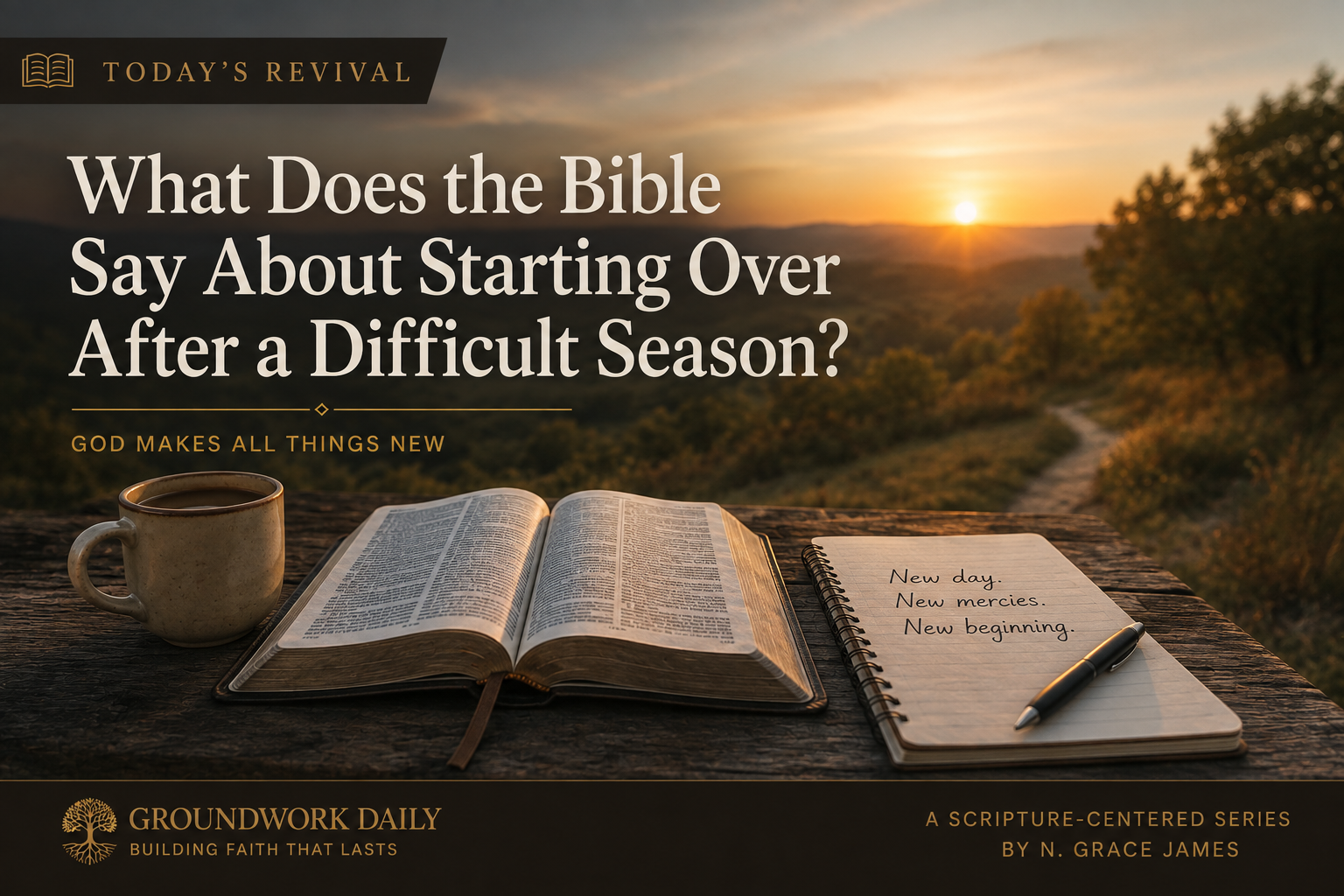
Primary Scripture
“He said to him, ‘Feed my sheep.’”
“Starting over is rarely starting from zero. Grace can give the past a different role without pretending it never happened.”
N. Grace James
What Peter Teaches Us About Starting Over
By the time we reach John 21, Peter is carrying history.
Before Jesus was crucified, he had insisted that he would remain loyal. Under pressure, however, Peter denied knowing Jesus three times. The failure hurt because it contradicted what he believed about his own courage.
Then the resurrection changes everything.
Jesus is alive. Even so, Peter still has to live with what he did. Resurrection does not magically remove memory.
Jesus Does Not Avoid Peter’s Failure
In John 21, Jesus meets Peter beside the sea and asks him three times, “Do you love me?”
Each question reaches into the place where Peter’s confidence had broken. Yet the conversation does not end with Peter’s regret.
After Peter answers, Jesus gives him something to carry: “Feed my lambs.” Later, He says, “Tend my sheep,” and then, “Feed my sheep.”
Therefore, restoration becomes more than emotional comfort. Peter receives responsibility again.
What Does the Bible Say About Starting Over After Failure?
Peter’s story shows that a new beginning does not require a missing past.
Real life rarely gives us a completely blank page. Instead, we may begin again with scars, lessons, changed relationships, or consequences that still need attention.
Nevertheless, those realities do not make renewal impossible.
A Groundwork Distinction
A new beginning does not require a missing past. It requires a different relationship to the past.
Carry Wisdom Forward, Not Permanent Condemnation
Peter cannot become a man who never denied Jesus. What changes is the authority that failure holds over him.
Because grace meets him in the truth, Peter can carry wisdom forward without making shame his permanent identity.
In that sense, starting over does not erase the lesson. Instead, it changes what gets to lead.
Starting Over May Require Repair
There is a version of “starting over” that tries to move forward too quickly.
It wants relief without truth. It wants a clean slate without responsibility. More importantly, it wants a future that asks nothing of the past.
John 21 gives us something sturdier.
Jesus returns to the place of Peter’s loyalty, names love, gives responsibility, and then calls him forward.
Grace Does Not Make Repair Unnecessary
If the difficult season included your own failure, starting over may involve an apology, changed behavior, or patiently rebuilding trust.
On the other hand, if the season involved harm done to you, repair may look very different. It may include naming what happened, restoring boundaries, seeking support, or accepting that forgiveness does not always require renewed access.
That is why Repair matters here. Rather than pretending damage never happened, repair asks what must be restored so life can function faithfully again.
What Repair Can Look Like in a New Season
Repair is not always dramatic.
Sometimes it looks like keeping a promise you once broke. At other times, repair means giving another person enough time to see whether your behavior has truly changed.
Likewise, repair may require accepting limits. You may not be able to restore a relationship to its former shape, recover lost time, reopen an opportunity, or remove every consequence.
Even so, you can still decide what faithfulness looks like now.
That is where repair becomes hopeful. Yesterday does not disappear; however, tomorrow can be built with greater truth.
What Does the Bible Say About Starting Over and “A New Thing”?
Isaiah 43:18–19 is often quoted when people want to begin again. In fact, the passage includes one of Scripture’s most familiar statements about newness:
“See, I am doing a new thing!”
In context, Isaiah speaks to God’s people about deliverance. Therefore, the verse should not become a promise that every difficult season will quickly be replaced by the exact outcome we prefer.
Still, the passage gives us a durable truth: God is not limited to repeating the past.
Biblical Newness Does Not Mean Amnesia
Paul uses similar language when he writes about being a new creation in Christ .
Yet biblical newness does not require people to deny their histories.
John 21 makes that especially clear. Peter’s future does not depend on forgetting his denial. Rather, grace becomes strong enough to carry both truth and responsibility.
As a result, his history remains real without remaining sovereign.
Beginning Again Is Not Always the Same as Restarting
Today’s Revival has already explored returning after interruption in Begin Again Without Shame .
That reflection focuses on returning after a setback without allowing shame to keep you stuck.
This question goes further.
What does the Bible say about starting over when a difficult season changed something important? And what happens when trust must be rebuilt or the old structure cannot simply be restarted?
In those moments, beginning again becomes more than repetition. It becomes reconstruction.
Why Starting Over Should Build What Holds
Difficult seasons often reveal weaknesses that were easier to ignore before pressure arrived.
Notice what Jesus rebuilds in Peter. He does not return Peter to the old identity of the confident disciple who once insisted he would never fall away.
Instead, Jesus calls forward a shepherd who now knows what weakness feels like.
That difference matters because starting over should not always mean rebuilding the old arrangement exactly as it was.
Build What Holds asks a harder question: what needs to be rebuilt so it can carry the pressure of the next season?
Do not rebuild the next season around the same weakness the last season exposed.
Let the Difficult Season Teach the Next One
A hard season should not be forced to become a blessing before you have had room to grieve it.
At the same time, hardship can reveal information. It may show where your limits were ignored, where support was missing, or where something appeared stable only because it had never been tested.
Consequently, wisdom asks more than, “How do I get back to normal?”
A better question may be, “What did this season reveal that I should not ignore when I build again?”
How to Start Over After a Difficult Season
You do not need to solve the whole future at once. Instead, let the next season begin with a few honest steps.
In Practice
1. Tell the truth about what happened.
Renewal built on denial will remain fragile. Therefore, name the loss, failure, change, or disappointment clearly.
2. Ask what still needs repair.
Forgiveness does not erase every consequence. Instead, notice what needs to be owned, grieved, changed, or rebuilt.
3. Carry the lesson, not permanent condemnation.
Let wisdom travel forward. However, do not allow shame to become your identity.
4. Build around what the season revealed.
If an old structure failed under pressure, resist the urge to reconstruct it unchanged.
5. Take the next faithful responsibility.
Jesus gave Peter something concrete to carry. Likewise, your next step may be quieter and more practical than the dramatic fresh start you imagined.
A Faithful New Beginning Can Be Small
Sometimes we delay starting over because we expect renewal to feel dramatic.
Yet Peter’s restored responsibility sounds wonderfully ordinary: feed, tend, care.
In the same way, your next step may be simple. Make the call. Keep the appointment. Return to prayer. Rework the budget. Rest. Apologize. Reopen the notebook. Ask for help.
Small does not mean insignificant. Often, a durable new season begins with one responsibility carried differently.
Sometimes Starting Over Means Accepting a Different Life
This may be the hardest part.
A new beginning does not always restore the old life. Sometimes a relationship does not return. A job may disappear. Health can change unexpectedly.
In other cases, a dream may require a different shape entirely.
Even then, Scripture does not require us to minimize those losses. Nor does faith require us to explain exactly why every difficult season happened.
However, loss does not have to become the only author of what comes next.
Peter’s Failure Was Not His Final Sentence
Peter’s denial remains part of his story, but it is not the end of his story.
Likewise, the difficult season can remain true without becoming the final definition of who you are.
More importantly, what happened does not get to decide every faithful possibility that still remains.
That is one reason starting over can be both honest and hopeful. The past is acknowledged, while the future remains open to faithful action.
What Does the Bible Say About Starting Over? Grace Gives You Somewhere to Go Next
So, what does the Bible say about starting over?
Scripture does not promise a life without history. Instead, it gives us people whose stories continue after failure, loss, grief, fear, and disruption.
Peter is one of them.
Rather than asking Peter to become the man he was before the denial, Jesus calls him forward as someone who now knows both his weakness and the mercy of being restored.
That is a sturdier beginning.
Therefore, carry the lesson. Make the repair that belongs to you. Receive grace without turning it into denial. Then accept the next faithful responsibility.
In the end, the past may explain part of your story. It does not have to own the whole architecture of your future.
A Prayer for Starting Again
Father, meet me honestly in what this season has changed. Give me grace for what cannot be undone and courage for what still needs repair. Help me carry wisdom forward without carrying shame as my identity. Show me what responsibility belongs to me now, and give me patience to rebuild what needs to become stronger. Teach me to trust that a new beginning does not require me to deny the past. Lead me faithfully into what comes next. Amen.
Starting Over After a Difficult Season FAQ
What does the Bible say about starting over?
The Bible shows that a new beginning can include grace, truth, repair, and renewed responsibility. In John 21, Jesus restores Peter after his denial and gives him meaningful work to carry forward.
Does starting over mean forgetting the past?
No. Biblical renewal does not require pretending the past never happened. Instead, lessons, consequences, wisdom, and repair may all remain part of the new beginning.
Can God restore you after failure?
Peter’s story shows that failure does not automatically end faithful usefulness. Jesus addresses Peter’s history and then entrusts him with responsibility again.
How do you start over after a difficult season?
Begin with honesty about what happened. Next, identify what needs repair, carry useful lessons forward, release unnecessary shame, and take the next faithful responsibility instead of trying to rebuild everything at once.
What does the Bible say about starting over when life cannot go back to normal?
Scripture does not require the future to look exactly like the past. A faithful new beginning can include changed circumstances, new responsibilities, repaired foundations, and a different way forward.
Further Groundwork
Continue through related reflections on beginning again, difficult seasons, and faithful restoration.
Groundwork Daily
Build a quieter foundation for a louder world.
Join the Groundwork List for Scripture-centered reflections, practical wisdom, and ideas built to help faith become something lived in ordinary life.
Meet the Builder
N. Grace James
N. Grace James builds in the space between what a person feels, what a person believes, and what a person allows to lead. Her work for Groundwork Daily explores faith, Scripture, prayer, discernment, stillness, emotional discipline, and the quiet choices that shape ordinary life.
Through Today’s Revival, she writes Scripture-centered reflections for honest spiritual formation. She also builds Wisdom Wednesday, a practical lane for clearer judgment and self-governance.