
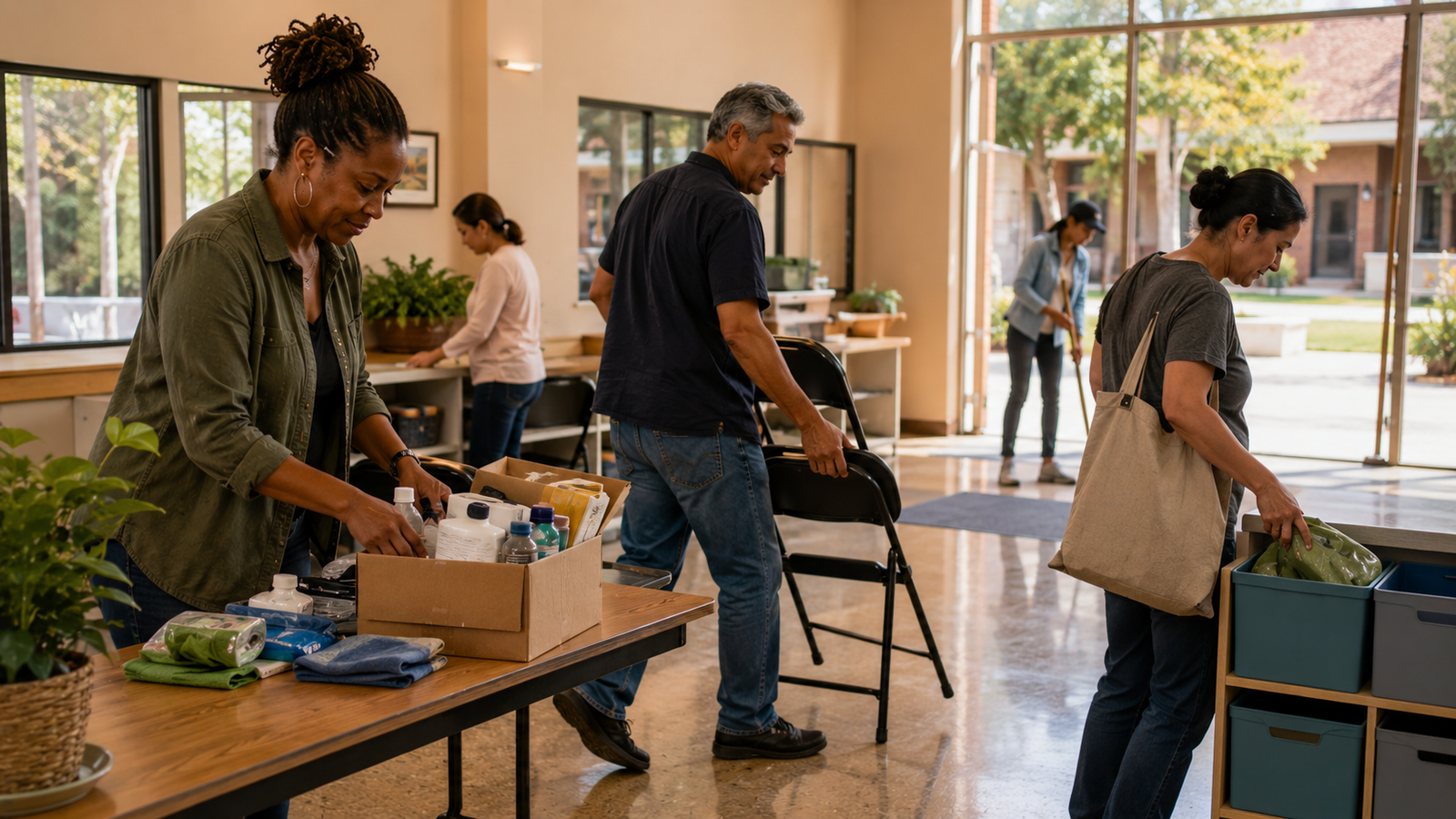
Small contributions can carry more weight than communities often realize. A person does not need to run the meeting, join the committee, or give away an entire afternoon to add something useful to a shared system.
Yet many participation systems are built as if large commitment is the only commitment worth recognizing.
A neighbor offers an hour, so the request grows into an afternoon. A parent agrees to bring supplies, then gets invited to the planning meeting. Someone helps with setup once and soon becomes one of the people expected to arrive early every time.
As a result, the contribution keeps getting bigger.
Meanwhile, the people with the most flexible schedules begin carrying more of the system. Everyone else can start to look disengaged, even when willingness still exists.
However, the problem may not be interest. It may simply be a matter of scale.
A healthy participation system knows how to receive small contributions without immediately converting them into permanent responsibility.
Therefore, the question is not always how to get people to do more.
Sometimes the better question is:
What is the smallest useful piece someone can carry?
Small Contributions Need More Than One Door
Many communities say everyone is welcome to participate. In practice, however, they often offer only one meaningful way to enter.
Come to the meeting. Join the committee. Take the shift. Become a regular.
Those are legitimate forms of participation. Still, they are not the only ones.
A resident may care about a building but work during every association meeting. Or a parent may want to support a school without giving up an entire Saturday. Elsewhere, a neighbor might notice a maintenance problem yet have no interest in joining the group responsible for repairs.
Those limits do not make the person useless.
Instead, they describe the amount and type of participation that person can realistically carry.
When a system recognizes only one form of involvement, it quietly excludes capacity that already exists.
By contrast, stronger systems create several legitimate entry points.
Why Small Contributions Still Count
A contribution can take ten minutes.
It might be one report, one introduction, one ride, one bag of supplies, one repaired item, or one hour of work.
Of course, participation can also mean a recurring responsibility or long-term leadership role.
The problem begins when a shared system treats only the largest commitments as meaningful.
For example, someone who cannot join a committee may still be able to distribute information. A resident who cannot manage a project may be able to report a recurring problem. Likewise, someone who cannot stay for an entire event may still have twenty minutes to help with setup.
Those actions are not incomplete versions of participation.
They are useful pieces.
The previous Groundwork Daily analysis, Participation Declines When Helping Costs Too Much, examined what happens when helping becomes difficult to enter.
Reducing that friction is important. However, removing friction is only the beginning.
The next task is to design participation at a size ordinary people can actually sustain.
That does not mean lowering standards.
Instead, it means dividing useful work into pieces that can be understood, completed, handed off, and repeated.
Contribution Scale
Useful Does Not Have One Size
A healthy system can receive different levels of help without turning each contribution into the same obligation.
Small Contributions Need Clear Handoffs
A useful contribution should not depend on the same person returning forever.
If someone brings supplies, the system should know where those supplies go. If a resident reports a broken light, the next step should belong to whoever owns the repair process.
Similarly, when someone organizes one event, the knowledge required for the next event should not remain trapped with that person.
This is the difference between participation and dependency.
Participation adds capacity to a shared system. Dependency turns one participant into part of the infrastructure.
That distinction matters because dependable people are easy to overuse.
Once someone proves capable, more work often begins moving toward that person. Before long, reliability becomes an unofficial job description.
Groundwork Daily examines that pattern in Reliability Should Not Become a Job Title.
A better system expects handoff from the beginning.
One person completes the piece. Then another person, role, or established process receives what comes next.
As a result, the work continues while the contributor remains free to leave.
The Handoff Test
If the work cannot move forward without the same person staying involved, the system has not completed the handoff.
People Need Proof That Their Help Mattered
Participation becomes difficult to sustain when people cannot tell whether their effort changed anything.
A resident reports a problem and hears nothing. A parent drops off supplies but never knows whether they were needed. Someone spends an hour helping with setup, then receives another request without any indication of what the first hour accomplished.
Eventually, the effort can feel disposable.
That is not simply a communication problem. It is also a participation problem.
People do not need applause for every useful act. However, they do need enough feedback to understand that their effort entered a functioning system.
That is why Groundwork Daily’s work on making contribution visible matters here.
Visibility reconnects effort to consequence.
The light got repaired. Somebody used the supplies. The chairs were ready in time. That introduction connected the right two people. And the hour of setup help took real weight off someone else’s shoulders.
Once that connection becomes visible, small contributions stop feeling insignificant.
Instead, people can see that a limited action produced a real result.
Small Contributions Become Powerful When They Can Repeat
Communities often celebrate the person who gives everything.
That person stays late, solves the problem, carries the extra load, remembers what others forgot, and returns the next morning.
Such effort can be valuable. At the same time, it can hide weak design.
A system that repeatedly needs extraordinary effort from the same few people may look productive while becoming increasingly fragile.
Now consider another model.
Twenty people each know one useful thing they can do. The task is clear. Time is bounded. And the handoff actually works. Nobody has to become indispensable.
That system may look less heroic.
Nevertheless, it may be much stronger.
Repeatable participation creates something maximum effort cannot guarantee: margin.
People can contribute while keeping enough time and energy for work, family, caregiving, rest, and other responsibilities.
Because they are not exhausted by one contribution, they may be able to participate again.
This matters because durable shared systems are not built by extracting the maximum possible effort from willing people.
They are built by creating useful forms of participation that people can realistically sustain.
The Groundwork
Find the Smallest Useful Piece
Choose one recurring participation need in a system you know.
It might be a building, school, workplace, block association, congregation, neighborhood group, community room, volunteer program, or shared public space.
First, do not ask how to recruit more people.
Begin with the work itself.
Six Questions to Ask First
-
What useful outcome is actually needed?
Separate the result from the traditions and routines that have accumulated around it. -
What is the smallest meaningful piece?
Find something a person can complete without inheriting the entire process. -
How does somebody enter?
Make the request understandable before the person commits. -
How does the contribution end?
Give the task a visible boundary instead of allowing one yes to expand. -
Who receives the handoff?
Make the next responsibility belong somewhere other than automatically returning to the same person. -
What proves the effort mattered?
Close the loop so people can see that what they carried became useful.
Of course, some responsibilities cannot be divided into tiny pieces.
Certain work requires expertise, continuity, authority, or long-term stewardship. Good participation design recognizes those limits.
Therefore, the goal is not to make every responsibility small.
The goal is to stop making every contribution large.
A strong participation system does not make every person carry more. It makes more kinds of contribution useful.
Continue Building
Follow how willingness becomes useful, distributed responsibility.
Series: Explore the Community Participation series
Participation Cost: Participation Declines When Helping Costs Too Much
Visibility: Contribution Must Be Visible or It Disappears
Receipts
Stanford Encyclopedia of Philosophy: Collective Action

Build better. Every day.
Strong Communities Make Room for Useful Contribution
Join Groundwork Daily for practical thinking about participation, stewardship, maintenance, incentives, and the shared systems that determine whether communities hold.
Groundwork Architecture
The Structure Beneath Participation
This article examines how shared systems become more durable when they can receive limited, useful help without turning every willing person into permanent infrastructure.
Primary Core Principle
Structure Is Mercy
Good structure makes contribution understandable, bounded, and transferable. People should be able to help without first absorbing unnecessary confusion or responsibility.
Primary Condition
Margin
Margin leaves enough room for people to contribute without consuming all of the time, energy, and attention they need elsewhere. Participation that preserves margin is easier to repeat.
Explore the full Groundwork Daily Core Principles and Conditions architecture .

Groundwork Daily Builder
Cyrus Mbeki
Community Groundwork · Shared Systems & Stewardship
Cyrus Mbeki studies what people actually do inside shared systems. His work examines maintenance, participation, incentives, stewardship, responsibility, and the everyday behaviors that determine whether communities remain functional under real conditions.
Through Community Participation, Mbeki follows what makes people enter shared work, remain involved, pull away, or return, and what those choices do to the capacity of the larger system.