


The architecture of focus begins before willpower. You can sit down with a clear priority, enough motivation, and every intention of doing serious work, then lose the next hour to messages, browser tabs, questions, alerts, small decisions, and tasks that were never supposed to own the day.
By the time you return to the work that mattered, the problem is no longer whether you care. Your attention has been repeatedly broken apart.
Most focus advice starts too late. It tells you to concentrate after the phone is already beside you, the inbox is open, the calendar is fragmented, and everyone around you has learned that your attention is available on demand. Then, when concentration becomes difficult, the failure gets assigned to discipline.
That diagnosis is too shallow. Focus is personal, but it is also structural. The spaces you work in, devices you keep within reach, communication rules around you, unfinished decisions you carry, and recovery your body receives all change the conditions under which attention operates.
Therefore, the better question is not simply, “How do I focus harder?”
Ask what kind of environment your attention is being asked to survive.
The Architecture of Focus Starts With Structure
The architecture of focus is the set of conditions that helps attention stay with a chosen task long enough for useful thought to develop. It includes obvious factors such as notifications and noise, but it also includes less visible structures: unclear priorities, unpredictable interruptions, excessive task switching, unresolved decisions, poor communication rules, and schedules that never leave enough uninterrupted time for concentration to deepen.
This is different from the argument in Attention Is a Gate, Not a Feeling . That piece asks what should gain access to attention in the first place. This one asks what happens after you have chosen the priority. Once attention enters the right room, what keeps every other demand from walking through the door?
That is an environmental question. Focus needs a path that remains reasonably clear. The goal is not silence, isolation, or perfect control. Real life does not consistently offer those conditions. Instead, the architecture should reduce preventable competition so every serious task does not begin as a fight against its surroundings.
A strong mind can redirect attention. A well-designed environment means it has to redirect attention less often.
Focused Attention Depends on Selection
Attention is selective by necessity. At any moment, more information is available than you can treat as equally important. The mind has to prioritize some signals while allowing others to remain in the background. Focus becomes possible when that selection remains stable long enough for a task to build continuity.
Trouble begins when the surrounding environment keeps demanding a new selection. A message appears. Someone asks a question. A badge changes color. Another tab becomes relevant. A meeting reminder arrives. The original task may still matter most, but the mind must repeatedly decide whether each new signal deserves access.
That evaluation creates work of its own. Even when you reject an interruption, you still had to notice it, interpret it, and decide what to do with it. Consequently, an environment that filters unnecessary demands before they reach you preserves more attention for decisions that actually require judgment.
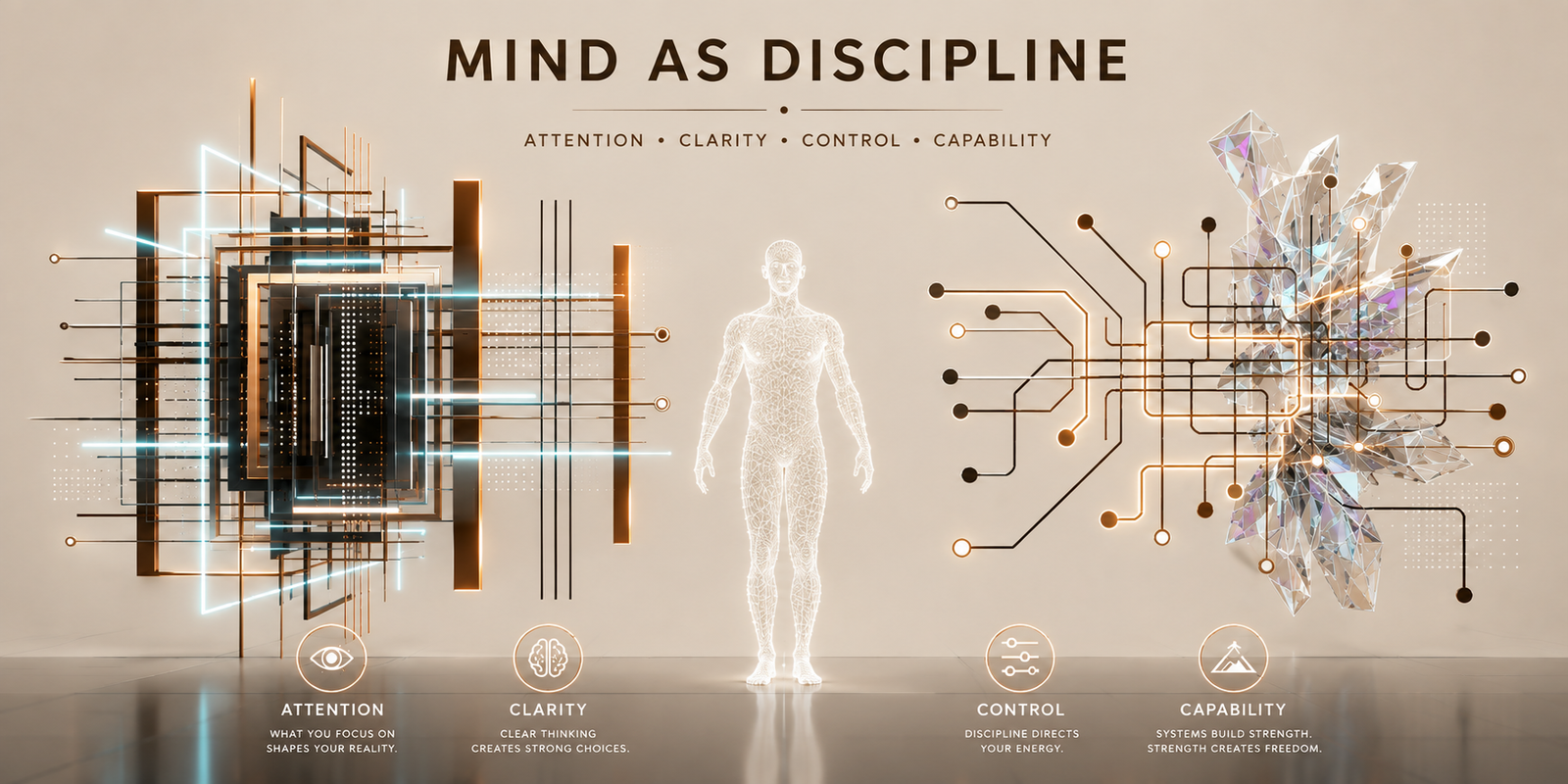
This is why boundaries matter inside Mind as Discipline. A boundary is not merely a social statement. It is a rule about access. It defines what can interrupt, when interruption is legitimate, and what must wait.
Interruptions Break More Than the Schedule
An interruption may consume only seconds on the clock while costing considerably more in the work itself. When attention leaves one task and enters another, the original context often has to be reconstructed on return. You may need to remember what you were considering, which assumption you were testing, what sentence you were building, or which decision remained unresolved.
Research on interruptions supports the importance of this resumption process. A systematic review of laboratory studies found that interventions designed to reduce interruption effects could improve primary-task accuracy and reduce resumption delay. The precise cost varies by task, interruption, and person, but the operating lesson is useful: returning is part of the workload.
A workplace can therefore lose cognitive capacity without anybody appearing idle. People may answer quickly, attend meetings, check project boards, respond to messages, and move through the day with visible urgency. The system looks active. Yet work requiring sustained reasoning keeps getting restarted.
The task is still there.
The deadline is still there.
But the path back into the work is longer.
Task Switching Can Leave Attention Behind
Switching tasks can become especially difficult when the first task remains unfinished. Research by Sophie Leroy described this phenomenon as attention residue: part of a person’s attention can remain attached to a previous task after the person moves to another one.
That does not mean every transition is harmful or that serious work always requires hours of uninterrupted solitude. Rather, transitions have a cost worth accounting for. A schedule built from fragments repeatedly asks the mind to close one context, open another, and reconstruct the first one later.
The architecture of focus tries to reduce unnecessary reconstruction. Related tasks can be grouped. Communication can happen within defined windows. Deep work can receive longer blocks. Before switching, a person can leave a short written note that makes the return point visible.
These are modest interventions. However, each one shortens the path back into the work.
The Digital Environment Competes for Focus by Design
Phones and computers are not passive containers. Many digital products depend on engagement, responsiveness, continued use, or return behavior. That creates incentives for notifications, badges, feeds, recommendations, reminders, and prompts that keep new signals moving toward the user.
Each feature may be useful by itself. Together, however, they can produce an environment where attention is repeatedly invited to leave what it was doing.
Experimental research has found that even receiving a phone notification can disrupt performance on an attention-demanding task without the person responding to the message. The signal itself can create measurable distraction. Therefore, a notification does not become cognitively free merely because you resist picking up the device.
The practical response is not to declare technology the enemy. That would be weak analysis. Technology should remove unnecessary work, expand capability, and improve access when governed well. The sharper question is what authority a tool receives over the flow of attention.
This is where Mind as Discipline intersects with Tech as Discipline . A tool may make one task faster while creating additional channels to monitor, more information to process, and more opportunities to respond.
Efficiency does not automatically protect attention. The surrounding system decides what fills the capacity technology creates.
Workplaces Can Manufacture the Distraction They Blame on Workers
Many organizations say they value focus while operating in ways that make focused work unusually difficult. Calendars become fragmented by short meetings. Messaging systems treat rapid response as professionalism. Priorities change without removing old priorities. Meanwhile, every team develops another channel, dashboard, notification stream, and status process.
Then employees are expected to find deep concentration somewhere between them.
That is a design problem before it becomes an individual performance problem. A worker can improve personal habits, but personal discipline cannot fully compensate for an operating environment where everyone is allowed to interrupt everyone else at any time.
Eventually, the strongest focus strategy becomes avoidance: work before everyone wakes up, work after everyone leaves, or disappear from the communication system long enough to finish something.
Better workplaces define communication norms. They distinguish genuinely urgent work from merely recent work. They provide blocks where response expectations are lower, question recurring meetings that no longer earn their cost, and clarify decision authority so unresolved questions do not circulate indefinitely.
These changes are not perks. They are operating design. If work requires judgment, planning, writing, analysis, technical precision, or complex decision-making, the organization has a business interest in protecting the attention those activities require.
The Environment Teaches Attention Through Repetition
The same architecture exists outside work. A phone beside the bed creates one kind of evening. A phone charging outside the bedroom creates another. A television running during every conversation produces one attentional environment, while a meal where devices are put away produces another.
Likewise, a classroom with clear transitions and predictable technology rules asks something different of attention than a classroom where every device can become a competing channel.
None of these structures guarantees behavior. Environment is influence, not destiny. That distinction matters because structural thinking becomes simplistic when every outcome is blamed on surroundings. People still make choices, and individual differences remain important.
The point is that choices happen inside conditions that can increase or decrease the friction attached to sustaining them.
This is also where Whose Rules Are You Following? connects to the argument. That piece examines how environments shape behavior broadly. The architecture of focus applies the same structural logic specifically to attention: what repeatedly gains access, what can interrupt, and what the environment makes easier to sustain.
The Architecture of Focus Depends on Boundaries
Trying harder can temporarily overpower a poorly designed environment. It is an expensive strategy because the mind must keep winning the same argument: do not check the phone, ignore the badge, stay out of the inbox, do not answer yet, return to the document, remember the priority.
Each decision appears small. Repeated negotiation, however, becomes part of the workload.
Boundaries move some of those decisions upstream. Nonessential notifications are disabled before work begins. Communication windows are established before a message arrives. The phone has a physical location before concentration is required. The calendar contains protected time before somebody else requests it. The day’s primary work becomes visible before the inbox supplies a different agenda.
Good boundaries reduce the number of moments where distraction gets to make its case. That makes them structural rather than merely aspirational.
You do not need to become unreachable. You need rules that distinguish access from unlimited access.
Useful Friction Can Protect Attention
Modern systems often treat friction as something that should always be removed. Sometimes that is correct. Needless repetition, confusing workflows, unnecessary approvals, and badly designed tools waste capacity.
Yet some friction performs a protective job because it creates a small pause between impulse and action.
Logging out of a distracting account adds friction. Keeping the phone outside the room adds friction. Removing social applications from the home screen adds friction. Requiring a meeting agenda before accepting a meeting adds friction. Writing the day’s priority before opening email adds friction.
The question is not whether friction exists. The question is what the friction protects.
Good attention architecture removes friction from the important path while adding enough friction to competing paths that distraction loses instant access. The important document is already open. Unnecessary alerts are already silent. Materials needed for the task are ready. Meanwhile, the distracting option requires another step.
That small asymmetry matters. Discipline becomes easier when the environment stops giving every option equal convenience.
Busyness Can Hide Weak Attention Architecture
Busyness is seductive because it leaves evidence: messages answered, meetings attended, notifications cleared, tasks touched, tabs opened, and requests acknowledged. By the end of the day, enough visible activity may exist to prove that effort occurred.
What busyness does not prove is that the work requiring the strongest judgment received the strongest attention.
Reaction produces motion, and motion can feel productive because something is always happening. Focus asks a harder question: did the most consequential work receive enough uninterrupted cognitive space to be done well?
This distinction becomes more important as tools make low-level activity faster. If technology increases the speed at which messages, updates, drafts, reports, and requests can be produced, then the volume of things competing for attention can rise even while each individual task becomes easier.
The response cannot be a permanent race to process more inputs. Eventually, the architecture has to decide which inputs should exist at all.
Attention Management Goes Deeper Than Time Management
A calendar can tell you where time is supposed to go. It cannot guarantee that attention arrives there intact.
A two-hour block labeled “deep work” means little if the phone remains active, messaging software is open, email is visible, the room is interruption-heavy, and the mind is carrying six unresolved decisions from the previous hour.
Attention management therefore asks a different set of questions. What kind of concentration does this task require? Which conditions improve the odds that concentration will survive? Which inputs need to close? What should be decided beforehand? What can wait? What does the body need in order to remain alert enough to do the work?
This is where the architecture of focus becomes more precise than ordinary productivity advice. The objective is not to squeeze maximum output from every hour. It is to match consequential work with conditions that make reliable attention possible.
Recovery Supports the Architecture of Focus
No attention system can be evaluated without considering the body carrying it. Sustained attention is affected by sleep and fatigue, which means focus cannot be protected only through better apps, cleaner desks, or tighter schedules.
A person who is consistently under-recovered is asking attention to perform with less capacity available.
Research on sleep deprivation has repeatedly identified vulnerability in vigilant or sustained attention. Effects vary across cognitive domains and between individuals, so the evidence should not be flattened into the claim that poor sleep makes every kind of thinking equally worse. Nevertheless, sustained attention is among the functions that reliably show impairment when sleep is restricted or lost.
That makes recovery part of the structural argument. Recovery Is Infrastructure develops this mechanism from the Health as Discipline side of Malik Rivers’ system. Mind governs access. Health governs whether the body has enough capacity to carry the demand.
Focus weakens when either side is ignored.
Work breaks matter for the same reason. Research on work breaks, well-being, and performance suggests that effects depend on factors such as the type, duration, frequency, and experience of a break. Recovery cannot be reduced to one universal timer.
The broader lesson is simpler: uninterrupted output is not the only design variable. A durable system also needs places where demand decreases.
Build the Architecture of Focus Around Four Jobs
You do not need a proprietary productivity system to redesign attention. The basic work is more ordinary. A useful focus environment performs four structural jobs: it reduces avoidable competition, makes priorities visible, protects enough uninterrupted time for concentration to deepen, and allows recovery before fatigue becomes the dominant condition.
01 · Reduce Competition
Remove signals, tools, tabs, meetings, and requests that do not need immediate access to the current work.
02 · Make Priority Visible
Decide the important work before incoming information gets an opportunity to rewrite the day’s agenda.
03 · Protect Continuity
Give demanding work enough uninterrupted space for the mind to move beyond repeated setup and into sustained thought.
04 · Protect Recovery
Treat sleep, breaks, movement, and genuine disengagement as capacity inputs rather than rewards for finishing everything.
The four jobs reinforce one another. Quiet without priority can become drift. Priority without protected time becomes frustration. Protected time without recovery eventually becomes fatigue. Recovery without direction restores capacity without deciding where that capacity should go.
The architecture works when the pieces support one another.
Change Your Focus Architecture Before Tomorrow Ends
Do not rebuild your entire life tonight. A giant focus overhaul usually becomes another project competing for attention. Instead, choose one important block of work tomorrow and change the conditions around that block before it begins.
Write the task down in one sentence. Close tools unrelated to it. Silence nonessential notifications. Put the phone somewhere that requires an intentional decision to retrieve it. Tell anyone who reasonably needs to know when you will be available again. Finally, give the work a defined stopping point so the boundary feels credible rather than indefinite.
Then notice what still breaks the path.
Was the problem an external interruption? An unresolved decision? Fatigue? An unclear task? A checking habit? A badly placed meeting? Anxiety about another responsibility?
The answer tells you what the next structural change should address.
This is how attention becomes more governable—not through one dramatic act of concentration, but through repeated changes to the environment that make the chosen path easier to remain on.
Frequently Asked Questions About the Architecture of Focus
What is the architecture of focus?
The architecture of focus is the design of environmental conditions, boundaries, routines, and recovery structures that help attention remain with a chosen task. It reduces preventable competition rather than relying on willpower alone.
Why is focus not only a willpower problem?
Willpower operates inside an environment. Notifications, interruptions, unclear priorities, task switching, fatigue, and communication expectations can all increase the work required to maintain attention. Personal discipline matters, but better structure can reduce how often discipline must fight the same distraction.
How do interruptions affect focused attention?
Interruptions can create a resumption cost because the mind must reconstruct the original task after attention shifts elsewhere. Effects vary, but reducing unnecessary interruptions and making return points easier to recover can protect continuity.
What is attention residue?
Attention residue describes the tendency for some attention to remain attached to a previous task after switching to another one, particularly when the earlier task remains unfinished.
How can workplaces protect focused attention?
Workplaces can clarify priorities, define communication expectations, reduce unnecessary meetings, create meaningful focus windows, and distinguish genuinely urgent work from work that merely arrived recently.
Why does recovery matter for focus?
Attention depends partly on physical capacity. Sleep loss and fatigue can weaken sustained attention, while appropriate recovery gives the system opportunities to restore capacity.
The Groundwork: Protect the Path, Not Just the Intention
You do not need to become a person who never gets distracted. That standard is unrealistic and not especially useful.
You need to become better at seeing where distraction has been designed into the environment and deciding which parts of that architecture you actually control.
Sometimes the correction is personal: turn off the alert, move the phone, close the tab, write the priority.
Sometimes it is relational: establish a communication boundary.
Sometimes it is organizational: remove the meeting, clarify the decision, or change the response expectation.
Sometimes it is physical: sleep, stop, walk, recover, and return with more capacity.
Focus becomes more reliable when the mind does not have to defend its priorities every few minutes.
Protect the path before demanding more discipline from the person walking it.
Further Groundwork
→ Attention Is a Gate, Not a Feeling
→ Mental Control Is Structural
Groundwork Architecture
What Holds the Architecture of Focus Together
This asset sits where environmental design meets governed attention. One Core Principle determines where preventable disorder should be absorbed. One Primary Condition determines which demands receive access to the protected path.
Primary Core Principle
Structure Is Mercy
Structure Is Mercy argues that strong systems absorb preventable disorder before human beings must repeatedly pay for it through effort, confusion, vigilance, or exhaustion.
Applied to focus, the principle is straightforward: unnecessary distraction should be filtered by the architecture before the person has to resist it.
A system that leaves every notification active, every communication channel open, every priority unresolved, and every interruption negotiable transfers design failure directly into cognitive load.
Good structure does not make discipline unnecessary. It stops wasting discipline on problems the system could have prevented.
Primary Condition · Contains
Boundaries
Boundaries determine what receives access, when interruption is legitimate, which demands must wait, and where responsibility stops.
In the architecture of focus, boundaries are the containment layer. They turn intention into an operating rule.
Notifications, meetings, messages, devices, requests, and unfinished work do not all deserve equal access simply because they can reach you.
Focus becomes more durable when access is governed before competition begins.
Supporting Conditions: Attention determines what receives cognitive priority; Margin preserves room between ordinary demand and overload; and Recovery restores the capacity that sustained concentration consumes.
Explore the Groundwork Daily Core Principles and Conditions Architecture .
Receipts
- Leroy, S. “Why Is It So Hard to Do My Work? The Challenge of Attention Residue When Switching Between Work Tasks.” Research examining how attention can remain attached to an unfinished prior task after a person switches to another task. Review the study .
- Interruption and task-performance systematic review. Review examining interventions intended to reduce the negative consequences of interruptions, including effects on primary-task performance and resumption. Review the research .
- Stothart, Mitchum, and Yehnert. “The Attentional Cost of Receiving a Cell Phone Notification.” Experimental research examining whether phone notifications can disrupt performance even when the user does not directly interact with the device. Review the study .
- American Psychological Association. Background material on task switching and the cognitive costs associated with rapidly moving between tasks. Review the APA overview .
- Sleep deprivation and vigilant attention review. Research reviewing the relationship between sleep deprivation, vigilant attention, and associated brain function. Review the research .
- Work-break systematic review. Research examining work breaks in relation to well-being and performance and the importance of factors such as break characteristics and context. Review the research .