
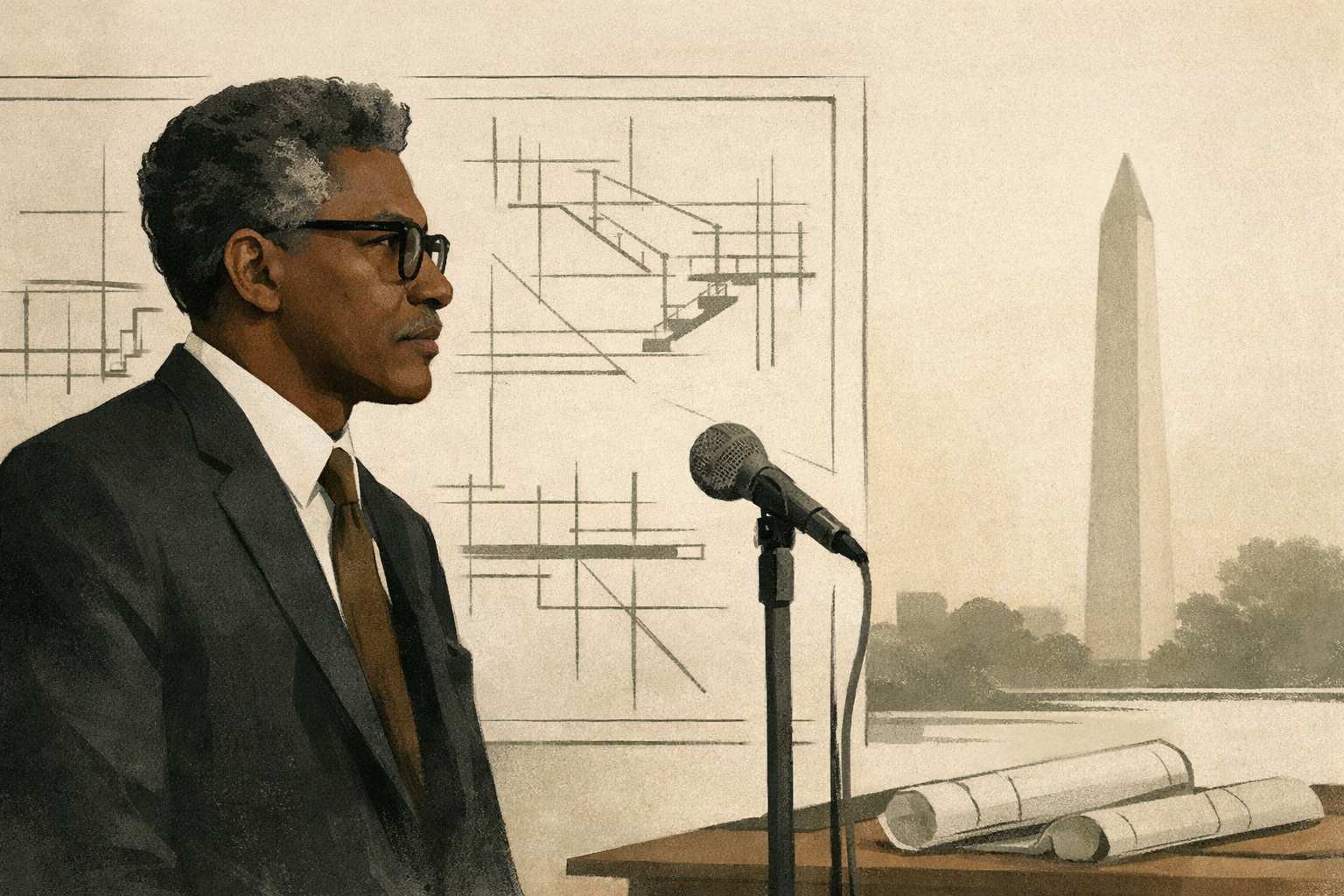
Bayard Rustin built the movement by doing something public memory rarely celebrates: he made moral conviction operational.
The speech matters. So does the person who made sure people could hear it. The crowd matters. So do the buses, trains, marshals, schedules, fundraising systems, coalition agreements, talking points, and thousands of decisions that allowed the crowd to arrive with purpose.
Rustin understood that distinction earlier than most. A just cause can be morally right and still fail operationally. Conviction needs a route. Pressure needs coordination. People need training. Coalitions need alignment. Scale needs structure.
That is what makes his life useful now. Rustin was not simply near some of the most important events of the American Civil Rights Movement. He helped build the machinery that allowed those events to carry weight.
History often remembers the person holding the microphone. Systems remember who made the microphone matter.
Before 1963, Rustin Was Already Building
Bayard Rustin was born in 1912 and raised by his maternal grandparents, Janifer and Julia Rustin, in West Chester, Pennsylvania. His grandmother’s Quaker faith helped shape his commitment to nonviolence, equality, and public service.
Those values did not remain private beliefs. Rustin spent his adult life turning them into organized action.
The 1941 pressure campaign
In 1941, labor leader A. Philip Randolph appointed Rustin youth organizer for a proposed March on Washington. Randolph and other Black leaders threatened a mass demonstration against discrimination in defense employment and the armed forces.
President Franklin D. Roosevelt ultimately issued Executive Order 8802, which prohibited discriminatory employment practices in the defense program and established the Committee on Fair Employment Practice to investigate discrimination. Randolph then called off the march.
The lesson was structural. The march did not have to occur for organized pressure to change federal policy. The credible ability to mobilize people had already altered the government’s calculation.
The first Freedom Ride
Six years later, Rustin and George Houser helped organize the 1947 Journey of Reconciliation. Sixteen Black and white men traveled through the Upper South to test the Supreme Court’s decision in Morgan v. Virginia, which barred state-enforced segregation in interstate bus travel.
Authorities arrested Rustin in North Carolina and convicted him of violating the state’s segregated-travel laws. He received a 30-day chain-gang sentence and returned to North Carolina in March 1949 to serve it. Rustin ultimately spent 22 days on the chain gang and later published a detailed account of the conditions he witnessed there. The journey became an important precursor to the Freedom Rides of 1961.
By then, the pattern was already visible. Rustin combined moral commitment with tactical design. He was willing to absorb personal risk, but he was equally interested in whether the action itself had a mechanism, purpose, and path toward consequence.
Youth organizer for A. Philip Randolph’s proposed March on Washington campaign.
Helps organize the Journey of Reconciliation, an early interracial challenge to segregated interstate travel.
Advises Martin Luther King Jr. and other civil rights leaders on nonviolent direct action and movement strategy.
Serves as deputy director and overall logistical planner of the March on Washington for Jobs and Freedom.
Continues working on labor, economic justice, human rights, and gay rights until his death in 1987.
Rustin Learned to Build Under Hostile Conditions
Rustin’s organizing career cannot be separated from the pressure surrounding it. He was Black, gay, a pacifist, a former member of the Young Communist League, and a strategist working in institutions that often considered some part of his life politically dangerous.
During World War II, he spent more than two years in federal prison as a conscientious objector. In 1953, authorities arrested him in Pasadena, California, on a morals charge related to homosexual activity. The conviction ended his position with the Fellowship of Reconciliation.
The consequences lasted much longer than the sentence.
His sexuality and earlier political associations gave opponents material they could use against him, Martin Luther King Jr., and the broader movement. Leaders therefore had to weigh not only Rustin’s extraordinary capability, but the political cost opponents could attach to his visibility.
That distinction matters. Rustin’s competence was rarely the question. The harder question was whether institutions were willing to absorb controversy on behalf of the person whose competence they needed.
Institutional Pattern
A system can depend on someone’s capacity while still refusing to give that person equal symbolic protection.
That is one reason Rustin’s story belongs in Foundation Innovators. The story is not only about exclusion. It is about what happens when essential infrastructure is built by someone the institution is reluctant to place at the center of its own narrative.
How Bayard Rustin Built the Movement in 1963
By 1963, A. Philip Randolph had returned to the idea of a national march. This time the scale was larger, the coalition was broader, and the political stakes were higher.
Randolph appointed Rustin deputy director of the March on Washington for Jobs and Freedom and placed the day-to-day organizing burden in his hands.
That burden was enormous.
The march had to bring together civil rights organizations, labor groups, religious institutions, local organizers, performers, speakers, volunteers, and hundreds of thousands of participants. It also had to remain disciplined enough that disorder would not become the story.
With only two months to plan, Rustin set up headquarters in Harlem and coordinated a core staff of roughly 200 organizers and volunteers. The work included recruiting marchers, organizing churches, raising money, coordinating buses and trains, preparing marshals, establishing crowd-control procedures, managing communications, and solving practical details ranging from the sound system to sanitation.
People had to reach Washington from across the country through coordinated bus, rail, and local organizing networks.
Marshals received nonviolent crowd-control training so the event could remain orderly under extraordinary pressure.
Organizers needed common messages, instructions, schedules, and information across a large coalition.
Sound, staging, sanitation, fundraising, staffing, and countless operational details had to function at the same time.
Approximately 250,000 people ultimately gathered in Washington on August 28, 1963. It was the largest civil rights demonstration in the United States to that point and became one of the defining public events of the Civil Rights Movement.
Martin Luther King Jr.’s “I Have a Dream” speech became its most famous moment. Yet the moment could carry national weight because an enormous operating system had been built underneath it.
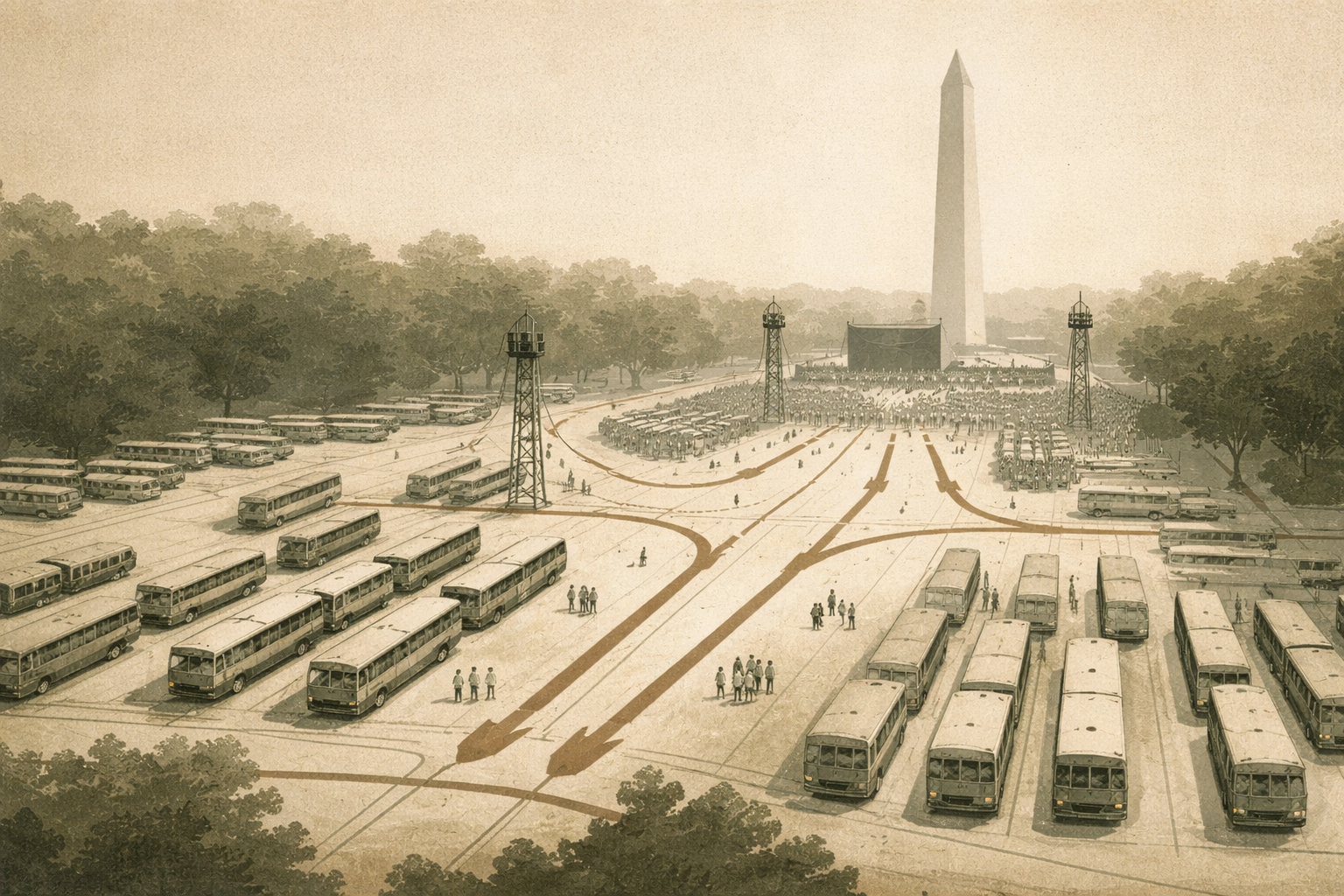
Scale did not make the march historic by itself. Organized scale did.
Necessary Does Not Always Mean Fully Protected
Rustin’s position exposes an uncomfortable institutional reality. Organizations often know exactly whose skill they need while remaining uncertain about whose full humanity they are prepared to defend.
Civil rights leaders understood Rustin’s organizing ability. They also understood that political opponents could weaponize his sexuality, pacifism, and earlier Communist affiliation.
That danger was not hypothetical.
On August 13, 1963, only two weeks before the march, Senator Strom Thurmond attacked Rustin from the floor of the United States Senate. Thurmond used Rustin’s former Communist affiliation, his imprisonment as a conscientious objector, and his 1953 conviction related to homosexual activity in an effort to discredit both the organizer and the demonstration he was helping build.
The attack clarified the stakes. Rustin was not being judged only on whether he could do the work. His personal history and political associations were being turned into weapons against the public legitimacy of the work itself.
Yet the march demonstrated something else. A. Philip Randolph stood behind Rustin, and the organizing coalition kept him in the operation. Capability could not simply be replaced by a more politically convenient public image.
The work continued. The operation succeeded.
That does not erase the discrimination Rustin faced. Instead, it makes the contradiction clearer: the same society that marginalized him depended on the organizational intelligence he brought to public life.
Recognition came later
Rustin died in 1987 at age 75. In 2013, President Barack Obama posthumously awarded him the Presidential Medal of Freedom. The White House recognized Rustin as a central organizer of the March on Washington and as an architect of social change.
The recognition mattered. The delay mattered too.
A medal can correct part of the public record. It cannot return the decades in which a builder’s contribution was easier to use than to fully honor.
Rustin’s Real Legacy Is a Method
The weakest way to remember Rustin is as a neglected historical figure who finally received recognition. That story is true, but it is incomplete.
The more useful inheritance is his method.
Rustin repeatedly translated values into operating systems. He asked what people had to do, how they would move, how conflict would be handled, what message would hold the coalition together, and what institutional pressure the action was designed to create.
Moral energy becomes useful when public action has a clear institutional objective.
Roles, transportation, staffing, rules, training, schedules, and resources turn intention into capacity.
Different organizations do not need identical interests, but they need enough coordination to move in one direction.
Discipline keeps public action from collapsing when pressure, disagreement, fatigue, or provocation arrives.
Groundwork Daily calls the first requirement Structure. Structure organizes roles, pathways, constraints, authority, and decision architecture. Rustin’s work makes that abstract idea visible.
The second requirement is Alignment. A coalition can contain different organizations, personalities, and interests. Those differences still have to coordinate around purpose, resources, priorities, and action.
Rustin did not eliminate complexity. He organized it.

The Modern Echo Is Infrastructure
Rustin’s lesson did not expire with the Civil Rights Movement. The technology of public communication has changed. The need for structure has not.
Large-scale civic work still requires training, transportation, communications, legal awareness, fundraising, coalition management, security planning, message discipline, follow-through, and a clear understanding of the institution being pressured.
Visibility can help mobilize people. It cannot replace those systems.
A viral message is not a coalition. A crowd is not automatically an organization. Agreement is not the same as coordination. Anger is not a strategy. Awareness is not institutional consequence.
That distinction is where Rustin becomes especially useful. He reminds us that public energy must eventually become organized capacity. Otherwise, the moment can become enormous while the underlying power remains thin.
The Structural Difference
Visibility creates attention. Infrastructure determines what attention can actually carry.
That lesson reaches beyond civic organizing.
Families need operating structure. Institutions need maintenance systems. Communities need people who coordinate work nobody applauds. Businesses need processes that survive the absence of a charismatic leader. Partnerships need agreements that remain useful after emotion changes.
In every case, the visible outcome rests on something less glamorous underneath.
What Rustin Leaves Us
Bayard Rustin does not need to be turned into a flawless hero for his work to matter. He is more useful than that.
His life shows what disciplined building looks like when the environment is hostile, the coalition is complicated, the timetable is compressed, and the builder himself carries vulnerabilities that opponents are eager to exploit.
He kept building anyway.
He built routes. He built training systems. He built coalitions. He built the operational order that allowed moral force to arrive in public without collapsing under its own scale.
So the deeper question is not whether we admire Bayard Rustin. It is whether we understand what he was doing.
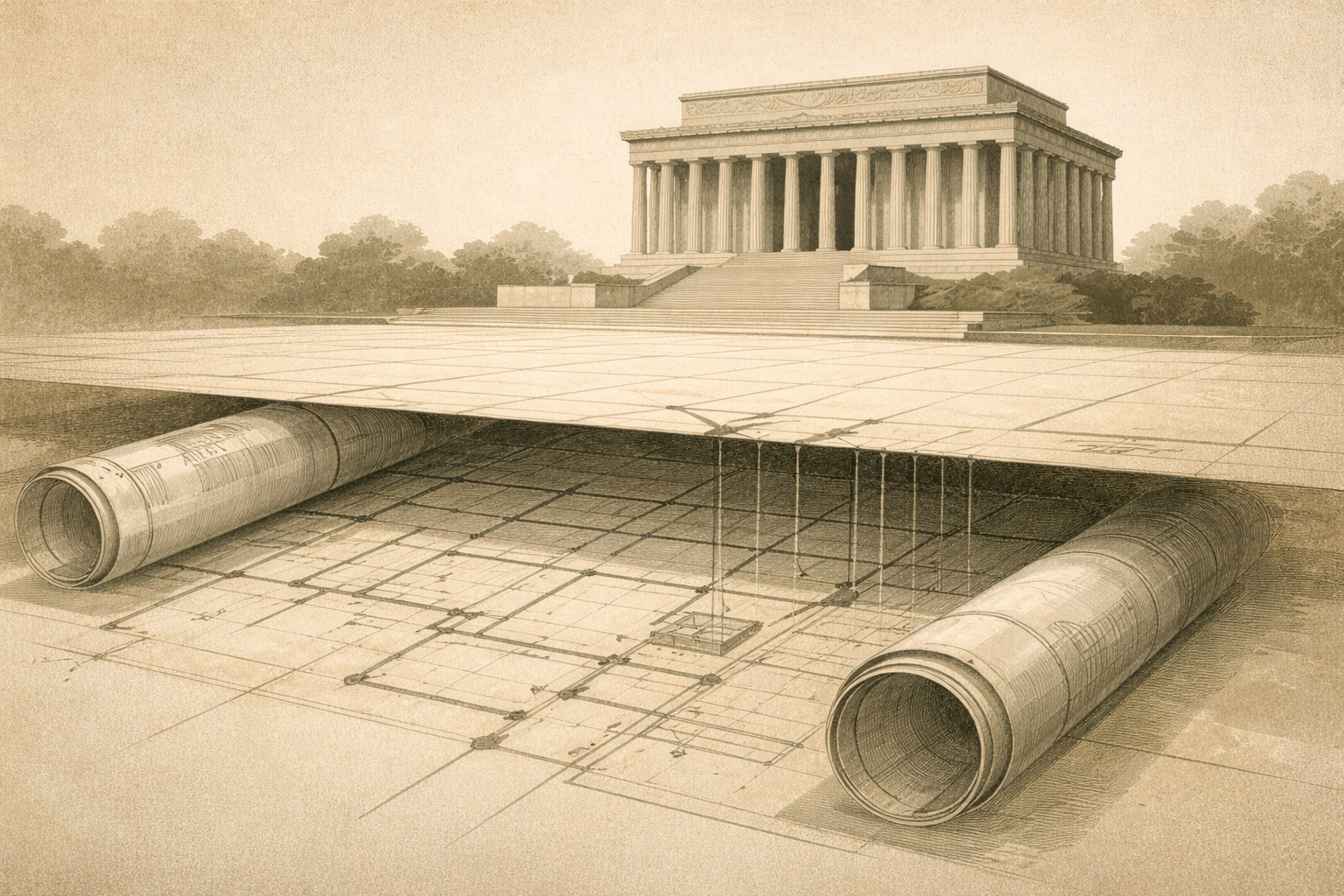
Every generation inherits structures that look almost inevitable because earlier builders already solved the invisible problems underneath them.
The work of the next generation is not merely to praise those structures. It is to understand how they were made, maintain what still holds, and build what the next moment requires.
The Groundwork
Moral clarity creates direction. Structure creates capacity. Alignment creates coordinated force. Discipline keeps the system together when pressure arrives.
Rustin’s legacy is not simply that he helped organize a historic march. He showed what happens when someone is willing to build everything conviction needs before asking the world to admire the result.
Continue Building
Rustin’s work shows the Groundwork architecture in practice. Move from the historical example into the principles that explain why the structure held.
→ Framework: Structure Builds Freedom
→ Mechanism: Structure: The Condition That Organizes the System
→ Mechanism: Alignment: The Condition That Coordinates the System
Receipts
→ National Park Service: Bayard Rustin
→ National Park Service: March on Washington for Jobs and Freedom
→ National Archives: Executive Order 8802
→ Library of Congress: Bayard Rustin and the Journey of Reconciliation
→ Congressional Record: August 1963 attacks on Bayard Rustin

Groundwork Daily Architecture
Primary Core Principle Structure Builds Freedom
Useful structure turns intention into reliable capacity and gives coordinated action room to work.
Primary Condition Structure
Structure organizes roles, pathways, constraints, authority, and decision architecture.
Supporting Condition Alignment
Alignment coordinates purpose, priorities, authority, incentives, resources, and action.
Supporting Principle Build What Holds
Durable systems must continue carrying the work after the public moment has passed.

Meet the Builder
The Groundwork Desk
Institutional Voice • Foundation Innovators
The Groundwork Desk examines the systems beneath history, institutions, culture, and public life. Its work moves beyond biography and recognition by asking what people actually constructed, which mechanisms made their work durable, and what those structures still teach us.
Within Foundation Innovators, The Desk recovers builders whose methods continue shaping the modern world, then translates those methods into usable Groundwork.
Continue Building
→ More from The Groundwork Desk
→ Explore The Original Builders
Reader Promise: Historical profiles that recover the builder, identify the system, and show why the structure still matters.