
System Updates · Institutional Power
The Great Incorporation is a Groundwork Daily framework for examining a central institutional question of the post-civil-rights era: what happens when legal access, representation, professional mobility, business opportunity, and market participation expand faster than durable ownership, wealth retention, and institutional capacity?
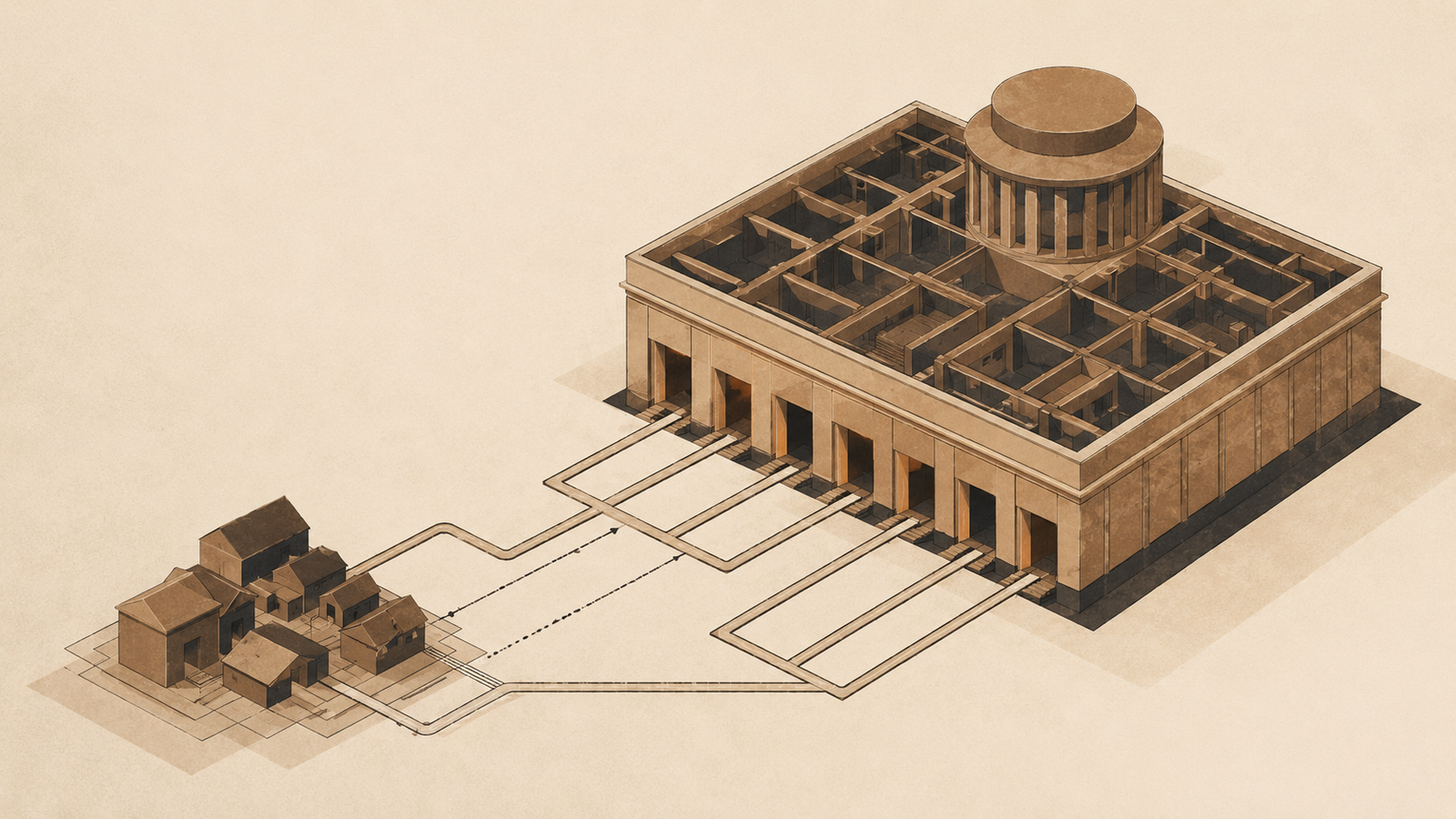
Analytical Frame
This article separates documented institutional changes from Groundwork Daily’s interpretation of them. Civil-rights legislation, federal minority-business policy, procurement systems, changes in media ownership, household wealth data, business formation, and development programs can be documented. “The Great Incorporation” is the interpretive framework used here to ask a different question: whether expanded access and representation produced durable, transferable institutional power at a comparable scale.
The Institutional Question Behind the Great Incorporation
The post-civil-rights transformation of Black American life cannot be described accurately as either simple progress or simple failure.
Legal barriers fell. Political participation widened. Black professionals entered institutions that had excluded them. Public-sector employment expanded. Minority-business programs opened contracting channels. Black elected officials, executives, entrepreneurs, academics, journalists, entertainers, and institutional leaders became more visible.
Those changes mattered.
Yet they raise a second question that access alone cannot answer: what became durable after the door opened?
The Great Incorporation is Groundwork Daily’s name for that institutional problem. It examines how growing participation in government, corporations, universities, media, nonprofit organizations, procurement systems, and financial markets interacted with the harder work of building ownership, retaining capital, preserving land, transferring assets, maintaining independent institutions, and creating succession.
The framework does not claim that Black Americans followed one strategy or that Black leadership moved uniformly in one direction. Different communities, organizations, political traditions, businesses, churches, unions, movements, and institutions pursued different strategies at different times.
The narrower argument is more defensible and more useful: access, representation, ownership, retention, and institutional capacity are different measures of power.
Access Expanded Faster Than Some Measures of Ownership
The distinction becomes visible in household wealth.
Federal Reserve data from the 2022 Survey of Consumer Finances estimated median wealth at about $285,000 for White families and $44,900 for Black families. Black median wealth had risen substantially from 2019, but the absolute White-Black median wealth gap also widened because the groups began from very different asset positions.
That evidence does not prove the Great Incorporation framework. It establishes something narrower: expanded participation and substantial Black wealth gains can coexist with a large racial wealth gap.
That is precisely why the institutional question matters.
Progress can occur in one layer while structural weakness persists in another.
The Core Distinction
The post-civil-rights era expanded the number of institutional pathways available to Black Americans. Professional achievement, electoral power, public employment, entrepreneurship, contracting, education, corporate advancement, and media visibility all became more significant routes to mobility and influence.
Some of those gains became durable. Others remained dependent on institutions, platforms, contracts, financing systems, or ownership structures controlled elsewhere.
This is where Structure Builds Freedom becomes the governing principle.
Access creates possibility. Structure determines whether that possibility can hold.
Visibility can create influence. Ownership determines whether value can be retained.
Representation can change who participates. Continuity determines whether the gain survives the person who achieved it.
From Civil Rights to Market Access
The Civil Rights Act of 1964 and Voting Rights Act of 1965 altered the legal and political structure of the United States by attacking major systems of formal racial exclusion.
Those achievements did not automatically resolve questions of capital, property, business ownership, housing, inheritance, credit, or institutional control.
The economic question therefore remained distinct from the legal-access question.
What Came After Legal Access?
By the late 1960s, debates over Black economic power included competing ideas about public investment, employment, redistribution, community control, entrepreneurship, ownership, and private enterprise.
The federal government increasingly developed minority-business policy as one component of that landscape.
President Richard Nixon signed Executive Order 11458 on March 5, 1969. The order established federal arrangements for developing and coordinating a national program for minority business enterprise. Executive Order 11625 superseded that framework in 1971 and expanded the federal minority-business-enterprise program.
These policies created institutional channels for entrepreneurship and contracting. They did not settle the larger debate over what economic power should mean.
Access and Control Measure Different Things
This distinction is foundational.
Market access asks whether people or firms can participate in an existing economic system.
Ownership asks who controls productive assets, land, equity, financing, intellectual property, distribution, and appreciating value.
Community capacity asks whether institutions can retain those resources, coordinate them, reproduce them, and transfer them across generations.
These layers can reinforce one another, but they are not interchangeable.
A successful entrepreneur can create jobs and assets. A procurement program can open markets. A professional appointment can alter institutional decision-making. None of those outcomes should be dismissed merely because they do not solve every structural problem.
At the same time, none should be treated as evidence that the ownership question has automatically been solved.
The Institutional Incentive Structure Changed
Earlier civil-rights organizing drew heavily on churches, unions, civic associations, student organizations, legal organizations, local newspapers, membership networks, and other institutions capable of coordinating collective action.
As legal access expanded, additional routes to influence became available through elected office, government agencies, corporations, foundations, universities, professional organizations, procurement systems, and national media.
The Great Incorporation framework studies what happens when those newer channels become more important to advancement and leadership.
The key question is not whether entering established institutions was good or bad.
The key question is what entry changed inside the institution, what resources became controlled, and what remained dependent on someone else’s structure.
Procurement Capitalism
Public procurement became an important route through which minority-owned firms could gain access to government spending and major development projects.
That mechanism deserves to be evaluated on its own terms.
The Atlanta Example
Atlanta under Mayor Maynard Jackson became an important case in the history of minority contracting. Jackson used the city’s purchasing and development power to press for greater participation by minority-owned businesses, including during the expansion of Atlanta’s airport.
The significance of that strategy was institutional. Political authority was connected to procurement rules, and procurement rules could alter who participated in public spending.
That created real opportunity.
It also exposes the next layer of the problem.
The Subcontracting Pyramid
A minority-owned firm can receive substantial work without controlling the financing, development structure, prime contract, underlying real estate, or long-term asset.
That is not a reason to dismiss subcontracting. Subcontracting can build expertise, revenue, employment, relationships, and operating capacity.
It is a reason to measure what happens next.
Does the firm survive?
Does it accumulate equity?
Does it graduate into prime contracting?
Does it build a durable workforce?
Does ownership transfer to another generation?
Does the surrounding community retain more of the value created by public spending?
Those questions turn procurement from an inclusion metric into a capacity metric.
Access Is Not Retention
Procurement can create opportunity without automatically creating broad community wealth.
That distinction is central to this framework.
A contract records who received a piece of spending. It does not by itself tell us where profits accumulated, whether the business survived, whether workers gained assets, whether local suppliers expanded, or whether enterprise value remained in the community.
This is where Discipline Before Dollars becomes institutional rather than merely personal.
Public spending should be evaluated by what it builds.
What Procurement Should Measure
A stronger procurement scoreboard would track contract awards, but it would not stop there.
It would also examine firm survival, movement from subcontracting to prime contracting, payroll growth, workforce development, capitalization, local supply chains, ownership transfer, and the durability of the enterprises created.
The distinction is simple.
Participation measures entry. Capacity measures what entry made possible.
Representation and Infrastructure
Representation matters because institutions make decisions through people.
Who occupies elected office, executive leadership, university administration, corporate management, journalism, philanthropy, and public agencies can affect agendas, opportunities, enforcement, legitimacy, and resource allocation.
But representation and infrastructure answer different questions.
When Representation Becomes Infrastructure
Representation becomes structurally durable when access helps produce institutions, assets, rules, knowledge, ownership, capital, succession, or other forms of capacity that can survive beyond an individual officeholder or leader.
That standard changes the measurement problem.
A historic appointment can matter even if it does not transform an entire institution.
A Black-owned company can matter even if it does not eliminate the racial wealth gap.
A Black elected official can matter even if political representation does not automatically create household wealth.
The mistake occurs when one form of progress is used as proof that every other layer has also changed.
The Celebrity Proxy Problem
Exceptional individual success is especially easy to confuse with broad economic security.
A billionaire, athlete, entertainer, founder, executive, or media personality can possess substantial economic power. That person’s achievement may also create jobs, investment, philanthropy, businesses, or cultural influence.
Still, individual net worth and population-level wealth are different measures.
The existence of exceptional wealth does not tell us the median household’s balance sheet, the rate of business survival, the amount of locally owned land, the distribution of equity, or the strength of institutions capable of transferring resources across generations.
This is not an argument against excellence.
It is an argument for measuring excellence and infrastructure separately.
The Transfer Test
The deeper test of institutional power is what can be transferred.
What assets remain?
What institution survives?
What knowledge was preserved?
Who was trained to take over?
What changed after the leader left?
Representation can have value even when those questions produce incomplete answers. But those answers tell us whether representation also became durable capacity.
Media, Visibility, and Platform Power
Media is another place where access, visibility, and ownership can diverge.
Black newspapers, radio stations, churches, civic organizations, and other communication networks historically served functions that extended beyond content. They distributed information, preserved memory, coordinated action, created employment, and helped communities define their own agendas.
Local Media Was Infrastructure
The Telecommunications Act of 1996 significantly changed federal media-ownership rules. Subsequent consolidation, particularly in radio, generated concerns at the Federal Communications Commission about concentration in local markets.
The institutional issue is larger than any single statute.
When ownership consolidates, a community can retain an audience while losing control over distribution.
That distinction becomes even more important in the platform era.
Platform Leadership Changed the Reward System
Membership institutions and digital platforms create different accountability structures.
A membership organization may depend on meetings, dues, bylaws, elections, records, local chapters, succession, and continuing participation.
A digital platform may reward reach, frequency, engagement, personality, conflict, entertainment, or attention.
Neither model is automatically legitimate or illegitimate. They simply produce different incentives.
The structural question is what happens when public influence becomes increasingly dependent on privately controlled distribution systems.
Audience Is Not Ownership
A creator can own a business and build durable intellectual property. A digital audience can become the foundation for a company, publication, subscription product, production studio, or independent distribution network.
But an audience by itself is not the same thing as owning the infrastructure through which that audience is reached.
Algorithms can change. Platforms can alter terms. Sponsors can leave. Distribution can weaken.
Institutions can also fail, but durable institutions can hold archives, employ people, establish standards, train successors, preserve knowledge, and create continuity beyond a single personality.
The Great Incorporation framework calls visibility that remains dependent on outside distribution rented visibility.
The strategic question is whether rented visibility eventually becomes owned infrastructure.
Development, Land, and the Ownership Test
Urban development creates another version of the same problem.
Neighborhoods generate value through location, housing, commerce, social networks, institutions, culture, history, and public investment.
When investment increases, property values and development activity can rise.
The institutional question is who owns the appreciating assets.
Who Captures the Value?
Opportunity Zones, tax incentives, redevelopment programs, stadium projects, university expansion, hospital expansion, housing investment, and private development operate through different legal and financial mechanisms.
They should not be collapsed into one policy.
They do, however, permit the same analytical question:
Who owns the asset after new capital arrives?
Opportunity Zones illustrate the distinction. The federal program was designed to encourage investment in designated low-income census tracts through tax incentives for qualifying investments.
That structure measures capital attraction more directly than it measures resident ownership.
Investment entering a neighborhood and wealth remaining with existing residents are therefore separate outcomes.
Capital Leakage Follows Weak Retention
Groundwork Daily uses capital leakage to describe value generated within a place or community that ultimately accumulates elsewhere because local ownership or retention mechanisms are weak.
Consider land.
If property values rise and residents own appreciating property, some of that increase can strengthen household balance sheets.
If residents rent while outside owners hold the appreciating property, the same increase can create higher housing costs without generating an offsetting asset gain for those residents.
The same development cycle can therefore produce different outcomes depending on ownership.
Revitalization Requires a Retention Measure
A serious development analysis should ask more than how much capital entered.
Who owns the land?
Who owns the housing?
Who owns commercial property?
Who financed the project?
Who captures appreciation?
Can existing residents remain?
Can ownership transfer to the next generation?
Those questions do not predetermine whether a development project succeeded or failed. They reveal which outcomes should be measured alongside investment, construction, tax revenue, and economic activity.
The Wealth Architecture Problem
Wealth is not simply accumulated income.
It is the net result of assets and liabilities, shaped over time by ownership, earnings, saving, investment returns, housing, business equity, debt, inheritance, taxation, valuation, and transfer.
Wealth Is Built in Layers
The Federal Reserve’s Survey of Consumer Finances shows substantial differences in household wealth across racial groups. It also shows that the composition of wealth matters.
Between 2019 and 2022, median Black family wealth increased substantially. Housing contributed heavily to wealth growth for Black families during that period.
Those gains matter.
So does the remaining gap.
The two facts can be true simultaneously.
This is an important discipline because a structural analysis becomes unreliable when it recognizes only evidence that supports its thesis.
Economic Activity Is Not the Same as Durable Capacity
Business formation is another example.
A self-employed business can generate income, independence, expertise, and a pathway toward growth. An employer firm adds another institutional layer because it coordinates payroll, workers, operating systems, customers, capital, and enterprise value.
Neither form should be dismissed.
The relevant question is what capacity the enterprise can reliably carry.
Can it survive a downturn?
Can it obtain financing?
Can it employ others?
Can it operate without the founder?
Can ownership be transferred?
Can it become an institution rather than remaining only an income stream?
Individual Discipline and Institutional Design Do Different Jobs
Personal discipline matters.
Education matters. Saving matters. Entrepreneurship matters. Career advancement matters. Household financial decisions matter.
Institutional design matters too.
Credit markets, inheritance systems, property law, housing markets, business finance, appraisal, taxation, insurance, public investment, and labor markets affect the environment in which individual decisions produce outcomes.
There is no serious reason to choose between agency and structure.
A strong analysis asks how they interact.
Individual responsibility cannot substitute for functional institutions. Functional institutions cannot substitute for individual judgment and action.
The durable system needs both.
From Access to Durable Capacity
The Great Incorporation framework becomes useful only if it produces a better institutional test.
The answer cannot be nostalgia.
The organizational environment of the mid-twentieth century cannot simply be recreated. Labor markets changed. Union membership changed. Media changed. Religious participation changed. Urban land markets changed. Technology changed. Capital became more mobile. Social networks became digital.
The useful question is what institutional functions still need to be performed.
1. Land Retention
Land is both an economic asset and a platform for institutional continuity.
Community land trusts, cooperative housing, estate planning, title clearing, homeownership strategies, and other anti-displacement mechanisms can be evaluated by a common standard: whether they increase the ability of residents and institutions to retain control over place as value changes.
2. Capital Retention
Businesses require financing that can survive beyond initial formation.
Community investment vehicles, cooperative finance, mission-oriented lenders, conventional banks, public financing tools, equity investment, and other forms of patient capital can play different roles.
The governing question is whether capital merely passes through or helps create assets capable of compounding and financing the next generation of activity.
3. Media Ownership
Reach is useful. Distribution is more durable when it is owned.
Newsletters, publications, podcasts, archives, production companies, membership systems, websites, intellectual property, and local media organizations can convert attention into institutional capacity when they are built to survive changes in third-party platforms.
4. Procurement Redesign
Procurement should continue to measure participation while adding measures of durability.
Firm survival, capitalization, payroll growth, prime-contracting capacity, employee development, local sourcing, ownership succession, and enterprise value provide a fuller picture of what public spending built.
5. Succession Systems
Institutions need leadership pipelines, governance documents, records, board discipline, operating standards, training, and continuity plans.
This is where Accountability Is a Form of Strength.
Charisma can start something. Continuity requires structure.
The difference between representation and infrastructure becomes clearest here.
Representation asks who reached the position.
Infrastructure asks what remains when that person leaves it.
The Groundwork
The Durable Takeaway
The Great Incorporation is not an argument that access failed.
Access produced real gains. Civil-rights protections mattered. Political representation mattered. Public-sector employment mattered. Procurement mattered. Business creation mattered. Education mattered. Professional mobility mattered. Media access mattered.
The framework asks what comes after those gains.
Did access become ownership?
Did ownership become retention?
Did retention become transfer?
Did representation produce institutional capacity that survived the representative?
Did investment leave residents with appreciating assets?
Did business access produce enterprises capable of surviving beyond the founder?
Did visibility become owned distribution?
Those questions produce a more demanding scoreboard without erasing the progress that preceded them.
Access changes who can enter. Durable power depends on what can be owned, retained, transferred, maintained, and rebuilt.
A Stronger Scoreboard
The next analytical step is therefore measurement.
How much land remained locally owned?
How much capital stayed available for reinvestment?
How many firms survived beyond their founders?
How many subcontractors became prime contractors?
How many workers accumulated assets or ownership?
How many institutions trained successors?
How much media distribution remained independently controlled?
How much value remained after attention, leadership, or political conditions changed?
No single measure answers the whole question.
Together, they distinguish entry from endurance.
The post-civil-rights expansion of access opened institutions that had long excluded Black Americans. The unfinished institutional question is what can be built from that access that does not disappear when the contract ends, the office changes hands, the platform shifts, the property appreciates, or the spotlight moves elsewhere.
Frequently Asked Questions
What is the Great Incorporation?
The Great Incorporation is a Groundwork Daily analytical framework for examining how expanded post-civil-rights access to government, business, procurement, professional institutions, media, and markets interacted with ownership, wealth retention, institutional independence, and continuity.
Is the Great Incorporation a historical period or established academic theory?
No. The term is being used here as Groundwork Daily’s interpretive framework. The underlying legislation, policies, economic data, business programs, media changes, and development systems are independently documentable. The framework connects those developments through the question of whether expanded access became durable institutional capacity.
What is individualized economic sovereignty?
In this framework, individualized economic sovereignty describes strategies that locate economic advancement primarily in personal earnings, entrepreneurship, professional mobility, investment, or individual asset accumulation. Those strategies can create real gains. The institutional question is whether individual gains also produce transferable capacity beyond the individual.
How did federal minority-business policy relate to the civil-rights era?
Federal minority-business programs became one component of the post-civil-rights economic-policy landscape. Executive Order 11458 in 1969 established a national federal program for minority business enterprise, and Executive Order 11625 superseded and expanded that framework in 1971. These policies emphasized business development and market participation while broader debates over employment, redistribution, ownership, and community control continued.
Why does representation not automatically create wealth?
Representation and wealth operate through different mechanisms. Representation can affect access, decision-making, legitimacy, agendas, and opportunity. Household and institutional wealth also depend on assets, liabilities, ownership, inheritance, business equity, property, financing, valuation, investment returns, and transfer.
What does procurement capitalism mean in this article?
Procurement capitalism is the article’s shorthand for economic opportunity created through public or institutional purchasing, contracting requirements, minority-business programs, and related access to large spending systems. The framework evaluates procurement not only by contract awards but also by firm durability, ownership, capitalization, employment, and transfer.
What is the difference between representation and institutional ownership?
Representation concerns who participates in or leads an institution. Institutional ownership concerns control over assets, capital, enterprises, distribution, property, or other structures capable of retaining and transferring value. The two can reinforce each other, but one does not automatically produce the other.
Why does media ownership matter?
Media ownership can provide control over distribution, archives, intellectual property, employment, standards, revenue, and institutional memory. Platform visibility can create substantial influence, but dependence on third-party distribution creates a different form of institutional risk.
What does this framework propose measuring instead?
It proposes measuring access alongside ownership, retention, durability, transfer, succession, local capital formation, land control, firm survival, media ownership, and institutional continuity. The purpose is not to replace one simplistic scoreboard with another. It is to measure more of the system.
Continue Building
From Incorporation to Institutional Inheritance
This article asks what happens when access and representation expand faster than ownership and durable institutional capacity. What Survives When Empire Ends? extends that institutional discipline across a different scale by examining what structures, assets, obligations, and capabilities remain after formal political arrangements change.
The connecting question is durability: what did the system build, what could it transfer, what remained dependent, and what could continue after the people or political moment that produced it were gone?
Groundwork Architecture
What This Article Is Built On
Core Principle: Structure Builds Freedom
Primary Condition: Structure
Supporting Conditions: Accountability · Continuity
Governing Mechanism: Access → Participation → Representation → Ownership → Retention → Transfer → Continuity

Research Trail
Receipts
The Great Incorporation is an interpretive framework. The sources below support the historical events, public-policy structures, household-finance data, media changes, business evidence, and development mechanisms discussed in the article. They do not independently establish the framework’s interpretive conclusions.
Racial Wealth and Household Finance
→ Federal Reserve: Greater Wealth, Greater Uncertainty
→ Federal Reserve: Changes in U.S. Family Finances from 2019 to 2022
Minority Business Policy
→ National Archives: Executive Order 11458
Media Ownership and Consolidation
→ FCC: Implementation of the Telecommunications Act of 1996 Radio Ownership Provisions
→ FCC: Statement on Radio Ownership Concentration After the 1996 Act
Wealth, Business, and Development Research
→ Brookings: Black Wealth Is Increasing, but So Is the Racial Wealth Gap
→ Kindred Futures: Black Wealth in Atlanta
Groundwork Daily Architecture
Access can change who enters a system. The harder institutional question is what becomes owned, retained, transferable, and durable after entry.