
Building Institutional Literacy
A constitutional rights violation is not established simply because something government did was unfair, harmful, intrusive, or connected to a constitutional right.
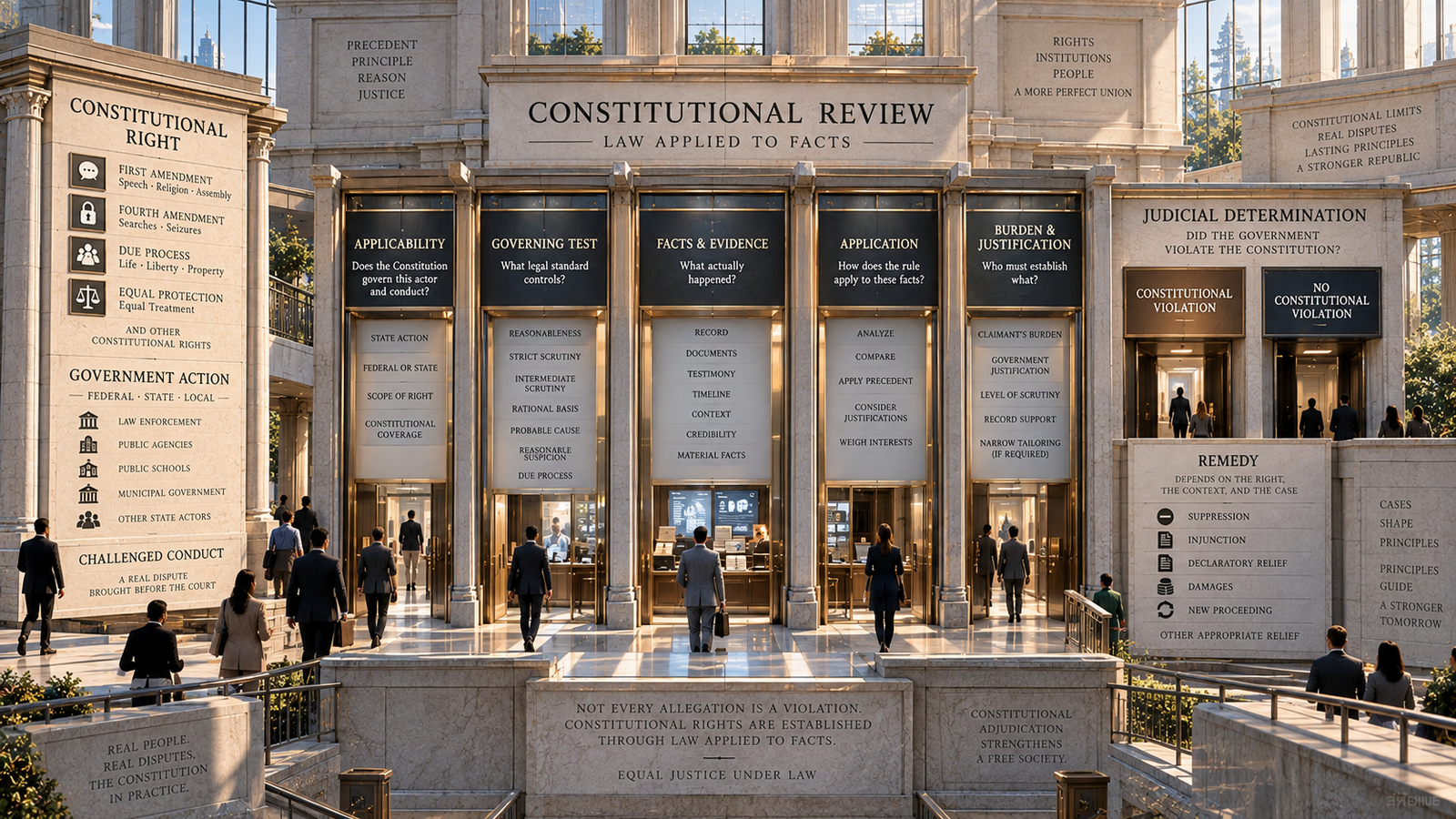
Courts have to do more. They identify the constitutional protection at issue. They determine whether the challenged conduct is attributable to government and whether that protection governs the dispute. Then they identify the controlling legal rule, examine the facts, and apply the rule to those facts.
How Courts Decide Whether a Constitutional Right Was Violated
This process is called constitutional adjudication. It is how courts move from constitutional text and precedent to a legal judgment about an actual government action.
Different rights require different analyses. A Fourth Amendment search case may turn on reasonableness, probable cause, a warrant requirement, or an exception. An Equal Protection case may require a level of scrutiny. A procedural due process case asks what protected interest is at stake and what process the Constitution requires.
There is no single universal test for every constitutional dispute. What remains consistent is the institutional sequence: identify the right, locate government action, determine the governing doctrine, establish the relevant facts, apply the law, and decide whether the constitutional boundary was crossed.
Even then, another question remains. A constitutional violation and the remedy for that violation are related, but they are not the same legal determination.
Critical Legal Note
This guide is educational, not legal advice. Constitutional claims are highly dependent on the specific right, government actor, procedural posture, jurisdiction, facts, controlling precedent, and available cause of action. Establishing that government violated a constitutional right does not automatically establish entitlement to damages or any particular remedy. Specific disputes require current legal analysis and qualified counsel.
Groundwork Guide
A Constitutional Right Is the Starting Point, Not the Verdict
The Constitution contains broad protections, but courts decide concrete disputes. A judge therefore cannot stop after identifying language such as freedom of speech, unreasonable searches, due process, or equal protection.
The court must translate that constitutional protection into the doctrine governing the particular case. That doctrine may contain thresholds, exceptions, burdens, standards of review, procedural requirements, or multi-part tests developed through precedent.
This distinction explains why two cases involving the same constitutional provision can produce different results. The right may be the same while the government action, factual setting, legal test, or institutional context differs.
The existence of a constitutional right does not answer whether that right was violated. Courts still have to connect the right to a government action, a governing rule, and the facts of the dispute.
Courts Resolve Cases, Not Abstract Constitutional Questions
Federal courts operate within Article III’s case-or-controversy requirement. Constitutional adjudication therefore occurs through disputes that satisfy requirements governing federal judicial power, rather than through general advisory opinions about whether a policy seems constitutional in the abstract.
Doctrines involving standing, mootness, ripeness, and other justiciability limits can affect whether a federal court may reach the constitutional merits at all. Those threshold doctrines perform a different job from the constitutional test itself.
This creates an important distinction: a court can dismiss a case without deciding whether the challenged conduct was constitutional. Jurisdiction and justiciability come before merits when they are genuinely disputed.
The Groundwork Constitutional Adjudication Framework
Constitutional analysis becomes easier to follow when the judicial process is separated into distinct institutional questions. Not every case litigates every step, and the precise sequence can vary. Still, the framework reveals what a court must ultimately connect before declaring government conduct unconstitutional.
Analytical discipline matters: “I have a constitutional right” and “government violated my constitutional right” are two different propositions.
Step One: Does This Constitutional Protection Govern This Conduct?
Before a court decides whether a constitutional boundary was crossed, it has to determine whether the constitutional provision applies to the actor and conduct before it. That can involve several separate structural questions.
Who acted? Was it the federal government, a state, a municipality, a public school, a police officer, a court, or a private organization? Which constitutional provision is invoked? Does that provision constrain this government actor?
Government Action Matters
Many constitutional protections restrict government rather than purely private conduct. When a private actor is involved, the court may need to determine whether the challenged conduct can legally be attributed to government.
That is the work of the State Action Doctrine. A private entity’s receipt of public funding, government regulation, or cooperation with public institutions does not automatically make every action of that entity governmental.
The Level of Government Matters Too
The original Bill of Rights constrained federal power. Most of its major protections now also constrain state and local government through the Fourteenth Amendment.
The Incorporation Doctrine explains that constitutional connection. It answers whether a particular Bill of Rights protection applies against state and local government.
Applicability comes before merits: first determine whether the constitutional protection governs the challenged actor and conduct. Only then does the court ask whether that protection was violated.
Step Two: What Constitutional Test Controls?
Constitutional provisions often use broad language. Judicial doctrine gives that language operational structure by developing rules for recurring categories of disputes.
The governing test depends on the constitutional right and the government action involved. Courts therefore do not feed every constitutional claim into the same standard of review.
| Constitutional Context | Possible Governing Inquiry | What the Court Is Trying to Determine |
|---|---|---|
| Fourth Amendment | Reasonableness, warrant requirements, probable cause, reasonable suspicion, or a recognized exception | Whether a search or seizure complied with the constitutional rule governing that type of government action. |
| Equal Protection | Strict scrutiny, intermediate scrutiny, rational basis, or another context-specific framework | Whether government’s classification or differential treatment satisfies the applicable constitutional standard. |
| Procedural Due Process | Protected interest, deprivation, and constitutionally sufficient process | Whether government supplied the process constitutionally required before or around a deprivation. |
| First Amendment | Tests vary by speech category, forum, government role, regulation, and other context | Whether government restricted protected expression in a constitutionally permissible manner. |
| Sixth Amendment | Right-specific criminal procedure standards | Whether the government respected the particular trial or defense guarantee involved. |
| Eighth Amendment | Doctrine varies across punishment, fines, bail, prison conditions, and related contexts | Whether government action crosses the constitutional boundary established for the specific Eighth Amendment protection. |
There Is No Universal Constitutional Scrutiny Test
The familiar levels of scrutiny are important, but they are not a master test for the entire Constitution. Strict scrutiny, intermediate scrutiny, and rational basis review appear prominently in equal protection and in certain other constitutional contexts. Fourth Amendment cases, by contrast, often revolve around reasonableness, warrants, probable cause, reasonable suspicion, and exceptions.
Procedural due process uses another structure. The court may first ask whether government deprived a protected life, liberty, or property interest. If so, it determines what process the Constitution required under the circumstances.
Constitutional literacy therefore requires a second classification skill after identifying the right: identify the doctrine that actually governs that kind of constitutional claim.
Step Three: Facts Determine How Constitutional Doctrine Operates
Constitutional cases are not decided by doctrine alone. Courts apply doctrine to facts, and the facts determine which portions of the doctrine become relevant.
A police encounter may be consensual at one moment and become a seizure later. A search may be lawful with valid consent but unlawful without it. Government treatment may survive rational basis review yet fail strict scrutiny. A hearing that provides adequate process in one administrative setting may be inadequate where the private interest and risk of error are much greater.
The Same Right Can Produce Different Outcomes
Consider the Fourth Amendment. Two searches can involve the same constitutional protection but differ in location, consent, warrant status, probable cause, exigency, scope, timing, and the person’s relationship to the place or property searched.
Those facts can change the constitutional analysis. The court is not changing the Fourth Amendment from one case to the next. It is applying the governing doctrine to materially different circumstances.
Facts do not sit beside constitutional doctrine. They determine how the doctrine attaches to the real-world conduct before the court.
Which Facts Matter Is Itself a Legal Question
Courts do not treat every detail in a record as constitutionally significant. The governing legal test identifies which facts matter.
If the doctrine asks whether an officer had reasonable suspicion, facts relevant to that inquiry become central. If strict scrutiny applies, the government’s asserted interest and the relationship between its classification and that interest become critical. If procedural due process is at issue, the protected interest, risk of erroneous deprivation, existing safeguards, possible additional procedures, and governmental burdens may matter.
Doctrine therefore organizes evidence. It tells the court which features of a complicated real-world dispute carry constitutional weight.
Step Four: Courts Apply Law to Facts
Application is where constitutional analysis becomes most visible. The court has identified the right, located the relevant government action, selected the governing rule, and established or assumed the relevant facts. It must now determine what the rule means for this dispute.
Judges compare the case with controlling precedent. They examine similarities and differences. They consider how prior courts defined the constitutional boundary and whether the present facts fall on one side of that boundary or the other.
Constitutional Analysis Is Often Analogical
Precedent rarely supplies a previous case with perfectly identical facts. Courts therefore reason by analogy. They ask whether legally important facts resemble or differ from earlier decisions and whether those similarities or differences change the constitutional result.
This is one reason constitutional litigation can remain contested even when everyone agrees on the text of an amendment. The disagreement may concern which precedent controls, how broadly a prior rule should be read, which facts are legally significant, or how a constitutional standard applies in a new setting.
Rules, Standards, and Multi-Part Tests Behave Differently
Some constitutional doctrines provide relatively defined rules. Others use standards such as reasonableness. Still others require several analytical steps or the balancing of constitutionally relevant considerations.
The form of the doctrine affects the judicial task. A more rule-like test can narrow the inquiry. A contextual standard can make factual distinctions especially important. Neither structure allows a court simply to substitute a personal sense of fairness for the governing law.
Step Five: Burdens and Government Justifications Matter
Constitutional litigation also requires attention to burdens. Who must establish the elements of a claim? When must government justify its action? How demanding is that justification?
There is no single answer across constitutional law. The allocation of burdens depends on the doctrine, procedural posture, and claim.
Strict Scrutiny Places a Demanding Burden on Government
When strict scrutiny governs a challenged governmental classification or restriction, government generally must establish a compelling interest and show that its action satisfies the demanding fit required by the doctrine, commonly expressed through narrow tailoring.
That is substantially different from rational basis review, where government action generally receives much greater judicial deference. Intermediate scrutiny occupies another doctrinal position and requires its own form of justification and fit.
Do Not Import Scrutiny Into Every Constitutional Case
A police officer does not ordinarily defend a traffic stop by establishing a compelling governmental interest under strict scrutiny. The Fourth Amendment has its own doctrines governing seizures, reasonable suspicion, probable cause, warrants, and reasonableness.
Likewise, a procedural due process dispute does not ordinarily begin by choosing among strict scrutiny, intermediate scrutiny, and rational basis. The court instead identifies the protected interest and asks what process the Constitution requires.
The governing constitutional doctrine determines the burden. The burden does not determine which constitutional doctrine governs.
Step Six: Precedent Gives Constitutional Text Operational Meaning
Courts do not ordinarily approach each constitutional dispute as if no court has interpreted the provision before. Under the judicial system’s rules of precedent, earlier decisions can establish controlling constitutional principles for later cases.
Lower federal courts must follow controlling Supreme Court precedent on federal constitutional questions. They are also bound by applicable precedent from the federal appellate court governing their circuit. State courts deciding federal constitutional questions must likewise follow controlling Supreme Court interpretations of federal constitutional law.
Precedent Can Define the Test Before the New Case Begins
A constitutional case often arrives with much of its analytical architecture already established. Prior decisions may identify the legal test, define important terms, allocate burdens, recognize exceptions, and specify which facts are constitutionally significant.
The new dispute then asks how that existing framework applies to a new record. In harder cases, courts may also confront competing lines of precedent or factual circumstances that existing cases did not clearly resolve.
Constitutional Interpretation and Constitutional Application Are Related but Distinct
Sometimes a court must determine what a constitutional provision means at a relatively general level. In many cases, however, the dispute concerns how an already recognized constitutional rule applies to particular conduct.
Keeping those tasks distinct helps explain why constitutional litigation is not always a referendum on the entire meaning of an amendment. Many cases concern the application of an established doctrine to a specific institutional action.
Step Seven: Violation or No Constitutional Violation
After the court applies the governing constitutional rule to the relevant facts, it can reach the merits determination: government either crossed the constitutional boundary established by that doctrine or it did not.
A finding of no constitutional violation does not necessarily mean the government’s conduct was wise, fair, ethical, or good policy. Constitutional law establishes particular legal boundaries. Conduct can survive constitutional review while remaining subject to criticism, legislation, administrative reform, state-law restrictions, or political accountability.
Likewise, Illegality Is Broader Than Unconstitutionality
Government can violate a statute or regulation without violating the Constitution. A public official can violate internal policy without creating a federal constitutional claim. A state can provide protections beyond the federal constitutional minimum.
This distinction is central to institutional literacy. Unfair, unlawful, unconstitutional, against policy, and unwise are not interchangeable legal categories.
| Question | What It Asks |
|---|---|
| Was it unfair? | A normative judgment that does not by itself identify a legal violation. |
| Was it against policy? | Whether conduct violated an institution’s internal rules or procedures. |
| Was it unlawful? | Whether conduct violated a statute, regulation, constitutional rule, or other applicable law. |
| Was it unconstitutional? | Whether government crossed a boundary imposed by the Constitution under the governing doctrine. |
A Constitutional Violation Does Not Automatically Determine the Remedy
Finding a constitutional violation answers the merits question. It does not automatically answer what happens next.
Constitutional remedies depend on the type of case, the right involved, the procedural setting, the defendant, the cause of action, immunity doctrines, jurisdiction, and other legal requirements. Different constitutional violations can therefore produce very different forms of relief.
Criminal Procedure
Suppression
In some criminal cases, unlawfully obtained evidence may be excluded under doctrines governing the exclusionary rule. Suppression is not a universal remedy for every constitutional violation.
Prospective Relief
Injunction
A court may sometimes order government officials to stop or refrain from unconstitutional conduct when the requirements for injunctive relief are satisfied.
Legal Status
Declaratory Relief
In an appropriate case, a court may issue a declaration concerning the parties’ legal rights or the constitutionality of challenged government conduct.
Civil Liability
Damages
Monetary damages may be available in some constitutional litigation, but a constitutional violation alone does not automatically establish a damages claim against every governmental defendant.
Proceedings
New or Corrected Proceeding
Some constitutional errors can affect a conviction, hearing, trial, or other proceeding and may require further judicial action under the rules governing that context.
Appellate Review
Reversal or Remand
An appellate court may reverse, vacate, or remand a decision when constitutional error and the applicable standards of appellate review justify that result.
Section 1983 Is a Cause of Action, Not a Constitutional Right
In many cases involving state or local officials, federal civil-rights litigation proceeds under 42 U.S.C. § 1983. Section 1983 provides a statutory vehicle for enforcing certain federal rights against persons acting under color of state law.
The statute does not itself create the underlying constitutional right. A claimant still must identify the federal right allegedly violated and satisfy the legal requirements governing the claim.
Immunity Can Affect the Remedy Without Erasing the Right
Doctrines such as qualified immunity can affect whether damages are available against certain government officials in particular circumstances. Other immunity rules can affect claims against governments, officials, judges, prosecutors, and other institutional actors.
That produces another important distinction. A court can encounter a constitutional-rights question and a remedy or immunity question within the same litigation. Those questions should not be collapsed into a single conclusion.
How to Read a Constitutional Rights Case
The strongest way to understand a constitutional case is to reconstruct the court’s reasoning rather than beginning with whether you agree with the outcome. The structure below works across many areas of constitutional law.
Institutional Diagnostic
Nine Questions to Ask
- Who is challenging whom? Identify the claimant, government institution, official, or other defendant.
- What government action is being challenged? Isolate the specific search, restriction, classification, deprivation, prosecution, policy, decision, or other conduct.
- Which constitutional right is implicated? Identify the provision and the particular protection rather than relying on broad constitutional language.
- Does that protection apply to this actor and conduct? State action, incorporation, jurisdiction, and other threshold questions may matter.
- What precedent establishes the governing test? Find the doctrine the court is required to apply.
- Which facts matter under that test? Separate constitutionally significant facts from details that do not affect the legal standard.
- Who bears the relevant burden? Determine what the claimant must establish and what justification government must provide where the doctrine requires one.
- Did government cross the constitutional boundary? Apply the governing rule to the established facts.
- If so, what remedy is actually available? Treat remedy, cause of action, immunity, and procedural consequences as their own legal questions.
This method changes how judicial opinions read. Instead of appearing as long collections of legal terminology, they become institutional maps: an actor, an exercise of authority, a constitutional boundary, a governing rule, a factual record, a determination, and a possible remedy.
Common Myths About Constitutional Violations
Constitutional language is powerful, which makes it easy to use too broadly. Several recurring misconceptions disappear once the judicial decision process is visible.
Myth: “If I have a constitutional right, any interference with it is unconstitutional.”
No. Constitutional protections have governing doctrines that determine what government may and may not do. The existence of a right begins the analysis rather than completing it.
Myth: “If something is unfair, it violates due process.”
Not necessarily. Procedural due process has a specific structure involving government action, a protected interest, deprivation, and the process constitutionally required under the circumstances.
Myth: “Courts use strict scrutiny whenever an important constitutional right is involved.”
No. Different constitutional doctrines use different tests. Strict scrutiny is important in certain contexts, but it is not the universal standard for constitutional review.
Myth: “If police violate department policy, they violated the Constitution.”
Not automatically. Internal policy and constitutional law are separate sources of rules. The same conduct can violate one, both, or neither depending on the governing standards.
Myth: “If a court finds a constitutional violation, the plaintiff automatically receives damages.”
No. Damages require a legally available cause of action and satisfaction of additional requirements. Immunity and other doctrines may also affect the available relief.
Myth: “A court that dismisses a constitutional case has necessarily ruled the government acted constitutionally.”
No. A case can end because of standing, jurisdiction, mootness, immunity, procedural defects, or other threshold issues without a final merits determination that the challenged conduct was constitutional.
Myth: “Judges decide constitutional cases by asking what seems fair.”
Constitutional adjudication is structured by text, precedent, doctrine, procedural rules, the factual record, and standards of review. Judicial disagreement can still occur, but the legal inquiry is more disciplined than a free-floating judgment about fairness.
Synthesis
The Groundwork
Constitutional rights become operational through institutions. The Constitution establishes boundaries, courts develop and apply doctrine, litigants present disputes, evidence establishes facts, and judicial decisions determine whether a particular exercise of government authority crossed the applicable line.
That system explains why constitutional analysis requires more than naming an amendment. A Fourth Amendment claim needs the doctrine governing the search or seizure. An Equal Protection claim needs the framework governing the classification. A due process claim needs the rules governing the protected interest, deprivation, and process. Other constitutional protections bring their own structures.
Locate the Rule Between the Right and the Result
The governing legal test is the bridge between constitutional principle and judicial outcome. It tells the court which facts matter, what burdens apply, what government must justify, and where the constitutional boundary sits.
Facts then determine how that rule operates in the actual dispute. Precedent helps define the rule. Judicial application connects the two. Only after that work can a court determine whether the Constitution was violated.
Even a finding of constitutional violation does not finish the institutional analysis. Courts must still determine what remedy the law authorizes, against whom, through what cause of action, and subject to which procedural or immunity rules.
Constitutional literacy means being able to trace the full path: right, government action, governing test, facts, application, constitutional determination, and remedy.
Constitutional Rights Violation FAQ
What is a constitutional rights violation?
A constitutional rights violation occurs when government conduct crosses a boundary imposed by an applicable constitutional protection under the governing legal doctrine. The exact test depends on the right and circumstances involved.
Does unfair government treatment automatically violate the Constitution?
No. Government conduct can be unfair, unwise, or contrary to policy without violating the federal Constitution. A constitutional claim requires an applicable constitutional protection and satisfaction of the doctrine governing that protection.
How does a court determine which constitutional test to use?
The court identifies the constitutional right and type of government action involved, then looks to controlling precedent establishing the legal rule or standard for that category of claim.
Do all constitutional cases use strict scrutiny?
No. Strict scrutiny applies in particular constitutional contexts. Other cases may involve intermediate scrutiny, rational basis review, reasonableness, probable cause, reasonable suspicion, procedural due process analysis, or another right-specific framework.
Why do facts matter so much in constitutional cases?
Constitutional doctrine is applied to real government conduct. Facts determine whether the elements of the governing test are satisfied and can therefore change the result even when two cases involve the same constitutional right.
What role does precedent play?
Precedent can establish the constitutional test, define important legal terms, recognize exceptions, allocate burdens, and show how constitutional principles apply in recurring factual settings. Courts then apply controlling precedent to the dispute before them.
Does a constitutional violation automatically result in damages?
No. A constitutional violation and a damages remedy are separate legal questions. The claimant must have an available cause of action and satisfy the requirements governing relief, while immunity or other doctrines may also affect recovery.
What is Section 1983?
Section 1983 is a federal statute that provides a vehicle for enforcing certain federal rights against persons acting under color of state law. It does not itself create the underlying constitutional right.
Can government violate a law without violating the Constitution?
Yes. Government conduct can violate statutes, regulations, state constitutions, court orders, or internal policies without necessarily violating the federal Constitution.
Can a case be dismissed without a court deciding whether a constitutional violation occurred?
Yes. Jurisdiction, standing, mootness, procedural rules, immunity questions, and other threshold issues can sometimes prevent a court from reaching or resolving the constitutional merits.
Is state action part of determining a constitutional violation?
It can be. Many constitutional protections constrain government rather than purely private conduct. When a private actor is involved, courts may first need to determine whether the challenged conduct is sufficiently attributable to government.
What is the difference between incorporation and constitutional adjudication?
Incorporation determines whether a Bill of Rights protection applies against state and local government. Constitutional adjudication is the broader process through which courts determine whether government violated an applicable constitutional protection in an actual dispute.
Does a finding of no constitutional violation mean the government acted properly?
Not necessarily. It means the claimant did not establish that the challenged conduct crossed the particular federal constitutional boundary at issue. Other laws, policies, ethical standards, or political accountability mechanisms may still apply.
Learning Path
Continue Building
Constitutional adjudication sits between constitutional structure and applied rights. These guides let you move backward to the foundations or forward into specific forms of government power.
Foundation
Constitutional Rights
Start with the larger map of where constitutional protections come from, who they protect, which governments they constrain, and how constitutional boundaries become enforceable.
Government Threshold
State Action Doctrine
Learn how courts decide whether conduct can be attributed to government before many constitutional restrictions can apply.
Scheduled for October 1, 2026 at 9:00 AM.
Federalism
Incorporation Doctrine
See how most Bill of Rights protections became enforceable against state and local governments through the Fourteenth Amendment.
Scheduled for October 8, 2026 at 9:00 AM.
Process
Due Process Clause
Apply the adjudication framework to government deprivations of protected life, liberty, and property interests and the question of what process is constitutionally due.
Scheduled for September 17, 2026 at 9:00 AM.
Classification
Equal Protection Clause
See how government classifications move through constitutional scrutiny, justification, fit, and judicial review.
Scheduled for September 17, 2026 at 9:00 AM.
Applied Authority
Fourth Amendment Rights
Follow the framework into searches and seizures, where reasonableness, warrants, probable cause, reasonable suspicion, and factual context shape constitutional outcomes.
Meet the Builder

Langston Reed
Builder, Civic Power & Policy
Langston Reed examines how institutions, governance, public policy, infrastructure, incentives, and authority shape everyday life. His work builds institutional literacy by tracing the systems operating beneath visible outcomes.
Research Trail
Receipts
This guide is grounded in constitutional text, Congress’s Constitution Annotated, federal statutes, and Supreme Court decisions illustrating how courts move from constitutional protections to governing tests, factual application, constitutional determinations, and remedies.
Judicial Power and Constitutional Review
Constitutional Tests in Practice
Government Action and Applicability
Civil Rights Enforcement and Remedies
Research note: Constitutional adjudication does not use one universal sequence or legal test in every case. The framework in this guide is an institutional map for understanding recurring stages of constitutional analysis. The precise elements, burdens, standards, defenses, and remedies depend on the constitutional provision, claim, jurisdiction, procedural posture, and controlling precedent. External source locations may change over time.