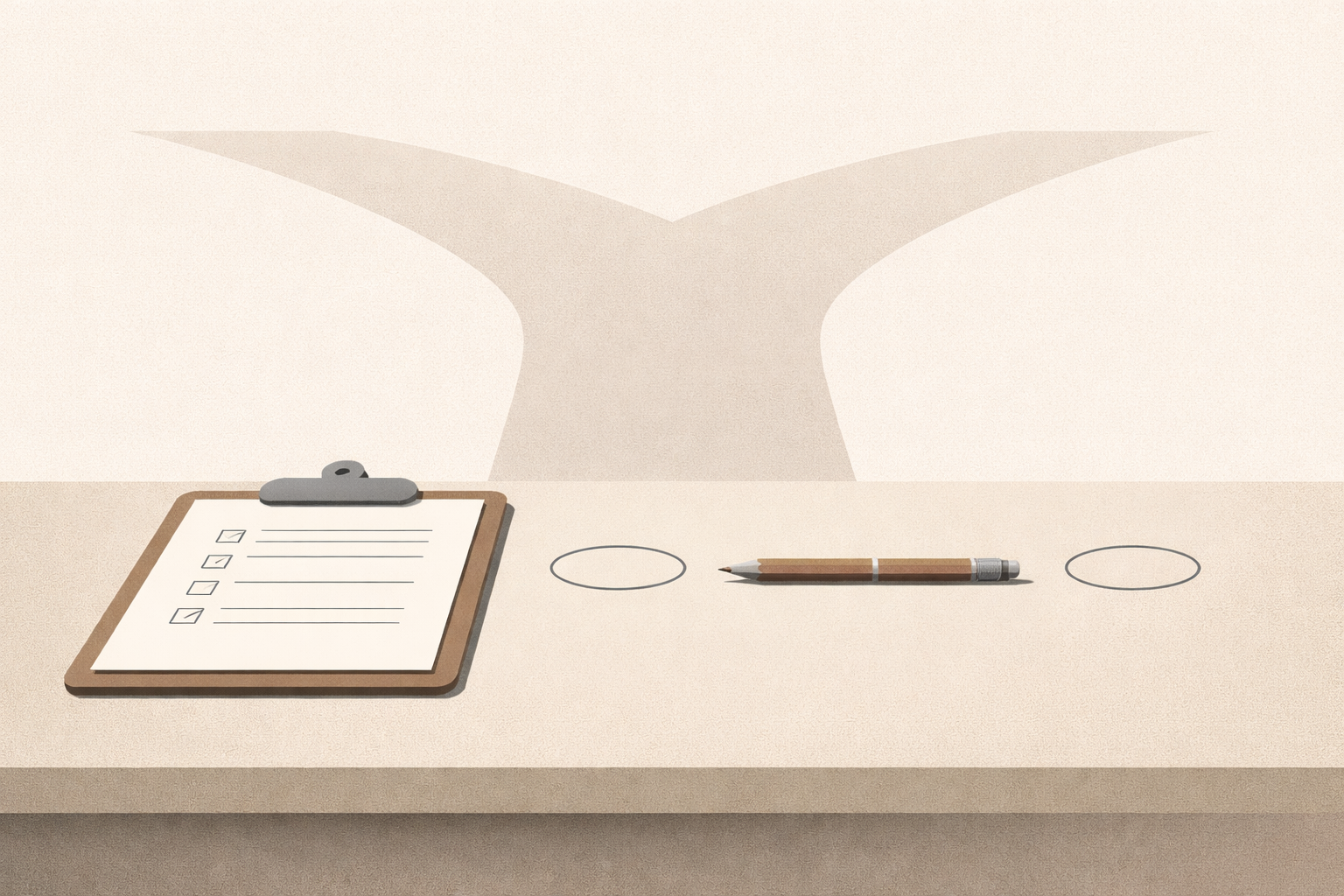
Fear of regret gets mistaken for indecision because hesitation looks passive from the outside.
People see delay and assume confusion. They assume someone lacks clarity, discipline, confidence, or enough information to move. That may be true sometimes, but often the person already knows more than they are admitting.
The problem is not always uncertainty. Sometimes the problem is visibility.
Choosing makes a person visible. It puts preference on record. It closes some doors and makes one direction easier to judge. That is why many people do not fear choosing wrong as much as they fear becoming publicly associated with choosing wrong.
That is a different kind of pressure. It is not just the fear of making a bad choice. It is the fear of being known by the choice after the outcome arrives.
Regret Became a Threat Instead of a Teacher
Regret used to be information. You did something, learned something, and carried the lesson forward. It did not always feel good, but it had a function. Regret told you where the choice cost more than expected.
Now regret feels more permanent. People talk about mistakes as if they reveal a person’s entire character. One wrong relationship, one bad job, one financial decision, one public failure, and suddenly the story becomes bigger than the choice itself.
So people start hesitating. Not because they have no idea what they want. Often they know. They just do not want the choice to become evidence against them later.
That is how fear of regret disguises itself as responsibility. Research looks mature. Waiting looks careful. Asking for one more opinion looks thoughtful. However, after a while, the delay becomes less about wisdom and more about protection.
Protection from being wrong. Protection from being judged. Protection from becoming the person who chose and had to live with the result.
That last part is where the room gets quiet. Because most people are not only afraid of choosing incorrectly. They are afraid of losing the version of themselves who could still say, “I haven’t decided yet.”
Regret Became More Public Than It Used to Be
Modern life created strange conditions for decision-making. People are expected to optimize everything: career, relationships, money, health, identity, image, timing, and even rest. Every choice feels like it should be strategic, defensible, and somehow aligned with a future version of yourself who has excellent posture and no unread emails.
Meanwhile, decisions feel searchable, comparable, measurable, and visible. People do not just make choices anymore. They explain them. They post them. They brand them. They revise them in public. Even private decisions start feeling like they are waiting to be judged by an imaginary committee.
That changes how regret feels.
Mistakes stop feeling temporary. They start feeling permanent. People become less afraid of being wrong and more afraid of becoming the person who was wrong.
So hesitation begins to sound responsible. Research becomes virtue. Waiting becomes strategy. Eventually the delay becomes easier to defend than the decision.
That is where indecision gets misread. From the outside, it looks like someone cannot choose. From the inside, it may feel like they are trying to avoid a future version of themselves saying, “You should have known better.”
And yes, that future version is very loud for someone who has not lived the consequences yet.
Waiting Still Makes a Choice
The tricky part is that waiting feels neutral. It feels like holding the decision in place. It feels like keeping options open until confidence arrives with a clipboard and a clean answer.
But waiting still makes a choice.
It chooses delay. It chooses uncertainty. It chooses the emotional comfort of not being accountable yet. That comfort can feel safe, but it is not free.
Options expire while people are trying to protect them. Energy drains while people are trying to preserve it. Relationships shift. Opportunities move. Sometimes the thing you were afraid to choose eventually leaves without needing your approval.
Very efficient, unfortunately.
Doing nothing still produces consequences. The difference is that those consequences arrive quietly. Nobody throws a parade for the life you did not choose. Nobody sends a calendar invite titled “Consequences of Waiting.” It just happens.
That is why fear of regret can be so convincing. It warns you about the pain of a wrong decision while staying very quiet about the cost of no decision.
That silence is expensive.
Movement Creates Information
Movement creates information. That part gets overlooked.
People often treat action like a final exam instead of data collection. They assume a decision has to prove certainty before it begins. But decisions reveal things. Choosing creates feedback. Waiting creates imagination.
And imagination is rarely neutral.
Usually it builds stories where every wrong turn becomes permanent. It invents future embarrassment. It writes scenes where everyone notices the mistake and nobody forgets. Very dramatic. Very committed. Not always useful.
Action interrupts that. It gives you evidence. It shows you what works, what does not, what matters, what costs too much, and what you can survive. Even the wrong move can return information that standing still never could.
That does not mean every decision should be reckless. It means clarity is often built after movement, not before it.
At some point, waiting for certainty becomes another way to avoid being seen trying.
That is usually where boundaries stop being theory. A choice begins to require a no somewhere else. A direction begins to require letting another direction close.
It also explains why exhaustion sometimes turns out to be something else entirely. There is a particular kind of tired that comes from holding every possible life open while living none of them fully.
Regret Is Not the Worst Outcome
People spend so much energy avoiding regret that they rarely notice another cost appearing: self-distrust.
Every delayed decision quietly teaches the same lesson. You cannot trust yourself yet. You need more proof. You need more reassurance. You need more time. You need someone else to make the choice feel safe enough to own.
That lesson compounds.
Eventually certainty becomes the requirement for movement, and nothing survives that standard. Not careers. Not relationships. Not identity. Not creative work. Not any meaningful life decision worth making.
Most choices do not come with enough certainty to satisfy fear. Fear is not looking for a reasonable amount of information. Fear wants a guarantee.
And guarantees are usually not on the menu.
So the better question is not always, “What if I regret this?”
The better question may be, “What am I already regretting by waiting?”
The Groundwork
The work is not pretending regret does not exist. It does. Some choices hurt. Some lessons cost more than expected. Some doors close and do not reopen simply because you became wiser later.
Still, regret is not the enemy. Regret is information. The bigger risk is allowing fear of future regret to quietly build a smaller life.
That smaller life can look responsible. It can look disciplined. It can even look successful. But if every decision must be protected from every possible future feeling, eventually nothing honest moves.
That is the trade people rarely notice. Not certainty. Not safety. Just less life.
Groundwork Actions
- Ask whether the delay is creating clarity or protecting fear.
- Notice which options are expiring while you wait.
- Treat action as information, not a final exam.
- Ask what you are already regretting by not choosing.
Clarity does not always arrive before action.
Sometimes it follows.
Funny as it is,
that’s still us.
Further Groundwork
Stay With The Work
Groundwork Daily arrives quietly.
Thoughtful observations, systems worth noticing, and articles that usually begin with someone saying, “I never thought about it like that.”